Silent Witnesses to the Emergence of the Maritime Silk Road
2017-07-21 21:37:43BystaffreporterDA
CHINA TODAY 2017年7期
By+staff+reporter+DANG+XIAOFEI
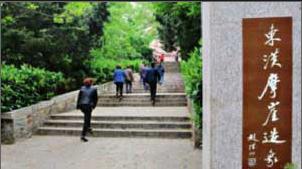

IN Lianyungang, a city on the eastern coast of China, is a hill known as Kongwang, which translates as “Confucius Contemplates,” a name it received after the great philosopher Confucius (Kong Zi in Chinese) climbed it to contemplate (wang in Chinese) the sea. However, the most amazing thing about this small hill only 129 meters high is not that it was visited by one of the great Chinese thinkers, but that it hides a group of Buddhist carvings from the Eastern Han Dynasty (25-220). This is testimony to the arrival of Buddhism in the country through the Maritime Silk Road.
200 Years Older than the Mogao Grottoes
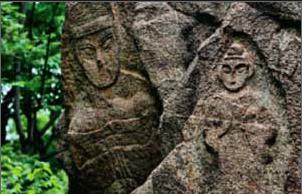
The figures can be seen from the paved road 500 or 600 meters west of the entrance at the foot of the hill. Carved into a yellow ocher rock, 105 figures of different sizes and positions tell Taoist and Buddhist stories. In fact, these images incorporate the secrets of the Maritime Silk Road.
Although the “picture” is dominated by Taoist figures, some Buddhist images can be found around them. This syncretism was a cultural particularity of the Eastern Han Dynasty, especially after Buddhism first entered China and took advantage of the local religion – Daoism – to spread. “The positions of the images and the carving techniques clearly reflect the Han style: full use of high relief and engraving with convex lines,” explained Gao Feng, deputy director of Haizhou District Tourism Department in Lianyungang.
Opposite the Buddhist images, upon four lotus flowers – one under each foot – is an elephant carved in stone, from a single gigantic rock. “Both the elephant and the lotus flower are closely related to Buddhism,” said Gao Feng. “They say that Sakyamuni Buddha rode an elephant before he was reincarnated. After his rebirth, Sakyamuni stepped on lotus flowers.” Along with the images that decorate the rock, the stone elephant relates to a time when Buddhism spread through China and coexisted harmoniously with Taoism. Inside the left front leg of the elephant is written in characters: “Fourth month of the fourth year of the reign of Yongping.”This date indicates the creation of the elephant, which took place during the rule of Liu Zhuang, second emperor of the Eastern Han Dynasty.
In 1980, experts revealed that Kongwang Buddhist images were carved in the late Eastern Han Dynasty, 200 years before the Mogao Grottoes –known as the “China Grottoes” – were created.
How is it possible that such syncretism occurred first on the Kongwang Hill and not in the center and west of the country where Buddhist culture was most developed? The explanation has to do with the fact that in that area, in addition to living in a strong religious atmosphere, the Eastern Han Dynasty had fully developed the stone carving technique. However, another explanation points to the fact that, in parallel with the overland Silk Road, Indian Buddhism was introduced to China through the Maritime Silk Road.
Xu Fus Trip to the East
How did the Maritime Silk Road open? More than 2,200 years ago, the First Emperor of the Qin Dynasty sent his alchemist, Xu Fu, overseas, in search of the elixir of immortality. As the head of a caravan of thousands of children and technicians from different fields and carrying tons of cereals of different varieties, Xu Fu left Haizhou (as Lianyungang was known at the time), his hometown, for the East. The alchemist obviously did not find the elixir, but he did open up a navigation route in the eastern part of the country, thus becoming the pioneer of the Maritime Silk Road.
On his journey, in addition to arriving in Wakayama, a prefecture located on Honshu, the main island of the Japanese archipelago, Xu Fu also went to Kitakyushu, on the northern tip of Kyushu Island, the Setonaikai Sea and the Kii Peninsula. In fact, nowadays in Japan it is possible to visit historical sites related to Xu Fu, like his temple, his tomb, his well, his point of disembarkation, and so on. Some Japanese scholars have even come to suggest that Xu Fu was Jimmu Tenno, the first Japanese emperor.
Why did Xu Fu chose Lianyungang as the starting point of his journey? According to Luo Lin, deputy director of the Lianyungang Historical Relics Protection Research Institute, the ancient inhabitants of the region mastered navigation techniques and traded with the outside world by sea, laying the basis for the opening of the Maritime Silk Road. “All that can be seen in the paintings on the Jiangjun Cliff,” Luo explained. Known as the“Heavenly Scriptures of the East,” the paintings on the Jiangjun Cliff are not only the first of their type to be discovered on the Chinese coast but also, with about 7,000 years of history, the oldest of their kind in the country.
In order to find the elixir of immortality for the emperor, Xu Fus expeditionary fleet traveled on several sea routes, which would then provide precious experiences for the merchant ships to come. Thanks to the gradual consolidation of the Maritime Silk Road, silk products and Chinese porcelain articles were exported from Lianyungang to Japan, the Korean Peninsula, India and Sri Lanka, among other South Asian countries. In turn, the ships brought back Buddhism.
If calculating since the date Xu Fu left Lianyungang, the Maritime Silk Road has existed for over 2,000 years. For its part, being the small hometown of Xu Fu, Lianyungang has been transformed and nowadays is a coastal commercial and military city.
Communication with Northeast Asia
Xu Fu not only took the techniques of agriculture, sericulture and medicine to Japan and Korea, but also inaugurated new shipping routes, unlocking the channels for cultural exchanges with countries along the way, and even with the Arab world.
During the Sui (581-618) and Tang (618-907) dynasties, the flames of war hampered the overland Silk Road. However, the adverse circumstances in the west helped the Maritime Silk Road to thrive in the southeast. Lianyungang so became an important center for exchanges with Silla (a country in the southeast of the Korean Peninsula) and Japan.
Japan sent numerous diplomats and scholars to Tang Dynasty China to learn about its experiences. One of the most prominent was the monk Ennin. Having fulfilled his mission, Ennin decided that Haizhou (Lianyungang) would be the starting point to return to his homeland. Abe no Nakamaro was another well-known character. As a member of the ninth Japanese delegation sent to China, he arrived in the Tang realm during the fifth year of Emperor Xuanzongs Kaiyuan Reign. Known in Chinese as Chao Heng, Abe no Nakamaro forged a friendship with the great poet Li Bai. When he decided it was time to return to Japan, Li Bai traveled to Lianyungang to bid farewell to his friend. Because the departure of Abe no Nakamaro coincided with a great storm, Li Bai thought his friend had died in the disaster. He then wrote a poem in his memory: “Sad clouds settle over Cangwu ...” (Cangwu referring to Lianyungang).
In addition to officials and scholars, Lianyungang also attracted ordinary people from Japan and Korea, living in harmony with the local population. Because many people from Silla wanted to settle in Lianyungang, a “consulate” was opened in Sucheng Town of Lianyun District. In addition to registering as citizens of Haizhou, many migrants took their relatives with them, who performed official work, carried out business, converted to Buddhism or married, and lived by farming. With such a notable population of people coming from Silla, a Silla Village was formed.
In July 1990, a small team of four Korean professors traveled to Lianyungang to conduct an inquiry into the old site of the Silla Village. At the end of their research they erected a tombstone in the north of the Baojia Mountain, which reads: “Ruins of Ancient Silla Houses in Sucheng.” It is another monument commemorating cultural exchanges between China and Korea.