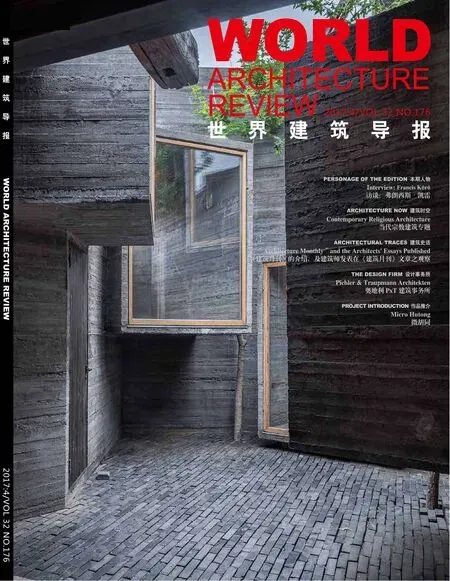
東原千潯社區中心
2017-09-07 03:46:17祝曉峰
世界建筑導報 2017年4期
東原千潯社區中心
Dongyuan Qianxun Community Center
項目地點:蘇州市相城區
項目功能:社區公建(社區事務受理中心、無界美術館、咖
啡廳、健身中心、休息廳、親子教育、社區閱覽、便利店 )
建筑規模:2238.2平方米(地上)1089.40平方米(地下)
設計/建成時間:2016年7月 / 2017年6月
項目團隊:祝曉峰(設計總監) 莊鑫嘉(項目經理)
石圻(高級設計師) 盛泰(駐場設計師)
杜士剛 李成 付蓉 羅琪 肖載源 尚云鵬
業主:東原地產
建筑設計:山水秀建筑設計事務所
合作設計院:蘇州建筑設計研究院股份有限公司
結構方案設計:張準
撰文:祝曉峰
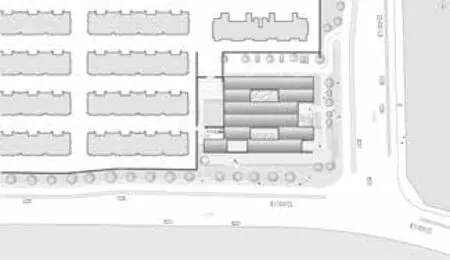
東原千潯社區位于蘇州市相城區,北面是黃橋鎮,東西兩面是其它住宅用地,南面一路之隔是虎丘濕地公園。社區中心位于整個用地的東南角,與兩條城市道路相鄰。
與大多數新城開發區里的住宅一樣,千潯社區仍然是一個閉合性的商品房小區。中國目前的住宅開發模式是過去30年的累積,與社會經濟階層的形成息息相關。“鼓勵開放式小區”的新政導向很難在短時間內顛覆這一模式,在相對空曠的新城,基于當下社會環境里的身份認同和安全需求,完全開放的社區就更難實現。在這種條件下,把“社區中心”這樣一個“配套公建”放在地塊的角落是一種必然。對于這樣一個推導出來的被動選擇,建筑師并不滿足,而是希望探索:能否依靠建筑本體的力量來回應并改變這個消極的邏輯?
Project Location: Xiangcheng District, Suzhou City
Program: community public facility ( community affairs center, art gallery, cafe, fitness
center, lounge, family education, community library, convenient store )
Building Scope: 2238 sqm. (above ground) 1089 sqm. (underground)
Design / completion: 2016.7 / 2017.6
Project team: Zhu Xiaofeng (Design Principal) Zhuang Xinjia (Project Manager)
Shi Yin (Senior Designer) Sheng Tai(Field Designer)
Du Shigang, LiCheng, FuRong, Luo Qi, Xiao Zaiyuan, Shang Yunpeng
Client: Dongyuan Real Estate CO.
Architectural design: Scenic Architecture office
LDI: Suzhou Architectural Design & Research Institute Ltd.
Structural Consultant: Zhang Zhun
Text: Zhu Xiaofeng
Dongyuan Qianxun community is in Xiangcheng District of Suzhou city, with Huangqiao Town in the north. There are residential lands in the east and the west, and Huqiu Wetland Park right on the southern side of the road. The community center is located in the southeast corner of the land, and is adjacent to two city roads.
Like most residential areas in newly developed cities, Qianxun is still a closed commercial housing community. The current model of residential development in China is a result accumulated over the past 30 years, and it is closely related to the formation of social and economic classes. The new policy of encouraging open community is difficult to subvert this model in a short period of time. In the relatively empty towns, completely open community is even more difficult to achieve due to the identity and security requirements of residents in current social environment. In this condition, it is inevitable to locate the public facilities in the corner of the block. We as architects are not satisfied with such a derived passive choice. Instead, we would like to explore: is it possible to use the ontological strength of architecture to respond and change this negative logic?
? 蘇圣亮
? 蘇圣亮
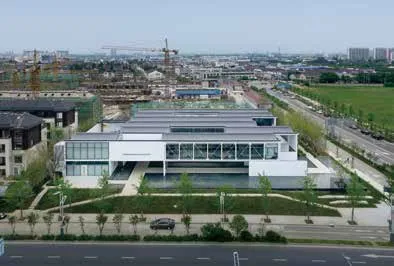
蘇州是以庭院生活為載體的江南文化薈萃之地;場地本身南側的濕地公園里又有一條東西向的河流,沿河的蘆葦和樹叢為這一帶的曠野帶來了流動的自然氣息:這兩個來自人文和自然的條件構成了建筑的外在環境。做為一個小區邊緣的社區中心,這座建筑需要給周邊社區(包括自己的小區)提供各種公共服務,包括社區事務、聚會交流、藝術展覽、親子活動、體育健身、便利商業等等,這些公共活動構成了建筑的內在需求。我們希望尋找一種特定的空間秩序,把建筑的內在需求和外在環境融合起來,成為二者的共同載體,從而營造一個兼容社會性和自然性、兼具凝聚力和開放性的社區活動場所。
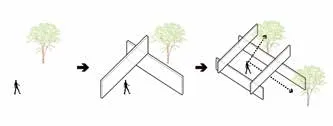
結構系統和空間秩序的相互推演是山水秀事務所近期的主要工作方法之一。在進行了多種構思的嘗試之后,我們決定用上下交錯疊放的剪力墻來生成空間,我們的結構顧問稱之為“疊墻深梁”體系。整層的結構墻通過上下交疊,在滿足結構對垂直荷載和水平剛度需求的同時,形成了一種特殊的空間秩序:墻體是圍合性的,可以劃分出不同的空間,空洞則是開放的,可以聯通不同的空間——我們希望這種秩序的雙重潛力能夠讓這座社區中心實現凝聚和開放的共存。
根據社區中心各項功能的需求,使用空間的基本寬度模數在7米左右。最終,我們采用了7.2米的跨度模數,將東西長約60米,南北寬約43米的兩層建筑納入了六根7.2米寬的條狀結構中,再根據內外空間和動線需要,運用交疊墻語言沿著這些條狀結構組織并生成了整座建筑的內外空間。
Suzhou is a place containing southern Yangtze river culture resources with courtyard life as their carrier; A river in east-west direction wanders in the wetlandpark along the south side of the community, the reeds and trees along the river bring natural flows to the wilderness of this area: these two conditions from humanity and nature constitute the external environment of the project. As a community center at the edge of the compound, this building needs to provide public services for the surrounding communities, including communal affairs, social events, art exhibitions, parent-child activities, sports, convenient store and so on: these public activities constitute the internal demands of the project. We here wish to pursue a specific spatial order, to integrate the internal demands and external environment of the building, so as to become a common carrier of both. We will then be able to create a dynamic community space compatible for both socialness and naturalness, with both cohesion and openness.
The mutual inference between structural system and spatial order is one of the main design methods of Scenic Architecture office recently. After trials of a variety of ideas, we decided to use alternately stacked shear walls to generate the space. Our structural consultant called it a system of "stacking walls as deep beams". It meets the structural needs of vertical loads and horizontal stiffness, while forming a special spatial order: the walls provide enclosure and divide different spaces, and the holes in between walls provide openness and link different spaces —— we hope the double potential of this order is capable to help this community center to achieve the coexistence of cohesion and openness. According to the functional demands of the programs, the basic width modulus of the usable space is around 7m. We ended up a span module of 7.2m to subdivide the building in the size of 60m X 45m into six strip structures in the width of 7.2m. These strips were integrated with the stacking wall system according to the internal and external circulations, to organize and generate the inside and outside spaces of the whole building.
? 蘇圣亮
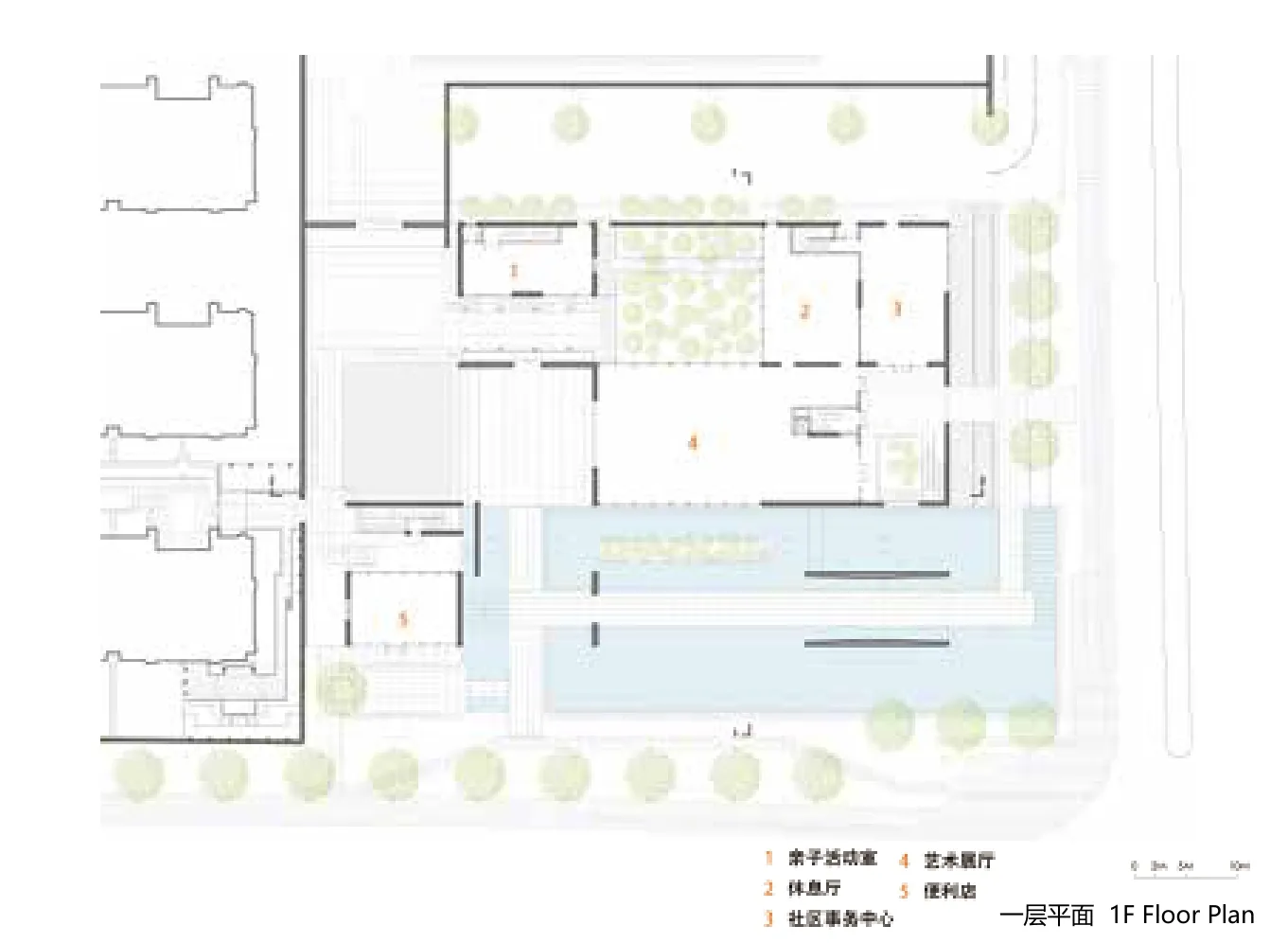
一層平面 1F Floor Plan
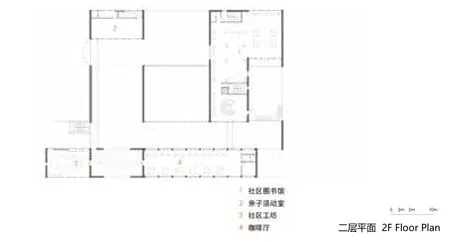
二層平面 2F Floor Plan
? 蘇圣亮
? 蘇圣亮
? 蘇圣亮
? 蘇圣亮
? 蘇圣亮
? 蘇圣亮
? 蘇圣亮
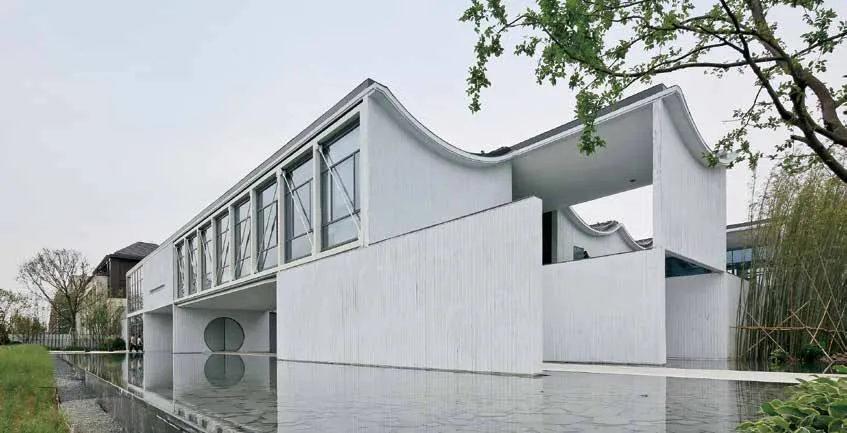
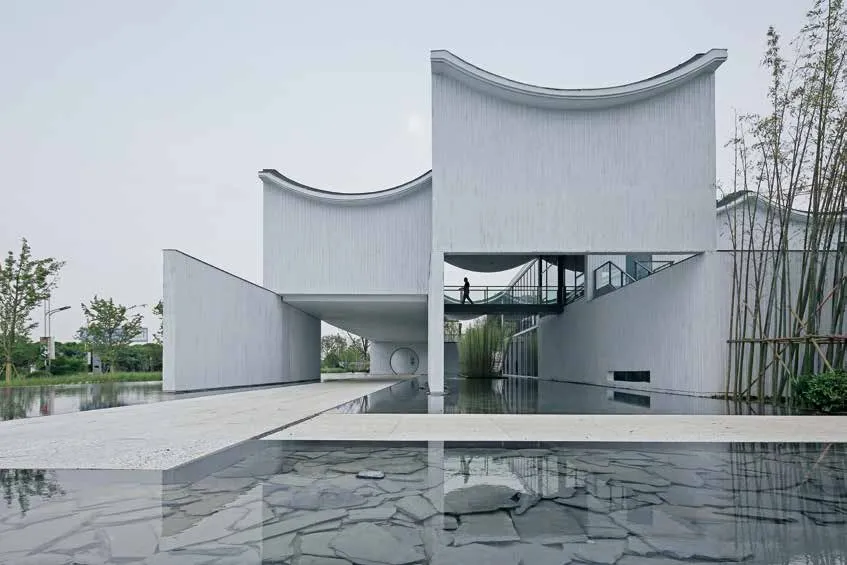
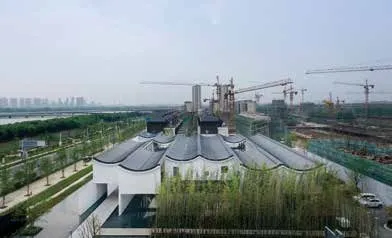
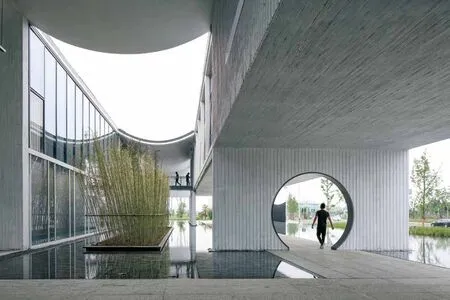
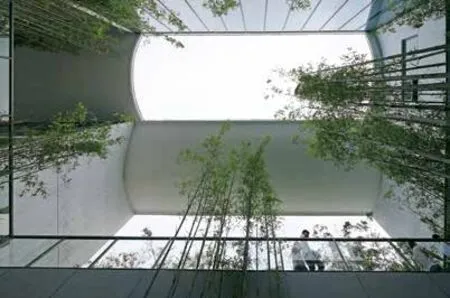
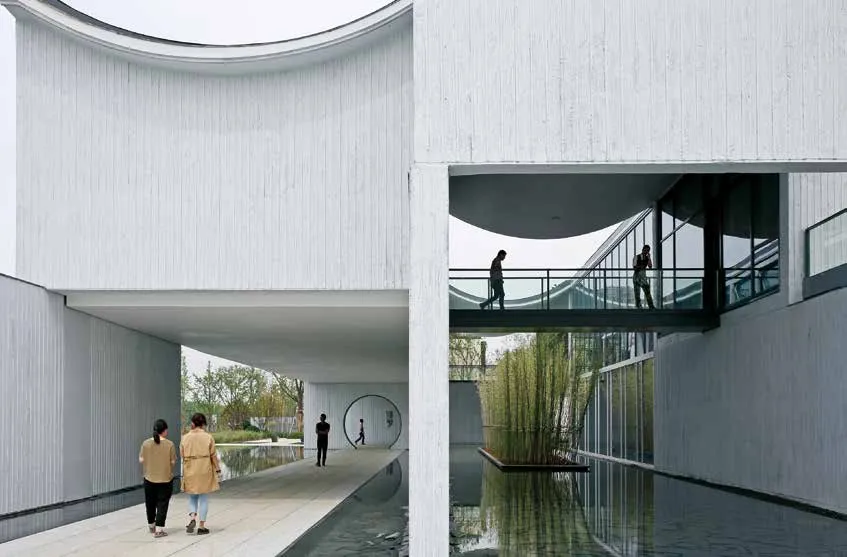
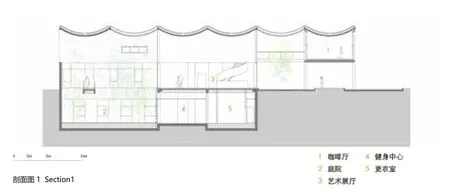
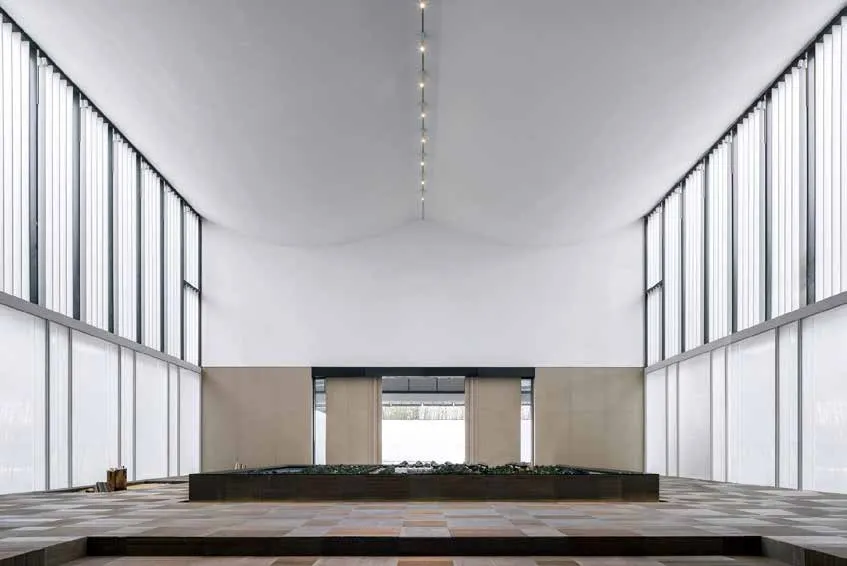
二層的豎向結構主要由南北向的山墻構成,這些山墻自由分布在條狀結構上,自然成了屋頂設計的出發點。通過比選,我們采用了下凹的混凝土筒殼做為建筑的覆蓋。160毫米厚的筒殼結構在短方向上的跨度均為7.2米,在長方向上則依靠1.3米的筒殼矢高,實現12至25米不等的跨度。筒殼下的空間體驗仿佛置身于波浪之下,以屋脊為中心,有置身傳統雙坡屋型內的安定感;以筒底為中心,又有空間向外側溢出的感受——連續的筒殼在內部造就了兩種體驗的融合,在外部則以波浪狀的山墻形式出現,表達了與水及江南傳統建筑風貌的關聯。
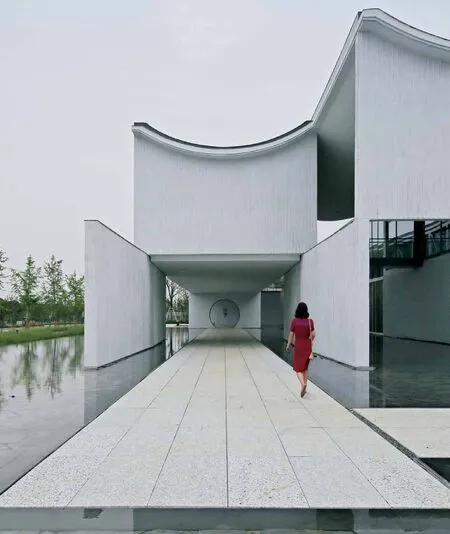
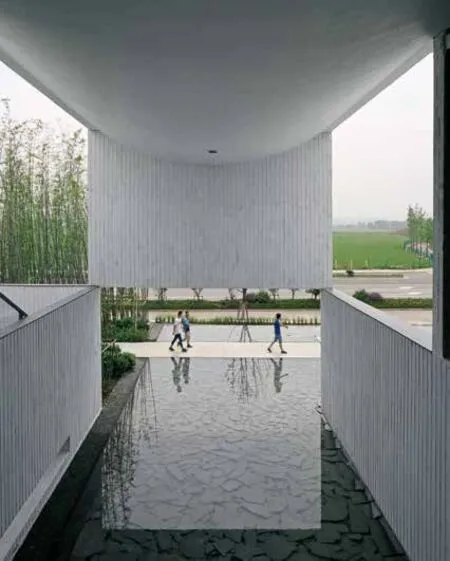
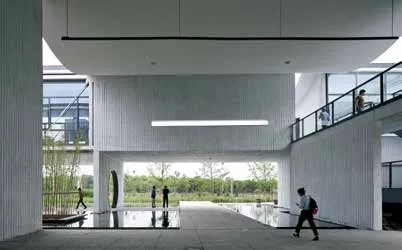
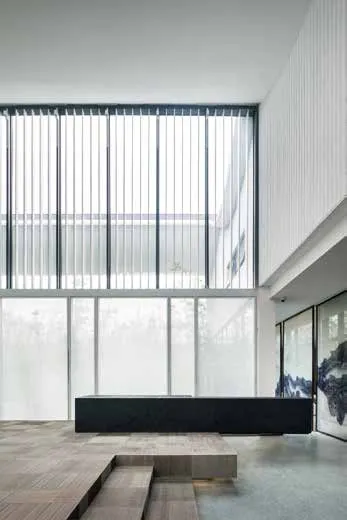
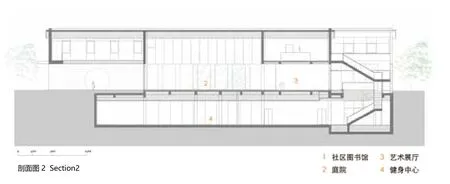
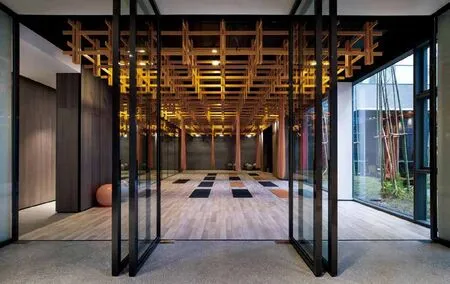
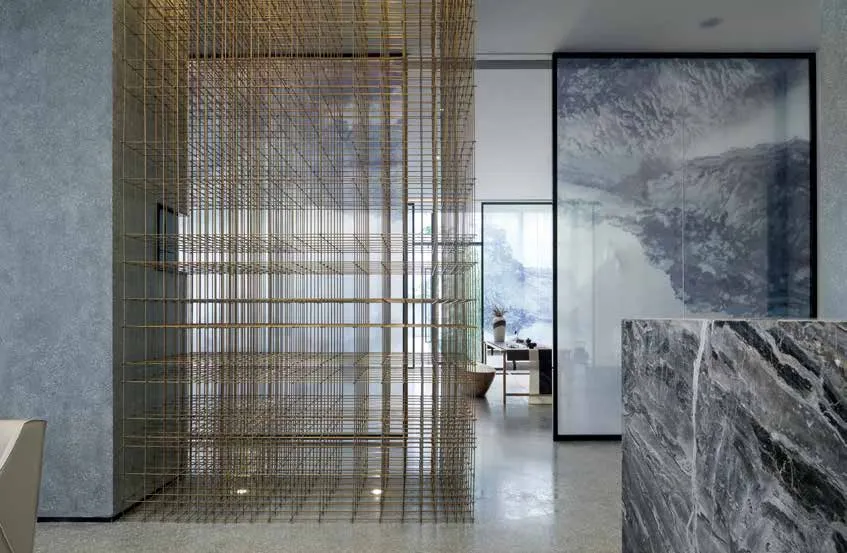
我們在建筑靠西的位置設計了一條南北向的主要步行通道,小區居民走出圍墻后,將使用這條步道穿過社區中心,前往南側的巴士站或濕地公園。建筑的東南角提供了另外一條步行通道,連接東側的小型商業庭院,并向西穿過水景庭院與主通道相連。沿著主通道,我們在靠近城市道路的西南角設置了一家進出行人都會經過的便利店,在靠近小區的北端設置了親子游戲室,主通道在建筑中部擴大,成為一個半室外的社區廣場,向西面對草坪庭院,向東則可以進入社區中心的多功能大堂,這里可以舉辦藝術展覽和各種社區活動,也是通往其它內部空間的樞紐:通過下沉庭院采光的地下室是一座健身中心,與小區地下室連通;一層提供了社區事務管理、小型商業和居民的交流空間;二層是社區圖書館和工作室,在朝南的咖啡廳可以享受濕地公園的景觀。
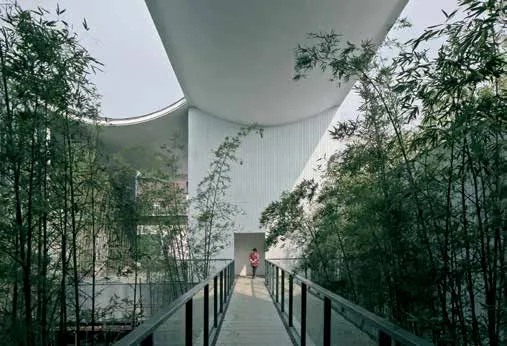
在這個空間結構里,交替出現的實墻和洞口讓建筑與自然在相互的界定中融會貫通,形成了一個可以相互滲透的庭院聚落。各種社區活動和步行動線通過庭院的劃分各得其所,也通過庭院之間的空間流動被聯系在了一起。
建筑的構造設計也緊緊圍繞這個體系來進行。交疊墻采用了鋼筋混凝土現澆結構+內保溫的方法,讓有固定垂直間隙的碳化木模板有機會給外露的混凝土山墻帶來垂直方向的粗糙質感;現澆筒殼的下部通過彎曲的黑色光滑木模板,保證了底板的抽象呈現,上部的屋面則使用了鐵灰色的鋁鎂錳板,柔軟的材料特性使之能夠充分貼合筒殼結構的曲面。下凹屋面的雨水則通過波谷處的天溝收集,而后通過沿墻水管或自由落水的方式排出。所有的構造均服從于建筑的整體秩序,而建筑的整體秩序也有賴于所有的細節才得以最終成立。
建構與空間是建筑師最可仰賴的建筑本體。在回應來自自然、社會和人之需求的過程中,我們希望運用建筑本體的力量探索新的建筑秩序。我們期待在營造社區公共生活空間的同時,為整個場所帶來光陰的流轉。
總平面 Site Plan
The vertical structure of the second floor is mainly composed by north-south gable walls that are freely distributed along the strip structures. They naturally became the starting point of the roof design. With comparison studies we adopted concrete concave shell as the building covering. The span of the 160mm thick cylindrical shell structure is 7.2m in short direction, and 12-20m in long direction with the shell height of 1.3m. The spatial experience under the roof is like segments under waves, with sense of stability under the ridge like the traditional double slope roof; and with sense of outflow under the bottom. The continuous shells create two fused internal experiences, and an external image of waved gable walls, which expressed a relevance of water and traditional architectural style in southern Yangtze River region.
We designed a main pedestrian passage from north to south on the west side of the building. The residents in the community can take this passage throughout the community center to the bus station or the wetland park in the south. In the southeast corner of the building there is another passage, which is connected with a small retail courtyard on the east side, connected with the main route through a waterscape garden. Along the main route we set up a convenient store on the southwest corner near the city road, and a children’s playroom on the north close to the residential area. The main passage is expanded to a covered public plaza in the central area of the building. The plaza faces the lawn to the west and from here you can enter the lobby to the east. The lobby is a multifunctional space for art exhibitions and other community activities. It is also the hub area to enter other internal spaces: through a sunken courtyard you will find a fitness center in the basement which is connected to the residential parking; on the ground floor the building provides spaces for the management, community affairs, small shops and social space for residents; and on the second floor you can find the community library and studio, in the cafe facing south you will be able to enjoy the view of the wetland park.
In this spatial structure, the alternately arranged solid walls and openings merge the architecture with the nature in their mutual definition, and form a courtyard cluster permeable to each other. A variety of community activities and passages find their own places with the division of courtyards, while they are also connected through the interflow of the spaces.
The detail design of buildings also firmly serves this system. By using cast-in-place reinforced concrete structure and internal insulation, we have then opportunity to bring a rough vertical texture to the exposed stacking shear walls casted by carbonized wood formwork with a fixed vertical gap; At the bottom of cast-in-place concave shells we use smooth wooden formwork to guarantee the abstract presentation of the exposed concrete ceiling. The roof is covered by aluminum magnesium panels, which enables curved surfaces to fit to the concave shell geometry. The rainwater on concave roof is collected by the gutters on the bottom of shell, and then drained through free fall or collective pipes. All tectonic details follow the integral order of architecture, and the establishment of the order of architecture also relies on all the details.
Tectonic and space are the architectural ontology that architects can mostly count on. In the process of responding to the needs from nature, society and human, we hope to use the strength of architectural ontology to explore new orders. We expect to not only establish a public life space for the community, but also bring flows of light, shadow and time to the place.
? 蘇圣亮
? 東原設計
剖面圖1 Section1
剖面圖2 Section2
? 東原設計
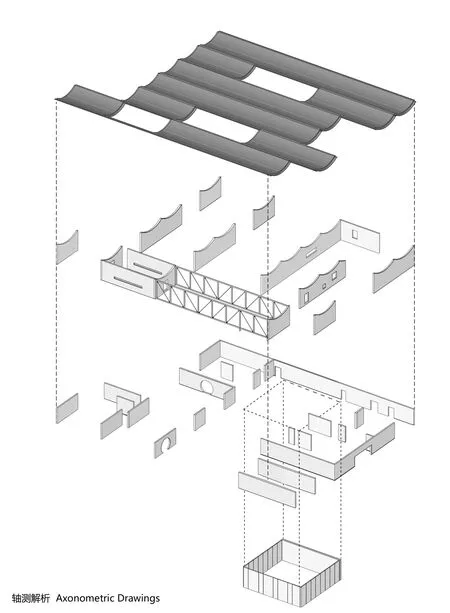
軸測解析 Axonometric Drawings
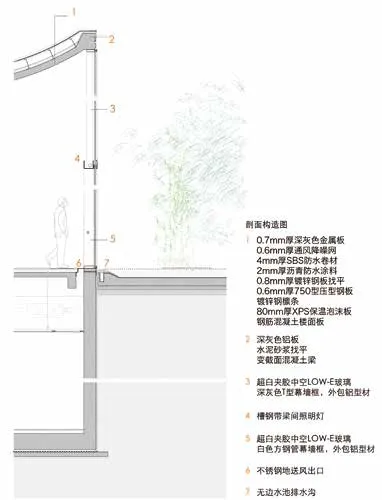
節點詳圖 Exterior Wall Detail
? 東原設計
? 東原設計
? 東原設計
猜你喜歡
北方建筑(2021年6期)2021-12-31 03:03:54
哲學評論(2021年2期)2021-08-22 01:53:34
文苑(2020年10期)2020-11-07 03:15:36
現代裝飾(2020年6期)2020-06-22 08:43:12
中華詩詞(2019年7期)2019-11-25 01:43:04
藝術啟蒙(2018年7期)2018-08-23 09:14:18
海峽姐妹(2017年7期)2017-07-31 19:08:17
Coco薇(2017年5期)2017-06-05 08:53:16
影視與戲劇評論(2016年0期)2016-11-23 05:26:01
少兒科學周刊·兒童版(2015年6期)2015-11-24 03:49:38