補充廣泛性手術治療意外發現的宮頸浸潤癌的效果
2018-05-11 00:02:00余江濤鄭飛云趙紅琴
溫州醫科大學學報 2018年4期
關鍵詞:手術
余江濤,鄭飛云,趙紅琴
(溫州醫科大學附屬第一醫院 婦科,浙江 溫州 325015)
意外發現的宮頸浸潤癌是指行子宮切除術后發現的宮頸癌,此類患者如不接受補充治療,其復發率約為60%,放療和補充手術治療是必要的治療手段[1-3]。子宮切除術后發現的宮頸癌,因失去天然宮腔結構,不能行腔內放療,如果直接行外照射,
效果低于同期可以行后裝治療的患者,且放療不良反應明顯且不可逆,包括放射性膀胱炎、放射性直腸炎、陰道攣縮、直腸陰道瘺等,不推薦用于年輕患者[4]。宮旁廣泛切除+主骶韌帶切除+陰道上段切除+盆腔淋巴結清掃術(以下簡稱補充廣泛性手術)是補充手術的基本術式,手術困難且風險相對較高,手術并發癥較常見[5],但補充廣泛性手術能夠準確判斷病變累及范圍,可使多數患者避免后續的放化療。現對我院近年來意外發現的6例宮頸浸潤癌患者進行分析,并總結經驗及手術技巧。
1 資料和方法
1.1 一般資料 收集2016年2月至2017年4月在溫州醫科大學附屬第一醫院住院并行補充廣泛性手術的6例意外發現的宮頸癌患者的臨床資料,包括患者年齡、第1次術前新柏氏液基細胞學檢測(Thinprep cytologic test,TCT)、人乳頭狀瘤病毒(human papilloma virus,HPV)、第1次術前診斷、子宮切除指征、手術方式、初次手術的病理特點、手術分期、2次手術間隔時間、補充廣泛性手術時間、出血量、術后病理、留置導尿管時間、術后并發癥、補充廣泛性手術后住院天數及術后輔助性治療等。所有病例均按2009年國際婦產科聯盟(International Federation of Gynaecology and Obstetrics,FIGO)標準進行臨床分期,且均經病理檢查證實。
1.2 隨訪 通過門診、電話等獲取患者生存及術后情況,出院后第1年每3個月隨訪1次,第2年每4個月復查1次,隨訪內容包括婦科檢查、陰道殘端TCT、鱗狀細胞癌抗原(squamous cell carcinoma antigen,SCC)、陰道分泌物HPV、盆腔B超(必要時全腹CT)、腹部平片、血常規及肝腎功能等,隨訪截止日期為2017年6月30日。
1.3 統計學處理方法 采用SPSS22.0統計學軟件進行統計學分析。計量資料符合正態分布以±s表示,非正態分布以M(P25,P75)表示。兩因素間以Spearman相關性檢驗進行相關性分析。P<0.05為差異有統計學意義。
2 結果
2.1 首次手術臨床病理資料 6例患者年齡40~61歲,平均(50.7±7.5)歲。子宮切除指征CIN III級2例,其中1例患者術前診斷CIN III級,因宮頸明顯萎縮無法行宮頸冷刀錐切術(cold knife conization of cervix,CKC),故術中行宮頸活檢,冰凍切片示宮頸極少量組織為CIN I~ II級;另1例61歲的患者因CIN III級于外院行子宮全切除術后意外發現宮頸癌后來我院行補充廣泛性手術。子宮平滑肌瘤1例。子宮腺肌病1例。宮頸癌Ia1期2例,其中1例行CKC,術后石蠟切片示宮頸灶區浸潤性鱗癌,浸潤深度3 mm,后行腹腔鏡輔助下陰式子宮切除術(laparoscopically assisted vaginal hysterectomy,LAVH),石蠟切片提示CIN II~ III級累及腺體,小灶區早浸,深度3 mm,寬度1 mm,脈管見癌栓,遂行補充廣泛性手術;另外1例術中行CKC,術中冰凍切片示CIN III級,早期微浸潤,深度<3 mm,行腹腔鏡輔助下子宮切除術(laparoscopic total hysterectomy,LTH)后發現宮頸浸潤癌。首次手術方式為經腹子宮切除術2例,LAVH 3例,LTH 1例。術前HPV 16陽性3例,其余3例未做HPV檢查。TCT提示高度鱗狀上皮內病變(grade squamous intraepithelial lesion,HSIL)2例,未見上皮內病變或惡性細胞(negative for intraepithelial lesion or malignancy,NILM)2例,未行TCT 2例。術后病理提示宮頸鱗癌(squamous cervical carcinoma,SCC)5例,宮頸腺癌(cervical adenocarcinoma,CAC)1例。肌層浸潤<1/2的有4例,等于1/2的有1例,1例肌層浸潤為4/5。浸潤深度3~13 mm,平均(7.3±4.6)mm,3例浸潤寬度1~6.5 mm,平均(3.8±2.8)mm,3例未檢測浸潤寬度,2例有脈管浸潤。高分化5例,中-低分化1例。FIGO分期為Ia1期1例,Ia2期2例,Ib1期3例。見表1。
2.2 補充廣泛性手術的臨床病理資料 6例患者行補充廣泛性手術與前次手術的手術間隔時間為14~51 d,平均(23.8±13.9)d,手術時間為85~314 min,平均(176.0±77.9)min,術中出血量為150(60,800)mL,盆腔淋巴結檢出數為17~36個,平均(24.5±6.6)個,術后留置導尿管時間為14~15 d,平均(14.3±0.5)d,術后住院時間為8~14 d,平均(10.0±2.4)d,所有患者術后病理均提示宮旁無殘余病灶,1例51歲的患者有脈管浸潤,再次手術術中發生膀胱損傷,術后發生淋巴囊腫,病理檢查提示3個盆腔淋巴結轉移,術后予輔助放化療。1例宮頸腺癌患者初次手術后4/5肌層浸潤,考慮宮頸腺癌對放療不敏感,故術后予鉑類為主的化療(見表2)。
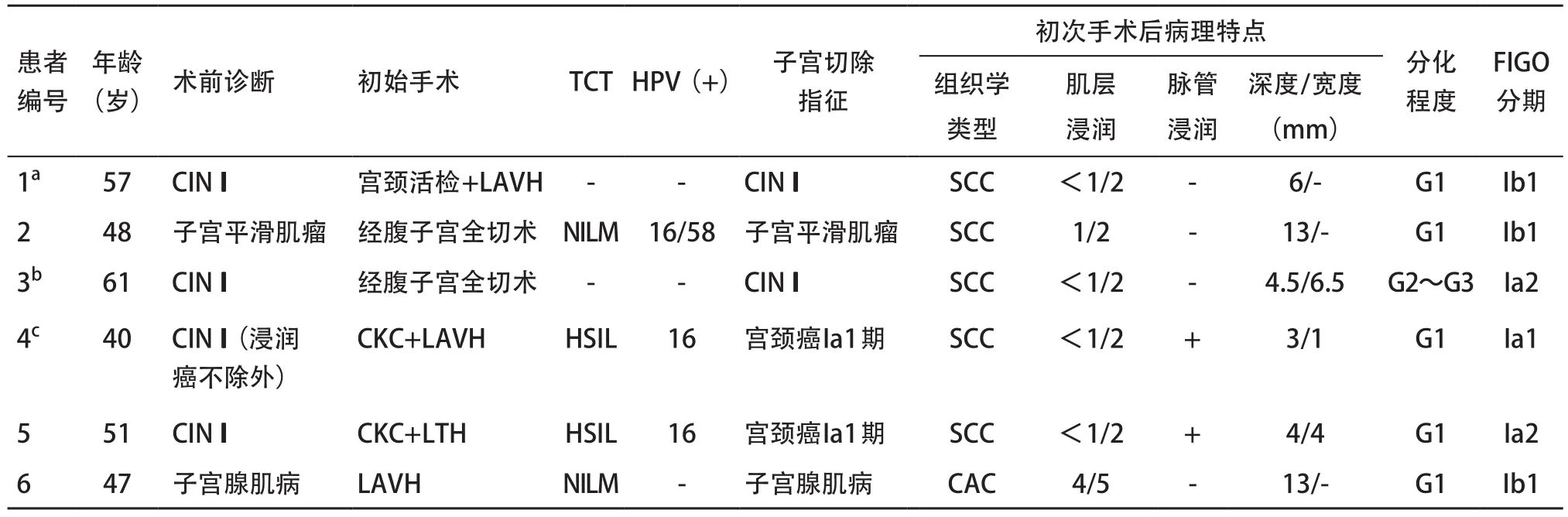
表1 6例患者首次手術臨床病理資料
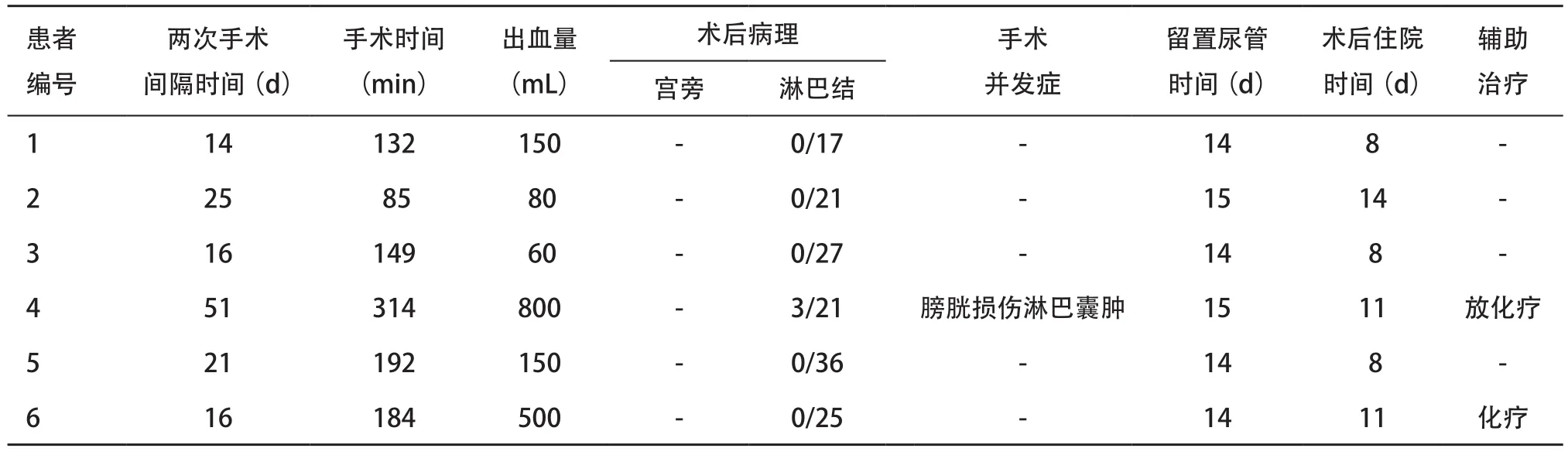
表2 6例患者補充廣泛性手術臨床病理資料
2.3 補充廣泛性手術中各因素之間的相關性分析將年齡、補充廣泛性手術術中出血量、留置導尿管時間、補充廣泛性手術后住院時間、補充廣泛性手術手術時間、兩次手術間隔時間等進行Spearman相關性檢驗,結果顯示兩次手術間隔時間和術后留置導尿管時間有相關性(r=0.840,P=0.036),其余因素差異均無統計學意義(P>0.05)。
2.4 隨訪 6例患者隨訪2~16個月,中位隨訪5.3個月,隨訪中1例51歲的患者發現盆腔淋巴囊腫,其余患者均無異常發現。
3 討論
早期研究顯示,全子宮切除術后發現宮頸浸潤癌,多數是因為術前未行宮頸細胞學檢查[6],漏診還可見于急診手術、宮頸細胞學假陰性、病理誤診[7]及對異常宮頸細胞學或HPV檢查結果的不當處理等。對于HPV16、18陽性且TCT正常的患者必須行陰道鏡下宮頸活檢,必要時行宮頸管搔刮。近年來,由于對宮頸疾病的重視,意外發現的宮頸癌亦多發生于因CIN而行單純全子宮切除術的患者,而診斷為CIN的主要依據為宮頸活檢,因此,對宮頸活檢結果的處理不當也是其中一個原因。目前普遍認為,因CIN而行全子宮切除術前必須行宮頸錐切術以明確病變范圍,于是又出現以下兩種觀點:一種是建議CKC后待石蠟病理報告后再行手術治療,這樣患者需經歷2次麻醉和2次手術,不僅身體創傷、住院時間、住院費用明顯增加,在等待病理結果過程中,由于對病變升級的恐懼,患者及家屬的心理負擔亦明顯增加;另一種觀點認為,CKC的同時可以行術中冰凍切片,如果冰凍切片提示CIN,則術中即行全子宮切除術,如提示浸潤癌,則按浸潤癌的手術范圍處理,但是術中冰凍切片和術后石蠟切片總體符合率90%左右[8],術中冰凍切片提示宮頸癌Ia1期的患者可能石蠟切片提示Ia2期或更高級別,所以我們建議對于CKC中提示宮頸癌Ia1期的患者,需待石蠟病理結果報告后再決定下一步處理。本研究中1例51歲的患者CKC中行冰凍切片提示CIN III級,灶區伴微浸潤,術中診斷考慮宮頸癌Ia1期,即行全子宮切除術,術后石蠟提示浸潤深度達到4 mm,超出Ia1期的范圍。我們建議宮頸活檢提示CIN的患者必須行HPV16、18的篩查、SCC檢測,必要時行盆腔MRI檢查以輔助診斷,術中盡量行CKC明確病變范圍后再制定下一步手術方案。
意外發現宮頸浸潤癌的治療應根據患者的基本情況、宮頸病灶的具體病理報告中危險因素而定。對于單純全子宮切除術后的浸潤性宮頸癌可以進一步行補充廣泛性手術或補救性放療,但是由于意外發現的宮頸癌失去天然宮腔結構,不能行腔內放療,如果直接行外照射,效果低于同期可以行后裝治療的患者[5]。如果子宮切除術后病理報告沒有顯著的高危因素或者患者比較年輕需保留卵巢功能,可以考慮補充廣泛性手術。手術的難度在于子宮已切除,盆腔粘連,膀胱輸尿管與陰道殘端和陰道旁組織的分離困難,術中容易出現輸尿管、膀胱、腸管的損傷等,可以通過術前放置輸尿管支架來預防術中輸尿管損傷。本研究中有1例患者行CKC和LAVH兩次手術后再行補充廣泛性手術術中出現膀胱損傷,可能與兩次手術引起膀胱周圍炎癥性改變、組織充血水腫有關[9]。補充廣泛性手術時間被認為與手術并發癥有關,本研究中1例51歲的患者手術時間達314 min,手術時間長,術中出現膀胱損傷,術后出現淋巴囊腫。補充廣泛性手術與前次手術間隔時間為14~51 d,平均(23.8±13.9)d,兩次手術間隔時間越長,留置導尿管所需時間越長,差異有統計學意義(r=0.840,P=0.036),可能與手術間隔時間越長,膀胱與周圍組織形成的粘連越致密,分離粘連對膀胱的神經損傷更大有關。PARK等[10]報道兩次手術間隔時間為13~114 d,平均34 d,也有學者[11]提出手術時機與術后并發癥無相關性,只要患者條件允許就可行再次手術。有研究報道盆腔粘連形成于術后7 d內,7 d后盆腔沒有新的粘連形成[12],之后盆腔粘連逐漸致密,首次手術后2周左右患者全身情況基本恢復,所以我們認為術后2周左右是患者再次手術的最佳時期。補充廣泛性手術難度較大,手術的難點在于恢復正常的盆腔解剖,仔細游離輸尿管、下推膀胱及直腸,才能最大限度減少手術并發癥的發生。
綜上所述,意外發現的宮頸浸潤癌臨床少見,作為補救治療措施之一,補充廣泛性手術是可行的,手術難度大,但并發癥并不多見,且經過補充廣泛性手術后多數患者無需放療和(或)化療,避免了放療和化療的不良反應。由于本研究病例數較少且隨訪時間較短,今后尚需更大樣本及更長的隨訪時間來對患者進行預后分析。
參考文獻:
[1] SMITH K B, AMDUR R J, YEUNG A R, et al. Postoperative radiotherapy for cervix cancer incidentally discovered after a simple hysterectomy for either benign conditions or noninvasive pathology[J]. Am J Clin Oncol, 2010, 33(3):229-232.
[2] PARK J Y, KIM D Y, KIM J H, et al. Management of occult invasive cervical cancer found after simple hysterectomy[J].Ann Oncol, 2010, 21(5): 994-1000.
[3] AYHAN A, OTEGEN U, GUVEN S, et al. Radical reoperation for invasive cervical cancer found in simple hysterectomy[J]. J Surg Oncol, 2006, 94(1): 28-34.
[4] CRANE C H, SCHNEIDER B F. Occult carcinoma discovered after simple hysterectomy treated with postoperative radiotherapy[J]. Int J Radiat Oncol Biol Phys, 1999, 43(5):1049-1053.
[5] 曹澤毅. 中華婦產科學[M]. 3版. 北京: 人民衛生出版社,2014: 2192-2193.
[6] GREEN T H, MORSE W J. Management of invasive cervical cancer following inadvertent simple hysterectomy[J].Obstet Gynecol, 1969, 33(6): 763-769.
[7] 金鑫紅, 翁珂, 王珊珊, 等. 49例宮頸腺癌臨床病理及診斷分析[J]. 溫州醫科大學學報, 2015, 45(4): 290-294.
[8] 孫百臣. 冰凍病理檢查在高級別宮頸上皮內瘤變診治中的應用研究[J]. 中國醫藥指南, 2016, 14(29): 2-3.
[9] 盧淮武, 王麗娟, 周暉, 等. 意外發現的宮頸癌宮旁廣泛切除和陰道上段切除術的臨床分析[J].中山大學學報(醫學科學版), 2014, 35(5): 791-795.
[10] PARK J Y, KIM D Y, KIM J H, et al. Management of occult invasive cervical cancer found after simple hysterectomy[J].Ann Oncol, 2010, 21(5): 994-1000.
[11] LI J, XU H, CHEN Y, et al. Laparoscopic nerve-sparing radical parametrectomy for occult early-stage invasive cervical cancer after simple hysterectomy[J]. Int J Gynecol Cancer,2012, 22(8): 1383-1388.
[12] GONZáLEZ-QUINTERO V H, CRUZ-PACHANO F E.Preventing adhesions in obstetric and gynecologic surgical procedures[J]. Rev Obstet Gynecol, 2009, 2(1): 38-45.
猜你喜歡
環球時報(2022-12-23)2022-12-23 09:28:37
昆明醫科大學學報(2022年1期)2022-02-28 07:45:04
中老年保健(2021年11期)2021-08-22 03:13:36
昆明醫科大學學報(2021年2期)2021-03-29 07:42:46
河北畫報(2020年10期)2020-11-26 07:20:50
小學閱讀指南·低年級版(2017年1期)2017-03-13 20:07:35
中國衛生標準管理(2015年3期)2016-01-14 03:41:47
中國醫療美容(2015年1期)2015-07-12 10:06:38
鄭州大學學報(醫學版)(2015年2期)2015-02-27 14:50:54
西南軍醫(2014年5期)2014-04-25 07:42:48