三氯異氰尿酸對斑馬魚胚胎及幼魚的發育毒性
2017-12-08 11:29:51閆雪瑩楊淋清吳德生劉素純袁建輝劉建軍
中國藥理學與毒理學雜志 2017年7期
閆雪瑩,楊淋清,吳德生,劉素純,袁建輝,劉建軍
(1.湖南農業大學食品科學技術學院,湖南長沙 410128;2.深圳市疾病預防控制中心,廣東深圳 518055)
三氯異氰尿酸對斑馬魚胚胎及幼魚的發育毒性
閆雪瑩1,楊淋清2,吳德生2,劉素純1,袁建輝2,劉建軍2
(1.湖南農業大學食品科學技術學院,湖南長沙 410128;2.深圳市疾病預防控制中心,廣東深圳 518055)
目的探討新型消毒劑三氯異氰尿酸(TCCA)對斑馬魚胚胎及幼魚的發育毒性。方法選擇受精后2 h的斑馬魚胚胎進行染毒:①將胚胎置于含有TCCA 50,100,150,200,250和300 mg·L-1的培養液中暴露48 h,檢測半數致死濃度(LC50)。②將胚胎置于含有TCCA 0,10.4,20.8和41.7 mg·L-1的培養液中暴露96 h,分別于暴露后48,72和96 h檢測胚胎死亡率、畸形率和心率,采用羥胺法于暴露后2,4和6 h檢測胚胎組織超氧化物歧化酶(SOD)的活性,HE染色觀察暴露后7 d幼魚頭部組織病理結構。結果TCCA暴露48 h,斑馬魚胚胎LC50為166.9 mg·L-1。與正常對照組相比,暴露后96 h,TCCA 41.7 mg·L-1組斑馬魚胚胎死亡率和畸形率顯著升高(P<0.05),TCCA各劑量組心率顯著下降(P<0.05);暴露后72 h,TCCA 41.7 mg·L-1組死亡率顯著升高(P<0.05),20.8和41.7 mg·L-1組畸形率顯著升高(P<0.05),心率顯著下降(P<0.05);暴露后48 h,TCCA 41.7 mg·L-1組畸形率顯著升高(P<0.05)、心率顯著下降(P<0.05)。TCCA暴露4和6 h,20.8和41.7 mg·L-1組SOD活性較正常對照組顯著下降(P<0.05)。TCCA暴露7 d后,與正常對照組相比,各濃度組斑馬魚幼魚均出現腦和眼部間隙變大及眼部視網膜分層不明顯的病理改變。結論TCCA對斑馬魚胚胎發育有毒性作用,能引起胚胎發育早期SOD活性下降,造成幼魚視網膜組織結構損傷。
三氯異氰尿酸;胚胎發育;視網膜;斑馬魚
氯化消毒劑在生活飲用水、餐具及環境消毒等領域應用廣泛,使用便捷,但近年來人們逐漸發現,其分解產物常與水中某些有機物和無機成分產生反應,從而生成氯化消毒副產物,對人體健康構成威脅[1]。三氯異氰尿酸(trichloroisocyanuric acid,TCCA)是第四代氯化消毒劑,其化學名稱為三氯-均三嗪2,4,6(1H,3H,5H)三酮,也稱強氯精,屬有機化合物,白色晶狀粉末或粒狀固體,具有強烈的氯化刺激味[2]。TCCA在水中分解后的主要產物為次氯酸,可穿透細胞膜進入細菌內,使蛋白質氧化;導致細菌死亡[3]。此外,TCCA還可分解產生尿氰酸,進而轉化成三聚氰酸[4-5]。有研究表明,TCCA對劍尾魚、羅非魚和藻類具有毒性作用[6-8],但其對胚胎的毒性效應鮮有報道。本研究擬探討TCCA暴露對斑馬魚胚胎及幼魚的毒性作用及初步作用機制,為闡明TCCA致胚胎發育毒性提供實驗依據。
1 材料與方法
1.1 動物
斑馬魚購自深圳市花鳥魚市場,體長1.0~3.0 cm,飼養于深圳市疾病預防控制中心生態毒理實驗室,水溫27~29℃,pH 7.2~7.4,光照/黑暗時間周期為14/10 h,電導率500~550 mS·cm-1,每天投食2次,喂以新鮮的鹵蟲幼體。
1.2 藥品、試劑和儀器
TCCA和HEPES購自美國Sigma公司;NaCl,KCl,CaCl2和MgSO4均購自國藥集團化學試劑有限公司,分析純;超氧化物歧化酶(superoxide dismutase,SOD)測定試劑盒(A001-3)購自南京建成公司。斑馬魚養殖系統(北京愛生有限公司);CKX41倒置顯微鏡(日本奧林巴斯公司);LRH-250生化培養箱(上海一恒科科技儀器有限公司);石蠟切片機和石蠟包埋機(德國萊卡公司);VCX400超聲波破碎儀(Sonics公司)。
1.3 試劑配制和胚胎收集
用 E3培養液(mmol·L-1:NaCl 5,KCl 0.17,CaCl20.33,MgSO40.33,HEPES 0.7;pH 6.8~7.0)配制TCCA母液,超聲溶解40 min,水溫≤18℃,再用培養液稀釋至染毒濃度,4℃保存備用。
將雌、雄斑馬魚以1∶2的比例放入交配盒中,用擋板隔開,適應過夜,第2天早晨給予光照并抽開擋板,1 h后收集胚胎,用E3培養液清洗胚胎2次。
1.4 胚胎染毒方法
在體視顯微鏡下挑選受精后2 h、發育正常且大小基本一致的胚胎,隨機分配至6孔板,每孔30個,分別加不同濃度TCCA染毒液(染毒組)或E3培養液(正常對照組)4.0 mL,置于27~29℃恒溫生化培養箱中,每24 h換1/2培養液或染毒液,實驗過程中及時清除死亡的胚胎。
1.5 半數致死濃度的測定
按1.4方法,將受精后2 h的胚胎暴露于含TCCA 50,100,150,200,250和300 mg·L-1的E3培養液中持續染毒48 h,每12 h在體視顯微鏡下觀察胚胎發育情況,記錄各組胚胎死亡數,計算半數致死濃度(LC50)。以卵凝結作為胚胎死亡學終點。實驗重復5次。
1.6 致死率和致畸率的測定
按1.4方法將胚胎暴露于含TCCA 0,10.4,20.8和41.7 mg·L-1的E3培養液中持續染毒96 h,每24 h在體視顯微鏡下觀察記錄胚胎或幼魚死亡數目,同時計數存活胚胎或幼魚中畸形個體的數目。以卵凝結作為胚胎死亡學終點,以心臟停止跳動作為幼魚死亡學終點。以脊柱彎曲,眼睛畸形,心包水腫為畸形的判定標準。致死率(%)=死亡數/總胚胎數×100%;致畸率(%)=畸形數/總胚胎數×100%。實驗重復5次。
1.7 心率的測定
按1.4方法將胚胎暴露于含TCCA 0,10.4,20.8和41.7 mg·L-1的E3培養液中持續染毒96 h,分別于染毒48,72和96 h在體視顯微鏡下記錄胚胎1 min內心跳次數。實驗重復5次。
1.8 羥胺法檢測胚胎組織SOD活性
按1.4方法將胚胎暴露于含TCCA 0,10.4,20.8和41.7 mg·L-1的E3培養液中。分別于暴露2,4和6 h后收集各組胚胎,加入生理鹽水400 μL,冰上制備勻漿,845×g離心10 min,取上清液,按照試劑盒操作步驟檢測SOD活性,以在本體系中SOD抑制率達50%時所對應的酶量為一個SOD活性單位(U)。實驗重復3次。
1.9 HE染色觀察幼魚組織病理結構
按1.4方法將胚胎暴露于含TCCA 0,10.4,20.8和41.7 mg·L-1的E3培養液中持續染毒7 d,用4%多聚甲醛將幼魚組織固定過夜,制成厚度6 μm的石蠟切片,經蘇木素-伊紅染色,中性樹脂封片,置顯微鏡下觀察。
1.10 統計學分析
2 結果
2.1 TCCA暴露48 h斑馬魚胚胎半數致死濃度
TCCA暴露后48 h,胚胎死亡率隨暴露濃度的增加而增加,250和300 mg·L-1組胚胎死亡率達99%,LC50為166.9 mg·L-1(圖1)。
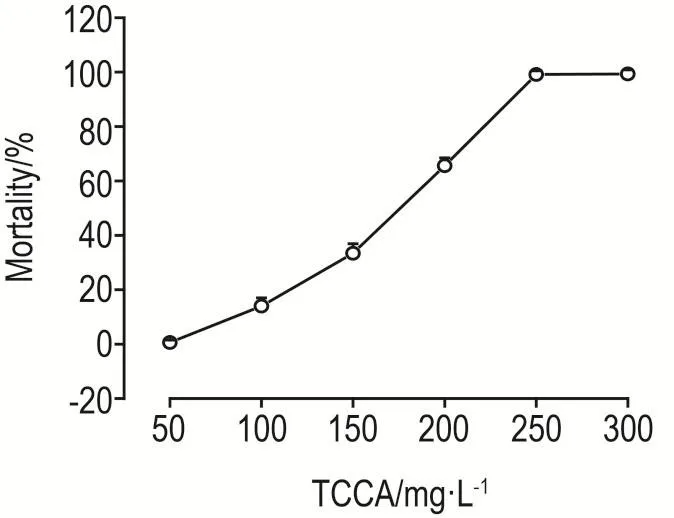
Fig.1 Mortality of zebrafish embryos exposed to trichloroisocyanuric acid(TCCA)for 48 h.Zebrafish embryos were treated with TCCA during 2-50 h post fertilization(hpf).The TCCA solutions were renewed every 24 h.±s,n=5.
2.2 TCCA對斑馬魚死亡率和畸形率的影響
TCCA暴露后72和96 h,斑馬魚死亡率隨TCCA暴露濃度增加而增加,與正常對照組相比,41.7 mg·L-1組死亡率分別為(12.0±3.0)%和(13.3±3.5)%(P<0.05)。暴露后48 h,TCCA各濃度組死亡率與正常對照組無明顯差異(圖2)。斑馬魚畸形率隨TCCA暴露濃度增加而增加。與正常對照組相比,暴露后48 h,TCCA 41.7 mg·L-1組畸形率達(9.3%±2.8)%(P<0.05);暴露后 72 h,TCCA 20.8和41.7 mg·L-1組畸形率分別為(6.7±3.4)%和(13.3±3.4)%(P<0.05);暴露后 96 h,41.7 mg·L-1組畸形率達(14.0%±2.8)%(P<0.05)(圖3)。
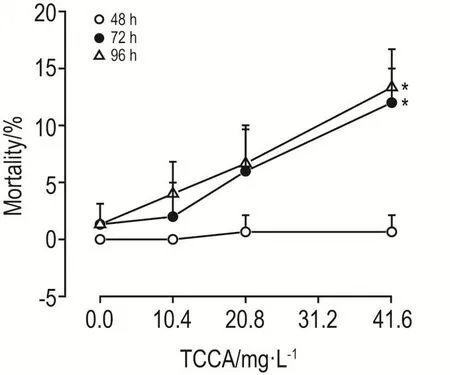
Fig.2 Mortality of zebrafish embryos exposed to TCCA.Zebrafish embryos were treated with TCCA 10.4,20.8 and 41.7 mg·L-1 during 2-98 hpf.Mortality was measured at 48,72 and 96 h after TCCA exposure,respectively.±s,n=5.*P<0.05,compared with normal control(0.0)group.
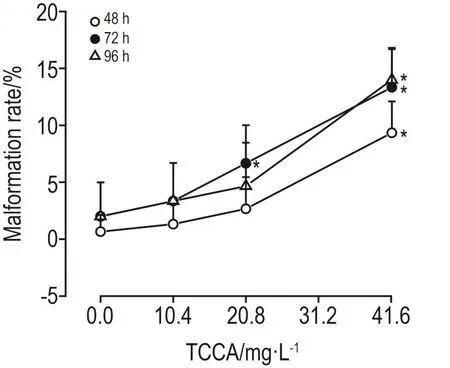
Fig.3 Malformation of zebrafish embryos exposed to TCCA.See Fig.2 for the zebrafish embryo treatment.±s,n=5.*P<0.05,compared with normal control(0.0)group.
2.3 TCCA對斑馬魚心率的影響
與正常對照組相比,TCCA暴露后48 h,僅41.7 mg·L-1組心率顯著降低(P<0.05);暴露后72 h,TCCA 20.8和41.7 mg·L-1組心率均顯著降低(P<0.05);暴露后96 h,TCCA各濃度組心率均顯著降低(P<0.05)(圖4)。
2.4 TCCA對斑馬魚胚胎組織SOD活力的影響
與正常對照組相比,TCCA暴露后4和6h,TCCA 20.8和41.7 mg·L-1組SOD活力均顯著下降(P<0.05),暴露后2 h,TCCA各濃度組SOD活力無顯著變化(圖5)。
2.5 TCCA對斑馬魚幼魚視網膜組織病理結構的影響
正常對照組斑馬魚腦部發育正常,視網膜色素上皮層、感光細胞層、外界膜、外核層、外網層、內核層、內網層、神經節細胞層、視神經纖維層和內界膜發育正常,而TCCA 10.4 mg·L-1組眼部與腦部出現間隙;20.8和41.7 mg·L-1組視網膜分層完全消失,眼部與腦部的空隙變大(圖6)。
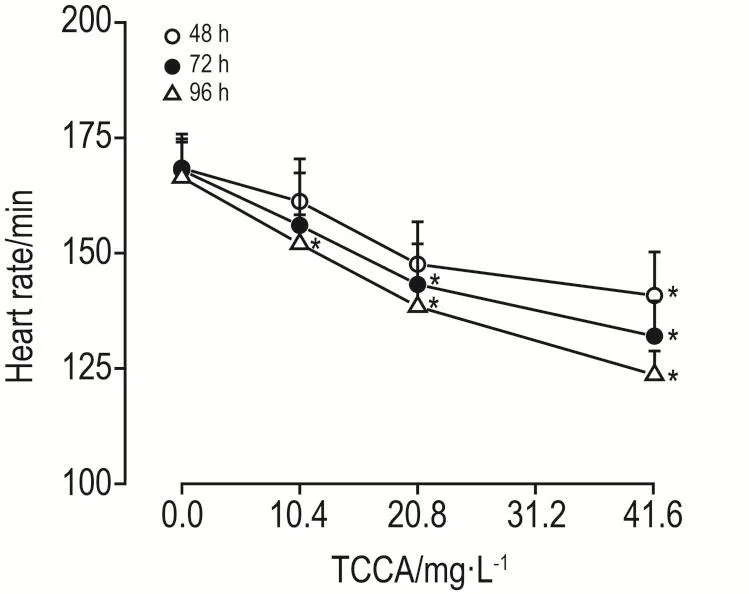
Fig.4 Heart rate of zebrafish embryos exposed to TCCA.See Fig.2 for the zebrafish embryos treatment.±s,n=5.*P<0.05,compared with normal control(0.0)group.
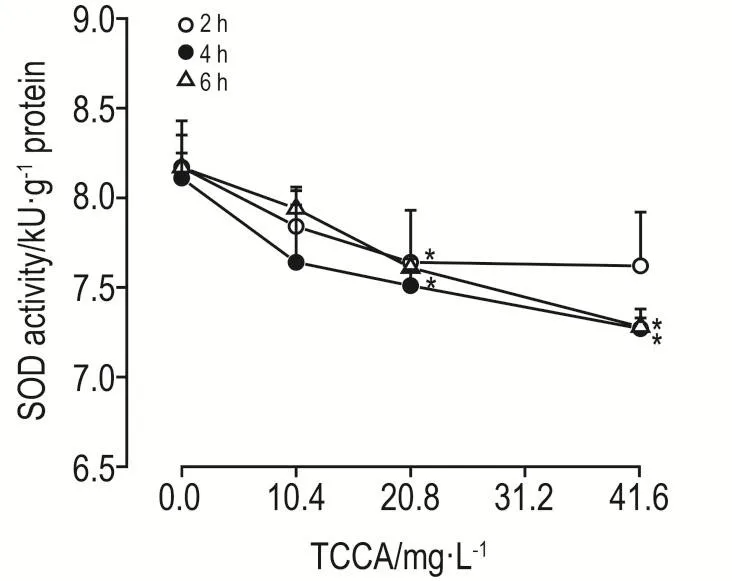
Fig.5 Effect of TCCA on superoxide dismutase(SOD)activity in zebrafish embryos.Zebrafish embryos were treated with TCCA 10.4,20.8 and 41.7 mg·L-1during 2-8 hpf and the SOD activity was detected at 2,4 and 6 h after TCCA exposure,respectively.±s,n=3.*P<0.05,compared with normal control(0.0)group.
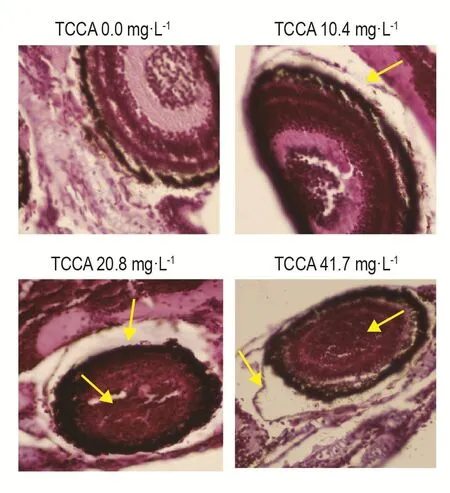
Fig.6 Effect of TCCA on histopathology in zebrafish larvae by HE staining(×400).Zebrafish embryos/larvae were treated with TCCA during 2 hpf to 7 d.Yellow arrows indicate the eye and brain tissue gaps and eye lesions.
3 討論
胚胎時期暴露于毒物中,能對脊椎動物,特別是卵生脊椎動物(如魚類和鳥類)產生嚴重的傷害。研究表明,這些物種在生命早期對污染物的生態毒理效應最敏感[9-11]。本研究通過測定TCCA暴露48 h斑馬魚胚胎LC50,選擇10.4,20.8和41.7 mg·L-1作為TCCA暴露劑量。研究結果顯示,TCCA對斑馬魚胚胎及幼魚具有致死和致畸的毒性效應,且TCCA對斑馬魚胚胎及幼魚的致死作用發生在暴露72 h以內,染毒72~96 h幼魚很少再發生死亡,因此致死率與致畸率很接近,這可能與染毒劑量較低有關,也可能與TCCA在生物體內代謝途徑有關,需進一步研究闡明。
氯化消毒劑暴露可導致心功能紊亂,血液流動減慢,使得氧和營養物質不能充分供給機體,從而導致畸形與死亡。經消毒劑氯胺、二氧化氯或次氯酸鈉處理的再生水均可引起斑馬魚胚胎心率減緩和畸形等毒性反應[12-13]。本研究發現,TCCA暴露引起斑馬魚胚胎心率下降,表明TCCA對斑馬魚胚胎發育具有毒性。
SOD是機體防御氧化損傷的關鍵酶之一,普遍存在于水產動物體內。可以通過催化歧化反應清除體內過量的O-2,將其分解為H2O2和O2,保護細胞免受氧化損傷[14-15]。大量研究表明,氯化消毒劑進入生物體內,會產生大量的活性氧。SOD是生物體有效清除活性氧的重要酶類之一,被稱為生物體內抗氧化系統的第一道防線[16],其活性可反映機體的氧化應激水平,可作為指示氯化消毒劑對斑馬魚胚胎及幼魚發育毒性的早期預警[6-7]。研究表明,農藥、重金屬和納米材料等暴露導致機體代謝紊亂,自由基增多,H2O2含量相應增加,導致SOD的輔基被還原,活性下降,進一步使其清除自由基的能力降低,自由基積累造成細胞結構和功能的破壞,累積到一定限度會損害機體合成酶的能力,并改變酶本身構象,導致不可逆的毒性損傷[17-18]。本研究結果顯示,TCCA暴露后斑馬魚胚胎組織SOD活性下降,提示TCCA對斑馬魚胚胎及幼魚的發育毒性可能與氧化脅迫有關。
含氯的水溶液對眼及黏膜均有刺激作用[19],消毒劑副產物在動物實驗中被證實具有生殖和神經毒性[20-21]。本研究結果顯示,TCCA暴露后,斑馬魚幼魚眼部視網膜組織形態異常。
綜上所述,TCCA對斑馬魚胚胎及幼魚發育具有毒性作用,能引起胚胎發育早期SOD活性下降,并造成幼魚視網膜組織結構損傷。
[1] Xu XM,Gao KD.Application of by-products from chlorination and chlorine dioxide disinfector[J].Chem Adhes(化學與粘合),2003,(6):319-322.
[2] Wang HB,Zhang H.Safety production and pollution treatment of trichloroisocyanuric acid[J].J Salt Chem Ind(鹽業與化工),2013,42(9):48-51,54.
[3] Dodds L,King WD.Relation between trihalomethane compounds and birth defects[J].Occup Environ Med.2001,58(7):443-446.
[4] Lu ML.Screening of toxic target organ and effector molecules of trichloroisocyanuric acid on zebrafish(三氯異氰尿酸對斑馬魚毒性靶器官效應分的篩選)[D].Changsha:Hunan Noamal University(湖南師范大學),2016.
[5] Wang J,E XL.Research progress of chlorinated isocyanurates disinfectants[J].J Environ Health(環境與健康雜志),2010,27(4):370-372.
[6] Nie XP,Wang X,Li KB,Wu SQ.Toxicity and its effects upon the antioxidant enzymes of trichloroisocyanuric acid to swordtail fishXiphophorus helleri[J].Oceanologiat Limnologia Sinica(海洋與湖沼),2008,39(5):494-498.
[7]Ma CG.Toxicity of chlorine dioxide and trichloroisocyanuric acid onTilapia(二氧化氯和三氯異氰尿酸對羅非魚的毒性試驗)[D].Changsha:Hunan Agricultural University(湖南農業大學),2013.
[8] Zhang NL,Xu N,Duan SS,Li AF,Nie XP,Lü SH.Effects of TCCA on growth of phytoplankton in mariculture areas[J].Mar Environ Sci(海洋環境科學),2009,28(1):5-8.
[9] Hoffman DJ,Albers PH,Melancon MJ,Miles AK.Effects of the mosquito larvicide GB-1111 on bird eggs[J].Environ Pollut,2004,127(3):353-358.
[10] Faria M,López MA,Fernández-Sanjuan M,Lacorte S,Barata C.Comparative toxicity of single and combined mixtures of selected pollutants among larval stages of the native freshwater mussels(Unio elongatulus)and the invasive zebra mussel(Dreissena polymorpha)[J].Sci Total Environ,2010,408(12):2452-2458.
[11]Du QP,Peng R,Liu WX,Jia XS,Wei DY.Toxic effects of TBBPA onin vivoandin vitrodevelopments in the zebrafish(Danio rerio)embryos[J].Acta Sci Circum(環境科學學報),2012,32(3):739-744.
[12] Tian WJ.Preliminary study on oxidative stress mechanism of zinc oxide nanoparticles to zebra fish embryos(納米氧化鋅對斑馬魚胚胎氧化應激機制的初步研究)[D].Qingdao:Qingdao University of Science and Technology(青島科技大學),2010.
[13] Sun SB,Li W,Pan XY,Lin X,He QZ,Zeng HC.Effects of PFOS on zebrafish embryo development and SOD,MDA and GSH levels in zebrafish larvae[J].Pract Prev Med(實用預防醫學),2015,22(6):648-651.
[14] Yu FF,Tang TL,Bai JJ,Xiong ZD,Tang WH.Toxicities and hazard classification of reclaimed water after disinfection of different approaches by zebrafish embryos bioassay[J].Asian J Ecotoxicol(生態毒理學報),2015,10(2):313-319.
[15] Tian WJ,Bai W,Zhao CL,Zhang ZY,Cui JA,He X,et al.Effects of ZnO nanoparticles on antioxidant enzyme system of zebrafish embryos[J].China Environ Sci(中國環境科學),2010,30(5):705-709.
[16] Cheng Y,Zhao D,Chen XH,Luo JX,Hao KN,Wang B.Effect of medical ozone on hypoxic brain injury in juvenile zebrafish[J].Matern Child Health Care China(中國婦幼保健),2015,30(15):2376-2380.
[17] Yang LL,Fang ZQ.Effects of estradiol,nonylphenol,polychlorinated biphenyls,cadmium and zinc on the activity of superoxide dismutase inTanichthys albonubes[J].Acta Lab Anim Sci Sin(中國實驗動物學報),2012,20(1):38-46.
[18]Zhao XS,Ren X,Duan XY,Luo ZY,Zhu R.The effect of PFOS on developmental toxicity and oxidative stress in zebrafish embryos[J].J Tangshan Univ(唐山學院學報),2016,29(6):12-16.
[19] Colman J,Rice GE,Wright JM,Hunter ES 3rd,Teuschler LK,Lipscomb JC,et al.Identification of developmentally toxic drinking water disinfection byproducts and evaluation of data relevant to modeofaction [J].ToxicolApplPharmacol,2011,254(2):100-126.
[20] Manasfi T,Coulomb B,Boudenne JL.Occurrence,origin,and toxicity of disinfection byproducts in chlorinated swimming pools:an overview[J].Int J Hyg Environ Health,2017,220(3):591-603.
[21] ErdingerL, KirschF, Sonntag HG.Irritating effects of disinfection by-products in swimming pools[J].Zentralbl Hyg Umweltmed,1998,200(5-6):491-503.
(本文編輯:趙 楠)
Developmental toxicity of trichloroisocyanuric acid on zebrafish embryos and larvae
YAN Xue-ying1,YANG Lin-qing2,WU De-sheng2,LIU Su-chun1,YUAN Jian-hui2,LIU Jian-jun2
(1.College of Food Science and Technology,Hunan Agricultural University,Changsha 410128,China;2.Shenzhen Center for Disease Control and Prevention,Shenzhen 518055,China)
OBJECTlVETo investigate the developmental toxicity of a new disinfectant trichloroisocyanuric acid(TCCA)on zebrafish embryos and larvae.METHODSZebrafish embryos of 2 h post fertilization(hpf)were exposed to TCCA:①The embryos were exposed to a culture medium containing TCCA 0,50,100,150,200,250 and 300 mg·L-1for 48 h before 50%lethal concentration(LC50)was calculated.②The embryos were exposed to a culture medium containing TCCA 0,10.4,20.8 and 41.7 mg·L-1for 96 h.The mortality,malformation rate and heart rate of embryos and larvae were measured at 48,72 and 96 h after TCCA exposure.The expression of superoxide dismutase(SOD)was detected at 2,4 and 6 h after TCCA exposure.The pathological changes in the head of zebrafish larvae were observed 7 d after exposure by HE staining.RESULTSLC50of 48 h after TCCA exposure was 166.9 mg·L-1.Compared with normal control group,the mortality and malformation rate of zebrafish embryos were significantly increased(P<0.05)in TCCA 41.7 mg·L-1group,but the heart rate was decreased significantly(P<0.05)in each dose of TCCA group at 96 h after TCCA exposure.At 72 h after TCCA exposure,the mortality rate of zebrafish embryos was significantly increased(P<0.05)in TCCA 41.7 mg·L-1group,the malformation rate of zebrafish embryos was increased(P<0.05)and the heart rate of zebrafish embryos was decreased(P<0.05)in 20.8 and 41.7 mg·L-1groups.At 48 h after TCCA exposure,the heart rate of zebrafish embryos was decreased significantly(P<0.05)in 41.7 mg·L-1group.The SOD activity of zebrafish embryos in 20.8 and 41.7 mg·L-1groups was significantly lower than that of control group(P<0.05).At 7 d after exposure,the brain and ocular space of larvae were enlarged and the ocular retina layers were not obvious in any dose of TCCA groups.CONCLUSlONTCCA has toxic effect on zebrafish embryonic development,which can down-regulate SOD activity in the early developmental stage of embryos and damage the retina tissue of larvae.
trichloroisocyanuric acid;embryonic development;retina;zebrafish
The project supported by Shenzhen Science and Technology R&D Fund Project(CYJ20140410171018510);Shenzhen Municipal Health Commission commissioned the Construction of Key Disciplines to Enhance the Project(201506064);and Shenzhen Science and Technology R&D Funding Disciplines Project(JCYJ20160328144536436)
LIU Su-chun,E-mail:liusuchun@163.com,Tel:(0731)4617007;WU De-sheng,E-mail:dswucn@126.com,Tel:(0755)25601914(
2017-04-10 接受日期:2017-07-17)
A
1000-3002-(2017)07-0736-06
DOl:10.3867/j.issn.1000-3002.2017.07.006
深圳市科技研發資金項目(CYJ2014041017-1018510);深圳市衛計委重點學科建設能力提升項目(201506064);深圳市科技研發資金學科布局項目(JCYJ20160328144536436)
閆雪瑩,女,碩士研究生,主要從事營養與食品衛生研究。
劉素純,E-mail:liusuchun@163.com,Tel:(0731)4617007;吳德生,E-mail:dswucn@126.com,Tel:(0755)25601914