哀牢山深變質帶內兩類晚漸新世花崗巖成因及其構造指示
2017-12-22 05:17:12郭小飛王岳軍劉匯川張玉芝
中山大學學報(自然科學版)(中英文) 2017年6期
郭小飛,王岳軍,劉匯川 ,張玉芝
(1.中國科學院廣州地球化學研究所同位素地球化學國家重點實驗室, 廣東 廣州 510640;2.中山大學地球科學與工程學院, 廣東 廣州 510275;3.中國科學院大學, 北京 100049;4.廣東省地球動力作用與地質災害重點實驗室, 廣東 廣州 510275 )
哀牢山深變質帶內兩類晚漸新世花崗巖成因及其構造指示
郭小飛1, 2, 3,王岳軍2, 4,劉匯川2, 4,張玉芝2, 4
(1.中國科學院廣州地球化學研究所同位素地球化學國家重點實驗室, 廣東 廣州 510640;2.中山大學地球科學與工程學院, 廣東 廣州 510275;3.中國科學院大學, 北京 100049;4.廣東省地球動力作用與地質災害重點實驗室, 廣東 廣州 510275 )
紅河-哀牢山構造帶發(fā)育了廣泛的、與印度歐亞板塊碰撞造山作用緊密相關的新生代構造-巖漿作用,出露于云南哀牢山變質帶中段的兩個花崗巖樣品鋯石U-Pb定年結果分別為26.2±0.5 Ma和26.8±0.5 Ma,說明哀牢山變質帶并不全是揚子板塊結晶基底的下元古界,也存在新生代巖漿巖。花崗巖鋯石εHf(t)分別為+0.3~+6.9和-9.8~-0.7,平均為+3.4和-4.3,其二階段模式年齡TDM2分別為526~853 Ma和903~1 355 Ma。低εHf(t)花崗巖源巖可能是元古宙哀牢山群變質雜砂巖,高εHf(t)花崗巖源自軟流圈地幔熱源加熱誘發(fā)的新生下地殼部分熔融。結合前人研究成果,認為晚漸新世紅河剪切帶剪切作用切穿了巖石圈地幔;漸新世印支地塊兩側的高黎貢山和哀牢山走滑剪切系統(tǒng)肢解了東南亞不同的塊體,為印支地塊向東南方向的擠出創(chuàng)造了條件。
哀牢山構造帶; 花崗質巖石; 鋯石年齡; Hf同位素; 走滑剪切; 擠出效應
我國滇西三江造山帶屬于東特提斯洋構造域的重要組成部分,經歷了復雜的原、古、新三期特提斯洋演化過程[1-6],是由一系列從岡瓦納大陸北緣分離出來的外來陸塊組成的多島洋俯沖-碰撞造山帶[7-11]。該構造帶在喜山期印度板塊與歐亞板塊俯沖碰撞作用下于始新世-中新世發(fā)育了多條大規(guī)模走滑剪切帶[12-14],并隨著新生代以來陸內造山帶的構造應力調整,形成了滇西地區(qū)復雜的地質構造現(xiàn)象。
哀牢山構造帶位于三江造山帶東南部,帶內廣泛發(fā)育了新元古代-晚古生代-中生代和新生代構造-巖漿作用[15-20]。紅河剪切帶新生代剪切作用強烈改造了哀牢山地區(qū)的構造-巖漿特征,形成了哀牢山深變質巖帶(即哀牢山群)。哀牢山群一直被認為形成于元古代,是揚子地臺結晶基底的一部分,但是Liu et al.[19]在哀牢山群內識別出了晚三疊世花崗巖,進而提出哀牢山群可能是包含多期次巖漿巖和變質巖的混雜巖帶,那么哀牢山群是否也包含新生代紅河剪切作用誘發(fā)的巖漿巖呢?此外,當前關于紅河剪切帶研究另一個重要爭論在于該剪切作用是否切穿了巖石圈地幔,因為該問題不僅關乎沿剪切帶發(fā)育的三江地區(qū)富堿斑巖Cu-Mo-Au多金屬礦產的成因,還對印支地塊東南向的擠出作用和南海的打開具有重要的指示意義。前人對哀牢山紅河剪切帶開展了運動學和構造變形的分析,也對剪切帶伴生的變質巖開展了變質、變形時代的研究[21-23]。但是對其中新生代巖漿巖研究尚存爭論,而新生代巖漿巖,尤其是記錄下地殼甚至深部地幔活動的巖漿巖報道較少,本文對云南省紅河州甲寅地區(qū)出露的兩類花崗質巖石開展了LA-ICP-MS鋯石U-Pb年代學和Lu-Hf同位素的分析,以期為紅河左旋走滑剪切作用在漸新世是否切穿巖石圈地幔,以及印支地塊向東南方向的擠出過程提供資料。
1 地質背景和樣品特征
哀牢山-紅河變質帶夾持于東西兩側的紅河斷裂和哀牢山斷裂之間,是分隔印支地塊和揚子地塊的一條重要地質界線(圖1)[26-27]。變質帶主體呈北西-南東向延伸,寬度在20~30 km,長度超過500 km。變質帶內遭受變質變形作用的深變質巖系從北西到南東依次包括點蒼山群、哀牢山群、瑤山群和越北的大象山群,主要由斜長角閃巖、片麻巖、大理巖等及后期侵位的巖漿巖組成[7]。前人研究中普遍把哀牢山群歸屬于下元古界,認為其屬于揚子基底的一部分或者與揚子基底具有相似性[17, 28-30],然而隨著鋯石U-Pb定年等高精度同位素年代學技術的發(fā)展和應用,許多原來認為是元古代的花崗巖侵入體,如今被證明屬中生代或新生代的變質-變形花崗巖[16, 19, 31-33]。研究區(qū)哀牢山變質帶主體由哀牢山群和部分瑤山群變質巖系組成,為一套混合巖化強烈的中深變質巖,沿哀牢山山脈呈NW-SE向狹窄帶狀展布,兩側分別被哀牢山斷裂和紅河斷裂所限,北延至南澗縣密滴附近,被紅河斷裂所切,使哀牢山斷裂尖滅,南延入越南范士版帶[34-35]。變質帶主體由東西兩個變質帶構成,即東部的高級變質巖和西部的低級變質巖。高級變質巖帶由角閃巖-綠片巖相的片麻巖、角閃巖、大理巖和花崗巖組成,帶內因受剪切帶活動影響巖石已強烈糜棱巖化。低級變質帶由低綠片巖相片巖、千枚巖和板巖等淺變質作用的早古生代碎屑巖組成。兩者被一逆沖斷裂分隔開,斷裂大體沿山脈的主脊延伸[36]。大部分片麻巖與斜長角閃巖片理化良好且平行于剪切帶方向,運動學標志指示左旋剪切。由于變質變形作用的疊加改造,加之混合巖化強烈,原巖面貌和層理特征基本消失,巖性復雜。
本文所研究的2個花崗質巖石樣品(10HH-99B、10HH-105B)位于哀牢山紅河剪切帶中段滇西紅河甲寅地區(qū)。10HH-99B采樣坐標(N 23° 14′ 18.9″,E 102° 24′ 33.2″),巖石類型為糜棱狀變形花崗巖,樣品呈灰色,糜棱狀結構,塊狀構造。巖石內部的長英質礦物被壓扁拉長形成線理,面理產狀與區(qū)域性走滑面理產狀一致(圖2a)。由斜長石、鉀長石、石英和少量黑云母、磁鐵礦、榍石和鋯石等礦物組成。石英因動態(tài)重結晶而發(fā)生晶體顆粒細粒化,斜長石表現(xiàn)出明顯的環(huán)帶結構,黑云母呈細小的鱗片狀分布在長石和石英的顆粒邊界(圖2b)。10HH-105B采樣坐標(N 23° 18′ 34.6″,E 102° 24′ 58.2″),巖石類型為混合巖化淺色花崗巖脈,其基質為花崗片麻巖。樣品所在的長英質脈體與巖石片麻理平行,脈體未發(fā)生明顯變形,產出方向與剪切帶構造面理方向一致。在野外可見長英質脈體被發(fā)育于更晚階段的花崗質脈體侵入,二者呈現(xiàn)顯著截切關系(圖2c)。淺色花崗巖脈呈白色,塊狀構造,主要礦物為斜長石、鉀長石、石英和少量黑云母、磁鐵礦、榍石和鋯石等(圖2d),可見長英質礦物的波狀消光。
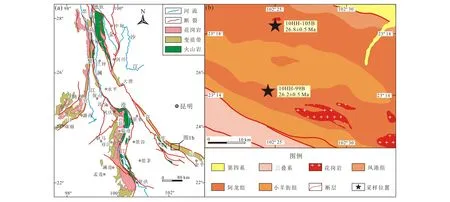
圖1 (a) 哀牢山紅河剪切帶構造綱要圖 (據[24-25]修改);(b) 甲寅地區(qū)地質簡圖Fig.1 (a) Tectonic outline map of Ailaoshan-Red River shear zone and (b) geological map of the Jiayin area

圖2 哀牢山紅河剪切帶花崗質巖石10HH-99B和10HH-105B野外照片(a和c)及正交偏光(10×4)顯微照片(b和d,Qz-石英, Pl-斜長石)Fig.2 Field photos (a and c) and microphotographs (b and d) for granitic rocks of 10HH-99B and 10HH-105B from Ailaoshan-Red River shear zone
2 分析方法
鋯石通過重選和磁選技術從新鮮的樣品中分選出來,用雙目顯微鏡挑選出無裂隙、無包體、透明干凈的鋯石顆粒,在玻璃板上用環(huán)氧樹脂固定、拋光,然后進行反射光和透射光照相,并進行陰極發(fā)光(CL)圖像分析以檢查鋯石內部結構。鋯石U-Pb年齡及Lu-Hf同位素分析在中國科學院地質與地球物理研究所巖石圈演化國家重點實驗室的Neptune型多接收電感耦合等離子體質譜儀(MC-ICP-MS)、Agilent7500a型四級桿電感耦合等離子體質譜儀(Q-ICPMS)和193 nm的ArF準分子激光系統(tǒng)上進行原位測定完成。詳細的分析流程和原理參見[37-39]。數(shù)據處理采用Ludwig 2001 SQUID 1.02及ISOPLOT程序[40]。鋯石U-Pb同位素比值計算采用標準樣品91500作外標進行校正,分餾校正及計算結果采用ICPMSDataCal (8.4)[41]。
3 分析結果
3.1 鋯石U-Pb年代學
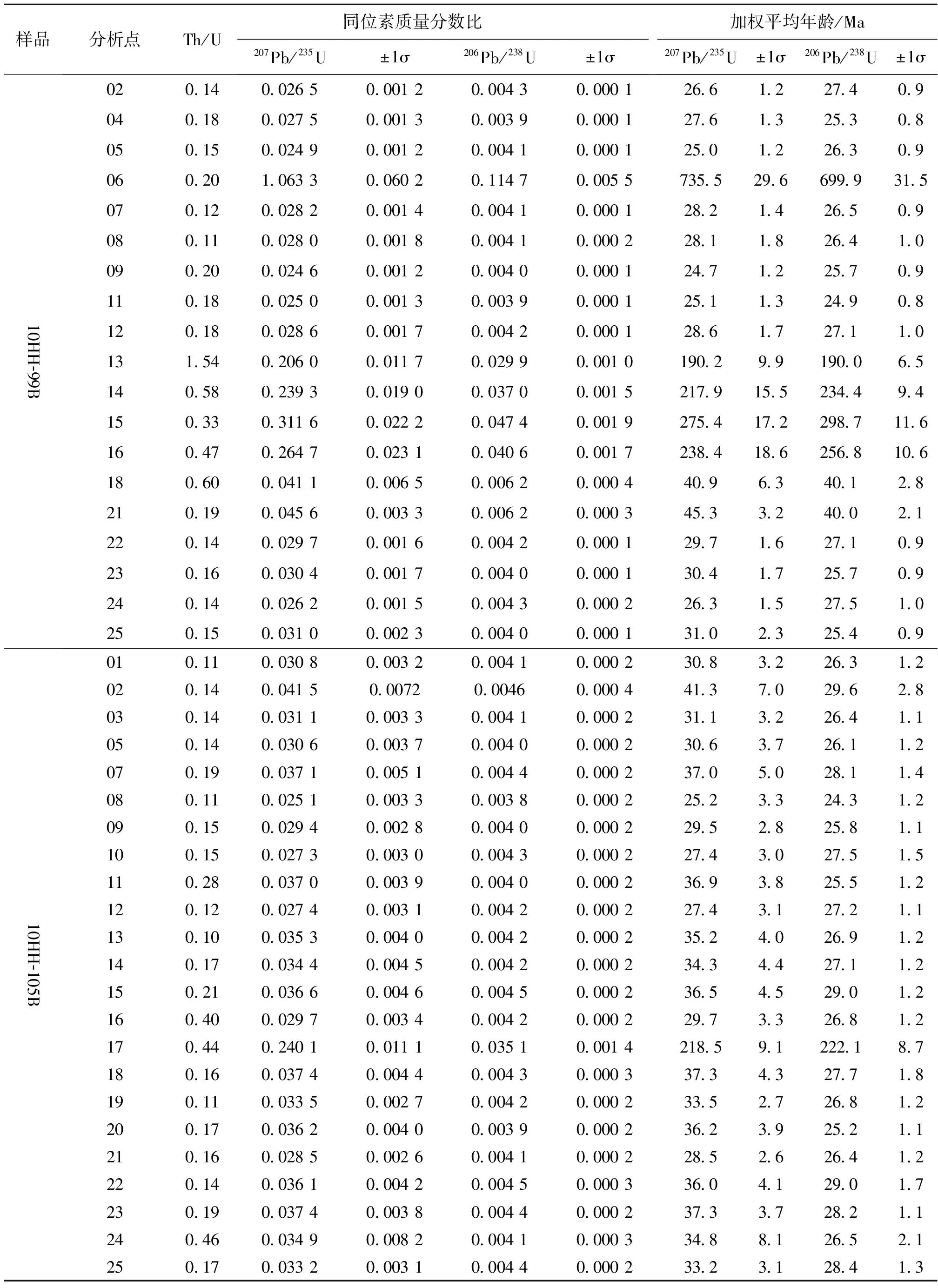
從云南紅河甲寅地區(qū)2個花崗巖樣品中挑選出的鋯石CL圖像如圖3所示,2個樣品的LA-ICP-MS鋯石U-Pb分析結果見表1和圖4。
10HH-99B樣品鋯石呈自形或半自形長柱狀,長度50~120 μm。依據鋯石CL圖像可分出明暗兩種鋯石,大部分為具有明顯巖漿震蕩環(huán)帶的暗色鋯石,亮色鋯石則呈弱分帶或者無分帶特點(圖3a)。此外,部分鋯石具有亮色核和暗色邊的核邊結構,為具有老核新殼的巖漿復合型鋯石。此類鋯石的新殼具有巖漿鋯石所具有的特點,其新殼年齡反映了巖體的結晶時間,老核的年齡為深部地質體提供的信息[16, 42]。對糜棱狀變形花崗巖(10HH-99B)中的18個鋯石顆粒進行了分析,所選測點晶形較好,無裂紋和包裹體。其中12個測點為暗色鋯石顆粒,具有較高的U含量。這些鋯石的Th/U比值在0.11~0.20變化,它們的206Pb/238U加權平均年齡值為26.2 ± 0.5 Ma (MSWD = 0.94; 圖4a)。另外有2個測點18和21為亮色鋯石,Th/U比值分別為0.60和0.19,對應表面年齡為40.1±2.8 Ma和40.0±2.1 Ma,可能反映了~ 40 Ma的變質事件;剩余的5個測點也為亮色鋯石,Th/U比值變化于0.20~1.54,表面年齡在190~699 Ma之間,代表繼承鋯石年齡。我們認為,12個測點的加權平均年齡值26.2 ± 0.5 Ma代表糜棱狀變形花崗巖的巖漿結晶年齡。
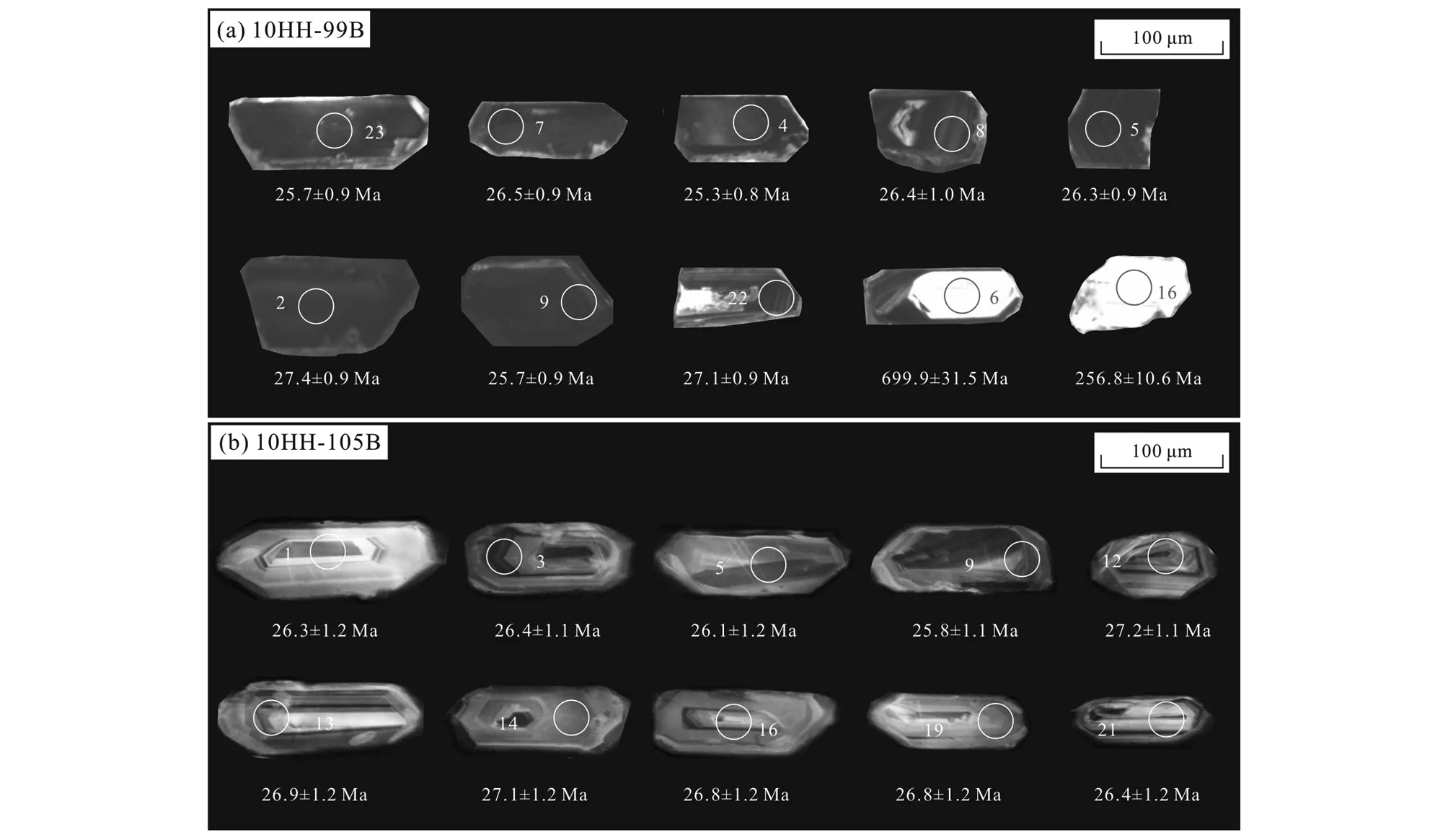
圖3 哀牢山紅河剪切帶花崗質巖石 (a) 10HH-99B和 (b) 10HH-105B代表性鋯石CL圖像Fig.3 The cathodoluminescence (CL) images of representative zircons from the granitic rocks of (a) 10HH-99B and (b) 10HH-105B from Ailaoshan-Red River shear zone
樣品分析點Th/U同位素質量分數(shù)比207Pb/235U±1σ206Pb/238U±1σ加權平均年齡/Ma207Pb/235U±1σ206Pb/238U±1σ10HH?99B020140026500012000430000126612274090401800275000130003900001276132530805015002490001200041000012501226309060201063300602011470005573552966999315070120028200014000410000128214265090801100280000180004100002281182641009020002460001200040000012471225709110180025000013000390000125113249081201800286000170004200001286172711013154020600011700299000101902991900651405802393001900037000015217915523449415033031160022200474000192754172298711616047026470023100406000172384186256810618060004110006500062000044096340128210190045600033000620000345332400212201400297000160004200001297162710923016003040001700040000013041725709240140026200015000430000226315275102501500310000230004000001310232540910HH?105B010110030800032000410000230832263120201400415000720004600004413702962803014003110003300041000023113226411050140030600037000400000230637261120701900371000510004400002370502811408011002510003300038000022523324312090150029400028000400000229528258111001500273000300004300002274302751511028003700003900040000023693825512120120027400031000420000227431272111301000353000400004200002352402691214017003440004500042000023434427112150210036600046000450000236545290121604000297000340004200002297332681217044024010011100351000142185912221871801600374000440004300003373432771819011003350002700042000023352726812200170036200040000390000236239252112101600285000260004100002285262641222014003610004200045000033604129017230190037400038000440000237337282112404600349000820004100003348812652125017003320003100044000023323128413
10HH-105B樣品鋯石晶面整潔光滑,大部分呈自形的長柱狀,少量存在繼承性鋯石核,直徑在50~220 μm之間,長短軸之比一般大于2。在CL圖像上大部分鋯石顯示出典型的震蕩生長環(huán)帶,表明其為典型的巖漿鋯石(圖3b)。對淺色脈體的23個鋯石顆粒進行了分析,所選測點晶形較好,同時避開裂紋和包裹體。測點17的Th/U比值為0.44,并給出了222.1±8.7 Ma的206Pb/238U年齡值。該測點位于鋯石核部,可能代表前期熱事件中殘留的鋯石。剩余22個測點Th/U比值在0.11~0.46,投點均落在諧和線上或其附近,它們的206Pb/238U加權平均年齡值為26.8 ± 0.5 Ma (MSWD = 0.94; 圖4b)。這一年齡代表混合巖化淺色花崗巖脈的巖漿結晶年齡。
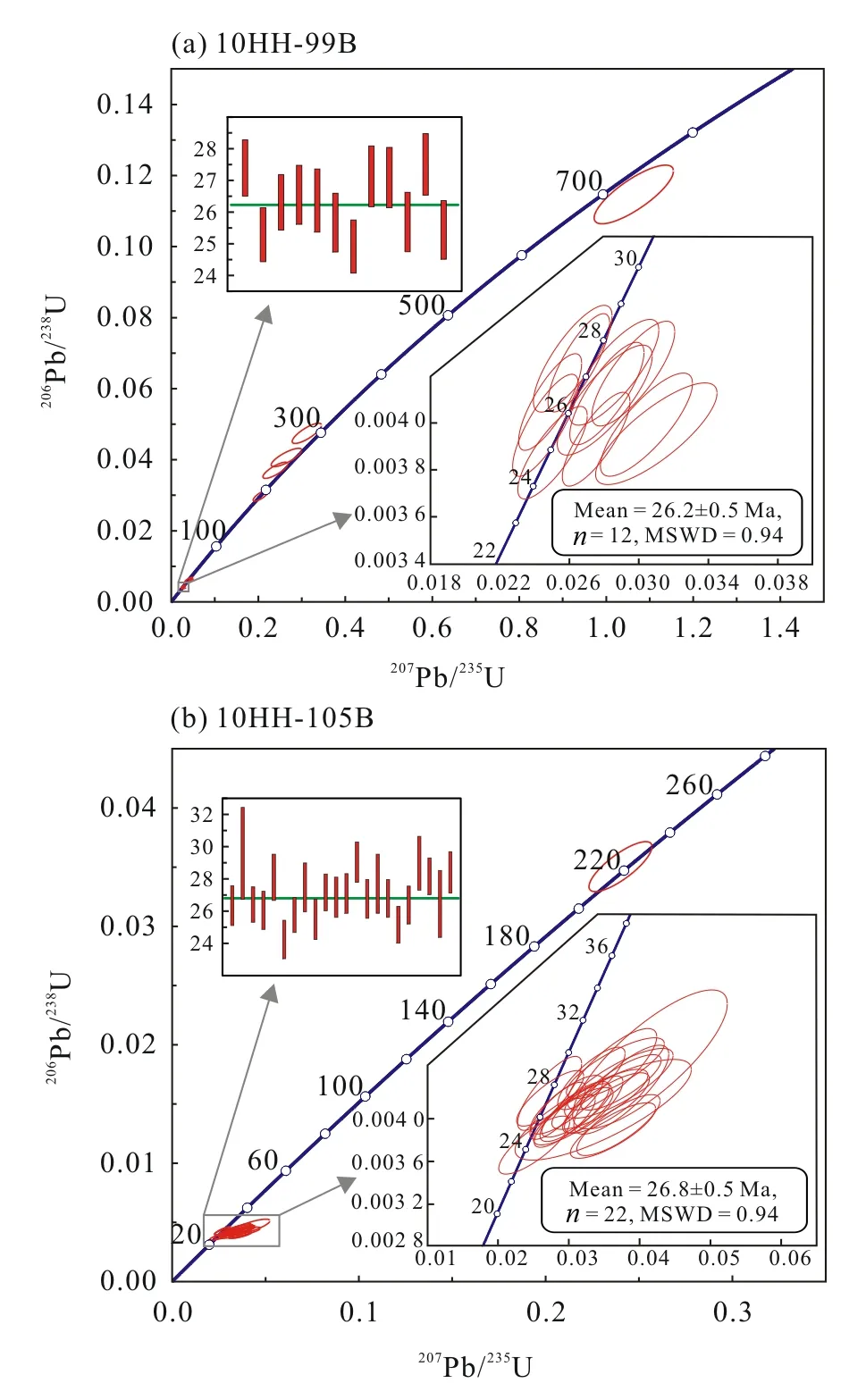
圖4 哀牢山紅河剪切帶花崗質巖石 (a) 10HH-99B和 (b) 10HH-105B LA-ICP-MS鋯石U-Pb定年結果Fig.4 Zircon LA-ICP-MS U-Pb isotopic data for granitic rocks of (a) 10HH-99B and (b) 10HH-105B from Ailaoshan-Red River shear zone
3.2 鋯石Lu-Hf 同位素分析
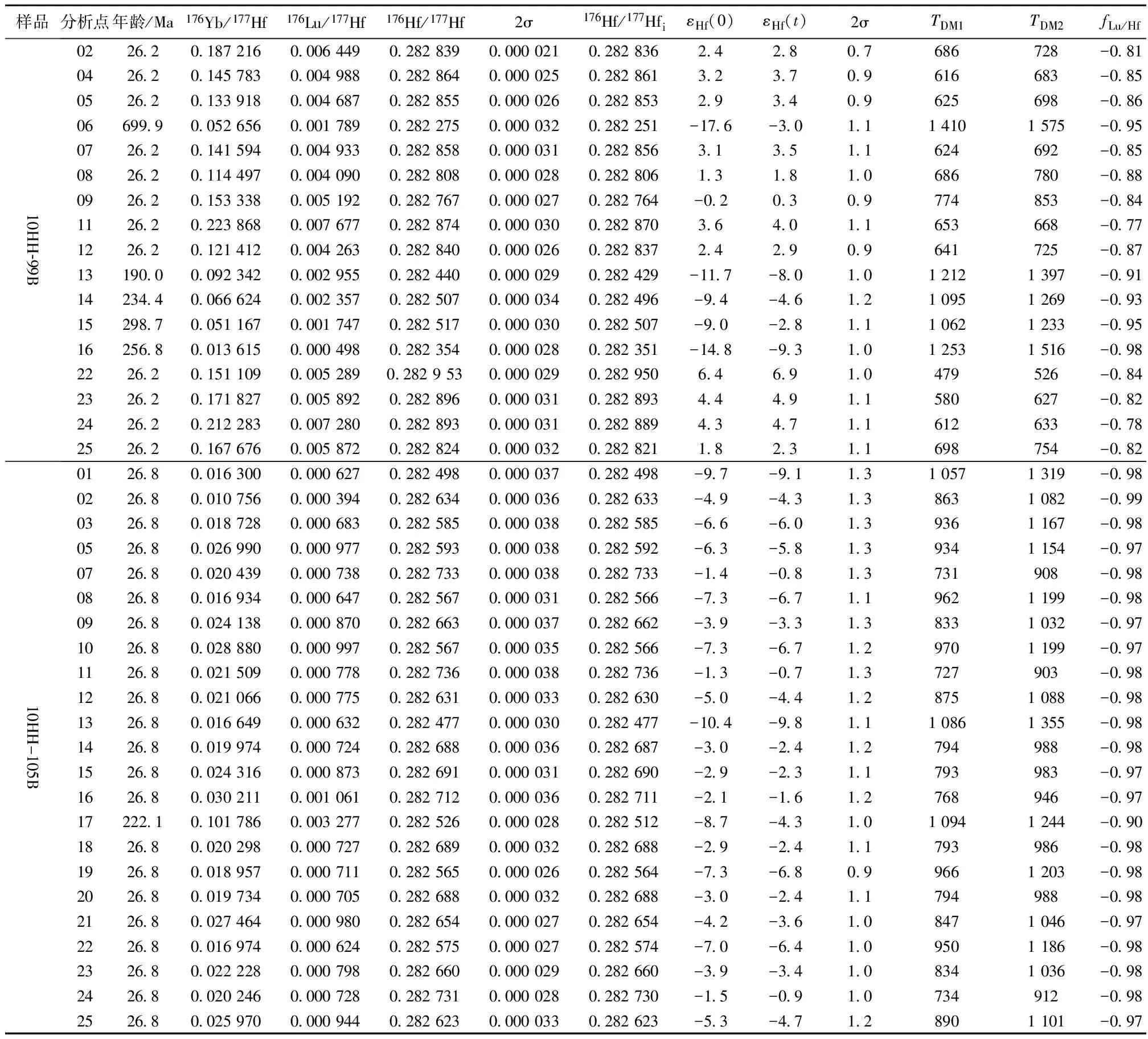
兩個樣品的LA-ICP-MS鋯石Lu-Hf同位素組成見表2。
變形花崗巖10HH-99B:進行了17顆鋯石的原位Lu-Hf同位素分析,按t= 26.2 Ma的形成年齡,對其中12顆鋯石計算出的εHf(t)為 +0.3~+6.9,平均+3.4,其二階模式年齡TDM2介于526~853 Ma之間。其中10HH-99B-06繼承鋯石給出最老206Pb/238U表面年齡699.9 ± 31.5 Ma,它的εHf(t)和TDM2值分別為-2.99和1 575 Ma。剩余4顆繼承鋯石206Pb/238U表面年齡在190~298 Ma變化,εHf(t)介于-9.25~-2.81,TDM2介于1.23~1.58 Ga,如圖5a和圖6所示。
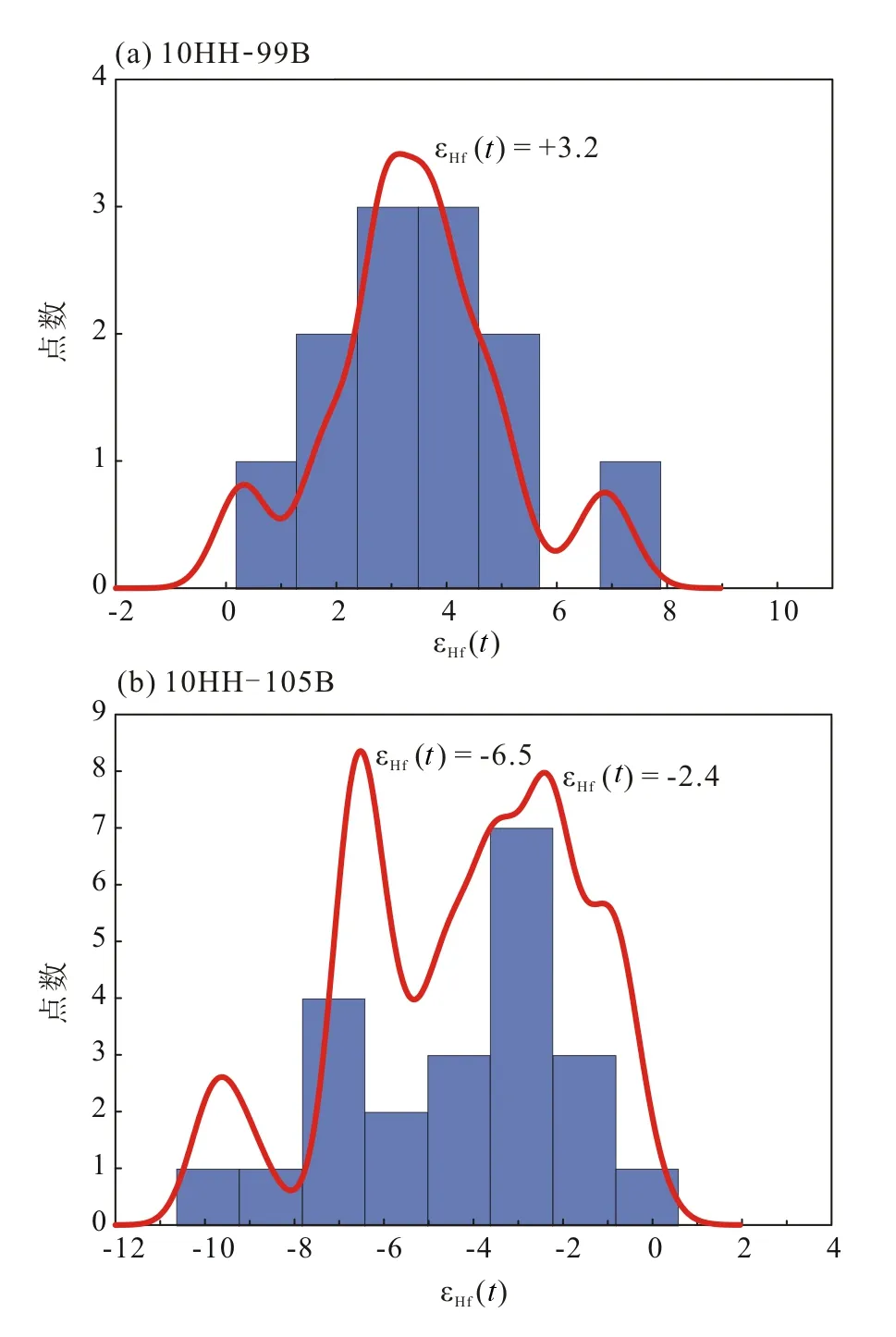
圖5 哀牢山紅河剪切帶漸新世花崗質巖石 (a) 10HH-99B 和 (b) 10HH-105B 鋯石Hf同位素組成Fig.5 Zircon Hf isotopic compositions for granitic rocks of (a) 10HH-99B and (b) 10HH-105B from Ailaoshan-Red River shear zone
樣品分析點年齡/Ma176Yb/177Hf176Lu/177Hf176Hf/177Hf2σ176Hf/177HfiεHf(0)εHf(t)2σTDM1TDM2fLu/Hf10HH?99B0226201872160006449028283900000210282836242807686728-0810426201457830004988028286400000250282861323709616683-0850526201339180004687028285500000260282853293409625698-08606699900526560001789028227500000320282251-176-301114101575-0950726201415940004933028285800000310282856313511624692-0850826201144970004090028280800000280282806131810686780-0880926201533380005192028276700000270282764-020309774853-0841126202238680007677028287400000300282870364011653668-0771226201214120004263028284000000260282837242909641725-08713190000923420002955028244000000290282429-117-801012121397-09114234400666240002357028250700000340282496-94-461210951269-09315298700511670001747028251700000300282507-90-281110621233-09516256800136150000498028235400000280282351-148-931012531516-0982226201511090005289028295300000290282950646910479526-0842326201718270005892028289600000310282893444911580627-0822426202122830007280028289300000310282889434711612633-0782526201676760005872028282400000320282821182311698754-08210HH-105B0126800163000000627028249800000370282498-97-911310571319-0980226800107560000394028263400000360282633-49-43138631082-0990326800187280000683028258500000380282585-66-60139361167-0980526800269900000977028259300000380282592-63-58139341154-0970726800204390000738028273300000380282733-14-0813731908-0980826800169340000647028256700000310282566-73-67119621199-0980926800241380000870028266300000370282662-39-33138331032-0971026800288800000997028256700000350282566-73-67129701199-0971126800215090000778028273600000380282736-13-0713727903-0981226800210660000775028263100000330282630-50-44128751088-0981326800166490000632028247700000300282477-104-981110861355-0981426800199740000724028268800000360282687-30-2412794988-0981526800243160000873028269100000310282690-29-2311793983-0971626800302110001061028271200000360282711-21-1612768946-09717222101017860003277028252600000280282512-87-431010941244-0901826800202980000727028268900000320282688-29-2411793986-0981926800189570000711028256500000260282564-73-68099661203-0982026800197340000705028268800000320282688-30-2411794988-0982126800274640000980028265400000270282654-42-36108471046-0972226800169740000624028257500000270282574-70-64109501186-0982326800222280000798028266000000290282660-39-34108341036-0982426800202460000728028273100000280282730-15-0910734912-0982526800259700000944028262300000330282623-53-47128901101-097
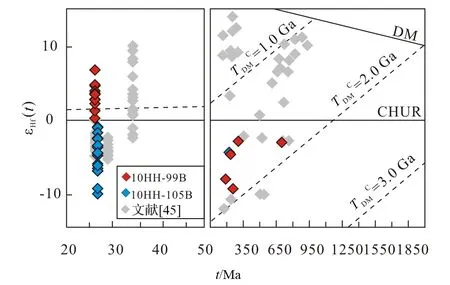
圖6 哀牢山紅河剪切帶漸新世花崗質巖石鋯石εHf(t)-t圖解Fig.6 εHf(t) vs.t diagrams for granitic rocks of 10HH-99B and 10HH-105B from Ailaoshan-Red River shear zone
混合巖脈體10HH-105B:進行了23顆鋯石的原位Lu-Hf同位素分析,其中17為繼承鋯石,εHf(t)為-4.3、TDM2為1 244 Ma。其余22個分析點176Hf/177Hf = 0.282 477~0.282 736。按t=26.8 Ma的形成年齡,εHf(t)=-9.8~-0.7,平均-4.3,二階模式年齡TDM2介于903~1 355 Ma,如圖5b和圖6。
4 討 論
4.1 成巖過程
近年來,在金沙江-哀牢山構造帶識別出許多新生代巖漿巖,為研究殼幔相互作用提供了豐富的地球化學信息[15, 22, 31]。這些新生代巖漿巖以花崗質巖石為主,普遍具有富鉀的特征,其鋯石Hf二階段模式年齡集中在1078~1448 Ma,與哀牢山構造帶內的前寒武紀變質巖系的Nd同位素模式年齡接近[7, 30, 43-44],被認為是中元古代地殼物質重熔再造形成的,幔源物質貢獻較少[15, 31, 45]。我們對哀牢山構造帶紅河甲寅地區(qū)花崗質巖石Lu-Hf同位素組成的測試結果表明,樣品10HH-99B初始εHf值變化在+0.3~+6.9之間,對應的二階段Hf模式年齡落在526~853 Ma之間,明顯大于鋯石的206Pb/238U表面年齡,與Liu et al.[19]提出的哀牢山新生基性下地殼模式年齡一致,表明該花崗巖與滑石板高εNd-εHf花崗巖具有相似的源區(qū),主要源于526~853 Ma新生地殼的重熔。另一件樣品(10HH-105B)初始εHf值變化在-9.8~-0.7之間,對應的Hf模式年齡落在903~1 355 Ma之間,遠大于其結晶年齡。鋯石具負εHf(t)值和古老的Hf兩階段模式年齡,揭示其源區(qū)主要為古老陸殼物質,可能來源于哀牢山高級變質帶中新元古代地殼物質的部分熔融[21, 46]。因此,哀牢山構造帶存在前寒武紀結晶基底,說明代表該區(qū)基底的哀牢山群形成時代包括中新元古代,綜合顯生宙時期各類巖石,可知哀牢山高級變質帶是一個雜巖。結合區(qū)域構造演化,我們認為該花崗巖形成可能與印歐板塊后碰撞背景下古老地殼熔融相關,是造山帶在漸新世時期剪切過程因伸展松弛而發(fā)生減壓熔融的產物。Lin et al.[45]在點蒼山和哀牢山也識別出了晚漸新世低εHf(t)片麻巖(圖8),其成因應與本文低εHf(t)花崗巖相似。綜合可知,低εHf(t)的花崗巖源巖可能是元古宙哀牢山群變質雜砂巖,高εHf(t)的花崗巖源自軟流圈地幔熱源加熱新生下地殼的部分熔融[19, 47]。
Rapp & Watson[48]的實驗表明變質玄武巖熔融的最低溫度為1 000 ℃,地殼加厚和中下地殼的放射性元素生熱顯然無法產生這么高的溫度,那么基性下地殼熔融的熱源來自哪里?哀牢山構造帶是特提斯-喜馬拉雅構造域的重要地區(qū),在青藏高原東南緣新生代以來的構造演化討論中,圍繞哀牢山構造帶對印歐碰撞的響應機制一直存在諸多爭議。目前,主要爭論的焦點在于三江地區(qū)廣泛分布的大型走滑斷層在大陸擠壓過程中扮演著怎樣的角色[49]。一種觀點認為,印度板塊本質上是剛性的巖石圈塊體,其變形主要集中在板塊的邊緣,紅河斷裂帶是大陸塊體側向逃逸的東部邊界。因此,走滑斷層切割深達巖石圈地幔[12, 14, 50-52]。另一種觀點認為擠壓加厚的陸殼是一種薄的粘性席體,其內部變形是均勻的,主體上是非旋轉巖石圈縮短,故而走滑斷層純粹是在地殼尺度[53-57]。此外需要注意的是,華南的大部分研究地區(qū)普遍受陸內深斷裂的控制,許多深斷裂繼承了古俯沖帶、古拼接帶等板塊邊界構造,在后來發(fā)生的部分熔融事件中,新生巖漿繼承了早先形成的與俯沖和碰撞有關的含有較多幔源物質的特征,在地球化學方面顯示幔源組分參與特征[58]。Zhang和Sch?rer[15]認為在哀牢山-紅河左旋走滑剪切過程中存在熱異常。因此,處于后碰撞環(huán)境的研究區(qū),最有可能的深部熱源就是上地幔尺度上的深大斷裂。此外,哀牢山富堿侵入巖不管是由古洋殼板塊加巖石圈地幔部分熔融形成[59-61],還是印歐板塊俯沖過程中板片斷離導致軟流圈物質上涌誘發(fā)加厚大陸下地殼部分熔融形成[62-63],均是處在強烈的區(qū)域性構造應力轉換階段[64],可能深切至上地幔的大型走滑斷裂系統(tǒng)是富堿斑巖巖漿的重要運移通道,也是地殼部分熔融的重要熱源之一。我們認為,兩類花崗巖的形成過程如下:在漸新世后碰撞構造環(huán)境中,地殼拉張和深大斷裂活動導致地幔上涌,高εHf(t)花崗巖由被底侵的玄武質下地殼物質部分熔融形成,其熱源可能是底侵的幔源鎂鐵質巖漿。受碰撞作用的影響,因地殼加厚及階段性剪切作用,導致地殼重熔產生低εHf(t)花崗巖,巖石部分熔融的熱源來自于塊體的摩擦運動。
4.2 兩類晚漸新世花崗巖的構造指示
近年來,哀牢山紅河剪切帶眾多高封閉溫度同位素體系的年代學,如獨居石、鋯石U-Th-Pb定年的研究,顯示其經歷了一個復雜的熱歷史(圖7)。該區(qū)域發(fā)表的大部分花崗質巖石U-Pb年齡集中在35~21 Ma,最老年齡在35~38 Ma[15, 22-23, 65-67]。同時,研究區(qū)同剪切礦物的40Ar/39Ar定年結果給出了32~22 Ma的年齡范圍[15, 68-69]。結合青藏高原東南、滇西地區(qū)以及越南地區(qū)廣泛存在的高鉀質巖漿巖,Liang et al.[70]認為初始左旋走滑運動發(fā)生在35~36 Ma。基于變質巖、熱年代學數(shù)據不少學者提出初始左旋剪切至少在35 Ma[15,71-72]。我們對云南紅河甲寅地區(qū)兩類花崗質巖石研究結果顯示,在晚漸新世存在一期巖漿巖的作用,并且同時軟流圈地幔的上侵說明此時哀牢山局部地區(qū)可能轉化為伸展背景,也就是說紅河剪切帶剪切作用在晚漸新世由壓剪轉為扭剪作用。這一結論也為我們在深變質帶內識別的26 Ma變基性巖所證明(課題組待刊數(shù)據)。
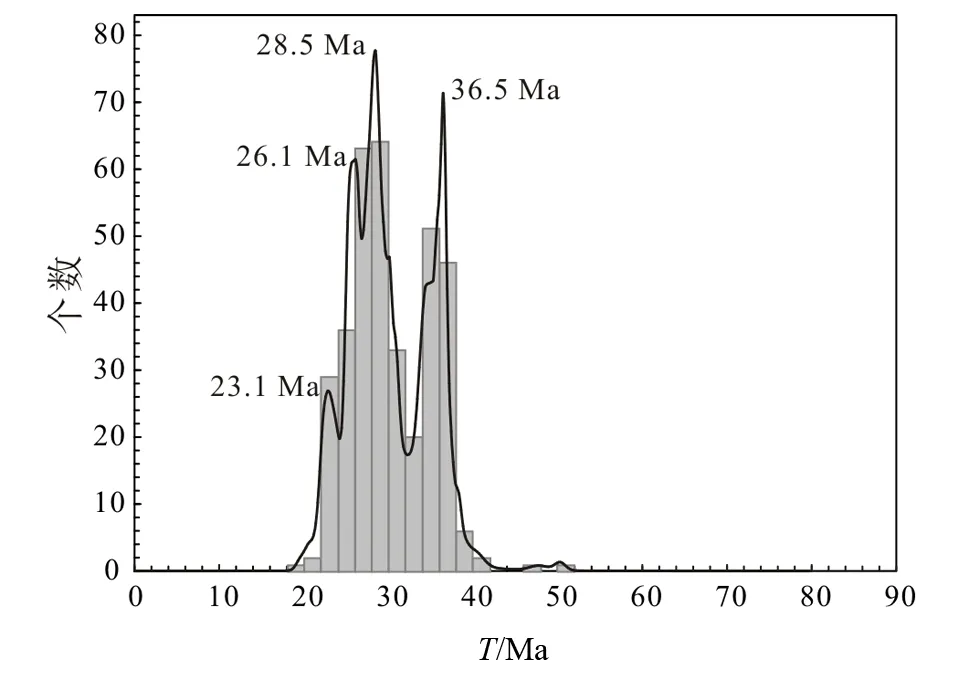
圖7 哀牢山紅河剪切帶新生代巖石鋯石U-Pb年齡譜系圖數(shù)據來源于文獻[22-23, 31, 45, 73-77]以及本研究Fig.7 Zircon U-Pb age histograms for the Cenozoic rocks from the Ailaoshan-Red River shear zone Age data refer to the following sources:[22-23, 31, 45, 73-77] and this study
結合鄰近的大地構造格局來看(圖8),哀牢山紅河剪切帶位于印支和揚子板塊交界處,高黎貢山右旋走滑斷裂帶位于騰沖地塊和保山地塊間,是思茅-印支地塊的西邊界斷層。這些韌性剪切帶可能與紅河剪切帶一致,都是切穿至巖石圈地幔深度的斷裂帶。Wang et al.[78]認為右旋的高黎貢山剪切帶和左旋的崇山剪切帶始于~ 32 Ma,終止于約 15~17 Ma。同樣不同學者對糜棱巖、片麻巖、花崗質脈中不同礦物進行同位素定年的結果表明,高黎貢山峰期變質時間介于38~22 Ma之間[79-81]。哀牢山紅河剪切帶剪切作用可能與高黎貢山右旋走滑剪切帶和崇山左旋走滑剪切帶具一致延續(xù)時限,它們都是新生代以來印歐板塊碰撞造山事件在青藏高原東南緣的響應。高黎貢山剪切帶和哀牢山紅河剪切帶肢解了至少兩大塊體(蘭坪思茅地體和撣泰地塊)(圖8),而不是由Tapponnier et al.[12]提出的東南緣各陸塊為一個單一的剛性塊體[82-83]。

圖8 三江地區(qū)漸新世時期印支地塊沿剪切帶東南向擠出被肢解成不同的塊體(改自[84])① 甘孜理塘縫合帶; ② 金山江縫合帶; ③ 龍木錯-雙湖縫合帶; ④ 班公湖怒江縫合帶; ⑤ 哀牢山縫合帶; ⑥ 昌寧-孟連縫合帶; ⑧ 密支那縫合帶.GLSZ=高黎貢山剪切帶; CSZ=崇山剪切帶; ARSZ=哀牢山-紅河剪切帶; SGSZ=實皆剪切帶; JLF=嘉黎斷裂Fig.8 Distribution of the late Oligocene shear zones in Southeast Asia (revised from [84]) ① Garzê-Litang suture; ② Jinshajiang suture; ③ Longmu Tso-Shuanghu suture; ④ Banggong-Nujiang suture; ⑤ Ailaoshan suture; ⑥ Changning-Menglian suture; ⑦ Myitkyina suture GLSZ=Gaoligongshan shear zone; CSZ=Chongshan shear zone; ARSZ=Ailaoshan-Red River shear zone; JLF=Jiali fault; SGSZ=Saging shear zone
5 結 論
1) 云南紅河甲寅地區(qū)識別出兩類晚漸新世(~26 Ma)花崗質巖石,其鋯石εHf(t)平均值分別為+3.4和-4.3,二階段模式年齡分別為526~853 Ma和903~1 355 Ma。前者源自新生基性下地殼的部分熔融,后者源巖為元古宙哀牢山群變質雜砂巖。
2) 甲寅兩類晚漸新世花崗巖的發(fā)現(xiàn)說明哀牢山群并不全是揚子板塊的元古代結晶基底,也包含有新生代巖漿巖。
3) 甲寅兩類花崗巖的發(fā)現(xiàn)還說明紅河剪切帶在晚漸新世切穿了巖石圈地幔,為我們認識東南亞陸塊屬性及南海打開提供了資料。
致謝:野外樣品采集以及室內巖石分析工作得到蔡永豐、張愛梅等的幫助,編輯部老師和評審專家的意見,對提高論文質量起了重要作用,在此一并致以誠摯謝意。
[2] 莫宣學, 路鳳香, 沈上越, 等. 三江特提斯火山作用與成礦[M]. 北京: 地質出版社, 1993.
[3] JIAN P, LIU D Y, KR?NER A, et al. Devonian to Permian plate tectonic cycle of the Paleo-Tethys Orogen in southwest China (I): Geochemistry of ophiolites, arc/back-arc assemblages and within-plate igneous rocks[J]. Lithos, 2009, 113(3/4): 748-766.
[4] JIAN P, LIU D Y, KR?NER A, et al. Devonian to Permian plate tectonic cycle of the Paleo-Tethys Orogen in southwest China (II): Insights from zircon ages of ophiolites, arc/back-arc assemblages and within-plate igneous rocks and generation of the Emeishan CFB province[J]. Lithos, 2009, 113(3/4): 767-784.
[5] WANG Y J, ZHANG A M, FAN W M, et al. Petrogenesis of late Triassic post-collisional basaltic rocks of the Lancangjiang tectonic zone, southwest China, and tectonic implications for the evolution of the eastern Paleotethys: geochronological and geochemical constraints[J]. Lithos, 2010, 120(3): 529-546.
[6] LIU H C, WANG Y J, CAWOOD P A, et al. Record of Tethyan ocean closure and Indosinian collision along the Ailaoshan suture zone (SW China)[J]. Gondwana Research, 2014, 27(3): 1292-1306.
[7] 鐘大賚. 滇川西部古特提斯造山帶[M]. 北京:科學出版社, 1998.
ZHONG D L. Paleo-Tethyan orogenic belt in the western parts of the Sichuan and Yunnan provinces[M]. Beijing: Science Press, 1998.
[8] METCALFE I. Gondwanaland dispersion, Asian accretion and evolution of eastern Tethys[J]. Australian Journal of Earth Sciences, 1996, 43(6): 605-623.
[9] METCALFE I. Tectonic framework and Phanerozoic evolution of Sundaland[J]. Gondwana Research, 2011, 19(1): 3-21.
[10] METCALFE I. Gondwana dispersion and Asian accretion: tectonic and palaeogeographic evolution of eastern Tethys[J]. Journal of Asian Earth Sciences, 2013, 66: 1-33.
[11] 劉本培, 馮慶來, CHONGLAKMANI C 等. 滇西古特提斯多島洋的結構及其南北延伸[J]. 地學前緣, 2002, 9(3): 161-172.
LIU B P, FENG Q L, CHONGLAKMANI C. Framework of paleotethyan archipelago ocean of western Yunnan and its elongation towards north and south[J]. Earth Science Frontiers, 2002, 9(3): 161-172.
[12] TAPPONNIER P, PELTZER G, ARMIJO R. On the mechanics of the collision between India and Asia[J]. Geological Society, London, Special Publications, 1986, 19(1): 113-157.
[13] TAPPONNIER P, LACASSIN R, LELOUP P H, et al. The Ailao Shan/Red River metamorphic belt: Tertiary left-lateral shear between Indochina and South China[J]. Nature, 1990, 343(6257): 431-437.
[14] LELOUP P H, LACASSIN R, TAPPONNIER P, et al. The Ailao Shan-Red River shear zone (Yunnan, China), Tertiary transform boundary of Indochina[J]. Tectonophysics, 1995, 251(s1-4): 3-10.
[15] ZHANG L S, SCHRER U. Age and origin of magmatism along the Cenozoic Red River shear belt, China[J]. Contributions to Mineralogy and Petrology, 1999, 134(1): 67-85.
[16] 張玉泉, 夏斌, 梁華英, 等. 云南大平糜棱巖化堿性花崗巖的鋯石特征及其地質意義[J]. 高校地質學報, 2004, 10(3): 378-384.
ZHANG Y Q, XIA B, LIANG H Y, et al. Characteristics of zircons for dating from Daping mylonitized alkaline granite in Yunnan and their geologic implications[J]. Geological Journal of China Universities, 2004, 10(3): 378-384.
[17] 劉俊來, 王安建, 曹淑云, 等. 滇西點蒼山雜巖中混合巖的地質年代學分析及其區(qū)域構造內涵[J]. 巖石學報, 2008, 24(3): 413-420.
LIU J L, WANG A J, CAO S Y, et al. Geochronology and tectonic implication of migmatites from Diancangshan, Western Yunnan[J]. Acta Petrologica Sinica, 2008, 24(3): 413-420.
[18] QI X X, ZENG L S, ZHU L H, et al. Zircon U-Pb and Lu-Hf isotopic systematics of the Daping plutonic rocks: Implications for the Neoproterozoic tectonic evolution of the northeastern margin of the Indochina block, Southwest China[J]. Gondwana Research, 2012, 21(1): 180-193.
[19] LIU H C, WANG Y J, FAN W M, et al. Petrogenesis and tectonic implications of Late-Triassic high εNd(t)-εHf(t) granites in the Ailaoshan tectonic zone (SW China)[J]. Science China Earth Sciences, 2014, 57(9): 2181-2194.
[20] CAI Y F, WANG Y J, CAWOOD P A, et al. Neoproterozoic subduction along the Ailaoshan zone, South China: Geochronological and geochemical evidence from amphibolite[J]. Precambrian Research, 2014, 245(5): 13-28.
[21] CAI Y F, WANG Y J, CAWOOD P A, et al. Neoproterozoic crustal growth of the Southern Yangtze Block: Geochemical and zircon U-Pb geochronological and Lu-Hf isotopic evidence of Neoproterozoic diorite from the Ailaoshan zone[J]. Precambrian Research, 2015, 266: 137-149.
[22] CAO S Y, LIU J L, LEISS B, et al. Oligo-Miocene shearing along the Ailao Shan-Red River shear zone: constraints from structural analysis and zircon U/Pb geochronology of magmatic rocks in the Diancang Shan massif, SE Tibet, China[J]. Gondwana Research, 2011, 19(4): 975-993.
[23] TANG Y, LIU J L, TRAN M D, et al. Timing of left-lateral shearing along the Ailao Shan-Red River shear zone: constraints from zircon U-Pb ages from granitic rocks in the shear zone along the Ailao Shan Range, Western Yunnan, China[J]. International Journal of Earth Sciences, 2013, 102(3): 605-626.
[24] PENG T P, WANG Y J, ZHAO G C, et al. Arc-like volcanic rocks from the southern Lancangjiang zone, SW China: Geochronological and geochemical constraints on their petrogenesis and tectonic implications[J]. Lithos, 2008, 102(1/2): 358-373.
[25] WANG Y J, ZHANG A M, FAN W M, et al. Petrogenesis of late Triassic post-collisional basaltic rocks of the Lancangjiang tectonic zone, southwest China, and tectonic implications for the evolution of the eastern Paleotethys: Geochronological and geochemical constraints[J]. Lithos, 2010, 120(3/4): 529-546.
[26] 云南省地質礦產局. 云南省區(qū)域地質志[M]. 北京: 地質出版社, 1990.
BUREAU OF GEOLOGY AND MINERAL RESOURCES OF YUNNAN PROVINCE. Regional Geology of Yunnan Province[M]. Beijing: Geological Publishing House, 1990.
[27] XIA X P, NIE X S, LAI C K, et al. Where was the Ailaoshan Ocean and when did it open: a perspective based on detrital zircon U-Pb age and Hf isotope evidence[J]. Gondwana Research, 2015.
[28] 翟明國, 從柏林, 喬廣生, 等. 中國滇西南造山帶變質巖的Sm-Nd和Rb-Sr同位素年代學[J]. 巖石學報, 1990, 6(4): 1-11.
ZHAI M G, CONG B L, QIAO G S, et al. Sm-Nd and Rb-Sr geochronology of metamorphic rocks from SW Yunnan orogenic zones, China[J]. Acta Petrologica Sinica, 1990, 6(4): 1-11.
[29] 翟明國, 從柏林. 對于點蒼山-石鼓變質帶區(qū)域劃分的意見[J]. 巖石學報, 1993, 9(3): 227-239.
ZHAI M G, CONG B L. The Diancangshan-Shigu metamorphic belt in W. Yunnan, China: their geochemical and geochronological characteristics and division of metamorphic domains[J]. Acta Petrologica Sinica, 1993, 9(3): 227-239.
[30] 沙紹禮, 包俊躍, 金亞昌, 等. 點蒼山變質帶同位素年代學研究新進展[J]. 云南地質, 1999, 18(1): 63-66.
SHA S L, BAO J Y, JIN Y C, et al. The new development of isotopic geochronology of the Diancang mountains metamorphic zone[J]. Yunnan Geology, 1999, 18(1): 63-66.
[31] 戚學祥, 趙宇浩, 朱路華, 等. 滇西點倉山構造帶新生代巖漿活動及其構造意義[J]. 巖石學報, 2014, 30(8): 2217-2228.
QI X X, ZHAO Y H, ZHU L H, et al. Cenozoic magmatism in Diancanshan Range,southwestern Yunnan,China,and its tectonic implications[J]. Acta Petrologica Sinica, 2014, 30(8): 2217-2228.
[32] 戚學祥, 朱路華, 李化啟, 等. 青藏高原東緣哀牢山-金沙江構造帶糜棱狀花崗巖的LA-ICP-MS U-Pb定年及其構造意義[J]. 地質學報, 2010, 84(3): 357-369.
QI X X, ZHU L H, LI H Q, et al. Zircon LA-ICP-MS U-Pb dating for mylonitized granite from the Ailaoshan-Jinshajiang tectonic zone in the eastern Qinghai-Tibet Plateau and its tectonic significance[J]. Acta Geologica Sinica, 2010, 84(3): 357-369.
[33] 李寶龍, 季建清, 付孝悅, 等. 滇西點蒼山—哀牢山變質巖系鋯石SHRIMP定年及其地質意義[J]. 巖石學報, 2008, 24(10): 2322-2330.
LI B L, JI J Q, FU X Y, et al. Zircon SHRIMP dating and its geological implications of metamorphic rocks in Ailao Shan-Diancang Mountain Ranges, west Yunnan[J]. Acta Petrologica Sinica, 2008, 24(10): 2322-2330.
[34] 王義昭, 丁俊. 云南哀牢山中深變質巖系構造變形特征及演變[J]. 沉積與特提斯地質, 1996, 20: 52-70.
WANG Y Z, DING J. Structural deformation and evolution of the medium-to high-grade metamorphic rock series in the Ailao Mountains, Yunnan[J]. Sedimentary Geology and Tethyan Geology, 1996, 20: 52-70.
[35] 胥頤, 劉建華, 劉福田,等. 哀牢山-紅河斷裂帶及其鄰區(qū)的地殼上地幔結構[J]. 中國科學(D輯), 2003, 33(12): 1201-1208.
XU Y, LIU J H, LIU F T, et al. Crust and upper mantle structure of the Ailao Shan-Red River fault zone and adjacent regions[J]. Science in China (Series D): Earth Sciences, 2005, 48(2): 156-164.
[36] 張進江, 鐘大賚, 桑海清,等. 哀牢山—紅河構造帶古新世以來多期活動的構造和年代學證據[J]. 地質科學, 2006, 41(2): 291-310.
ZHANG J J, ZHONG D L, SANG H Q, et al. Structural and geochronological evidence for multiple episodes of Tertiary deformation along the Ailaoshan-Red River shear zone, Southeastern Asia, since the Paleocene[J]. Acta Geologica Sinica, 2006, 80(1): 79-96.
[37] YUAN H L, GAO S, LIU X M, et al. Accurate U-Pb age and trace element determinations of zircon by Laser Ablation-Inductively Coupled Plasma-Mass Spectrometry[J]. Geostandards and Geoanalytical Research, 2004, 28(3): 353-370.
[38] WU F Y, YANG Y H, XIE L W, et al. Hf isotopic compositions of the standard zircons and baddeleyites used in U-Pb geochronology[J]. Chemical Geology, 2006, 234(1/2): 105-126.
[39] 謝烈文, 張艷斌, 張輝煌, 等. 鋯石/斜鋯石U-Pb和Lu-Hf同位素以及微量元素成分的同時原位測定[J]. 科學通報, 2008, 53(2): 220-228.
XIE L W, ZHANG Y B, ZHANG H H, et al. In situ simultaneous determination of trace elements, U-Pb and Lu-Hf isotopes in zircon and baddeleyite[J]. Chinese Science Bulletin, 2008, 53(10): 1565-1573.
[40] LUDWIG K R. User’s manual for Isoplot/Ex, version 3.0, a geochronological toolkit for Microsoft Excel[CP]. Berkeley Geochronology Center, CA, special publication, no.4,2003.
[41] LIU Y S, GAO S, HU Z C, et al. Continental and oceanic crust recycling-induced melt-peridotite interactions in the Trans-North China Orogen: U-Pb dating, Hf isotopes and trace elements in zircons from mantle xenoliths[J]. Journal of Petrology, 2010, 51(1-2): 537-571.
[42] 林清茶, 夏斌, 張玉泉, 等. 哀牢山-金沙江堿性巖帶南段云南金平八一村鉀質堿性花崗巖鋯石SHRIMP U-Pb年齡[J]. 地質通報, 2005, 24(5): 420-423.
LIN Q C, XIA B, ZHANG Y Q, et al. Zircon SHRIMP dating of the Bayicun potassic alkali-granite, Jinping, Yunnan, in the southern segment of the Ailaoshan-Jinshajiang alkaline rock belt[J]. Regional Geology of China, 2005, 24(5): 420-423.
[43] 鄒日, 朱炳泉, 孫大中, 等. 紅河成礦帶殼幔演化與成礦作用的年代學研究[J]. 地球化學, 1997, 26(2): 46-56.
ZOU R, ZHU B Q, SUN D Z. Geochronology studies of crust-mantle interaction and mineralization in the Honghe ore deposit zone[J]. Geochimica, 1997, 26(2): 46-56.
[44] 朱炳泉, 常向陽, 邱華寧, 等. 云南前寒武紀基底形成與變質時代及其成礦作用年代學研究[J]. 前寒武紀研究進展, 2001, 24(2): 75-68.
ZHU B Q, CHANG X Y, QIU H N, et al. Geochronological study on formation and metamorphism of Precambrian basement and their mineralization in Yunnan, China[J]. Progress in Precambrian Research, 2001, 24(2): 75-68.
[45] LIN T H, CHUNG S L, CHIU H Y, et al. Zircon U-Pb and Hf isotope constraints from the Ailao Shan-Red River shear zone on the tectonic and crustal evolution of southwestern China[J]. Chemical Geology, 2012, 291(1): 23-37.
[46] WANG Y J, ZHOU Y Z, CAI Y F, et al. Geochronological and geochemical constraints on the petrogenesis of the Ailaoshan granitic and migmatite rocks and its implications on Neoproterozoic subduction along the SW Yangtze Block[J]. Precambrian Research, 2016, 283: 106-124.
[47] 劉匯川, 王岳軍, 蔡永豐, 等. 哀牢山構造帶新安寨晚二疊世末期過鋁質花崗巖鋯石U-Pb年代學及Hf同位素組成研究[J]. 大地構造與成礦學, 2013, 37(1): 87-98.
LIU H C, WANG Y J, CAI Y F, et al. Zircon U-Pb geochronology and Hf isotopic composition of the Xin'anzhai granite along the Ailaoshan tectonic zone in west Yunnan province[J]. Geotectonica et Metallogenia, 2013, 37(1): 87-98.
[48] RAPP R P, WATSON E B. Dehydration melting of metabasalt at 8-32 kbar: implications for continental growth and crust-mantle recycling[J]. Journal of Petrology, 1995, 36(4): 891-931.
[49] SEARLE M P. Role of the Red River Shear zone, Yunnan and Vietnam, in the continental extrusion of SE Asia[J]. Journal of the Geological Society, 2006, 63(6): 1025-1036.
[50] ARMIJO R, TAPPONNIER P, HAN T L. Late Cenozoic right-lateral strike-slip faulting in southern Tibet[J]. Journal of Geophysical Research: Solid Earth, 1989, 94(B3): 2787-2838.
[51] MOLNAR P, TAPPONNIER P. Cenozoic tectonics of Asia: effects of a continental collision[J]. Science, 1975, 189(4201): 419-426.
[52] PELTZER G, TAPPONNIER P. Formation and evolution of strike-slip faults, rifts, and basins during the India-Asia collision-An experimental approach[J]. Journal of Geophysical Research: Solid Earth (1978-2012), 1988, 93(B12): 15085-15117.
[53] England P, McKenzie D. A thin viscous sheet model for continental deformation[J]. Geophysical Journal International, 1982, 70(2): 295-321.
[54] ENGLAND P, HOUSEMAN G. Finite strain calculations of continental deformation: 2. Comparison with the India-Asia collision zone[J]. Journal of Geophysical Research: Solid Earth, 1986, 91(B3): 3664-3676.
[55] BURCHFIEL B C, DENG Q D, MOLNAR P, et al. Intracrustal detachment within zones of continental deformation[J]. Geology, 1989, 17(8): 748-752.
[56] HOUSEMAN G, ENGLAND P. Crustal thickening versus lateral expulsion in the Indian-Asian continental collision[J]. Journal of Geophysical Research: Solid Earth, 1993, 98(B7): 12233-12249.
[57] JOLIVET L, BEYSSAC O, GOFFé B, et al. Oligo-Miocene midcrustal subhorizontal shear zone in Indochina[J]. Tectonics, 2001, 20(1):46-57.
[58] 華仁民, 陳培榮, 張文蘭, 等. 華南中、新生代與花崗巖類有關的成礦系統(tǒng)[J]. 中國科學(D輯), 2003, 33(4): 335-343.
HUA R M, CHEN P R, ZHANG W L, et al. Metallogenic systems related to Mesozoic and Cenozoic granitoids in South China[J]. Science in China (Series D): Earth Sciences, 2003, 46(8): 816-829.
[59] 劉福田, 劉建華, 何建坤, 等. 滇西特提斯造山帶下?lián)P子地塊的俯沖板片[J]. 科學通報, 2000, 45(1): 79-65.
LIU F T, LIU J H, HE J K, et al. Subduction slab of lower Yangtze massif in Tethys orogenic belt. West Yunnan[J]. Chinese Science Bulletin, 2000, 45(1): 79-83.
[60] 徐興旺, 蔡新平, 宋保昌, 等. 滇西北衙金礦區(qū)堿性斑巖巖石學、年代學和地球化學特征及其成因機制[J]. 巖石學報, 2006, 22(3): 631-642.
XU X W, CAI X P, SONG B C, et al. Petrologic, chronological and geochemistry characteristics and formation mechanism of alkaline porphyries in the Beiya gold district, western Yunnan[J]. Acta Petrologica Sinica, 2006, 22(3): 631-642.
[61] FLOWER M F J, HOàNG N, LO C H, et al. Potassic magma genesis and the Ailao Shan-Red River fault[J]. Journal of Geodynamics, 2013, 69(Special Issue): 84-105.
[62] 寇彩化, 張招崇, 侯通, 等. 滇西劍川OIB型苦橄玢巖:俯沖板塊斷離的產物?[J]. 巖石學報, 2011, 27(9): 2679-2693.
KOU C H, ZHANG Z C, HOU T, et al. OIB-type picritic porphyrite from Jianchuan in tne western Yunnan Province: Results of break-off of the subducting plate?[J]. Acta Petrologica Sinica, 2011, 27(9): 2679-2693.
[63] 和文言, 莫宣學, 喻學惠, 等. 滇西北衙金多金屬礦床鋯石U-Pb和輝鉬礦Re-Os年齡及其地質意義[J]. 巖石學報, 2013, 29(4): 1301-1310.
HE W Y, MO X X, YU X H, et al. Zircon U-Pb and molybdenite Re-Os dating for the Beiya gold-polymetallic deposit in the western Yunnan Province and its geological significance[J]. Acta Petrologica Sinica, 2013, 29(4): 1301-1310.
[64] WANG J H, YIN A, HARRISON T M, et al. A tectonic model for Cenozoic igneous activities in the eastern Indo-Asian collision zone[J]. Earth and Planetary Science Letters, 2001, 188(1): 123-133.
[65] LELOUP P H, ARNAUD N, LACASSIN R, et al. New constraints on the structure, thermochronology, and timing of the Ailao Shan-Red River shear zone, SE Asia[J]. Journal of Geophysical Research: Solid Earth, 2001, 106(B4): 6683-6732.
[66] SASSIER C, LELOUP P H, RUBATTO D, et al. Direct measurement of strain rates in ductile shear zones: A new method based on syntectonic dikes[J]. Journal of Geophysical Research: Solid Earth, 2009, 114(B1): 549-549.
[67] GUO X F, WANG Y J, LIU H C, et al. Zircon U-Pb geochronology of the Cenozoic granitic mylonite along the Ailaoshan-Red River shear zone: New constraints on the timing of the sinistral shearing. Journal of Earth Science, 2016, 27(3): 435-443.
[68] WANG P L, LO C H, CHUNG S L, et al. Onset timing of left-lateral movement along the Ailao Shan-Red River shear zone:40Ar/39Ar dating constraint from the Nam Dinh Area, northeastern Vietnam[J]. Journal of Asian Earth Sciences, 2000, 18(3): 281-292.
[69] SEARLE M P, YEH M W, LIN T H, et al. Structural constraints on the timing of left-lateral shear along the Red River shear zone in the Ailao Shan and Diancang Shan Ranges, Yunnan, SW China[J]. Geosphere, 2010, 6(6): 316-338.
[70] LIANG H Y, CAMPBELL I H, ALLEN C M, et al. The age of the potassic alkaline igneous rocks along the Ailao Shan-Red River shear zone: implications for the onset age of left-lateral shearing[J]. The Journal of Geology, 2007, 115(2): 231-242.
[72] GILLEY L D, HARRISON T M, LELOUP P H, et al. Direct dating of left-lateral deformation along the Red River shear zone, China and Vietnam[J]. Journal of Geophysical Research: Solid Earth, 2003, 108(B2): 183-185.
[73] LI B L, JI J Q, WANG D D, et al. Determination of Eocene-Oligocene (30-40 Ma) deformational time by zircon U-Pb SHRIMP dating from leucocratic rocks in the Ailao Shan-Red River shear zone, southeast Tibet, China[J]. International Geology Review, 2014,56(1): 74-87.
[74] 趙春強, 趙利, 曹淑云, 等. 點蒼山變質雜巖新生代變質-變形演化及其區(qū)域構造內涵[J]. 巖石學報, 2014, 30(3): 851-866.
ZHAO C Q, ZHAO L, CAO S Y, et al. Cenozoic deformation-metamorphic evolution of the Diancang Shan metamorphic complex and regional tectonic implications[J]. Acta Petrologica Sinica, 2014, 30(3): 851-866.
[75] ZHANG B, ZHANG J J, LIU J, et al. The Xuelongshan high strain zone: Cenozoic structural evolution and implications for fault linkages and deformation along the Ailao Shan-Red River shear zone[J]. Journal of Structural Geology, 2014, 69: 209-233.
[76] LIU F L, WANG F, LIU P H, et al. Multiple partial melting events in the Ailao Shan-Red River and Gaoligong Shan complex belts, SE Tibetan Plateau: zircon U-Pb dating of granitic leucosomes within migmatites[J]. Journal of Asian Earth Sciences, 2015, 110: 151-169.
[77] LIU J L, CHEN X Y, WU W B, et al. New tectono-geochronological constraints on timing of shearing along the Ailao Shan-Red River shear zone: Implications for genesis of Ailao Shan gold mineralization[J]. Journal of Asian Earth Sciences, 2015, 103: 70-86.
[78] WANG Y J, FAN W M, ZHANG Y H, et al. Kinematics and40Ar/39Ar geochronology of the Gaoligong and Chongshan shear systems, western Yunnan, China: Implications for early Oligocene tectonic extrusion of SE Asia[J]. Tectonophysics, 2006, 418(3): 235-254.
[79] 季建清, 鐘大賚, 張連生. 滇西南新生代走滑斷裂運動學、年代學、及對青藏高原東南部塊體運動的意義[J]. 地質科學, 2000, 35(3): 336-349.
JI J Q, ZHONG D L, ZHANG L S. Kinematics and dating of Cenozoic strike-slip faults in the Tengchong area, west Yunnan: Implications for the block movement in the southeastern Tibet Plateau[J]. 2000, 35(3): 336-349.
[80] SONG S G, NIU Y L, WEI C J, et al. Metamorphism, anatexis, zircon ages and tectonic evolution of the Gongshan block in the northern Indochina continent—An eastern extension of the Lhasa Block[J]. Lithos, 2010, 120(3): 327-346.
[81] 李再會, 王立全, 林仕良, 等. 滇西高黎貢剪切帶內花崗質糜棱巖LA-ICP-MS鋯石U-Pb年齡及其構造意義[J]. 地質通報, 2012, 31(8): 1287-1295.
LI Z H, WANG L Q, LIN S L, et al. LA-ICP-MS zircon U-Pb age of granitic mylonite in the Gaoligong shear zone of western Yunnan Province and its tectonic significance[J]. Geological Bulletin of China, 2012, 31(8): 1287-1295.
[82] CHEN H H, DOBSON J, HELLER F, et al. Paleomagnetic evidence for clockwise rotation of the Simao region since the Cretaceous: A consequence of India-Asia collision[J]. Earth & Planetary Science Letters, 1995, 134(1/2): 203-217.
[83] ZHANG B, ZHANG J J, ZHONG D L. Structure, kinematics and ages of transpression during strain-patitioning in the Chongshan sear zone, western Yunnan, China[J]. Journal of Structural Geology, 2010, 32(4): 445-463.
[84] DENG J, WANG Q F, LI G J, et al. Cenozoic tectono-magmatic and metallogenic processes in the Sanjiang region, southwestern China[J]. Earth-Science Reviews, 2014, 138: 268-29.
PetrogenesisoftwotypesoflateOligocenegranitesinAilaoshantectoniczoneandtheirtectonicimplications
GUOXiaofei1, 2, 3,WANGYuejun2, 4,LIUHuichuan2, 4,ZHANGYuzhi2, 4
(1.State Key Laboratory of Isotope Geochemistry, Guangzhou Institute of Geochemistry,Chinese Academy of Sciences, Guangzhou 510640, China;2. School of Earth Sciences and Engineering, Guangzhou 510275, China; 3. University of Chinese Academy of Sciences, Beijing 100049, China;4. Guangdong Provincial Key Lab of Geodynamics and Geohazards, Sun Yat-sen University,Guangzhou 510275, China)
The widespread Cenozoic magmatism in the Red River-Ailaoshan tectonic zone is closely related to the Indian-Eurasian plate collision orogeny. Zircon U-Pb dating results of two granitic samples exposed in the middle part of the Ailaoshan metamorphic belt are 26.2 ± 0.5 Ma and 26.8 ± 0.5 Ma, respectively. This indicates that the Ailaoshan metamorphic zone is not entirely attributed to the Proterozoic crystalline basement of the Yangtze block, while it also contains Cenozoic magmatic rocks. Zircon εHf(t) values of the samples range from +0.3 to +6.9 and from -9.8 to -0.7 with mean values of +3.4 and -4.3, respectively and their corresponding two-stage Hf model ages (TDM2) range from 526 to 853 Ma and from 903 to 1 355 Ma. The high εHf(t) granites were derived from partial melting of juvenile crust induced by the asthenospheric mantle heat source, while low εHf(t) granites from Proterozoic metamorphic sandstones of the Ailaoshan group. In combination with previous research results, we suggest that the Red River fault has cut across the lithosphere mantle. In SE Asia, the Gaoligongshan and Ailaoshan strike-slip shear zones on both sides of Indosinian block dismembered different blocks and created conditions for their Oligocene extrusion to the southeast.
Ailaoshan tectonic zone; granitic rocks; zircon ages; Hf isotope; strike slip shear; extrusion effect
10.13471/j.cnki.acta.snus.2017.06.001
2016-10-20
國家重點研發(fā)計劃項目(2016YFC0600303);國家重點基礎研究發(fā)展計劃(973)項目(2014CB440901);國家自然科學基金聯(lián)合基金(U170160005);中山大學高校基本業(yè)務費項目
郭小飛(1990年生),男;研究方向構造地質學;E-mail:niubidrbsr@126.com
劉匯川(1986年生),男;研究方向構造地質學;E-mail:liuhuichuan1986@126.com
P588.121
A
0529-6579(2017)06-0001-14