Luoyang Dragon’s Gate Grottoes
2018-01-02 00:32:28
中國經(jīng)貿(mào)聚焦·英文版 2017年6期
The Dragons Gate Grottoes or Longmen Caves are some of the finest examples of Chinese Buddhist art. Housing tens of thousands of statues of Buddha and his disciples, they are located 12 kilometres south of present-day Luoyang in Henan province, China. The images, many once painted, were carved as outside rock reliefs and inside artificial caves excavated from the limestone cliffs of the Xiangshan and Longmenshan mountains, running east and west. The Yi River flows northward between them and the area used to be called Yique (The Gate of the Yi River). The alternative name of “Dragons Gate Grottoes”derives from the resemblance of the two hills that check the flow of the Yi River to the typical “Chinese gate towers” that once marked the entrance to Luoyang from the south.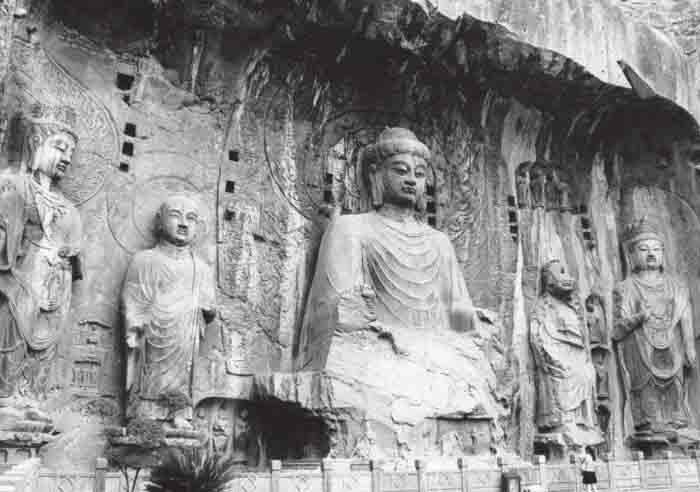
There are as many as 100,000 statues within the 2,345 caves, ranging from an 1 inch (25 mm) to 57 feet (17 m) in height. The area also contains nearly 2,500 stelae and inscriptions, whence the name “Forest of Ancient Stelae”, as well as over sixty Buddhist pagodas. Situated in a scenic natural environment, the caves were dug from a 1 kilometre stretch of cliff running along both banks of the river. 30% date from the Northern Wei Dynasty and 60% from the Tang, caves from other periods accounting for less than 10% of the total. Starting with the Northern Wei Dynasty in 493, patrons and donors included emperors, members of the royal family, other rich families, generals, and religious groups.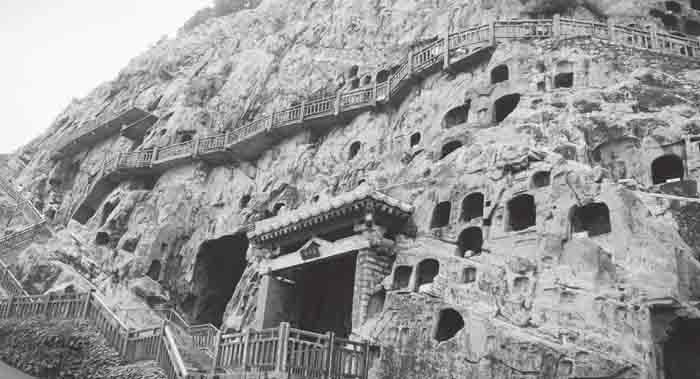
In 2000 the site was inscribed upon the UNESCO World Heritage List as“an outstanding manifestation of human artistic creativity,” for its perfection of an art form, and for its encapsulation of the cultural sophistication of Tang China.
There are several major grottoes with notable displays of Buddhist sculptures and calligraphic inscriptions. Some of the main caves and the year when work began within them include: Guyangdong (493), Binyangdong (505), Lianhuadong (520s), Weizidong (522), Weizidong (520s), Yaofangdong (570), Huijiandong (630s), Fahuadong (650s), Fengxiansi (672), Wanfosi (670-680s), Jinandong (684), Ganjingsi (684), and Leigutaidong (684).The Guyang, Binyang, and Linahua caves are horseshoeshaped.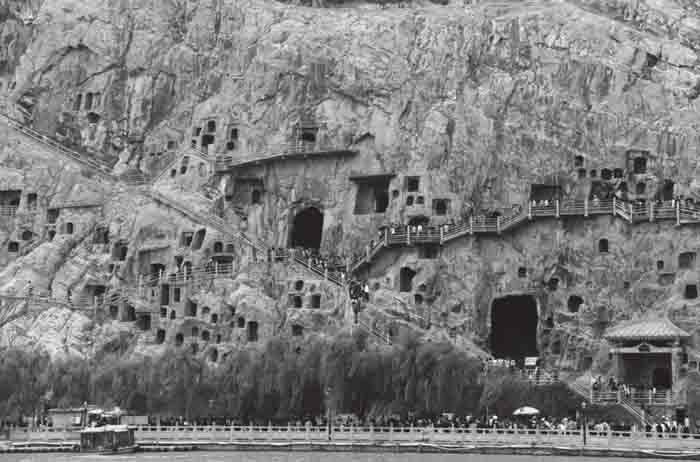
Guyangdongendprint
Guyangdong, or Guyang Cave, or Old Sun Cave, is recorded as the oldest Longmen cave with carvings in the Northern Wei style. It is also the largest cave, located in the central part of the west hill. It was carved under the orders of Emperor Xiaowen. The earliest carving in this limestone cave has been now dated at 478, during the period when Emperor Xiaowen was thought to have been moving his capital from Datong to Luoyang. The Buddhist statues in the niches of this cave are very well sculpted. Also found here are 600 inscriptions in fine calligraphy of writings in the Northern Wei style. Many of the sculptures inside the cave were contributed by royalty, religious groups supported this activity. The cave has three very large images – the central image is of Sakyamuni Buddha with Bodhisattvas on either side. The features of the images are indicative of the Northern Wei style, typically of slim and emaciated figures. There are about 800 inscriptions on the walls and in the niches inside the cave, the most in any cave in China. There are two rows of niches on the northern and southern walls of the cave, which house a very large number of images. The artists recorded their names, the dates, and the reasons for carving them.
Binyangzhongdong
Binyangzhongdong or the Middle Binyang Cave, is carved in the Datang style on the west hill, on the northern floor. It was built by Emperor Xuanwu to commemorate his father Xiaowen, and also his mother. It is said that 800,000 workers created it over the period from 500 to 523. In the main wall of this cave, five very large Buddhist statues were carved all in Northern Wei style. The central statue is of Sakyamuni Buddha with four images of Bodhisattvas flanking it. Two side walls also have Buddha images flanked by Bodhisattva. The Buddhas, arranged in three groups in the cave, are representative of Buddhas of the past, the present, and the future. The canopy in the roof was designed as a lotus flower. There were two large bas-reliefs of imperial processions, that included Emperor Xiaowen, Empress Dowager Wenzhao, and the emperors late parents in worship. The reliefs were stolen completely in the mid-1930s. The emperors procession is now in the Metropolitan Museum of Art in New York and two thirds of the empresss is in the Nelson-Atkins Mu- seum of Art in Kansas City. While a few statues were sculpted with “l(fā)ong features, thin faces, fishtail robes and traces of Greek influence”, others are in Tang period natural style and heavily built.endprint
Fengxiansi
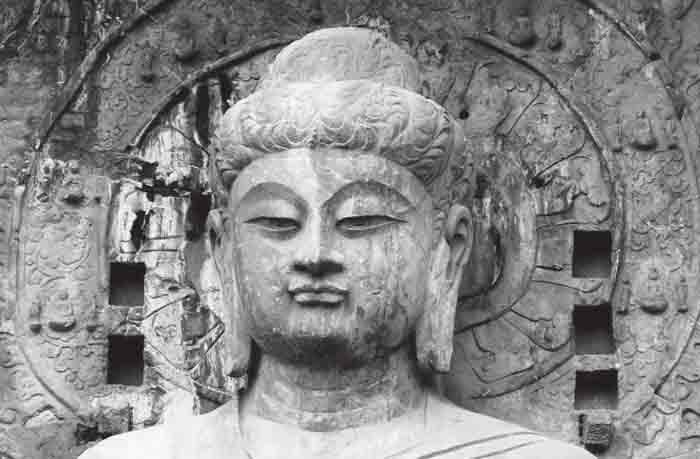
Fengxiansi, or Feng Xian Si, or Li Zhi cave is the Ancestor Worshipping Cave, which is the largest of all caves carved on the west hill built between 672 and 676 for Empress Wu Zetian. The carvings are claimed to be the ultimate in architectural perfection of the Tang dynasty. It has the largest Buddha statue at the Longmen Grottoes. Of the nine huge carved statues, the highly impressive image of Vairocana Buddha was sculpted on the back wall of the Fengxian. The image is 17.14m high and has 2 m long ears. An inscription at the base of this figure gives 676 as the year of carving. The Bodhisattva on the left of the main image of Buddha is decorated with a crown and pearls. Also shown is a divine person trampling an evil spirit. The main Vairocana images features are plumpish and of peaceful and natural expression. Each of the other large statues are carved with expressions match- ing their representative roles. These were carved at the orders of Empress Wu Zetian, and are considered uniquely representative of the Tang dynastys“vigorous, elegant and realistic style.”The huge Vairocana statue is considered as “the quintessence of Buddhist sculpture in China.”
The Vairocana statue also provides at its base the names of the artisans who worked here, the name of the Emperor Gaozong, who was the donor, and also honors Wu Zetian. It is said that Wu Zetian donated “twenty-thousand strings of her rouge and powder money” to complete this edifice. Hence, it is conjectured that the Vairocana Buddha was carved to resemble the Empress herself and termed a “Chinese Mona Lisa, Venus or as the Mother of China”. All the images here, which remain undamaged, project character and animation. Statues of Kasyapa and Ananda, the two principal disciples of Vairocana, and of two Bodhisattvas with crowns flank the main statue, in addition to numerous images of “l(fā)okapalas (guardians or heavenly kings), dvarapalas (temple guards), flying devas and numerous other figures.”endprint