個體化翻譯視角下《道德經》英譯本譯者性別與語言特征研究
2018-01-09 00:19:35王汐
陜西教育·高教版 2017年12期
【摘要】據近年來系統功能語言學的新研究熱點——個體化層級,可從語言使用者層面提供一種新的系統功能視閾下的翻譯研究視角。譯者性別是個體化翻譯的重要因素之一。本文以詞匯密度和語法難度作為判斷譯本特征的指標,從詞匯、句法和語氣三個層面探究譯者性別對《道德經》英譯本語言特征的影響。
【關鍵詞】個體化《道德經》英譯本譯者性別詞匯密度語法難度
基金項目:本研究為陜西省教育廳重點科學研究計劃(哲學社會科學重點研究基地)“系統功能視閾下的個體化翻譯模型——以典籍《道德經》英譯為例”(項目編號:17JZ060)、教育部人文社會科學研究青年基金項目“系統功能視域下典籍復譯的語際再實例化模型研究——以《道德經》英譯為個案”(項目編號:17YJC740088)的階段性成果。
《道德經》作為世界典籍翻譯排行榜上僅次于《圣經》的第二大源語文本,深受西方讀者的關注,現已有超過130個英譯本(辛紅娟,2008),據其譯本時間可劃分為三個翻譯高峰期。20世紀60年代的女權主義運動使得社會性別得到空前關注。《道德經》第三次翻譯高峰(1972—2004年)以第一部女性參與翻譯的、由馮家富和英格里希合譯的《老子〈道德經〉新譯》為開端。此后又出現了女性譯者獨立完成的譯本,如Ellen Marie Chen(1989)、Ursula K. Le Guin(1997)、Lee Sun Chen Org(2000)和ChaoHsiu Chen(2004)等。個體化層級是系統功能語言學的新研究熱點,據此提出了個體化翻譯研究視角,而譯者性別是個體化翻譯的重要因素之一(王汐、楊炳鈞,2015)。本文依據個體化翻譯,以詞匯密度和語法難度作為判斷譯本特征的指標,從詞匯、句法和語氣三個層面考察譯者性別對《道德經》英譯本語言特征的影響,并總結男性譯本和女性譯本所呈現的特征。
譯者性別與語言特征
本研究選取六個《道德經》英譯本:三個女性譯本(Chen,1989;Guin,1997;Chen,2004)和三個男性譯本(He et al.,1985;Mair,1990;Gu,1995),從詞匯、句法和語氣三個層面對比和分析,探究譯者性別對譯本語言特征的影響。
1.詞匯選擇
例(1):故能長生(第七章)
對“長生”的翻譯,女性譯者選擇動詞詞組,如“last long”(Chen,1989),“go on and on”(Guin),“live for ever”(Chen,2004);男性譯者選擇名詞或名詞詞組,如“longevity”(He et al.),“long-lived”(Mair),“eternal life”(Gu)。
例(2):居善地(第八章)
對“居”和“地”的翻譯,女性譯者選取了較為口語化的名詞和動詞,如“dwelling”“land”(Chen,1989),“house”“earth”(Guin),“settle”“ground”(Chen,2004);男性譯者Mair選用較為書面化的詞匯“abode”“location”,He et al.和Gu采取了意譯的翻譯方法,將其譯為“lowness”和“low place...as water”。對“善”的翻譯,女性譯者選擇較為生動的形容詞“good”“quiet”;男性譯者選用較為抽象的名詞“quality”“goodness”。
例(3):其事好還(第三十章)
在翻譯“還”時,女性譯者將其翻譯為較為口語化的詞匯“returning(huan)”(Chen,1989),“backfires”(Guin)和“return”(Chen,2004);男性譯者則選擇更為書面化的“requital”(He et al.)“boomerang”(Mair)和“retaliatory”(Gu)。
例(4):民之饑(第七十五章)
對“饑”的翻譯,女性譯者選取形容詞和動詞,如“starving”和“hungry”;男性譯者選用名詞,如“famine”和“hunger”。
韓禮德(1985)在探討書面語文本和口語文本的復雜性時,提出了“詞匯密度”和“句法難度”兩個概念。詞匯密度是每個小句中實義詞的數量,句法難度指每個小句復合體中小句的數量。口語文本和書面語文本的復雜度所呈現的方式是不同的,前者具有相對較高的句法難度而具有相對較低的詞匯密度,后者恰恰相反,具有相對較高的詞匯密度和相對較低的句法難度。這是因為書面語文本更傾向于名物化,而口語文本在句法上更加的多變。例(1)—例(4)的句法難度均為1,表1顯示了4個例子原文本和各譯本的詞匯密度。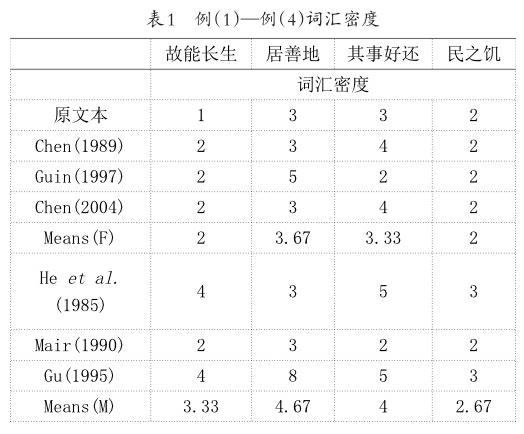
從表1中可看出在句法難度相同的情況下,女性譯本的詞匯密度低于男性譯本。因此,女性譯本更加接近于口語文本,而男性譯本更加接近于書面語文本。具體表現在:(1)女性譯者傾向于使用具體而形象的動詞和形容詞,男性譯者更多使用抽象的名詞;(2)女性譯者傾向于使用口語化詞匯,男性譯者更多使用書面語詞匯。
2.句法選擇
例(5):事善能,動善時。(第八章)
Chen(1989):Projects are carried out by good talents,activities are good in timing.
Guin(1997):The good of work is skill,and of action,timing.
Chen(2004):It adapts to all necessities./It moves at the right moment.endprint
He et al.(1985):He is competent in deeds,/He is timely in action.
Mair(1990):The quality of an enterprise depends on ability,the quality of movement depends on timing.
Gu(1995):He does a thing as properly as water,/He takes action as timely as water.
在翻譯小句復合體時,所有男性譯者都采用了排比句式,如“he is...in...,he is...in...”“the quality of...depends on...,the quality of...depends on...”“he...as...as...,he...as...as...”,以保持形式統一;女性譯者并未使用排比結構,而是選擇更為隨意的句式。
例(6):生之畜之,生而不有,長而不宰。(第十章)
Chen(1989):To give birth yet not to claim possession(yu),/To act(wei)yet not to hold on to,/To grow(chang)yet not to lord over(tsai).
Guin(1997):To bear and not own,/to act and not lay claim,/to lead and not to rule.
Chen(2004):Can one give life and grow life and yet claim no possession?/Can one supervise and benefit others,yet exercise no authority and rely on no pride?
He et al.(1985):To beget all things,but not to take possession of them,/To advance them,/but not to take credit for doing so,/To be leader but not master of them.
Mair(1990):It gives birth to them and nurtures them,/It gives birth to them but does not possess them,/It rears them but does not control them.
Gu(1995):Giving all things life and propagation/Without claiming to be their owner,/Benefiting them without claiming to be their benefactor,And being their head without ruling them.
在翻譯小句復合體時,女性譯者(除了Chen,2004)都使用了較為簡潔的表達,省略參與者(Participant)而只用過程(Process);男性譯者均選擇完整的表達方式,將參與者、過程,甚至環境成分都譯出,如He et al.“To advance(過程)them(參與者), but not to take(過程)credit(參與者)for doing so(環境成分)”。
例(7):知其白,守其黑,為天下式。(第二十八章)
Chen(1989):To know(chih)the white(pe),/But to abide(shou)by the black(heh),/Is to be the model(shih)of the world.
Guin(1997):Knowing light,/and staying dark,/be a pattern to the world.
Chen(2004):Recognize the white - the yang,/guard the black - the yin./Be a model under Heaven.
He et al.(1985):He who knows the white(glory)but keeps to the black(obscure),is ready to be the(divination)instrument of under Heaven.
Mair(1990):Know whiteness,/Maintain blackness,/and be a model for all under heaven.
Gu(1995):Though knowing what is honor,/You are ready to play the role of the disgraced/And content to be a valley in the world.
同樣,女性譯者以相對簡單的句式翻譯小句復合體,均采用“過程+參與者”的結構(如“know the white”“staying dark”)和并列邏輯關系;而男性譯者選用較為復雜的句式,如He et al.使用包含并列小句復合體的內嵌小句,Gu使用并列和從屬兩類邏輯關系的小句復合體。
表2為例(5)—例(7)詞匯密度和語法難度的數據,數據顯示女性譯本的詞匯密度平均值均低于男性譯本,女性譯本的語法難度均等于或高于男性譯本。因此,男性譯本在風格上更接近書面文本,女性譯本更接近口語文本,具體體現在:(1)女性譯者傾向于使用簡單句和并列關系小句復合體,男性譯者傾向于使用復合句,如內嵌句和從屬關系小句復合體;(2)女性譯者傾向于使用更為簡潔的表達,以核心過程進行翻譯,省略不必要的功能成分,男性譯者傾向于使用更為完整的結構,包含參與者和環境成分;(3)女性譯者在句式形式上較為隨意,男性譯者傾向于使用形式上更為一致的排比句式。endprint

3.語氣選擇
例(8):故常無欲,以觀其妙;常有欲,以觀其徼。(第一章)
Chen(1989):Therefore,by the Everlasting(chang)Non-Being(wu),/We desire(yü)to observe(kuan)its hidden mystery(miao);/By the Everlasting(chang)Being(yu),/We desire(yü)to observe the manifestations(chiao).
Guin(1997):So the unwanting soul sees whats hidden,/ and the ever-wanting soul sees only what it wants.
Chen(2004):Observe the mysteries of the Tao without longing./Survey its appearance with desire.
He et al.(1985):Therefore,the subtleties of Tao are always apprehended through their formlessness,/The limits of things are always seen through their form.
Mair(1990):Always be without desire in order to observe its wondrous subtleties;/Always have desire so that you may observe its manifestations.
Gu(1995):Hence one should gain an insight into the beginning of the Tao by constantly observing the Nothingness,And should perceive the end of the Tao by constantly observing the Being.
Chen(1989)譯本采用第一人稱代詞復數“we”,不僅促成譯者的身份定位,還邀請目標語讀者進行相似的自我定位,以結盟讀者;Guin選擇兩個相反的表達“unwanting soul”和“ever-wanting soul”作為主語,清晰而主觀地將人分為兩類,使讀者不由地考慮自己屬于哪一類;Gu選擇“one”和高值情態動詞“should”表達強烈的義務,疏遠了讀者,使讀者產生說教感;Chen(2004)和Mair選擇了祈使句,在語氣上比陳述句更為強烈,另外,Mair選擇“always”在語氣上比Chen(2004)強烈;He et al.選擇被動語態,更為客觀。
例(9):信不足焉,有不信焉。(第十七章)
Chen(1989):When you dont trust(hsin)[the people] enough,/Then they are untrustworthy(puhsin).
Guin(1997):To give no trust is to get no trust.
Chen(2004):If they do not rule the country with faith,the people will not respond to them with trust.
He et al.(1985):Only when one is not faithworthy,will faithless events take place!
Mair(1990):When the rulers trust is wanting,there will be no trust in him.
Gu(1995):The lack of faith on the part of the ruler,Leads to the lack of confidence in him on the part of the people.
Chen(1989)選擇第二人稱“you”,語氣更加柔和,譯者嘗試與目標語讀者進行對話,拉近了譯者與讀者之間的距離,從而結盟讀者;Guin在兩個內嵌小句中選擇使用非限定小句“to give no trust”和“to get no trust”,省略語氣系統中的主語(Subject)和定式成分(Finite),省略及物系統中的施事(Agent),使得指代模糊化,納入了讀者;He et al.用不定代詞“one”作泛指,同樣納入了讀者;Mair和Gu使用第三人稱“the ruler”,作為旁觀者,更加客觀。
從例(10)可看出Chen(2004)譯本在語氣上更接近男性譯本,更為強烈和客觀。這可能是因為她本身性格更偏向男性,也可能是她為了在性別不平等社會中更容易發表自己的作品而作出的妥協。
例(10):奈何萬乘之主,而以身輕天下?(第二十六章)
Chen(1989):How could the Lord of ten thousand chariots,/Conduct himself lightly in the world?
Guin(1997):How can a lord of ten thousand chariots let his own person weigh less in the balance than his land?endprint
Chen(2004):Unfortunately the great ruler of ten thousand chariots governs the country indiscreetly.
He et al.(1985):How is it that a lord of ten thousand chariots belittles his own importance under Heaven?
Mair(1990):How then should a king with ten thousand chariots conduct himself lightly before all under heaven?
Gu(1995):Why should a ruler of ten thousand chariots/ Take reckless action to govern the empire.
原文在語氣上是特殊疑問句,Chen(2004)將其譯為陳述句,在語氣上比原文弱。從情態動詞上看,語氣強弱順序為“could(Chen,1989) 男女譯者在語氣選擇上的區別在于:(1)男性傾向于使用更為強烈的語氣,從一定程度上無意識地疏遠了讀者,女性譯者語氣更為溫和,更好地結盟讀者;(2)男性譯者在主語和情態操作語的使用上更為客觀,而女性則更為主觀。 結語 譯者性別作為個體化翻譯中一個重要因素,在《道德經》英譯中體現在詞匯、句法和語氣的選擇上。詞匯選擇方面,女性譯者傾向于使用具體的動詞、形容詞和較為口語化的詞匯,男性譯者傾向于使用抽象的名詞和較為書面化的詞匯;句法選擇方面,女性譯者傾向于使用簡單句、省略結構和較為隨意的句式,男性譯者傾向于使用復合句、完整結構以及排比句式;語氣選擇方面,女性譯者更為柔和和主觀,男性譯者更為強烈和客觀。 參考文獻: [1]Chen,C.H.,Tao te ching cards:Lao Tzus classic Taoist text in 81 cards(New York:Marlowe,2004). [2]Chen,E.M.,The Tao Te Ching(New York:Paragon House,1989). [3]Gu,Z.K.,Lao Zi,The Book of Tao and Teh(Beijing:Peking University Press,1995). [4]Guin,U.K.L.,Lao Tzu Tao Te Ching(Boston & London:Shambhala,1997). [5]He,G.H.et al.,The Book of Lao Zi(Beijing:Foreign Languages Press,1993). [6]Mair,V.H.,Tao Te Ching(New York:Bantam Books,1990). [7]Halliday,M.A.K.,Spoken and Written Language(Victoria,Australia:Deakin University,1985). [8]王汐、楊炳鈞:《系統功能視閾下的個體化翻譯——以〈道德經〉英譯為例》,《翻譯季刊》2015年第77期,第26-48頁。 [9]辛紅娟、高圣兵:《追尋老子的蹤跡——〈道德經〉英語譯本的歷時描述》,《南京農業大學學報》(社會科學版)2008年第1期,第79-84頁。 [10]辛紅娟:《〈道德經〉英譯文本的另類闡釋》,《中國外語》2011年第2期,第93-97頁。 作者單位:西安外國語大學外國語言學及應用語言學研究中心/英文學院陜西西安
猜你喜歡
中華詩詞(2021年3期)2021-12-31 08:07:22
大連民族大學學報(2021年2期)2021-07-16 05:41:42
中華胰腺病雜志(2021年1期)2021-02-26 11:28:36
山東醫藥(2020年34期)2020-12-09 01:22:24
中華胰腺病雜志(2019年4期)2019-08-29 08:52:20
中華詩詞(2018年3期)2018-08-01 06:40:40
中華詩詞(2018年11期)2018-03-26 06:41:32
山東醫藥(2017年35期)2017-10-10 02:45:28
國際漢語學報(2016年2期)2016-05-17 04:04:08
當代修辭學(2014年3期)2014-01-21 02:30:46