
探
2018-01-22 10:22:20
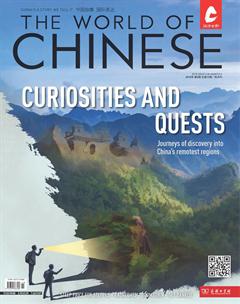
漢語世界(The World of Chinese) 2018年6期
關鍵詞:探究
A character that probes the unfamiliar and questions
the unknown
探:搭建未知與已知的橋梁
When famous Three Kingdoms-era general Lü Meng (呂蒙) was just 15, he ran away from home and secretly joined the Wu states military campaign against mountain bandits. Returning home afterwards, Lü ?pointed out to his furious mother that his life-threatening adventure had granted him fame and fortune, asking “不探虎穴,安得虎子?” (“How can one catch tiger cubs without venturing into the tigers lair?”)—that is to say, “nothing ventured, nothing gained.”
From a personal adventure to a national expedition to outer space or the deep sea, 探?(t3n) is the word for the exploration of any unfamiliar or little-known field. In picto-phonetics, the left “hand” radical represents its meaning, and the right,  ?originally gave the character its pronunciation, although this changed over time.
According to the Han dynasty dictionary Explaining and Analyzing Characters?(《說文解字》), 探?refers to extending ones hand to reach for something. For example, “探囊取物” (t3nn1ng q^w&) means to take something from ones pocket. The expression later became a proverb to indicate an easy task, since it takes no effort to reach into ones own pocket.
Other things are better hidden, and may take more time and energy to find. For example, 探礦?(t3nku3ng) means to prospect for minerals; 探案?(t3n3n), to investigate and find out the truth in a criminal case; 探秘?(t3nm#), to probe into secrets or explore unexplained phenomena; and 探險?(t3nxi2n), to venture into the unknown. In particular, the last two are commonly undertaken in remote and inaccessible locations, as in 深山探秘?(sh8nsh`n t3nm#, exploring remote mountains), or 南極探險?(N1nj! t3nxi2n, exploring the South Pole).
探?can also be paired with other verbs to describe different types of exploration. For example, 探索?(t3nsu6) means to explore and seek, and is often used in scientific contexts, as in 人類不斷地探索自然界的奧秘。?(R9nl-i b%du3n de t3nsu6 z#r1nji- de 3om#. “Humans are continually exploring the secrets of nature.”) 探究?(t3nji$) means to probe deeply and reflect. For example: 這本書探究的是人生的意義。?(Zh- b0n sh$ t3nji$ de sh# r9nsh8ng de y#y#. “This book probes the meaning of life.”) However, its usually important to look at multiple perspectives and solutions in an exploration; therefore, 探討?(t3nt2o) means to examine and discuss a topic. For example:
最近經濟學家在對經濟體制改革做進一步的探討。(Zu#j#n j~ngj#xu9ji` z3i du# j~ngj# t@zh# g2ig9 zu7 j#n y! b& de t3nt2o. “Recently, economists are further examining the question of structural reform.”)
Apart from reaching with ones hand, 探?also implies putting the rest of ones body forward. The common usages include 探頭?(t3nt5u, pop ones head in), as well as 探頭探腦?(t3nt5u t3nn2o, pop ones head in and look about furtively); the latter is often used pejoratively to mean “snooping.” For example: 小偷兒進了大樓后探頭探腦地四處張望。?(Xi2ot4ur j#n le d3l5u h7u t3nt5u t3nn2o de s#ch& zh`ngw3ng. “The thief looked around furtively after breaking into the building.”)
In this sense, some 探?expressions can be extended to mean visit, call on, or see. 探望?(t3nw3ng) is to visit someone from afar. For example: 路過北京,順道探望一下老朋友。?(L&guo B0ij~ng, sh&nd3o t3nw3ng y! xi3 l2op9ngy6u. “While traveling through Beijing, I dropped by to visit an old friend.”) Similarly, 探病?(t3nb#ng) means to visit patients at the hospital or in their homes; 探親?(t3nq~n) is to visit ones parents or relatives; and 探監?(t3nji`n) is to visit inmates in prison.
Not all explorations are carried out in the open: 探聽?(t3nt~ng, inquire about) usually means to find out information covertly, as in 已經有好幾個人來探聽新所長任命的消息了。?(Y@j~ng y6u h2o j@g- r9n l1i t3nt~ng x~n su6zh2ng r-nm#ng de xi`oxi le. “Several people have nosed around for news about the appointment of a new director.”) The verb 刺探?(c#t3n, spy on) particularly refers to scoping out a rival, or opposition research. For example, 敵軍在刺探我方軍事設施。?(D!j$n z3i c#t3n w6f`ng j$nsh# sh-sh~. “The enemy is spying on our military installation.”) The character can also be used in nouns referring to the person sent out to collect the information, such as 偵探?(zh8nt3n, detective), 探子?(t3nzi, scout), or 密探?(m#t3n, spy).
Throughout history, human beings have continually explored the outer limits and unknown spheres of nature and society, from the medical tests of Shennong (神農, a legendary prehistoric ruler of China, sometimes known as the father of Chinese medicine and agriculture), to the modern search for the “wild man” of Shennongjia Forest. As long as human beings have curiosity, ambition, and a need to survive in the universe, the urge for exploration will doubtlessly persist.
- Huang Weijia (黃偉嘉) and TAN YUNFEI (譚云飛)
猜你喜歡
中國交通信息化(2023年11期)2023-12-26 07:43:50
中學生數理化·高三版(2023年1期)2023-09-04 09:24:31
中學生數理化·七年級數學人教版(2022年5期)2022-06-05 07:51:48
中等數學(2021年11期)2021-02-12 05:11:46
今日農業(2019年14期)2019-09-18 01:21:42
快樂語文(2018年13期)2018-06-11 01:18:16
中等數學(2018年11期)2018-02-16 07:47:42
中學生數理化·高一版(2017年5期)2017-06-07 07:09:32
中學數學雜志(初中版)(2016年4期)2016-10-08 09:21:22
中國商論(2016年33期)2016-03-01 01:59:34
 漢語世界(The World of Chinese)2018年6期
- 漢語世界(The World of Chinese)的其它文章
- Performance Anxiety
- To Be Continued
- Rice Crispy
- Tracing the Tangut
- Spiterary Ambitions
- Seeing Red