
China’s Bike-sharing Industry has turned into a Bubble
2018-01-25 17:19:21
中國經貿聚焦·英文版 2018年1期
Hit a Roadblock
Chinas bikesharing craze kicked off in late 2016 and, since the beginning of that year, companies and investors have been pouring cash into the flourishing market.
Last year expert said the bike-sharing industry in China has close to 60 startups, and fewer than 10 will survive in 2018.
By using a smart phone, customers can unlock a bicycle, ride it around town, and then leave it at their destination. It works, but the industry has grown too big to control.
The proof is scattered across Chinas urban sidewalks, where piles of underused bikes have been dumped. Complaints have even prompted authorities to limit the number of bikes in some cities.
Its difficult to track the scale of the damage, because many of the startups close their doors quietly and without much warning.
Several bike-sharing companies have already gone out of business. Others have been forced to merge as funding becomes scarce.
Bluegogo, which claimed at its peak to have 20 million users and over 600,000 bikes, cited a lack of funding as one of the main reasons it handed over operations to a rival firm in last November.
“Since the very first day, we have been on the ice,” CEO Li Gang wrote in an open letter. “I went to hundreds of funds, received numerous praise ... but none of it was translated into money.”
Bike-sharing Graveyards
Chinas bike-sharing market was rattled by lack of funding, government crackdowns, or stiff competition. The industry has also copped criticism for dumping bikes, as piles of broken, disused bikes pile up in suburbs, creating bike-sharing graveyards.
Last March, a 11-year-old child in Shanghai was run over by a bus while riding an Ofo after cracking the bikes lock. The incident sparks public outrage, with netizens urging the government and shared-bike companies to impose better regulations and upgrade their technology.
Last June, the cutthroat bike-sharing market witnesses its first casualty as Chongqing-based Wukong Bike is squeezed out of the market after only six months in business.
Beijing-headquartered 3Vbike ceases operation after nearly 99 percent of the companys bikes are stolen.
Last Auguest, the founder of Nanjing-based Dingding Bike is arrested and investigated by local police for illegal financing and fraud.
Last October, Beijing-based Deerbike — a shared electric bike provider— is suspended by the local government for safety issues.endprint
Last November, after Beijing-based Bluegogo declares bankruptcy, consumers struggle to retrieve their 199-yuan deposits. To make matters worse, the companys CEO disappears.
Another struggling shared-bike company, CoolQi, makes its users travel to Beijing if they want to recover their deposits.
Last December, Guangzhouheadquartered Xiaoming Bike becomes the first among its peers to be taken to court over unreturned deposits. The case is rejected by the local public prosecutor, but the company is now facing legal action over user deposits in Beijing.
Customers are Leaving
As companies fold, some customers have reported trouble getting their rental deposits back. Shuting Wang, a 25-year-old management consultant in Beijing, says she lost approximately 200 yuan ($30) to Bluegogo.
After trying and failing to retrieve her money, Wang said, she became wary of leaving deposits with bike-sharing firms.
“Its too risky,” she said. “Some people take the bikes home and sell it online because they cant get their deposit back.”
Bluegogo did not respond to multiple requests for comment.
Chinas Ministry of Transport announced last November that it would clamp down on the sector to “protect customers interests and put the industry in a healthy and orderly track.”
Angela Cai, the communications chief at major industry player Ofo, said that more regulation could help quell an“industry bubble.”
She added that some companies“will be squashed out.”
In last March, China has produced a draft guideline to regulate the industry.
Led by bicycle associations in Shanghai and Tianjin, the draft solicits advice from Chinas major bicycle manufacturers and bike-sharing companies such as Mobike and ofo.
It comprises standards on the pro- duction, operation and maintenance of shared bikes, which has witnessed a soaring number of complaints. Random parking, high malfunction rate - though often caused by vandals, are at the top of the list.
In response, the draft demands companies hire one member of maintenance personnel for every 200 bikes.
More than three million shared bikes are on the streets of Chinese cities, which means at least 15,000 staff should be hired to support the industry.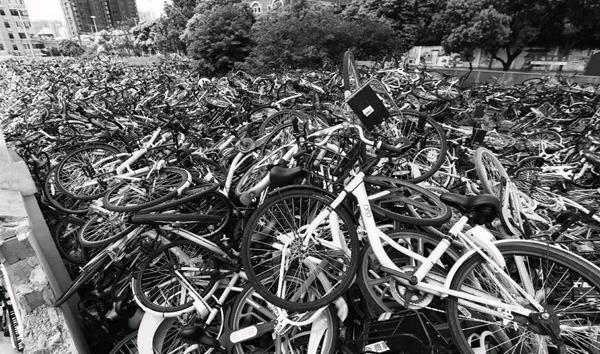
The draft also specified a service life of three years for all such bikes and requested companies provide bike-sharing services open a 24-hour hotline to handle customer complaints.endprint
Two firms have a major advantage over the rest.
At the start of year 2016, a number of companies were vying for a slice of the bike-sharing pie, but now two major players have risen above the others to dominate the market and the sidewalk: orange-colored Mobikes and yellow Ofos.
Mobike is backed by tech giant Tencent, and Ofo has e-commerce heavyweight Alibaba in its corner.
Both Ofo and Mobike reported 3 million bikes ridden each day in the second quarter of 2017 — significantly more than their competitors, which each had no more than 1 million daily users, according to internet consultancy iResearch.
They control a combined 90% of the market, according to expert. Both are valued at more than $1 billion, giv- ing them war chests that smaller firms just dont have.
The financing power of the other players is not strong enough.
Ofo and Mobike say that their goal is not profitability, but greater scale and branding. And while cash-strapped startups struggle to survive, they are worried about keeping up with expansion.
Ofo recently hit its goal of reaching 20 countries and 200 Chinese cities.
Mobike said the companys emphasis on cost management had allowed it to thrive “while other players struggle.”Mobike launched in 150 cities and a dozen countries in 2017.
Reports of a potential merger between the industry leaders have circulated for months. Expert says is “highly possible” at some point. Mobike said it has “no plans” to merge, while Ofo declined to comment.
Smaller players are now trying to pivot to what they say are more sustainable business models.
Hellobike has made a recent push into shared electric mopeds -- 60,000 of which have been deployed so far -- as a way to reduce its reliance on bicycles.
Hellobike and Mobike are also considering moving into car-sharing, while Ofo says it might not even be a bikesharing company by 2020.endprint
