
A LM-2D Launches GF-6 Satellite
2018-02-20 05:39:06WANGXu
Aerospace China 2018年2期
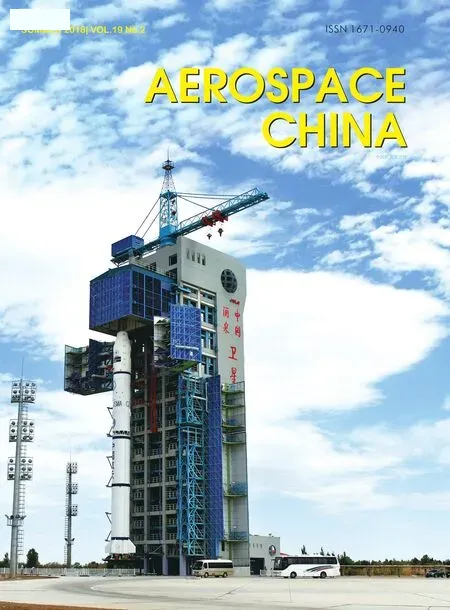
A LM-2D launch vehicle lifted off from the Jiuquan Satellite Launch Center at 12:13 Beijing time on June 2, launching the GF-6 satellite as well as the Luojia-1 scientific experiment satellite into their preset orbits.
The GF-6 satellite was developed by the China Spacesat Co, Ltd., under the China Academy of Space Technology(CAST). It is a part of China’s high-resolution Earth observation project and will be used in many fields such as agriculture and rural monitoring, natural resources,emergency management and ecological environment monitoring for the Ministry of Agriculture and Rural Affairs once it is networking with the GF-1 satellite in orbit.

A LM-2D launch vehicle lifted off from the JSLC with two satellites
Equipped with a multi-spectral widewidth camera and a multi-spectral highresolution camera, GF-6 has achieved a technological level with super large field of view imaging in a single projection center, strengthened the ability of high aging imaging, imaging on abroad scope and for multi-target imaging. In addition it has improved the accuracy with a large field view camera and realized an international lead in the integrated technical index applied in the space optics field based on off-axis four-mirror and freeform surface.
Technical indexes such as those for detection spectrum, image quantization bits and scroll angle have reached a leading level in China and within the world.The real-time visual telemetry of the satellite can transform satellite telemetry from digital interpretation to image recognition.The satellite conducts accurate ground remote sensing through the guarantee of image geometric quality, radiation quality and spectral quality, reducing the dependence on the ground through technical methods such as autonomous health management, visual monitoring, software definition functions, unsupported lunar imaging and calibration.
GF-6 will be applied in many industries with a large coverage of the Earth.It is China’s first small satellite with a design life of 8 years, adopting a reliability growth design for the whole satellite system and realizing the indigenous supply of core devices and single machine products.
The LM-2D launch vehicle was developed by the Shanghai Academy of Spaceflight Technology (SAST), applying a combined guidance mode using “perturbation in the second stage of the main engine + iteration in the venier stage”for the first time.
The launch vehicle team completed the launch preparation in 15-days for the first time and minimal work force at the launch site. The team has also formulated a LM-2D Launch Site Process Manual, promoting the accurate quality management of CASC.
This was the 276th flight of LM family.
- Aerospace China的其它文章
- 2017 LM-5 Launch Failure Investigation Finished
- China Launches the 32nd Satellite of the BeiDou Navigation System
- China-Egypt Cooperation for Egyptian Space City Project Formally Initiated
- China and Saudi Arabia Jointly Unveil Lunar Images
- International Cooperation on the Chinese Space Station Officially Initiated
- Promoting Space Internationalization Development Based on QIAN Xuesen Think Tank