
A Fragmentation Mechanism of Homemade Explosive TMDD Using DART-MS and Isotopic Labeling
2018-04-19 02:42:43AlexanderPedrozaZarateFredyColpasCastilloDanielAlcazarFrancoWilmanCabreraLafaurieEduardoEspinosaFuentes
火炸藥學報 2018年1期
Alexander Pedroza Zarate, Fredy Colpas-Castillo, Daniel J.Alcazar Franco, Wilman A. Cabrera-Lafaurie,Eduardo A. Espinosa-Fuentes
(1. Department of Chemistry, Universidad de Cartagena; Facultad de Ciencias Exactas, Cartagena, Colombia;2.Department of Natural and Exact Science, Corporación Universidad de la Costa (CUC) Barranquilla, Colombia;3. Department of Civil and Environmental Sciences, Corporación Universidad de la Costa (CUC), Barranquilla, Colombia)
Introduction
Tetramethylene diperoxide dicarbamide (TMDD) is a cyclic organic peroxide compound of fourteen atoms, whose scientific name is 1, 2, 8, 9-tetraoxa-4, 6, 11, 13-tetraazacyclotetradecane- 5, 12-dione. TMDD is also known as a homemade explosive because its precursors are household or consumer products. TMDD was first prepared by Von Girsewald and Siegens in 1914, from urea, formaldehyde, and hydrogen peroxide precursors (see Figure. 1)[1]. Despite having been synthesized from long ago, there are limited spectroscopic and physical data available in order to compare the veracity of our results; further that, its solubility in many organic solvents is minimal, being soluble only in sulfuric acid, which limits the methods that can be used for characterization, including LC-MS and GC-MS[1]. Direct Analysis in Real Time (DART) is a novel method of atmospheric-pressure sample ionization mass spectrometry that offers a non-solvent based ionization[2-4]. Metastable helium or nitrogen atoms are used to generate ions stabilized by water clusters that produce the reactions that ionize molecules before entering the mass spectrometer orifice[5-6]. Interfacing this ionization technique with a high resolution time-of-flight (TOF) MS produces accurate mass information that can be used to identify organic compounds while separating them from possible interferences. This combination of DART-TOF permits the immediate detection of organic compounds with little or no sample preparation[7-9]. The present research deals with the fragmentation mechanism and characterization of the TMDD using DART-TOF-MS and isotopic labeling.
1 Experimental section
1.1 Reagents
The chemical reagents used in this research were: urea, urea-15N2, urea-13C (purity of 98% ), formaldehyde (CH2O) at 37% and hydrogen peroxide (H2O2) at 50%. All of these reagents were purchased from Aldrich-Sigma Chemical Co. Sulfuric acid (H2SO4, conc.) was obtained from Fisher Scientific International.
1.2 Synthesis
TMDD, TMDD-13C2and TMDD-15N4isotopomers were synthesized using an improved synthesis of the initially proposed by Von Girsewald and Siegens (see Scheme 1)[1].
In detail, the precursors were mixed according to the connectivity order in the overall structure of the compound, specifically, carbonyl and amine groups came from urea structure, the methylene and peroxyl tails from formaldehyde and hydrogen peroxide reagents, respectively. In this sense, it was dissolved urea in formaldehyde solution in stoichiometric amounts, and then catalytic amounts of sulfuric acid were added. The resultant reaction mixture was stirred for one hour, and finally the hydrogen peroxide was added dropwise. The reaction was accomplished in a refrigerator for 3 to 5 days at 0℃. The white precipitate was filtered and washed with water and acetone to remove the organic impurities. The solid samples had a powder-like consistency. Similarly, the TMDD-15N4and TMDD-13C2isotopomers were synthesized from urea-15N2and urea-13C , respectively.
1.3 DART-MS setup
The direct probe MS analysis was performed on a JEOL GC-Mate II. A JEOL AccuTOF DARTTMwas used to characterize the sample under ambient conditions. The DART chemical ionization region used a helium flow rate set at 2L/min, a needle voltage of 3500VDC, an electrode 1 setting of 150VDC and an electrode 2 setting of 250VDC. As a starting point, unlabeled TMDD was used to optimize the DART temperature and ionization conditions. The DART gas temperature was tested at 250, 350, 450 and 500℃. The 450 and 500℃ temperatures showed the best results for producing an [M+H]+signal. Next, the sample was tested with the DART gas dopant NH4OH at both 450 and 500℃.
For both temperatures, the overall [M+H]+signal improved when ammonium was added, with only a slightly better signal for the 500℃ experiment. In addition, the [M+NH4]+was also observed, which offered additional confirmation of the observed analyte. As a result of these experiments, all samples were analyzed at 500℃ using NH4OH as a DART gas dopant.
2 Results and discussion
TMDD is a homemade explosive relatively stable to impact and heat, but it has an extremely low vapor pressure. The latter property is a problem for the analysis of this compound by vaporization methods such as GC-MS. In addition, it has a low solubility in many organic solvents, which limits it to be analyzed by separation techniques such as LC-MS and HPLC-MS. The fact that TMDD is soluble in sulfuric acid is not a useful option for wet chemistry-analysis, since most chromatographic and MS equipment can be severely damaged by contact with strong inorganic acids. Fortunately, open air ionization techniques like DART-MS offer an option for mass spectrometry analysis for these compounds, given that, it does not require high volatility of the samples or solubility in a some specific solvent. Fig.1 of the supplemental section shows a typical DART-mass spectrum of TMDD exhibiting a large number of fragment peaks and the molecular adduct ions: [TMDD+H]+and [TMDD+NH4]+confirming the identity of the analyzed samples. The large numbers of peaks indicate that this compound is more unstable than other organic peroxides such as HMTD which showed very little fragmentation by DART-MS analysis[10]. On the other hand, the DART-MS spectra of the isotopomers successfully corroborated the respective molecular adducts; specifically, the [TMDD-15N4+NH4]+and [TMDD-13C2+NH4]+molecular ion adducts shifted an additional of four and two mass-units than the unlabeled adducts peak respectively. The principal fragmentation residues also showed coherence according to the number of isotopically labeled atoms on the TMDD structure. The principal mass-shifts found are summarized in Table 1.
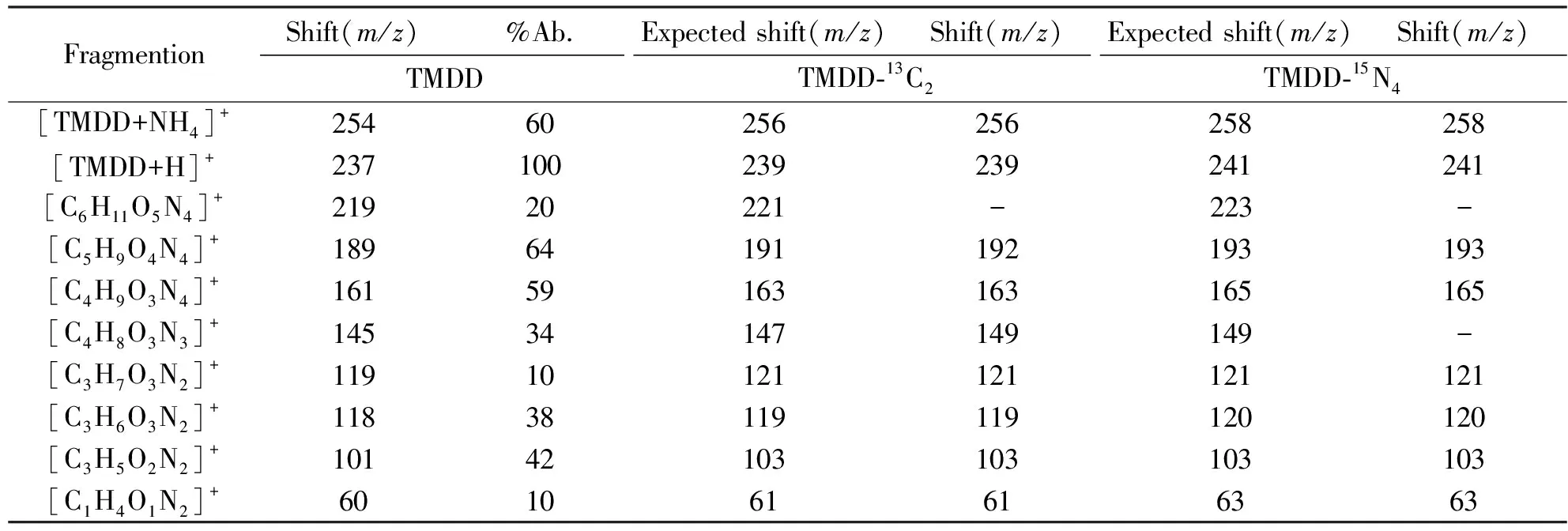
Table 1 Fragments list of the [TMDD-15N4·NH4]+, [TMDD-13C2·NH4]+ and [TMDD-NH4]+ adducts
Note:“-”Values not found.
In order to explain the fragmentation pattern of the present homemade explosive, the principal molecular adducts, possible residual tails and possible reaction with ammonium and proton ions were optimized and modeled at semiempirical and Hartree-Fock level of theory. In general, the theoretical results showed that the DART-MS fragmentation pattern of the [TMDD+NH4]+adduct is strongly dependent of: (1) the interaction of the amine, methylene and atmospheric proton atoms with the different electrophilic atoms of the molecular ring (N and O atoms); (2) the TMDD ring flexibility and multiple ring configurations that this molecule can adopt. The Figure 2 shows the optimized structure of lower energy and higher symmetry forming several intramolecular hydrogen bondings that may cause the fragmentation of the TMDD-ring and formation of the tails atm/z118 and 119 when a minimal amount of energy is provided. The atomic movements proposed and hydrogen bondings can vary depending of the ring conformation; by giving rise to the other fragments.
Figure 3 shows several conformations of the [TMDD+NH4]+adduct, exhibiting the flexibility TMDD ring and the possible hydrogen bonding that can form with the ammonium molecule. Some fragmentation tails were modeled considering the possible transition states and intrinsic reaction coordinates (IRC) calculation at Hartree-Fock level of theory in order to corroborate the decomposition mechanism. The energy diagrams of the most important peaks were modeled corroborating experimental results (See Figures 4(a)-4(c). The [TMDD+NH4]+adduct atm/z254 is formed by the interaction between the ammonium hydrogen atoms with different ring electrophilic atoms forming multiple hydrogen bonding (see Figure 3); among all possible interactions, the stronger one is formed when the ammonium hydrogen atoms interact with the carbonyl oxygen atom leading to the formation of the molecular fragment atm/z237 (See energy diagram Figure 4(a)), which is the base peak of the mass spectrum. On the other hand, the DART ionization commonly produces protonated molecular ion [M+H]+as result of proton transfer from the atmospheric molecules[6].
In summary, the fragmentation tails formation and molecular rearrangements are promoted by hydrogen bonding and molecular collisions with the ionizing gas. The principal fragments formation mechanism are classified in three main groups: (1) by breaking of O-O bond, (2) by C-O and (3) one latter by C-N bond breaking. The most probable fragmentation mechanisms are schematized in the Figures 5(a)-5(b). Specifically, the fragment ion atm/z219 is formed by water loss of the fragment atm/z237; in this step, the proposed atomic movements are as follow: first, a proton source (ammonium protons or atmospheric molecules) interacts with the previously protonated oxygen atom of the carbonyl tail (~C=O…H)+releasing a water molecule, this process is promoted by the lone electronic pair of the adjacent
nitrogen atom, while compensating the electron-deficient of the carbonyl carbon atom. The fragment ion atm/z189 is formed by acylium ion loss (H-C≡O+) from the fragment atm/z219, which is a characteristic residual loss of the fragmentation of carbonyl structures[11].
Figure 5(a) shows the sequence of atomic movements for this process. The fragment ion atm/z161 is formed from the fragment atm/z189 by loss of an acylium ion moiety, following the same decomposition pattern of the fragment atm/z219; In this mechanism, an internal or external proton atom interacts with a nitrogen atom by causing a C-N bond rupture and then a molecular rearrangement according to electron densities requirements. The formation of the fragments ions atm/z118 and 119 occurs through a breaking of O-O bond promoted by the either external or internal proton atoms, by forming bifunctional structures containing hydroxyl and carbonyl groups or two carbonyl tails (See Figures 4(b) and 5(b)). Figures 4(c) and 5(b) show the O-O bond rupture process catalyzed by ammonium protons and intramolecular hydrogen atoms. The fragment ion atm/z101 can be explained from two pathways; first, by water loss of the fragment atm/z119; and second, from O-O bond breaking of the fragment atm/z219 following a decomposition pattern similar to the peak atm/z237 above explained (See Fig. 5(c)). The fragment ion atm/z60 corresponds to a residue similar to the protonated urea, which can be formed from symmetrical rupture of the C-N bonds catalyzed by external protons or from the residue at 119m/zas schematized in Figure 5(a). The fragment ions atm/z130, 173 and 203 are formed by loss of an oxygen atom from the peaks atm/z146, 189 and 219 respectively, which can be explained by the water loss after two successive protonations on the same oxygen atom of the precursor ion.
The DART-MS spectra of TMDD isotopomers corroborated the vast majority of the fragments proposed in this manuscript. Some peaks showed one m/z-unit above or below of the expected value, specifically, the [C5H9O4N4-13C2]+residue of the TMDD-13C2DART spectrum showed a shift atm/z192 rather than 191 with respect to the number of isotopically labeled carbon; this may be because the implied structures are constitutionally different by a hydrogen atom or the presence of natural isotopes. In general, the principal fragments ions of the DART mass spectrum could be assigned using theoretical modeling and the DART-MS spectra of the TMDD-15N4and TMDD-13C2isotopomers. The statements propose here for the fragmentation mechanism of the TMDD compound is one of the many others possible.
3 Conclusions
(1)Each peak of the DART-mass spectrum was successfully related to a structural residue of the TMDD molecule. The global fragmentation process was explained by taking into account hydrogen movements and heterolytic breaking of the C-N, C-O and O-O bonds. The DART-MS spectra of TMDD isotopomer helped to corroborate the vast majority of the fragments proposed here.
(2)Some peaks showed onem/zshift above or below the expected value because the implied structures may be constitutionally different by a hydrogen atom or the presence of natural isotopes.
[1]C. Von Girsewald and H. Siegens. Beitr?ge zur Kenntnis des Wasserstoffperoxyds. II. Tetramethylendiperoxyd-dicarbamid[J].ChemBer 1914,47: 2464-2469.
[3]Cody R B, Laramée J A, Durst H D. Direct analysis in real Time (DART) mass spectrometry [J]. JEOL News, 2005,40(1): 8-12.
[4]Cody RB, Laramée J A. Laramee,Durst H D. Versatile for analysis materialsin airunderambient open conditions [J]. Analytical Chemistry, 2005, 77: 2297-2302.
[5]David E C, Damon W P. New heterocycles from tetrazines and oxadiazoles[J]. Journal of Heterocyclic Chemistry, 2009, 46: 88-90.
[6]Hiskey M A, Chavez D E, Naud D L. Propellant containing 3,6-bis(1H-1,2,3,4-tetrazol-5-yl-amino)-1,2,4,5-tetrazine orsalts thereof:US, 6458227[P]. 2002.
[7]Hervé G. Derivatives of 1,1-diamino-2,2-dinitroethene(DADNE) and specific reactivity understanding [J]. Propellants, Explosives, Pyrotechnics, 2009, 34: 444-451.
[8]Shawali A S and Tawfik N M. Novel facile synthesis of imidazo[1,2-b]-[1,2,4,5]tetrazines with potential antimicrobial activity[J]. Arch Pharm Res, 2009, 32(7): 975-982.
[9]Gong Y H, Miomandre F, Meallet-Renault R , et al. Synthesis and physical chemistry of s-tetrazines: Which ones are fluorescent and why?[J]. European Journal of Organic Chemistry, 2009, 35: 6121-6128.
[10] Steinhauser G, Klap?tke T M. Using the chemistry of fireworks to engage students in learning basic chemical principles: a lesson in eco-friendly pyrotechnics[J]. Journal of Chemical Education, 2010, 87(2): 150-156.
[11] Pavia D L, Lampman G M, Kriz G S,et al. Introduction to Spectroscopy [M].Singapore:Cengage Learning,1995: 350.
