
Chinese Longest Sea-crossing Metro Tunnel:Wuyuan Bay Station-Liuwudian Station Section of Xiamen Metro Line #3
2018-04-19 06:49:54HEWeiguoSONGChaoyeDUBaoyi
隧道建設(中英文) 2018年3期
HE Weiguo, SONG Chaoye, DU Baoyi
(China Railway Tunnel Survey and Design Institute Co., Ltd., Tianjin 300133, China)
1 Project significance
Xiamen metro Line #3 runs from Xiamen Railway Station to Xiang′an Airport. It is the southwest-northeast trunk line that connects the main island and the subcentre in the eastern regions (Xiang′an District). The Wuliu Section (the sea-crossing section from Wuyuan Bay Station to Liuwudian Station) is the main engineering feat of the metro line due to its high construction difficulty and tight schedule. As one of the earliest sea-crossing metro tunnels constructed in China, this project represents significant engineering achievements and innovations. The plane view of Wuliu Section is shown in Fig. 1.
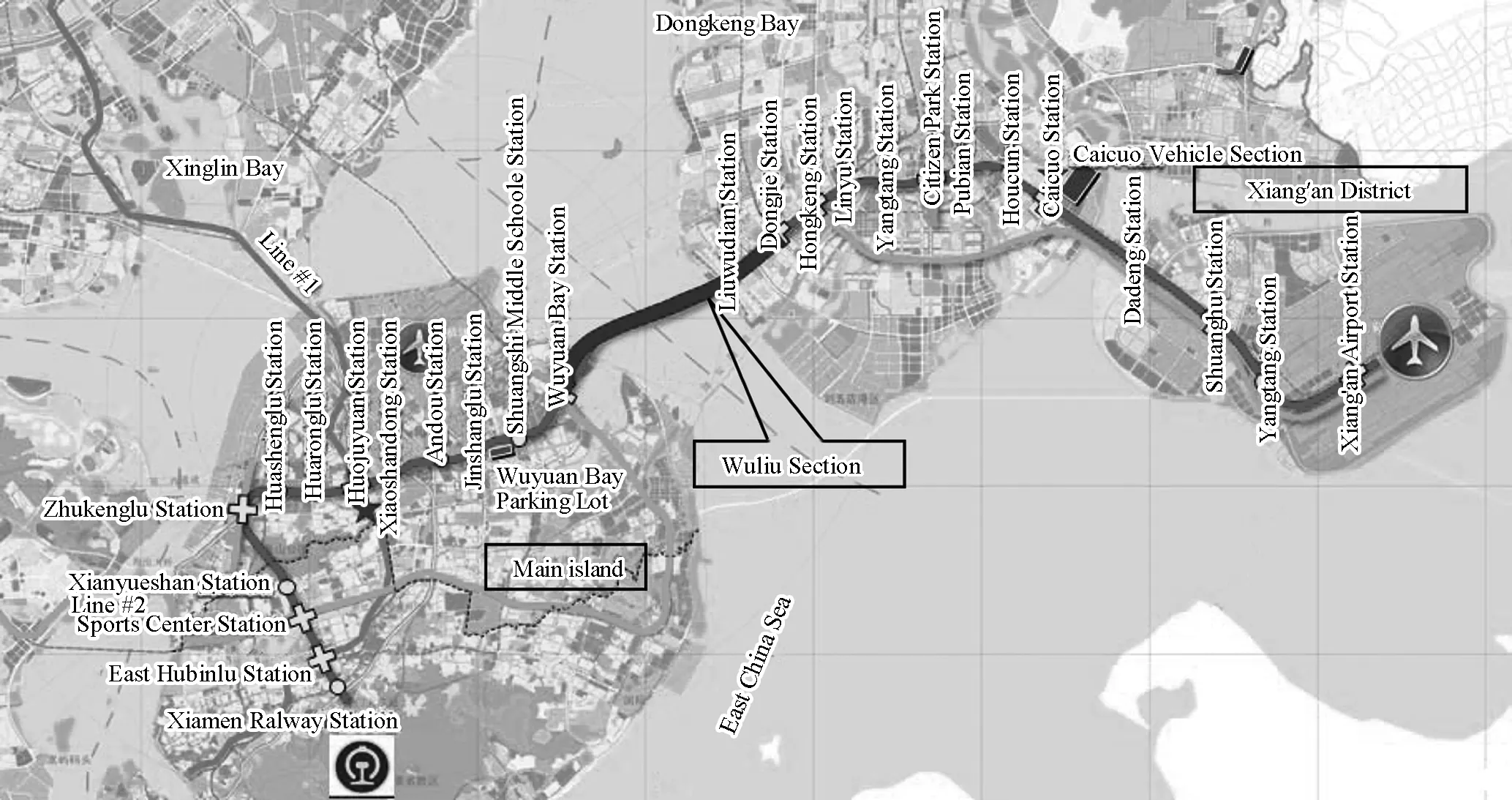
Fig. 1 Plane view of Wuliu Section
2 Brief introduction of the project
2.1 Design overview
The Wuliu Section of Xiamen Metro Line #3 crosses the Xiamen east sea area and connects the main island with Xiang′an Dis trict. It is to the northwest of the Xiang′an subsea tunnel. The total length the section is 4.95 km, including about 3.6 km of sea-crossing section. The maximum water depth is 25 m and the maximum buried depth of the tunnel is 69 m. It adopts a single-line, dual-bore section and uses the combined "mining method-shield method" construction technique. There are one inclined construction shaft, one air shaft, ten service channels, three wastewater pump houses and one power substation. The plane view of the tunnel is shown in Fig. 2.
2.2 Engineering geology
The section crosses complicated and varying geological conditions. The tunnel in the Xiang′an District runs mainly through layers of medium-coarse sand, pebble and intensely/completely weathered granite, which are highly permeable and connected with seawater. The tunnel in the land area of the main island mainly runs through layers of residual soil and intensely/completely weathered granite, accompanied by local basement bulges and relatively developed boulders. The sea-crossing section mainly runs through a slightly weathered granite layer and four groups of weathered troughs. The slightly weathered rock has an average strength of 110 MPa and has relatively high quartz content. The weathered troughs are mainly filled with completely weathered granodiorite and intensely weathered granodiorite that is granular, fragmented, and shows compact sand-gravel-cohesive soil mixture characteristics. The geological profile of the tunnel is shown in Fig. 3.
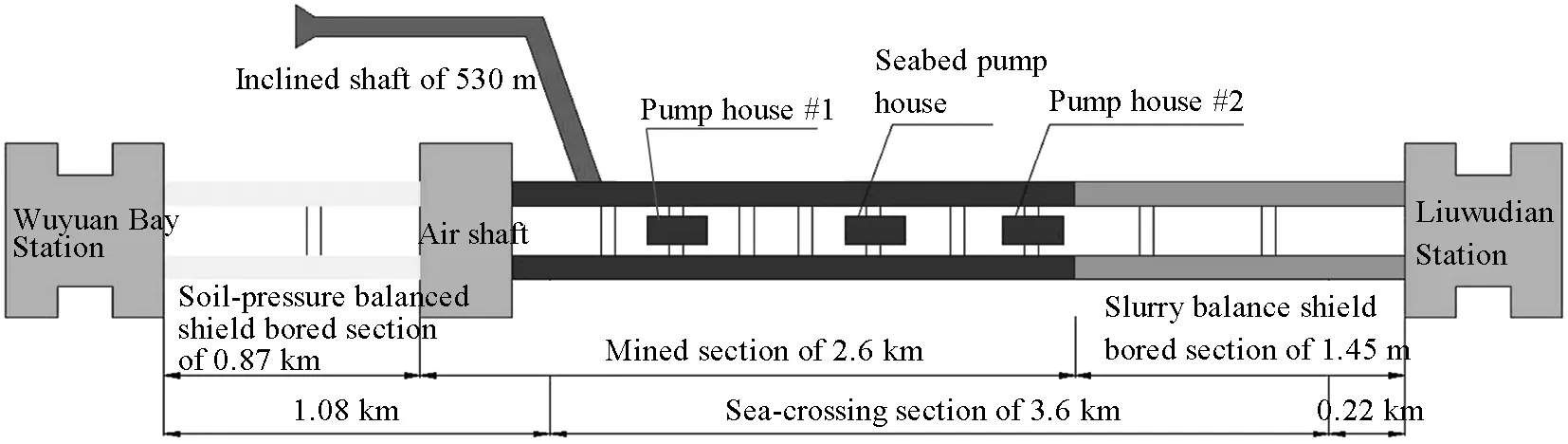
Fig. 2 Layout plan of Wuliu Section
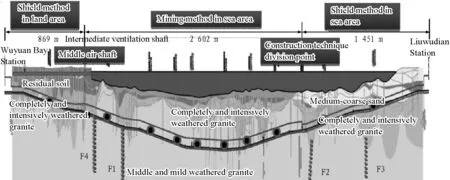
Fig. 3 Plane view of tunnel geology of Wuliu Section
3. Difficulties and solutions of engineering design
3.1 Disaster prevention ventilation and evacuation in ultra-long subsea tunnel
The Wuliu Section is 4.95 km long and accommodates three trains simultaneously during peak hours. According to the ventilation and disaster prevention requirements, only one train can run in each ventilation section at any time. Following the vertical ventilation mode in conventional segmentation, it requires at least two air shafts in the middle of tunnel. However, since the tunnel crosses the sea, conditions are poor for installing air shafts and excavation is also highly difficult.
Solutions: (1) This tunnel covers 3.6 km of subsea area, where it is not feasible to construct a middle air shaft. Instead, a special civil construction air shaft is placed above the tunnel section using the mining construction method. Sectioned vertical ventilation and the smoke discharge mode are adopted to solve disaster prevention and ventilation problems in the long sea-crossing section. (2) Reducing the distance between service channels and widening the vertical evacuation platform are considered to increase the evacuation capacity from the perspective of disaster prevention and evacuation. A total of 11 service channels are arranged in the Wuliu Section with an average cross distance of about 420 m. The evacuation platform width in the mined tunnel is 2 m (Fig. 4) and that in the shield-bored tunnel is 0.95 m (Fig. 5). The inclined shaft is also used as an evacuation path and its width is 4 m. (3) Many safety zones and emergency exits are arranged, including Wuyuan Bay Station, Liuwudian Station, non-disaster fire tunnel, interval air shaft and inclined construction shaft. During a fire event in the sea-crossing interval and if the train still has power, it shall proceed to Wuyuan Bay Station or Liuwudian Station for evacuation and rescue. If the train loses power and cannot reach a station, it shall stop immediately for passengers to disembark via the side or rear train doors onto the evacuation platform or track bed, and evacuate to a non-fire tunnel through the transverse service channel.
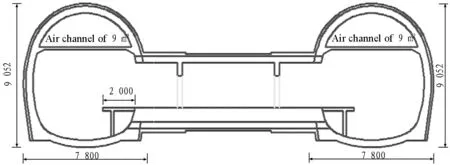
Fig. 4 Cross-section of tunnel using mining method (unit: mm)
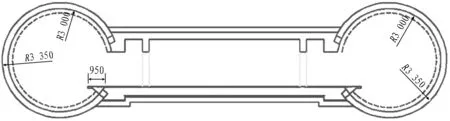
Fig. 5 Cross-section of tunnel using shield method (unit: mm)
3.2 Intermediately-weathered troughs in the mined sea-crossing section
The sea-crossing section of mined tunnel passes through four large weathered troughs. These are composed mainly of completely/intensely weathered granites. The rock body is crushed and there is abundant pore water storage, which increases construction difficulty and risks.
Solutions: (1) Conduct geological forecast using advanced geological drilling, TSP, infrared water exploration, geological radar and other means to identify and locate the water-rich section, fault-broken section and other poor geological bodies as accurately as possible. (2) Develop initial grouting standards according to the strata properties, water inflow and hydraulic pressure and formulate grouting program specifically (Fig. 6). (3) Verify grouting reinforcement quality through water exploration holes and core drilling. (4) Prevent groundwater rush and other extreme conditions by setting up a movable water dam 100 m in front of the face, and quickly pass through using mechanized construction method (Fig. 7).
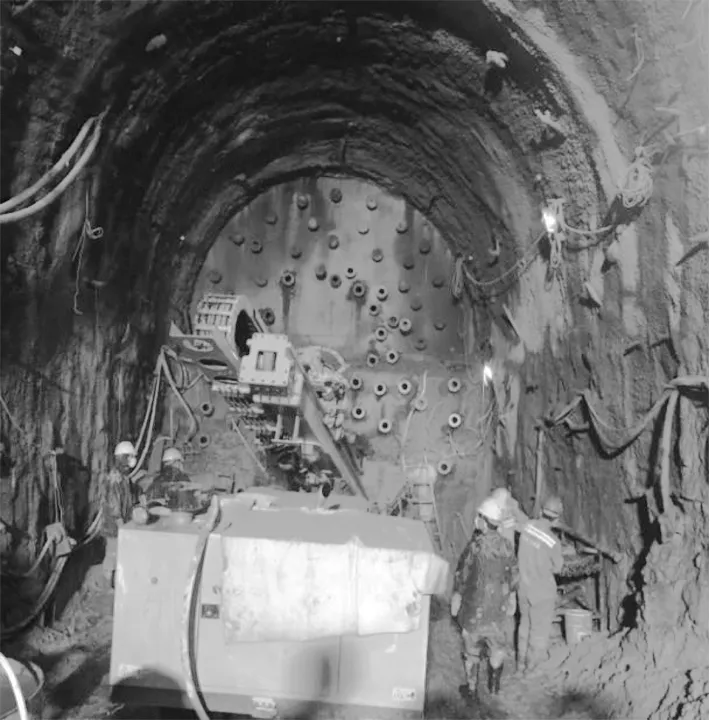
Fig. 6 Advanced curtain grouping construction site in mined tunnel section Fig. 7 Trolley and transport corridor in mined tunnel section
3.3 The shield tunnel through bad subsea strata
The construction area has a number of adverse geologic conditions including shallow sand layer, hard rocks, soft-hard uneven strata and boulder-developed strata, which make the advancing of the shield structure highly risky. Additionally, the sea area above the tunnel is an ecological preservation area, thus sea operations such as vertical reinforcement and deep hole blasting are restricted.
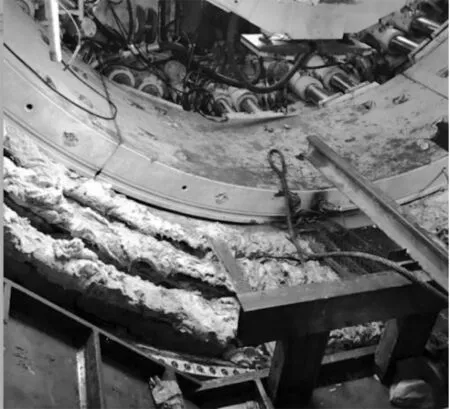
Solutions: (1) The shield tunnel, which runs through the shallow sand layer, adopts technical measures such as advancing supporting pressure, advancing parameters and deslagging control, slurry quality control, synchronized grouting and secondary grouting quality control, and shield sealing management (Fig. 8). The equilibrium chamber pressure in the slurry shield is adjusted dynamically in correspondence to groundwater level changes in the intertidal zone. (2) For the shield structure passing through boulders and soft-hard uneven strata, use technical measures of advanced probing, bedrock and boulder pre-treating, cutterhead and cutter equipment adjustement, advancing parameters and slag quantity control. Sections with high rock strength and difficult direct shield advancing or uneven soft-hard strata are pre-treated with over-the-sea deep hole blasting. (3) For long-distance subsea advancing of the shield structure, adopted technical measures focus mainly on cutter suitability, cutter wearing monitoring, batch change at planned locations, and operation of high hydraulic pressure and decompression discharge-limited cabins. The completed shield structure is shown in Fig. 9.
3.4 Connections of tunnel constructed by different methods in the sea
The slurry shield starts from the Xiang′an side, and the shield section and mined section connects in the sea. To ensure safety and waterproof connections, comprehensive consideration are given to the connecting point and procedures.
Solutions: Strata intact rock and with thick and hard overlying rock are selected as the connection point, with the exact location being flexible depending on the actual progress of the shield and mining methods. (1) If the mining method arrives first, the expanded reception section shall be reinforced. (2) If the shield method arrives first, the rock wall thickness at the connection point shall be confirmed and the surrounding curtain grouting shall be performed. Additionally, the shield structure shall be equipped with a detachable cutterhead for the convenience of disassembly within the tunnel.
3.5 Structure durability in marine corrosion environment
The sea-crossing tunnel area belongs to the typical marine chloride environment. The chlorine ion content in underground water exceeds 15 000 mg/L and the action class is Ⅲ-E, which requires extremely strong corrosion resistant structures. Currently existing sea-crossing metro tunnels, such as the Shenzhen Qian Bay Cable Tunnel and Guangzhou-Shenzhen-Hong Kong Passenger-dedicated Shiziyang Tunnel, encountered various degrees of structural corrosion phenomena. Adequate attention shall be paid to structural durability in corrosive marine environment.
Solutions: (1) The main structural body will be constructed with C50 or C55, seepage-resisting class P12 concrete materials. Durability indexes such as diffusion coefficient of chloride ion and water-binder ratio shall be strictly controlled. (2) Mineral admixtures and additives will be added to reduce the hydration heat of concrete, increase its workability and enhance the anti-cracking performance of the structure. (3) Special attention will be paid to the water proof-drainage system of the mined section, and enhance the durability of key components such as the shield tunnel joint and bolt joint. (4) Improve structural members curing method.
3.6 Waterproof and drainage problems in long sea-crossing metro section
As a long sea-crossing tunnel, the Wuliu Section has a long marine span and large structural water percolating quantity, which impose considerable requirements for dewater capacity during the tunnel construction and operation.
Solutions: (1) Follow the design philosophy of "block-oriented, block-discharge combination", develop reasonable tunnel water leakage and seepage standards and strictly control the discharging volume of the tunnel using advanced grouting. (2) To meet discharge requirements during the operation period, three large wastewater pump houses are built at the lowest point and on two sides of the line. The capacity of the pump houses is adjusted dynamically depending on inflow during tunnel construction, and shall accommodate at least 24 h of tunnel seepage volume. (3) Maintainability of the water discharge system is comprehensively considered during the design stage. The diameter of the longitudinal blind drain pipe is increased as appropriate and inspection wells are arranged at longitudinal intervals along the tunnel. Blocked pipelines can be cleared with high-pressure water gun at late stages.
4 Main technical innovations
(1) Combined construction techniques and connections of metro tunnels of a long sea-crossing section in a complicated environment. Based on the sea-crossing section of Xiamen Metro Line #3, cross-sectional forms and construction techniques (combined shield method and mining method) appropriate for metro construction in the complicated geological environment and high hydraulic pressure environment were developed.
(2) Building information monitoring (BIM)-based, integrated construction risk control system for long sea-crossing metro tunnel. The construction information model of the sea-crossing tunnel project and modelling standard are proposed. BIM information technologies are used in conjunction with various information technologies to enable real-time analysis and integrated control of construction risks.
(3) Freezing reinforcement technology under soft seabed strata conditions. Service channel excavation and shield cutter changing are accomplished by using vertical freezing method over the sea and horizontal freezing method within the tunnel. Technical difficulties, such as hole guiding and orientation on freezing pipe and freezing temperature control in strong transfusion strata, are resolved to achieve safe construction of the service channel and open chamber shield excavation under normal pressure in soft subsea strata.
(4) Configuration requirements for disaster prevention and rescue systems in the sea-crossing metro tunnel section, based on the characteristics of railway traffic operation. Configuration requirements include ventilation, illumination, power supply, fire suppression, emergency communication, emergency shelter, emergency rescue systems and emergency train running protocols.
(5) Discharge reliability and maintainability design of the subsea tunnel. Allowable standards for groundwater discharge in the long sea-crossing metro tunnel section are researched and developed based on multiple factors including geological conditions, water proofing cost and construction duration, which are incorporated into the design for the subsea tunnel waterproof system and tunnel maintainability measures.
5.Constructionscheduleandprogress
5.1 Schedule
This project commenced on January 1st, 2016 and is scheduled for completion on September 30th, 2019, for a total of 45 months.
5.2 Project progress (as of March 31st, 2018)
5.2.1 Construction of main island segment
(1) The inclined shaft runs through F4 weathered trough and the accumulated construction length is 530 m, with 178 m remaining till reaching the main tunnel.
(2) The main air shaft structure 5th and 4th underground floors are completed. 88 m of the main tunnel has been constructed by using the mining method.
(3) Base rock pre-treatment in the earth-pressure balanced shield-bored section of the land area of the main island has been performed. The starting conditions will be ready by April 2018.
5.2.2 Construction of Xiang′an Section
(1) The top of the starting station has been sealed and local backfill of the Dalicheng end has been completed.
(2) A total of 594 rings has been installed in the left line of the slurry balanced shield-bored section for a distance of about 891 m with 526 m remaining. On the right line, a total of 821 rings has been installed for a distance of about 1 231.5 m with 190.5 m remaining.
6 Construction participants
Owner: Xiamen Rail Transit Group.
Designer: China Railway Tunnel Survey & Design Institute Co., Ltd.
Construction Contractors: China Railway Tunnel Group Co., Ltd. and China Railway First Group Co., Ltd.
Supervisor: A corporation of Guangzhou Mass Transit Engineering Consultant Co., Ltd.and Holsin Engineering Consultant Group Co., Ltd.

- 隧道建設(中英文)的其它文章
- Statistics of Railway Tunnels in China as of 2017
- 高速鐵路隧道支護參數的計算研究
- 2018年世界隧道大會暨國際隧協(ITA)第44屆年會將在迪拜舉辦
- Extra-large Undersea Shield Tunnel in Composite Ground:Maliuzhou Traffic Tunnel in Zhuhai
- Construction Technologies for Tunnels in Special and Complicated Geology of Lanzhou-Chongqing Railway
- TBM滾刀布置方案對比分析與評價