
Planaxidae (Mollusca, Gastropoda) from the South China Sea*
2018-05-07 06:07:51CHENZhiyun陳志云ZHANGJunlong張均龍LIANXiping連喜平TANYehui譚燁輝
CHEN Zhiyun (陳志云) , ZHANG Junlong (張均龍) , LIAN Xiping (連喜平) TAN Yehui (譚燁輝)
1 Marine Biodiversity Collections of South China Sea/Key Laboratory of Tropical Marine Bio-Resources and Biology, South China Sea Institute of Oceanology, Chinese Academy of Sciences, Guangzhou 510301, China
2 Department of Marine Organism Taxonomy and Phylogeny, Institute of Oceanology, Chinese Academy of Sciences, Qingdao 266071, China
1 INTRODUCTION
Most members of Planaxidae (Mollusca,Gastropoda) are microphagous herbivores commonly living in intertidal rocky environment of the tropical or subtropical sea. They are relatively small to medium in size, usually occurring with large populations. Currently, 30 to 40 valid species are known worldwide (Strong et al., 2011).
There are a few systematic studies on Planaxidae from the China seas.Planaxissulcatus(von Born,1778)=Planaxistectus(Gmelin, 1791), is the only species recorded from the South China Sea (Zhang,2008a, b). While a variety of species have been reported from adjacent areas, six species are recorded in Taiwan (Shao et al., 2008), eight in Japan(Hasegawa, 2000), five in the Philippines (Lozouet,2008), five in Vietnam (Thach, 2005, 2007) and two in Singapore (Tan and Low, 2014). It is likely that more planaxid species will be discovered in the South China Sea, and enhanced investigations are necessary to identify the potential species.
In this contribution, we recognize and illustrate three species from the family Planaxidae in the South China Sea, such asPlanaxissulcatus(von Born,1778),Angiolalongispira(Smith, 1872), andSupplanaxisniger(Quoy and Gaimard, 1833). The radulae of the last two species were studied and have been reported rarely before. In China,Supplanaxis nigerhas only been reported in Taiwan before and this work improved its distribution information. We also briefly discuss the taxonomy including both shell and radula characteristics, distribution, and habitat.
2 MATERIAL AND METHOD
All specimens examined were preserved in 75%ethanol and deposited at the Marine Biodiversity Collections of South China Sea, Chinese Academy of Sciences (Guangzhou, China). Shell quantity,collection locality, collector, and collection date were recorded for each registered specimen number, except some items, which lacked this information. The distribution of the species of Planaxidae from the South China Sea are illustrated in Fig.1. Photographs of small specimens were taken with a Leica EZ4 HD compound microscope. Radula of the three species were obtained and handled in 10% NaOH solution for scanning electron microscopy.
3 TAXONOMY
Family Planaxidae Gray, 1850
Subfamily Planaxinae Gray, 1850
Genus Planaxis Lamarck, 1822
PlanaxisLamarck, 1822: 50 (nonPlanaxisRisso,1826)
ProplanaxisThiele, 1929: 203 (Type species:PlanaxisplanicostatusSowerby, 1825, by original designation).
Type species:Buccinumsulcatumvon Born, 1778,by subsequent designation (Gray, 1847: 138).
Diagnosis:Shell conical, solid, dark brownish black with white spiral patches; whorls sculptured with spiral grooves; body whorl large; aperture ovate,purple; outer lip thick, lirate within; columella white,concave, with large parietal tooth at anal canal.
Remarks:Planaxisis widespread in the tropical Indo- Pacific and occurs in intertidal or subtidal zones(Cernohorsky, 1972; Houbrick, 1987; Tr?ndlé and Boutet, 2009). This taxon is clearly distinguished from the other genera of Planaxidae by the relatively large shells and spiral grooves.
3.1 Planaxis sulcatus (von Born, 1778) (Fig.2)
Buccinumsulcatumvon Born, 1778: 251–252.BuccinumpyramidaleGmelin, 1791: 3488.
Planaxistectus(Gmelin, 1791): Zhang, 2008a:475.
PlanaxissulcataLamarck, 1822: 51; Quoy and Gaimard, 1833: 486–488, pl. 33, figs. 25–39.
PlanaxisundulataLamarck, 1822: 51; Sowerby,1822: pl. 1, Fig.1.
PlanaxisbuccinoidesDeshayes, 1828: 237.
PlanaxisbrevisQuoy and Gaimard, 1833: 488–489, pl. 33, figs. 30–32.
PlanaxisobscuraA. Adams, 1851: 271.
PlanaxismenkeanusDunker, 1861: 41–42.
Planaxissulcatus(von Born): Smith, 1872: 37–38;Sowerby, 1878, pl. 1, Fig.4; Cernohorsky, 1972: 58,pl. 12, Fig.17; Houbrick, 1987: 5–10, text-figs. 1–4;Hasegawa, 2000: 129–130, pl. 65, Fig.1; Thach,2005: 47, pl. 10, Fig.26; Lozouet, 2008: 298, pl. 94,Fig.11; Zhang, 2008b: 55; Tr?ndlé and Boutet, 2009:15; Tan and Low, 2014: 17–18, Figs. 1, 2, 3C–H, 4.
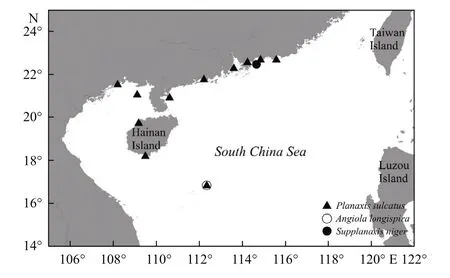
Fig.1 Distribution of Planaxis sulcatus, Angiola longispira,and Supplanaxis niger in the South China Sea
Type location: Unknown.
Material examined:SCSMBC008036, 35 shells,Zhenzhu Bay, Dongping, collected by Yangjiang,Duangdong, Lian Xiping and Chen Zhiyun, 17 Nov.2012; SCSMBC008037, 12 shells, Yongxing Island,collected by Chen Zhiyun and Wang Junfeng, Nov.2013; SCSMBC008062, 8 shells, Luhuitou, Sanya,Hainan, Apr. 1981; SCSMBC008063, 2 shells,Ganchong, Hainan, Oct. 1972; SCSMBC008064, 14 shells, Aaotou, Guangdong, Dec. 1980;SCSMBC008065, 27 shells, Zhuhai, Guangdong,Oct. 1982; SCSMBC008066, 18 shells, Yantian,Shenzhen, Guangdong, Jan. 1981; SCSMBC008067,2, Zhelang, Shanwei, Guangdong, Sep. 1972;SCSMBC008068, 10 shells Naozhou Island,Guangdong, Feb. 1961; SCSMBC008069, 7 shells,Weizhou Island, Guangxi, Oct. 1972;SCSMBC008070, 2 shells, Zhenzhu Bay, Dongxing,Guangxi, Aug. 1965.
Diagnosis:Shell solid, moderately elongate,reaching 21.0 mm in length; spire conical, suture well-marked, apex often eroded; body whole large,wide, about 2/3 of shell height (in ventral view), base of body whorl moderately constricted with a weak keel shoulder at periphery; whorls sculptured with spiral cords and grooves, shell brown to brownish black with irregular white or gray markings; aperture ovate, a little less than one-half the shell length with short, wide, anterior canal; outer lip thin at the edge,interior prominently lirate; columella concave, white with a prominent parietal tooth posterior. Operculum large, brown, lenticular, paucispiral with subterminal nucleus.
Radula:The rachidian tooth (Fig.2g) is somewhat squarish in shape and has a single broad spoon-like cusp, the basal plate of which has a pair of basal lateral cusps and a long thin lateral extension on each side. The lateral tooth (Fig.2f) has a broad central cusp with about two small denticles on the inner side.The marginal teeth (Fig.2f, h) are long, narrow, and expanded to claw shape at the tips.
The rachidian and lateral teeth of the anterior radula ribbon have worn cusps (Fig.2h, i), showing significant difference compared with the posterior radula ribbon teeth in morphological characters.
Distribution: South of Taiwan and Fujian Province, Guangdong; Guangxi, Hainan, Xisha Islands, China. Wide spread in the Indo-Pacific from South Africa, the Red Sea, Indian Ocean, to Malaysia,Singapore, Indonesia, Australia, the Philippines,Polynesia, China, and Japan.
Habitat: This moderately common snail occurs among intertidal, rocky environments, frequently found on large rocks and stones in low to high tidal zones. Grazes on microalgae covering rocky substrates in moderate to low energy habitats(Houbrick, 1987; Hasegawa, 2000). Groups ofP.sulcatusfrequently cluster together in crevices or on the shaded side of rocks when exposed to air during low tides (Fig.2e).
Genus Angiola Dall, 1926
AngiolaDall, 1926:63; Thiele, 1929: 204; Wenz,1940: 722.
Type species:AngiolaperiscelidaDall, 1926, by original designation.
Diagnosis:Shell small, thick, mostly smooth,glossy, shell white, with numerous spiral bands colored orange, brown and black. Columella concave,with no parietal tooth at anal canal.
Remarks: This genus is easily recognized by their glossy small size and spiral color patterns.Angiolaspecies occur throughout the Indo-Pacific and Caribbean provinces, usually under rocks at the low tide mark (Houbrick, 1987).
3.2 Angiola longispira (Smith, 1872) (Fig.3)
PlanaxislongispiraSmith, 1872: 45, sp. 34.
Angiolalongispira(Smith): Yen, 1942: 206; Habe,1964: 37; Shao et al., 2008: 698.
Type location: Chinese seas.
Material examined: SCSMBC008038, 59 shells,Yongxing Island, collected by Chen Zhiyun and Wang Junfeng, Nov. 2013.
Diagnosis:Shell small, thick, elongate-ovate, up to 7.1 mm in length. Spire produced with a brown apex,whorls rather convex, suture distinct; body-whorl moderately large, about 2/3 of the shell length in ventral view; wet shell glossy, dry shell yellowish white, three distinct red lines in the middle of the last whorl and below; shell smooth but spirally grooved in upper whorls and base of the body whorls; aperture small, much shorter than spire ovate, interior smooth and showing the external red lines; outer lip rather thick; inner lip thin and glossy, columella, short and arched with no parietal tooth posterior; anterior canal short. Operculum thin, translucent and yellow with a subterminal nucleus.
Radula:The rachidian teeth (Fig.3d) are concave on top and have a triangular central cusp climbed by 1–4 tiny serrations on each side. The basal plate has tapering lateral downward extensions on each side.There is a central triangular basal extension between the 2 cusps. The lateral tooth (Fig.3c) is subtriangular and slit into 5 cusps at the top with the largest one in the middle. The marginal teeth (Fig.3c) are long, the top of which are curved and sliced into numerous fine denticles, nearly stuck together.
Distribution:Xisha Islands, China. Tropical Indo-West Pacific: Japan, Malaysia, Philippines.
Habitat:Clustered in the intertidal zone near the low tide line, and often hidden under coral rocks near the low tide line in large populations in the Yongxing Islands (Fig.3e).
Genus Supplanaxis Thiele, 1929
SupplanaxisThiele, 1929: 203–204 (subgenus);Houbrick, 1987, 445: 25.
Type species:BuccinumnucleusBruguière, 1789,by monotypy.
Diagnosis: Shell ovate, obese, dark and smooth except for area beneath suture and part of body whorl,where incised spiral grooves; aperture wide with fine lines on the inner side of outer lip, and thick callus with broad canal notch.
Remarks:This taxon was previously given subgeneric rank (Thiele, 1929; Wenz, 1940). However,Houbrick (1987) accordedSupplanaxisas generic status based on the many significant morphological differences in the shell, radula, soft anatomy, and embryonic development.Supplanaxisspecies occur in the Indo-Pacific, eastern Pacific, Caribbean, and inhabit the rocky, intertidal zone (Houbrick, 1987).
3.3 Supplanaxis niger (Quoy and Gaimard, 1833)(Fig.4)
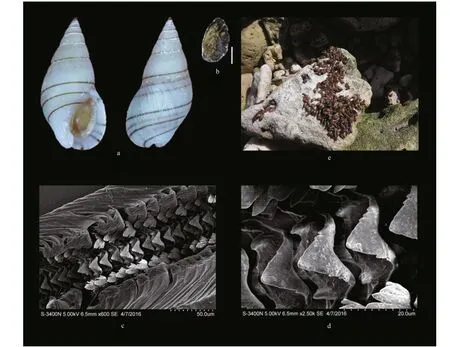
Fig.3 Angiola longispira (Smith, 1872)
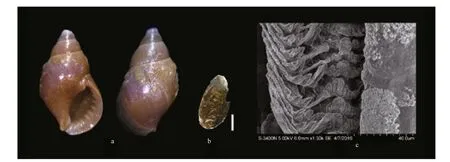
Fig.4 Supplanaxis niger (Quoy and Gaimard, 1833)
PlanaxisnigraQuoy and Gaimard, 1833: 491–492,pl. 33, Figs. 22–24; Cernohorsky, 1972: 59, pl. 12,Fig.19.
PlanaxisabbreviataPease, 1865: 515–516; Smith,1872: 43.
PlanaxisatraPease, 1869: 72, pl. 8, Fig.4.
Planaxisnicobaricusvon Frauenfeld, 1867: 9–10,pl. 2, Fig.12; Subba Rao, 2003: 1–416.
PlanaxissimilisSmith, 1872: 41.
Supplanaxisniger(Quoy and Gaimard):Cernohorsky, 1972: 59, pl. 12, Fig.19; Hasegawa,2000: 130–131, pl. 65, Fig.6; Thach, 2005: 47;Lozouet, 2008: 298–299, pl. 94, Fig.12; Shao et al.,2008: 698; Tr?ndlé and Boutet, 2009: 15.
Type location: New Ireland.
Materialexamined:SCSMBC008039, 5 shells,Sanmen Island, Aotou, Guangdong.
Diagnosis:Shell length 6.9 mm, ovate, stout; spire conical, suture distinct; body whorl large, about 1/4 of theshell height (in ventral view); dark and smooth except for area beneath suture and part of body whorl,where incised spiral grooves; colored brown with yellow periostracum. Growth lines obvious, base of body whorl incised with several spiral grooves;aperture large and expanded outwardly with short,wide, anterior canal; outer lip thick with 8–9 palatal ridges inside; columella concave with thick callus and a prominent parietal tooth at edge of anal canal.Operculum relatively large, thin, yellow, lenticular with a subterminal nucleus.
Radula:The rachidian tooth has a large squarish median cusp flanked on each side by three, smaller denticles. The lateral tooth is long and has a large,squarish, central cusp with two sharp outer denticles.The marginal tooth is lost (Fig.4c).
Distribution: Taiwan and Guangdong Province,China. Tropical Indo-Pacific: from Indian Ocean to Polynesia; India; Japan; the Philippines.
Habitat:On boulders near high tide mark on exposed shores to subtidal zone about 1 m deep(Hasegawa, 2000; Lozouet, 2008).
4 DISCUSSION
As the type species of genusPlanaxis,Planaxis sulcatushas a medium-sized shell and whorls with distinct spiral cords and grooves, which are different from the other two species of Planaxidae in the present study. BothAngiolalongispiraandSupplanaxisnigraare small.Angiolaspecies are easily distinguished by their small shells with spiral color bands. To date, the largest individual of this genus is 12.0 mm (Houbrick,1987), and ourAngiolalongispiraonly reached 7.1 mm in length. Shells ofAngiolalongispiraare almost smooth except spirally grooved in the upper whorls and base of the body whorls.Supplanaxisnigrais more inflated thanAngiolalongispira, with spiral grooves beneath suture and at the base of the body whorls. BothPlanaxissulcatusandSupplanaxisnigrahave a parietal tooth at the anal canal, butAngiola longispiradoes not. Opercula of these three species are lenticular with a subterimal nucleus, and completely close the aperture when the animal is retracted. Among them, the operculum ofPlanaxissulcatusis larger,thinner, and darker in color. Based on materials we examined, differences in shell morphology ofPlanaxis sulcatusfrom different regions are slight but distinct.Shells of this species from the coast of Guangdong(e.g., Yangjiang) are predominantly brownish black with white markings (Fig.2c–d), whereas the shells from localities further south (e.g., Hainan Island) are lighter in color (Fig.2a–b). Even from the same location, different shell color patterns occur in this species. For example, shells ofPlanaxissulcatusfrom Hainan Islands are from dark brown with sparse white markings to brown with more white markings(Fig.2a–b). However, we did not have sufficient material from the entire distribution range to determine the consistency of differences in the shell patterns.More specimens and future studies, such as molecular phylogeny, are needed to determine whether the different color patterns of the shells are geographic variations between populations.
Among the three planaxid genera, the marginal teeth and lateral teeth are similar, but there are major differences in the cusps of the rachidian teeth:Planaxishas a rather broad and round central cusp with a smooth margin; the central cusp ofAngiolais triangular in shape and has a concave furrow on its head, with 1–4 denticles on each side; central cusp ofSupplanaxisis subquadrate, with three small denticles on each side (Fig.5).
Houbrick (1987) found two long and narrow marginal teeth on each margin of the radular ribbon ofPlanaxissulcatus. The tip of the inner marginal tooth has five wide denticles, while the outer marginal tooth has nine digitate denticles. These were also found in our material (Fig.2f, h).
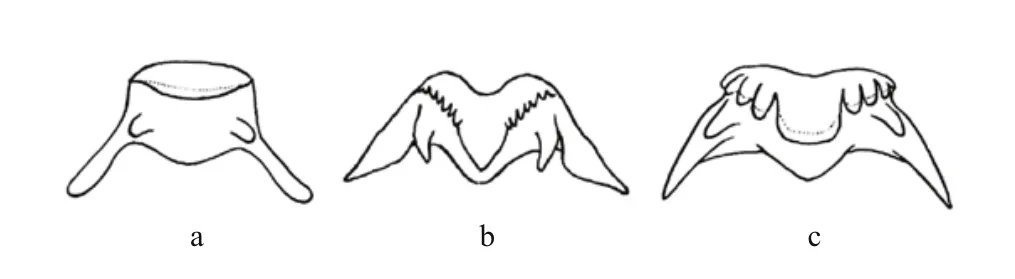
Fig.5 Rachidian teeth of the three planaxid genera (From Houbrick, 1987)
The radular ribbon is attached to a basementmembrane with associated muscles stretching out and drawing back to rasp food into the mouth. The cusps of the anterior teeth wear away, and new teeth are continuously secreted and formed in the posterior of the radular ribbon (Zhang and Qi, 1961). Teeth at the anterior end of the radular ribbon inPlanaxissulcatusoften differ in their morphology probably due to abrasion while scraping algae from rocks.
The crystals on the surface of the radula ofSupplanaxisnigrawere caused by the residue of sodium hydroxide solution that was used to ablate muscle tissue of the radular sac during the dissection.As our specimens have been preserved in 75% alcohol for a long time, the radulae tend to break easily, and the marginal teeth were lost (Fig.4c).
A thin membrane was found adhering to the outer edge of the outer marginal teeth inPlanaxissulcatusandAngiolalongispira(Figs.2f, 3c). It is a difficult structure to see, as it is frequently lost during preparation of the radular ribbon. This structure was called the “lamella-like flange” by Houbrick (1987)who reported that the lamella-like flange on the outside of the outer marginal teeth is a characteristic of planaxid radulae. It was alluded to by Thiele (1929)as a characteristic of Planaxidae.
Planaxids are found under rocks and in gravel or coral rubble near the high or low water marks of the intertidal zone; some species prefer the exposed shore.The members reported in the present study are warmwater species.Angiolalongispirais currently only reported from Taiwan and Xisha Island in China.PlanaxissulcatusandSupplanaxisnigerare distributed from the coast of Japan southward to the Polynesian Islands, South Pacific. The fauna in the South China Sea belong to the Indo-Malaysian tropical biota (Liu,2008), where molluscan diversity should be very high.However, owing to insufficient sampling, only three species belonging to the three genera were recorded in this family. The planaxid species from China are still far fewer than those from adjacent waters of Japan(Hasegawa, 2000), the Philippines (Lozouet, 2008),and Vietnam (Thach, 2005, 2007). We strongly believe that there are largely undiscovered species in the South China Sea that await further investigations.
5 ACKNOWLEDGMENT
We wish to thank Dr. Roger H. Goodwill and Dr.Sanoma Goodwill (Brigham Young University-Hawaii) for advice and assistance with the manuscript.We are also grateful to the anonymous reviewers.
Adams A. 1851. Descriptions of several new species ofMurex,Rissoina,Planaxis, andEulima, from the Cumingian collection.ProceedingsoftheZoologicalSocietyof London,19: 267-272.
Bruguière J G. 1789. Encyclopédie Méthodique: Histoire Naturelle Des Vers, Vol. 1. Panckoucke, Paris. p.254.
Cernohorsky W O. 1972. Marine Shells of the Pacific, Vol. 2.Pacific Publications, Sydney. 411p.
Dall W H. 1926. New Shells from Japan and the Loochoo Islands.ProceedingsoftheBiologicalSocietyof Washington,39: 63-66.
Deshayes G P. 1828. Planaxe.Planaxis, Moll.In: Audouin J V ed. Dictionnaire Classique D’Histoire Naturelle, Ouvrage Dirigé Par ce Dernier Collaborateur, et Dans Lequel on a Ajouté, Pour le Porter au Niveau de la Science, un Grand Nombre de Mots Qui N’Avaient pu Faire Partie de la Plupart des Dictionnaire Antérieurs. Tome Quatorzième.PLA-ROY. Rey et Gravier/Baudouin Frères, Paris. p.237.
Dunker W. 1861. Beschreibung neuer Mollusken.MalakozoologischeBl?tter,8: 35-45.
Gmelin J F. 1791. Caroli a Linné. Systema naturae per regna tria naturae, secundum classes, ordines, genera, species,cum characteribus, differentiis, synonymis, locis. Vol. 1,(Part 6). Georg. Emanuel. Beer Vermes, Lipsiae. p.3 021-3 910.
Gray J E. 1847. A list of the genera of recent Mollusca, their synonyma and types.ProceedingsoftheZoological SocietyofLondon,15: 129-219.
Gray J E. 1850. Figures of molluscous animals selected from various authors.In: Gray M E ed. Etched for the Use of Students, Vol. 4. Longman, Brown, Green & Longmans,London. 219p.
Habe T. 1964. Shells of the Western Pacific in color II.Hoikusha, Osaka. 233p.
Hasegawa K. 2000. Family Planaxidae.In: Okutani T ed.Marine Mollusks in Japan. Tokai University Press, Tokyo.p.129-131.
Houbrick R S. 1987. Anatomy, reproductive biology, and phylogeny of the Planaxidae (Cerithiacea: Prosobranchia).SmithsonianContributionstoZoology,445: 1-57.
Lamarck J B P A. 1822. Histoire Naturelle des Animaux Sans Vertèbres, Vol. 7. Verdière, Paris. 711p.
Liu R Y. 2008. Checklist of Marine Biota of China Seas.Science Press, Beijing, China. 1 267p. (in Chinese with English abstract)
Lozouet P. 2008. Family Planaxidae.In: Peppo G T ed.Philippine Marine Mollusks, Vol. 1. ConchBooks,Hackenhein. p.298-299.
Pease W H. 1865. Descriptions of new genera and species of marine shells from the islands of the Central Pacific.ProceedingsoftheZoologicalSocietyofLondon,33(1):512-517.
Pease W H. 1869. Descriptions of new species of marine Gastropodae inhabiting Polynesia.AmericanJournalof Conchology,5(2): 64-79.
Quoy J R C, Gaimard J P. 1833. Voyage de Découvertes de L’Astrolabe, Exécuté Par Ordre du Roi, Pendant les Années 1826-1827-1828-1829, sous le commandement de M. J. Dumont D’Urville. Zoologie, Tome 2, Part 2. J.Tastu, éditeur-Imprimeur, Paris. p.321-686.
Risso A. 1826. Histoire Naturelle des Principales Productions de L’Europe Méridionale et Particulièrement de Celles Des Environs de Nice et des Alpes Maritimes. Levrault,Paris. Vol. 1, 448p., Vol. 4, 444p.
Shao K T, Peng C I, Wu W J. 2008. 2008 Taiwan Species Diversity II. Checklist. Forestry Bureau, Council of Agriculture, Executive Yuan, Taiwan. 796p. (in Chinese)
Smith E A. 1872. A list of species of the genusPlanaxis, with descriptions of eleven new species.AnnalsandMagazine ofNaturalHistory,4(9): 37-47.
Sowerby G B. 1821-1834. The Genera of Recent and Fossil Shells: for the Use of Students in Conchology and Geology. G. B. Sowerby, London.
Sowerby G B. 1878.Planaxis.In: Reeve L A ed. Conchologia Iconica: Or Illustrations of Molluscous Animals, Vol. 20.L Reeve & Co, London.
Strong E E, Colgan D J, Healy J M, et al. 2011. Phylogeny of the gastropod superfamily Cerithioidea using morphology and molecules.ZoologicalJournaloftheLinneanSociety,162(1): 43-89.
Subba Rao N V. 2003. Indian Seashells (Part 1) Polyplacophora and Gastropoda.RecordsoftheZoologicalSurveyof India,192: 1-416.
Tan S K, Low M E Y. 2014. Singapore mollusca: 5. The subfamily planaxinae (Gastropoda: Caenogastropoda:Cerithioidea: Planaxidae).NatureinSingapore,7: 15-23.
Thach N N. 2005. Shells of Vietnam. Conchbooks,Hackenheim. 338p.
Thach N N. 2007. Recently Collected Shells of Vietnam.L’Informatore Piceno, Ancona. 384p.
Thiele J. 1929. Handbuch der Systematischen Weichtierkunde,Vol. 1, Part 1. Gustav Fischer, Jena. 376p.
Tr?ndlé J, Boutet M. 2009. Inventory of Marine Molluscs of French Polynesia.AtollResearchBulletin,570: 1-87.
von Born I. 1778. Testacea Musei Caesarei Vindobonensis Quae Jussu Mariae Theresia. J. P. Kraus, Vienna. 442p.
von Frauenfeld G R. 1867. Mollusken. Aus der Kaiserlich-K?niglichen Hof-und staatsdruckerei. Commission Bei Karl Gerold’s Sohn, Wien. 16p.
Wenz W. 1938-1944. Gastropoda, Teil 1: allgemeiner teil und prosobranchia.In: Schindewolf O H ed. Handbuch der Pal?ozoologie, Vol. 6. Borntraeger, Berlin. 1 639p.
Yen T C. 1942. A review of Chinese gastropods in the British museum.ProceedingsoftheMalacologicalSocietyof London,24(5-6): 170-289.
Zhang S P. 2008a. Seashells of China. Ocean Press, Beijing,China. p.55. (in Chinese)
Zhang S P. 2008b. Family Planaxidae Gray, 1850.In: Liu R Y ed. Checklist of Marine Biota of Chinese Seas. Science Press, Beijing, China. p.475. (in Chinese with English abstract)
Zhang X, Qi Z Y. 1961. The Essentials of Conchology. Science Press, Beijing, China. p.56-58. (in Chinese)
登錄APP查看全文
 Journal of Oceanology and Limnology
2018年2期
Journal of Oceanology and Limnology
2018年2期
- Journal of Oceanology and Limnology的其它文章
- Editorial Statement
- Hydroacoustic estimates of fish biomass and spatial distributions in shallow lakes*
- A comparison between benthic gillnet and bottom trawl for assessing fish assemblages in a shallow eutrophic lake near the Changjiang River estuary*
- Morphological beak differences of loliginid squid, Uroteuthis chinensis and Uroteuthis edulis, in the northern South China Sea*
- Muelleria pseudogibbula, a new species from a newly recorded genus (Bacillariophyceae) in China*
- Morphological characters and DNA barcoding of Syngnathus schlegeli in the coastal waters of China*