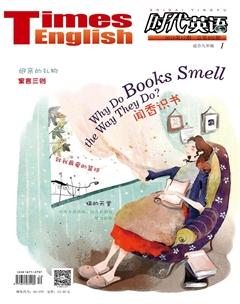
聞香識書
2018-05-14 13:28:01
時代英語·初中 2018年3期
If youre into reading, youll probably have noticed how a brand new book has a rather special smell. Yes, its that new book smell—and its quite different from the smell of an older book. Whats going on?
Books have been around for about 4,500 years. Some of the earliest books come from the fifth dynasty of Egypt, about 2,400 BC. They were written on papyrus—similar to modern paper, but thicker.
They made papyrus sheets by weaving together the stems of the papyrus plant into a sheet, and then smoothing out the bumps by pounding the woven sheet with some kind of mallet. But these were scrolls, a continuous roll of paper, rather than “the book” as we think of it today, which is a collection of individual sheets, stuck together along one edge so that the pages hinge on that side.
The book, in its modern form, began to appear around the first century AD. These books had the advantages of being easier to read than a scroll, easier to find a specific page, and you could stack them more efficiently than you could with scrolls.
In the early days, books were heavy and cumbersome. Each book had to be made individually by hand—with every word on every page written by a scribe.
So by 800 AD, a large library might hold only 500 books. Around 1045 AD, the Chinese inventor, Bi Sheng, came up with movable type made of earthenware—mud or clay, not metal.
Unfortunately, neither his printing press nor any books made with it have yet been found.
So the credit usually goes to Johannes Gutenberg for devising the printing press with movable type. He independently invented it around 1450 AD.
Suddenly, books could be produced much more rapidly. Adding steam power meant that by 1800 AD, a printing press could deliver over 1,000 sheets per hour.
So, where does the smell come from? Three sources—the paper, the ink and the glue.
The Chinese first came up with paper like our modern paper around 200 AD. This invention slowly spread westward to Muslim countries, and then to Europe.
Now theres a big difference between a lump of wood, and a sheet of paper. The wood has to be crushed, and then chemicals have to be used.
Chemicals have to be added to make the wood fibres swell, to remove acid, to bleach the paper to the desired grade of whiteness, to confer some degree of water resistance, to add a sheen to the paper, and so on.
Thats part of the smell: each chemical comes with its own odour.
And there are many different inks. Some inks fade with time, while others get darker.
Theres a huge range of glues that can be used to bind the sheets together along one side to form a hinge. Different glues again would be used to attach the covers, whether hardcover or paperback.
So you can see that there is an enormous range of different chemicals that can waft out of the freshly opened pages of your brand new book.
Even within the books of one publishing house, there would be many different chemicals used, depending on the purpose of the book. A cheap black-and-white paperback would use quite different chemicals compared to an expensive coffee table book with glossy colour pages.
The whole situation gets more complicated again as the book degrades. Not only will the inks and glues age and break down at their own rates, so too will the lignin and the cellulose in the paper.
Today, the evolution of books has continued into the digital revolution, with eBooks. They might be convenient, but you cant give your copy to another person as a present, and they dont smell as nice.
在中國古代,讀書人多有在書頁中夾蕓香草驅蠹的習慣。草有清香之氣,打開書后香氣襲人,這便是書香一說的來源。如今,風習不再,嶄新的書卻不乏撲鼻而來的獨特氣味,舊書亦如此,有時是淡淡的杏仁味兒,有時是香草味兒,有時是花香宜人……難道書中不僅有黃金屋和顏如玉?
如果你愛讀書,可能你曾注意到:一本嶄新的書會散發出一股奇特的氣味。沒錯,那就是新書的味道,與舊書的相去甚遠。其中奧妙何在?
書的歷史可追溯至大概4500年之前。公元前2400年左右,埃及第五王朝的一些書應屬最早的書籍之一了。它們用的是莎草紙——與現代紙張相似,但較之更厚。
埃及人把莎草的莖梗編織在一起,做成一大張莎草紙,然后用類似于木槌的工具連續砸擊其凹凸不平的表面,使紙變得平滑。但那時用的紙都是卷軸,即長長的一卷紙,而非我們所以為的現代意義上的“書籍”——紙被裁成一張一張的,沿一側粘貼起來,形成書脊。
公元1世紀左右,現代書籍開始出現,這樣的書籍與卷軸相比更便于閱讀,更容易翻到某一頁,也能更好地摞起來。
早期書籍過于笨重,成書過程復雜煩瑣。 每本書都是“手工”制作——古代抄寫員一字一句謄寫在書頁上。
因此,公元800年時,一家“大型”圖書館的藏書量可能僅有500本。公元1045年左右,中國的發明家畢昇發明了泥活字——使用泥土或黏土制版,而不是金屬。
不幸的是,他的印刷機和用之印制的書籍尚未被發現。
所以,人們常常將活字印刷機的發明歸功于約翰尼斯·古登堡——他在公元1450年左右獨立發明了活字印刷機。
忽然之間,書籍得以更快速地生產出來。到了公元1800年,蒸汽動力出現之后,一臺印刷機1小時就能印刷1000余張紙。
那么,書的氣味究竟從何而來?源頭有三: 紙、墨、膠。
公元200年左右,中國首先造出了類似現代紙張的紙。這項發明慢慢向西傳到伊斯蘭國家,然后再傳入歐洲。
一塊木頭和一張紙看上去差異巨大。木材必須碾碎,然后使用各種化學藥品進行處理。
加入化學藥品,使木質纖維膨脹,去除酸液,漂白紙張至想要的白度,使其具有一定的防水性,增添其光澤度,造紙需要進行上述等一系列的處理工藝。
每一種化學藥品都具有自己獨特的氣味,這就是書氣味的部分來源。
印刷時還會使用許多不同種類的油墨。隨著時間的推移,一些墨水慢慢褪色,另一些則越來越深。
沿書頁一側粘貼書脊時可用的膠水也是五花八門。同樣,在粘貼封面時——無論是精裝還是平裝——也會用到不同的膠水。
因此,當你剛剛打開一本嶄新的書時,一大堆各種各樣的化學品的氣味撲鼻而來。
即使是同一個出版社的書,書的定位不同,所用的化學品亦會不同。單色的廉價平裝書所用的化學品必然與亮麗的彩色印刷的昂貴咖啡桌配書完全不同。
隨著書籍的年頭越來越長,情況又愈加復雜起來。不光油墨和膠水會以各自的速度老化、分解,紙張中的木質素和纖維素也同樣在降解。
如今,隨著電子書的誕生,書籍的進化已經進入了數字革命時代。電子書倒是攜帶方便,可是你沒法將它們作為禮物贈送他人,而且它們聞起來可沒有紙書這么好。
Vocabulary
papyrus? n. 紙莎草紙
smooth? v. 撫平;抹平
efficiently? adv. 效率高地
cumbersome? adj. 復雜而低效的; 大而笨重的
devise? v. 設計;發明;策劃;想出
source? n. 來源;產地; (困難的)根源,原因
remove? v. (用化學品)去除,洗掉(污漬)