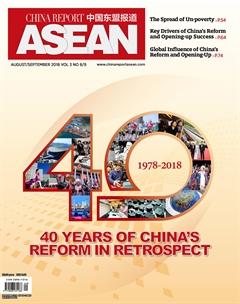
40—Year Reform Quest
2018-05-14 20:42:29ZhongXinmin
中國東盟報道 2018年8期
Zhong Xinmin
The year 2018 marks the 40th anniversary of Chinas introduction of reform and opening-up policy.
From 1978 to 2018, China has continued steady progress akin to “crossing the river by feeling for stones” as put by Deng Xiaoping, chief architect of the reform and opening-up. Across the four decades, China has produced earthshaking changes in terms of material wealth and peoples mental outlook, evidencing the historical significance of the epic journey of reform and opening-up.
“China began its historic reform and opening-up quest in 1978 when the Third Plenary Session of the 11th Central Committee of the Communist Party of China (CPC) convened under the direction of Deng Xiaoping,” Chinese President Xi Jinping noted in his keynote speech at the opening ceremony of the Boao Forum for Asia Annual Conference 2018 on April 10. “Over the last four decades, the Chinese people have continued forging ahead and written a glorious chapter of the development epic of the country and the nation, starting from rural areas to urban regions, from pilot zones to nationwide, and from economic restructuring to comprehensive deepening of reform and opening-up.”
Turning a New Page
In 1976, China ended the decade-long “cultural revolution” that had wreaked devastating destruction on the economy and society. Which path was right for the future? China had to make a choice.
In December 1978, the 11th CPC Central Committee convened its Third Plenary Session to rectify mistakes of “the cultural revolution,” and decided to shift the priorities of the nation and the Party to developing the economy and implementing policy of reform and opening-up. Like a spring breeze melting away a chilly winter, the stunning news enthralled the people and brought them new vitality.
In just one year from January 1978 to February 1979, Deng visited Myanmar, Nepal, DPRK, Japan, Thailand, Malaysia, Singapore and the United States. The visits, especially those to Japan and the United States, enabled Deng to determine Chinas relations to the outside world and develop the strategy of promoting common development with the world via win-win solutions through reform and opening-up. Deng stressed on many occasions that peace and development are the central themes of the world. On January 1, 1979, state heads of China and the United States exchanged congratulatory letters to celebrate the establishment of diplomatic relations. That same day, Peoples Daily published an editorial calling for the whole nation to concentrate on economic development. The day heralded both the inception of two historic missions: advancing domestic modernization and maintaining world peace and common development.
In January 1979, Deng paid a historic visit to the United States. Upon hearing the news, then Singaporean Prime Minister Lee Kuan Yew predicted that China would never again close its door. The trip marked a historic change and the dawn of a new era.
Land of Vitality
As the Chinese extended their arms to the outside world, at the same time they were undertaking domestic reform.
Traditionally an agricultural country, China saw 90 percent of its 1 billion population living in rural areas in the 1970s. Before 1978, rural residents were tethered to the farmland via the system of the peoples commune, known for the collective activities within them including preparing labor and meals together and sharing welfare.
Over 20 years of the practice caused problems including low agricultural productivity. In the winter of 1978, farmers in Xiaogang Village in Anhui Province took the initiative to adopt the practice of fixing farm output quotas on a household basis. The experiment proved a success when they welcomed a good harvest the next year. In April 1980, the CPC Central Committee recognized the practice and expanded the household contract responsibility system with remuneration linked to output nationwide, bringing vitality to the vast rural land.
The process of reform and opening-up brought myriad changes including the practice of fixing farm output quotas on a household basis to township enterprises, intensive processing of agricultural products, agritourism and rural e-commerce. More and more farmers have shaken off poverty and seized prosperous lives. Meanwhile, unchained from the land, some ventured to cities to seek fortune.
Chinas southern regions were the first to open to the outside world. In April 1979, the CPC Provincial Committee of Guangdong asked for policy support from the CPC Central Government to establish export-oriented manufacturing areas in Shenzhen, Zhuhai and Shantou, which are all close to Hong Kong and Macao and home to many overseas Chinese. The request was approved. The first pilot Special Economic Zone was 2.14-square-km Shekou Industrial Zone in Shenzhen. A host of innovation-driven businesses emerged in the city and talent swarmed in. From spearheading domestic development, Shenzhen is growing into an international innovation center.
In less than four decades, Shenzhens GDP rocketed to 2.24 trillion yuan in 2017 from 197 million yuan in 1979, over 11,000-fold. During the same period, Chinas economy multiplied more than 200 times, testifying to the success of Chinas reform and opening-up.
The past four decades have proven that reform and opening-up bring development opportunities to China. The country has become a member of the World Bank, the International Monetary Fund and the World Trade Organization and now contributes more than 30 percent of the world economy. As a developing nation, China has been actively participated in international affairs and fulfilled its obligations. To address common development issues, it proposed building a community with a shared future for mankind and is making more contributions to the peaceful development of the world.
Decoding the Chinese Miracle
Reform and opening-up policy is the secret driving Chinas leapfrogging development and how the nation and the people achieved a historic change.
Without emancipating the mind, there would be no reform and opening-up. The process was not at a loss for setbacks or difficulties and sated with constant questioning, debates and objections. At every threshold outdated mentalities were broken through to clear the way forward for Chinas transformation from a highly-centralized planned economy to a dynamic market-oriented one, from the closed and semi-closed state to a fully open market.
Economics Nobel Prize laureate Joseph Stiglitz attributed the success of Chinas reform and opening-up to an approach of being pragmatic and progressive, as he put at the China Development Forum held in Beijing late this March. It has been consensus among Chinese people that freeing the mind and seeking reform is an endless endeavor.
Socialism with Chinese characteristics is an institutional guarantee for the success of reform and opening-up. It is in line with Chinas reality and culture and improves with changing times. The capability to renew and reform internally is the secret reason why socialism with Chinese characteristics is an advantageous system in terms of politics, economics, culture and social progress. It has unleashed tremendous driving forces for development over the past 40 years as it facilitated Chinas transition from a planned economy to a market-oriented one, which freed untold productivity and fostered common prosperity as well as judicial reform, improved living standards, supply-side structural reform and institutional restructuring.
The people have been driving reform and opening-up forward. For a developing nation, the peoples aspirations for better lives are the fundamental driving force. Every breakthrough, innovation and experience is the result of peoples endeavor and wisdom, be it a village official leading his flock to affluence, an enterprising businessperson, a diligent researcher, a dedicated craftsman or an adventurous startup. “Chinese people are brave, innovative and ready to meet every challenge,” declared President Xi Jinping. “The 1.3 billion Chinese people are the real heroes driving the history.”
The vigorous reform and opening-up begun 40 years ago has generated tangible benefits to the people. Today, President Xi has called on the whole nation and entire Party to roll up their sleeves and work with greater energy for better lives. Reform and opening-up is still the most important political consensus in China.
Furthering Reform
Over the past five years, CPC central leadership with Xi Jinping at the core, has been committed to furthering reform. As a result, China has experienced more historical changes with reforms carried out in an unprecedented manner involving the widest range and the most entrenched interests. A host of policies relating to judicial reform, the anti-graft campaign, land reform in rural areas, the household registration system, enrollment system, public hospitals and ecological conservation have been put in place.
In the past five years, another 68 million people have been lifted out of poverty. As the rural revitalization strategy advances, farmer is becoming a promising profession, and agribusiness is thriving. More inclusive international city clusters are taking shape.
The integration of internet technologies with industries is accelerating, creating huge growth potential for traditional industries such as manufacturing. Facing structural problems, China is working to upgrade its economy with the focus shifting from quantity and scale to quality and performance.
By opening the door, Chinese people learned about the world, and the world also saw an open and developing China. The reform and opening-up is reshaping China and the world. China could not prosper without the world and, in turn, a prosperous China is beneficial to the world.
“The door of Chinas opening-up will not be closed but will only become wider and wider,” pledged President Xi Jinping at this new historical starting point. Today, China is more confident in expanding opening-up and more capable to write a new chapter for its reform and opening-up.
In this new era, China is committed to doubling its efforts to further comprehensive opening-up in a better way. An open China that is stable and prosperous and increasingly interwoven with the world will not only foster high-quality domestic development and meet peoples demands for a better life, but also contribute to exchange and connectivity among nations and inject vitality into world peace and prosperity.