FROM RAGS TO RICHES
2018-09-20 20:41:18ByWenQing
Beijing Review 2018年36期
By Wen Qing
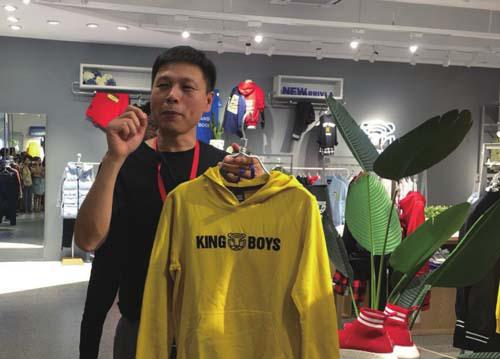
‘This pullover is made from 100-percent pure cotton. It is stretchy and comfortable for kids, and is also the latest style this autumn,” said Pu Xinquan, Managing Director of the King Boy & King Girl Clothes Co., while introducing a yellow childrens hoodie to a customer on August 22 at one of his stores in Zhili, a small town in east Chinas Zhejiang Province.
Like many other successful business people in the town, Pu did not receive much of an education and started working at an early age. He held many different posts, at one time a carpenter, at another a purchasing and sales clerk at a cement plant. During the 1990s, many people around him began to make a fortune in the childrens wear industry. Pu, seeing the huge business potential, took the plunge.
“In 1996, I bought 2 mu (1,333 square meters) of land and six sewing machines to build a small workshop, and started my career,” Pu told Beijing Review. At first, his small factory was only capable of original manufacturing for clothes companies in Shanghai. “We could only make meager profits in the early days, but we did gain some valuable industry knowledge. After practicing for a few years, I began to dream of having my own company and brand,” Pu said.
After two decades of development, Pus dream came true at last. His family workshop grew into the King Boy & King Girl Clothes Co., which registered sales of around 270 million yuan ($40 million) in 2017.
Pus story reflects the leapfrog progress of his hometown, Zhili, which evolved from a small, poor village into a prosperous town with one of the most thriving private economies in China over the four decades since the introduction of the reform and opening-up policy in 1978.
Childrens wear capital
Zhili, a small town located in Huzhou, has long been known as the center of Chinas childrens wear industry. There are around 13,000 companies producing 1.3 billion pieces of clothing in the town every year, which equates to more than 50 percent of Chinas childrens clothing. In 2017, Zhilis total GDP reached 20.3 billion yuan($3 billion).
Yet in the 1970s it was a rundown village where the local people struggled to eke out a basic existence. “At that time, Zhili was known as a backwater due to rapid population growth and limited arable land,” said Wu Zhiyong, Secretary of the Communist Party of China Wuxing District Committee in Huzhou.
Zhili remained this way until the implementation of reform and opening up in 1978. People in the town quickly responded to the new opportunities presented by the free market by promoting embroidered products such as pillowcases across China, a traditional local industry that had withered during the planned economy era.
In the mid-1980s, those with a sharp business mind switched to childrens wear, an industry in which the profits were much bigger. “Every household could become a small family workshop as long as it had a sewing machine,” Wu noted. The childrens wear industry boomed in Zhili throughout the 1990s following Deng Xiaopings speeches on his tour of the south in 1992, in which he called for local governments to take more measures to deepen economic reform.
However, development in this period was intensive and haphazard. In many small workshops workers lived, worked and stored materials in the same building. “The first floor was used as the shop, the second and third floors as dormitories and warehouses, which brought huge safety risks,” Sheng Ge, Deputy Mayor of Zhili told Beijing Review.
Disaster eventually struck. In 2006, two fires broke out resulting in the deaths of 23 people.“It was a painful lesson for our town. From that point on, the government implemented stricter rules requiring factories to separate living and manufacturing,” Sheng noted. The Zhili Government took immediate action after the fire and established various industrial production parks, such as the Qi Long Industrial and Innovation Park, which not only effectively separated workers living and manufacturing spaces, but also provided room for small factories to expand in size and capacity.
After four decades of development, Zhili has established a complete industry chain of childrens wear from design and manufacture, to storage, logistics and retail. “The concentration of related industries in Zhili earned it fame as the capital of Chinas childrens wear sector, a label of immeasurable value to the towns future development,” said Sheng .
Zhilis development has also provided opportunities for people from other parts of the country. The towns reputation has attracted 350,000 people from across China. For Cao Miaohong and his wife, who come from east Chinas Anhui Province, Zhili has become their second home. “My wife and I work as sewing machine operators at a childrens wear factory where we can earn 160,000 yuan($23,000) a year with a three-month holiday,” Cao said. The influx of people has in turn provided rich human resources for the further development of the industry in Zhili.
Brand building
Despite its success, Zhilis entrepreneurs are not about to rest on their laurels. In recent years, childrens wear businesses have been striving to upgrade themselves by nurturing more famous brands and expanding sales via e-commerce.
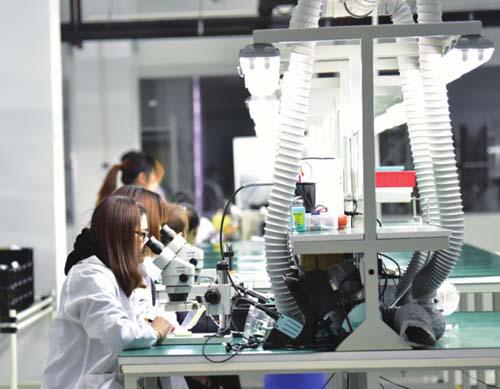
According to research provided by the local government, over 80 percent of the profit from one item of childrens clothing is generated by design and marketing processes. In 2013, the local government invested 20 million yuan ($3 million) in the construction of Chinas first design center for childrens wear, which is equipped with supporting facilities such as an independent studio, catwalk and design salons.
“Many small factories used to imitate the styles of other brands as they had no professional design teams, among which Qirui & Deze was a prime example. But imitation meant that these companies lacked clear positioning and style,” Ye Fangping, Operation Manager at the design center, told Beijing Review.
After the establishment of the center, more than 20 design teams with 240 resident designers moved in. “Our center cooperates with different companies with various business models. Small companies come to buy templates directly. For companies with their own design capacity, they cooperate with us to develop multiple series,” Ye said.
Through efforts to improve their design capability, many companies have succeeded in building distinguishable brands. The clothes of Qirui & Deze are now defined by cotton and linen materials in pastoral style, according to Ye.
The Zhili Government is also planning various measures to help companies enhance their comprehensive strength and competitiveness. It is set to establish a China Childrens Wear College in cooperation with Hangzhou Vocational and Technical College, aiming to cultivate talent for the Zhili childrens wear industry.
Besides improving design capacity, companies are also making efforts to upgrade their marketing methods. With the rise of e-commerce, businesses are aiming to expand their sales through the Internet. With a population of over 3,000, Dahe, a village under the administrative control of Zhili Township, has more than 700 e-commerce companies. Thirty-yearold Ren Kunpeng, from central Chinas Henan Province, opened an online childrens wear store called Mu Le from the village, through which he now sells 4,000 items every day. “I can earn 1 million yuan ($140,000) a year and many people from my hometown have begun asking me about the possibility of coming over here next year.” Ren said.
E-commerce has also provided companies in Zhili with access to foreign markets. Ma Weizhong, Managing Director of B.YCR Kid Co., was among the first to take advantage of crossborder e-commerce to sell childrens clothing to foreign markets. Today, the company has an established e-commerce department and its own e-commerce platform. Its products are exported to more than 10 countries and regions, with sales exceeding $1,500 per day.
In order to conserve resources and focus on design and sales, more and more companies in Zhili are outsourcing their manufacturing. In 2017, 450 million pieces of childrens wear were processed outside the town, accounting for 34.6 percent of its total output. This strategy has contributed to the development of other, more economically underdeveloped, areas outside the province, according to Sheng.
Entrepreneurial spirit
The tale of most entrepreneurs in Zhili is one of rags to riches, and they continue to display the hardworking spirit of their roots as they strive to keep apace of rapid development in science and technology. Many, having made major progress in their business ventures, also participate in charity work in an attempt to give back to society.
For 62-year-old Shen Xinfang and his son Shen Xiaoyu, 2017 was an extraordinary year. Their business, the Tony Electronic Co.(Tony Tech), was listed on the Shanghai Stock Exchange. The predecessor to this technology company was a woolen sweater factory founded by Shen and his son in 2001.
“I first came to know about ultra-fine electronic wire in 2005 during a business trip to South Korea. After some research I felt that the industrys prospects were promising, so I decided to test the water,” the younger Shen, now General Manager of Tony Tech, told Beijing Review.
“Whether to keep on with our woolen sweater factory, which was already producing huge profits, or move into a new industry with zero experience was a critical choice,” said Shen Xinfang, who now holds the position of the companys CEO.
Driven by their entrepreneurial spirit, they finally took the plunge and established Tony Tech in 2008. Today Tony Tech has become one of the leading companies in China producing ultra-fine electronic wire, and has built partnerships with Apple, Siemens and other major international companies as their core supplier.
“Entrepreneurs should not only think about making profit. We must also give back to society,” said Pan Axiang, CEO of Axiang Group. An illiterate former farmer, Pans success story is inspiring. Although he cannot read or write, he watches political and economic news broadcasts on television every day to gain a better understanding of national policies, a habit which has helped him find many new business opportunities.
In the late 1990s, answering the governments call to develop the telecommunication industry, Pan acted quickly and built a small cable factory, which went on to become the basis of his business conglomerate.
Carefully marrying national policy with the needs of the market has been the key to Pans success. Today, his Axiang Group has expanded to include business ventures in aluminum alloy, linen and textiles, and equipment manufacturing, with sales of 3 billion yuan ($400 million) in 2017.
Increasing in tandem with Pans business success are his philanthropic projects, and he has donated 80 million yuan ($11 million) to charity in recent years. “We entrepreneurs have benefited a lot from society, and we must give back,” he said.