
Should Bookstores Continue To Be Free to Wander?
2018-10-31 14:47:06
Beijing Review 2018年42期
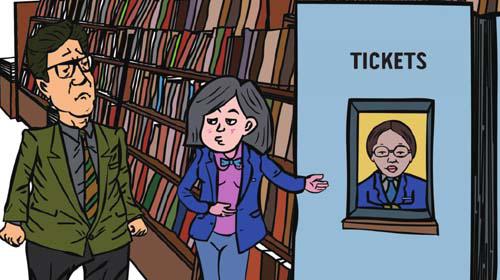
Given that a large number of people who go to bookstores do not buy books, but only go to read books and use bookstores as free libraries, some Chinese bookstores have begun to charge an admission fee.
A bookstore in Shijiazhuang, north Chinas Hebei Province, began to charge a 20-yuan ($2.89) admission fee as of September 18. If a customer ends up buying a book, the 20-yuan ticket can be used as a coupon. In addition, once a ticket is bought, a person can enter the store several times on the same day. There is also a 5-yuan ($0.72) ticket, which allows people into the store but cant be used as a coupon.
The bookstore named A Study in the City was formally opened early this year, but operational costs continued to rise and sales were fl at leading the bookstore to operate at a loss six months in a row. Thus the idea of charging an admission fee was hatched.
As to whether this is a good idea, some people believe it is because nowadays most people going to bookstores do not intend to buy books. They read and use books, wear them out, resulting in a big loss for bookstores. Others point out that if customers think it is acceptable and are willing to pay, and bookstore revenues begin to grow, then it will result in a good strategy. If people are not willing to pay, however, then it will not be a good scheme in the long run.
A rational practice
Yuyuanzatan (Science and Technology Daily): Its hard for most people to accept the newly imposed bookstore entrance fee, but this is by no means a reckless decision.
Today, brick-and-mortar bookstores are grappling with growing pressure from higher book prices resulting from rising paper, labor and operation costs as well as competition from online shops and e-books. In the past, people were willing to buy books in bookstores although buying online may have saved them money. But nowadays, the price gap between the two is so large that most people are driven to online shops.
Many people who browse at a brick-andmortar bookstore tend to compare the price tag with online prices. In most cases, if they fi nd a book that interests them, they will not buy it in an actual bookstore but will turn to online shops which usually sell at a lower price. These people are actually a bookstores worst customers.
In recent years, many big bookstores or shopping malls have set up mini cafés and begun to sell cultural products so as to attract more readers, or rather, potential buyers. However, their revenue tends to mostly come from the other two services, instead of book sales.
To some extent, it seems that to charge an admission fee is a rational practice for bookstores. When going to an exhibition or a museum, people usually acquire some new knowledge and may sit and sip a cup of coffee. They may even buy some souvenirs. Thus they are asked to pay for this experience.
However, bookstores are different from these venues; what attracts people is books not exhibits. Shopping malls do not charge an admission fee just because customers come only to watch movies or have a snack, but do not buy any clothes or merchandise.
Of course, since there is still no best way out for brick-and-mortar bookstores, such a new practice is worth trying. If the bookstores products and services are worth the money customers pay, then its all right. Ultimately, it will be the market that will have the final say. Consumers dont need to worry that they will have no access to books.
He Yong (www.qlwb.com.cn): Most brick-and-mortar bookstores are struggling to survive in the face of challenges from both online shops and e-books. To charge customers to enter a bookstore can be easily seen as an insane practice, unacceptable to the vast majority of customers. It seems that bookstores are distancing themselves from customers with the fee.
However, bookstore owners are not idiots. They chose the ticket business model based on realistic problems. Customers in bookstores are different from those in shopping malls. The latter need a large traffi c fl ow to tap into potential customers. However, many people who go to bookstores to read or have fun will never become buyers. Therefore, constant traffi c is not so important to a bookstore.
A large number of people see bookstores as free libraries where they can stay for half a day or even a whole day. Bookstores always have a lot of books that are frequently read that are quite dilapidated, but these books will never find their way to a customers home. Some parents leave their children in bookstores for the entire day, especially during summer and winter vacations. Meanwhile, some people go to bookstores to see whether they have any interesting new books and then buy the books they fi nd online.
They are never potential customers and bookstores dont need such customers. They are not bringing tangible benefi ts to bookstores but instead are doing harm to these stores and adding to their operational costs.
Actually, real potential customers will hardly be affected by the admission fee. If they buy a book more expensive than 20 yuan, they will get a 20-yuan coupon. The ticket, to some extent, only blocks those who mean to take advantage of bookstores and makes bookstores a place for those who really intend to buy a book.
A bookstore trend
Cen Rong (Daily Business): If customers only read but never buy books, bookstores will have to bear the high cost of rent, air conditioning, and electricity alone. In this sense, its reasonable to charge a fee. However, this may not be a far-sighted strategy.
Shops always hope to see as many people as possible, whether they buy something or just have a look. They will never charge fees because they know that even if people dont buy things today, they are all potential customers in the future.
By charging entrance fees, bookstores are actually blocking potential customers who greatly outnumber current customers. People go to bookstores because they want to buy one or two books, but of course, they may not fi nd the books they really want every time they enter. Twenty yuan is sometimes the full price of a book, or at least a large part of the price. Thus, the entrance charge is a bit too high.
Nowadays, more and more bookstores have begun to sell other things besides books, such as arts and crafts products and various souvenirs. Many also provide coffee, tea and snacks. Bookstores are thus developing into a place people can read and have fun.
Maybe a lot of people go to bookstores just for fun and dont intend to buy any books, but by no means should they be despised by the shops. They do not buy books, but they might buy coffee and interesting souvenirs, which make up a big part of a bookstores revenue.
Brick-and-mortar bookstores pale in comparison to online bookstores in terms of pricing, but they still have their own advantages. If welloperated, they will never be surpassed by online shops. He Ke (Anhui Daily): A fee-charging bookstore may be fresh news in China, but it is already practiced in other countries. For example, Portugals Lello Bookstore is one of the worlds oldest bookstores and is also among the most beautiful and attractive stores in the world. Every day, it receives about 5,000 visitors and charges an admission ticket of 5 euros ($5.75). The admission revenue alone brings a substantial amount of money to the bookstore.
Although it is no match for Lello Bookstore in some aspects, the Shijiazhuang bookstore A Study in the City is still quite attractive in terms of its decor, service and most importantly the quality of its books. Bookstores have a responsibility to spread culture and knowledge, but as a business they also need profi ts to survive. Today, more and more brick-and-mortar bookstores are experiencing operational difficulties and decreasing revenue. In this case, the operational model needs to change and it can include selling admission tickets.
Those who only go to bookstores to take advantage, enjoy the environment and read books free of charge will not contribute money to bookstores but are actually eating into the shops.
The ticket will help to sift real and potential customers from the rest, thus saving costs on bookstores daily operations and allowing limited resources to be better used to serve real customers. Those who are unwilling to pay for reading can go to free libraries.
Faced with competition from online stores among other challenges, brick-and-mortar bookstores have good reasons to attempt to charge admission fees.
