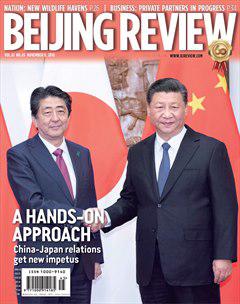
A PRAGMATIC PARTNERSHIP
2018-11-22 10:22:20ByLiuJunhong
Beijing Review 2018年45期
By Liu Junhong

The relations between Asian neighbors China and Japan have got back on track with the exchange of visits by Chinese Premier Li Keqiang and Japanese Prime Minister Shinzo Abe in the same calendar year. As the worlds second and third largest economy respectively, the warming of ties between China and Japan is not only good news for their two peoples but also for the world economy, especially against the backdrop of the prevailing trade protectionism.
Warming ties
Since China overtook Japan to become the worlds second largest economy in 2010, its stature has been growing in the global economic structure. In 2014, Chinas total economic output exceeded $10 trillion for the first time, taking it even closer to the center of the world stage. There are three economies today that have a GDP of more than $10 trillion—the United States, the European Union, and China. This is the reason economists think a three-pole economic system is emerging while Japan has fallen behind.
China shares the fi rst place with the U.S. vis-à-vis the total import and export trade volume while its exports are 1.4 times that of the U.S. today, Chinese border ports are the busiest hubs of visitors, capital, goods and information or data.
In the past seven years, the heads of major countries led delegations to China, building landmark trade and economic relations and promoting the expansion and upgrading of industrial chains. Due to frozen China-Japan political relations, Japan failed to catch up with the other countries in cooperating with China, and the division of labor and trade and economic relations between the two lagged behind the world average. Abes visit was a journey to gloss over the gap.
With trade protectionism, populism and anti-globalization prevailing under U.S. President Donald Trumps administration, trade frictions have brought great pressure to China-U.S. and Japan-U.S. economic ties. China-Japan relations, therefore, need to be more stable to withstand the potential risk. The leaders of both countries are actively undertaking responsibilities for the development of their nations and also for regional stability and prosperity. They chose to restart normal exchanges and return to the right track.
In fact, as early as in November 2014, the leaders took the initiative to create conditions for multilateral meetings and during the Asia-Pacific Economic Cooperation Summit in Beijing, reached a four-point agreement on improving bilateral relations. Since then, both countries have been promoting non-governmental exchanges.
In his meeting with a Japanese nongovernmental delegation in Beijing on May 23, 2015, Chinese President Xi Jinping emphasized that “the China-Japan friendship is rooted in the people, and the future of the bilateral relationship is in the hand of the people of the two countries. The more obstacles we face in bilateral relations, the more we need to strengthen people-to-people exchanges, creating conditions to improve the bilateral relationship.” He also said the two countries should “manage historical issues, and prevent new issues from emerging” to overcome the “stumbling blocks.”
This set the tone for the development of China-Japan relations in the new era.
This year, Premier Li Keqiang visited Japan in May to attend the seventh meeting of the leaders of China, Japan and South Korea, an important opportunity to strengthen the normalization of bilateral relations. It was followed by Xi meeting Abe in Vladivostok in September on the sidelines of the Eastern Economic Forum during which the Chinese president told Abe the Belt and Road Initiative can be a new platform for the two countries to deepen cooperation.
Abes official visit to China and the signing of more than 50 cooperation agreements during the visit have shown the people of both countries the fruits a strategic and mutually benefi cial relationship can bear.
Wider cooperation
Abes visit, coming in the wake of the fourth industrial revolution, shows adaptation to the requirements of a fast changing world. It provides an opportunity for the two countries manufacturing industries to upgrade their capacities. Each era has its leading technologies and industries. Take the 1990s for example. The information technology(IT) revolution in the United States Silicon Valley ushered in a golden decade for the U.S. economy and propelled the rest of the world into the IT era. In this new era, people can learn from that revolution.
In the IT and Internet era, technologies are changing the mode of manufacturing and promoting industrial upgrading and progress. As globalization deepens, crossborder capital movements have become much more frequent, technological innovations are becoming popular worldwide, and industrial and product standards are becoming internationalized. The Internet of Things has enabled cross-border integration of manufacturing industries, which will accelerate the globalization of production. Enterprises from all countries are integrated and interdependent, resulting in crossborder division of labor and large-scale intra-industry and intra-enterprise international trade. Traditional trade and investment has undergone a sea change with multinational enterprises and products giving rise to a new concept of regional origin.
In this era, China and Japan, both worldclass manufacturing countries, need to break into the ranks of world manufacturing powers and promote the digitization and intelligentialization of industrial chains, setting up a world standard. This requires the two governments to establish new and sound rules for their respective enterprises and meet each other half way.
During their talks, Xi and Abe not only saw great prospects of industrial development and cooperation, but also took into consideration the risks and issues existing between the two countries and within the region. They are seeking to manage economic cooperation and safety issues separately while dealing with bilateral relations. The consensus is that there should be more coordination than competition.
More third-party market cooperation for both countries to jointly safeguard and improve a free, open and fair multilateral trading system should be encouraged. In the economic field, the two leaders have proposed cooperation in new areas, jointly exploring new ways of working together in third-party markets, new technologies and currencies. If carried out under the framework of the Belt and Road Initiative, this would avoid cutthroat competition and boost regional common development.
Future commitments
It is estimated that the infrastructure needs of Asias developing countries will reach $26 trillion from 2016 to 2030, or $1.7 trillion per year, according to an Asian Development Bank report. Extensive regional financing cooperation is needed to meet this demand, which will not only provide new space and fields for cooperation and development, but also opportunities to jointly build a stable environment and achieve regional integration. Regional infrastructure construction is indispensable for economic development and conducive to common prosperity. They can play an active role in building telecommunication, transportation, logistics, water resources and healthcare infrastructure.
During Abes visit, a forum on third-party market cooperation was held in Beijing with more than 1,000 participants mainly from the two countries, demonstrating the two sidesdetermination and professionalism.
Besides traditional bilateral geopolitical and security issues, the leaders also had in-depth exchanges on non-traditional security issues such as climate change, environmental problems, natural disasters and terrorism. They discussed the threats mounting protectionism, populism, and anti-globalization pose to peace and development in Asia, China and Japan in particular. The leaders concurred that the two countries should assume their responsibilities, enhance mutual trust and strengthen cooperation and coordination.
During the visit, leaders of the two countries also agreed on more mutual visits between military-related departments, establishing a maritime rescue system, and negotiating to jointly exploit maritime resources and address global and regional financial risks. They exchanged frank views on a free and fair trade system.
The relationship between the two countries is returning to the right track, with priority given to bilateral exchanges and assuming responsibilities in economic development and international affairs. The world is changing rapidly and China and Japan are changing too. The thoughts and methods of dealing with their bilateral relations must keep up with the tide of globalization and the world situation. The two big countries can work together to promote development and safeguard peace, bringing benefits to the people of both nations.