
Mild stir-assisted membrane dispersion for enhancing propionic acid extraction☆
2019-02-09 08:16:52XiaoyanZhengDongFengLiangrongYangJunfengHuiJiemiaoYuQiyuMengHuizhouLiuDaidiFan
Xiaoyan Zheng,Dong Feng,Liangrong Yang*,Junfeng Hui,Jiemiao YuQiyu MengHuizhou Liu*,Daidi Fan,*
1Shaanxi Key Laboratory of Degradable Biomedical Materials,Shaanxi R&D Center of Biomaterials and Fermentation Engineering,School of Chemical and Engineering,Northwest University,Xi'an,710069,China
2College of Life Sciences,Northwest University,Xi'an,710069,China
3Key Laboratory of Green Process and Engineering,State Key Laboratory of Biochemical Engineering,Institute of Process Engineering,Chinese Academy of Sciences,Chinese Academy of Sciences University,Beijing 100190,China
Keywords:Membrane dispersion extraction Propionic acid Triocylamine Tributyl phosphate
ABSTRACT Mild stir-assisted membrane dispersion extraction(MDE)method was employed to enhance propionic acid(HA)extraction and compared to the mechanical stirred extraction(MSE)method.Triocylamine(TOA)and tributyl phosphate(TBP)were chosen as model extractant to extract HA.Firstly,droplet size and the size distribution of organic phase were analyzed,and then the effects of phase ratio,extractant and HA concentration on extraction performance were investigated.Comparing the two extraction methods,the results show mild stir-assisted MDE method reduced the mass transfer equilibrium time compared to MSE method.The mass transfer mechanism was explored by analyzing mass transfer resistance.Mild stir-assisted MDE had less total mass transfer resistance than MSE.When the extractant concentration was 40%,the extraction process was controlled by organic phase mass transfer process with HA volume fraction was 1%and controlled by both of reaction process and organic phase mass transfer process when HA concentration increased to 5%.This work may provide a new type of extraction method for the recovery of organic carboxylic acid.
1.Introduction
Propionic acid(HA)is a kind of important fine chemical and basic chemical raw material,widely used in food,feed,rubber,plastics,paint,spices,printing and other fields[1,2].Producing HA by the biological fermentation method has received more and more attention due to the advantages of mild conditions,low price and high economic benefit,et al.[2-6].Recovering HA from the fermentation broth is a promising and challenging work[7-9].The conventional methods for recovering carboxylic acid include precipitation[10],crystallization[11,12],adsorption[13],liquid ion exchange[14],extraction method[15,16]and so on.
Extraction method is widely used due to it possesses the advantages of high selectivity and easy of continuous operation.However,the HA concentration in fermentation broth is usually lower than 10% (w/w)[17],and the composition of the fermentation broth is complicated by proteins,medium residues,etc.While the traditional extraction process usually requires intense mechanical agitation,which will lead to emulsification,loss of organic phase,cost loss,etc.[17-19].To solve the problems,the novel and efficient operation extraction method has become a research hotspot.
Membrane dispersion extraction utilizes microporous membrane as phase-dispersed medium.The pressure difference between the two sides of the membrane is higher than that of the penetrating pressure,dispersing the dispersed phase into the continuous phase,which realize the mass transfer.The MDE method does not require intensely stirred but achieves the desired micron-sized droplets by adjusting the membrane pore size,etc.Therefore,the application of the MDE method to recover HA in the fermentation broth might solve the problem such as loss of organic phase,and emulsification,etc.Mashallah et al.[20,21]reviewed the method of solving membrane fouling and the application of different types of membranes in wastewater treatment to greatly promote the development of membrane dispersion process.
Many researchers have tried to develop the membrane dispersion reactors and mass transfer mechanisms.For example,Wu et al.[22]used ceramic membrane micro-extractor re-extraction penicillin G(PEN G),under the optimal conditions the re-extraction efficiency of PEN G achieved 99%and the degradation rate of PEN G(D)decreased to 0.5%.Chen et al.[23]studied the extraction of Nd(III)using 2-ethylhexyl phosphoric acid-2-ethylhexyl ester as extractant via microfluidic-based hollow droplet.Results showed the extraction efficiency was higher than 90% even at a high phase ratio of 200.In summary,the membrane dispersion technology could be used to enhance the extraction process.Muhammad et al.[24]studied the CFD simulation of TFA extraction copper(II)during non-dispersive membrane extraction.However,the related researchers were almost focused on the rare earth elements,etc.[25,26].Moreover,some operation problem will happen to the MDE process.Such as,the coalescence of dispersed droplets on the membrane surface due to the infiltration of extractant when there is no cross-flow shear force.
Thus,in this manuscript,mild stir-assisted MDE method was explored to extract HA.Two common model extractants for organic carboxylic acid extraction including TOA [27-29]and TBP [30,31]were studied.Problems such as organic phase coverage on the membrane surface could be effectively solved with the mild stir-assisted membrane dispersion method.And it can be applied to the fermentation liquid system,micron level droplets can be obtained without intense mechanical stirring,propionic acid can be recovered efficiently,and emulsification can be avoided at the same time.Finally,the total mass transfer resistance and the percentage of mass transfer resistance of the organic phase were studied to reveal the mass transfer mechanism.
2.Experimental
2.1.Reagents
Propionic acid [purity > 99% (mass fraction)]was supplied by Shanghai Aladdin Bio-Chem Technology Co.,LTD,china;Tributyl phosphate [purity >98.5%(mass fraction)]was bought from Beijing chemical reagent company,china;Sulfonated kerosene was supplied by Shanghai Rare-Earth Chemical CO.,LTD,china;Triocylamine[purity>95.0%(mass fraction)]was provided by Beijing chemical reagent company,China;Octanol was supplied by Beijing chemical reagent company,China.All reagents in this experiment are of analytical grade.
2.2.Extraction device and procedure
Membrane dispersion medium was made with porous glass sand core(GSC).The schematic diagram of the mild stir-assisted MDE equipment is shown in Fig.1a,and Fig.1b shows the droplet dispersion diagram of MDE method,Fig.1c shows the simple drawing of the MSE method.Membrane dispersion extraction column mixing room size is 50 mm×50 mm×1000 mm.
Porous GSC with acid and alkali resistance and excellent physical and chemical properties,hydrophilic surface was used to disperse the organic phase.And the Porous GSC possesses the advantages of wide source,low cost and physical and chemical modification of the surface.Porous GSC has a diameter of 50 mm,thickness of 5 mm.The droplet dispersion behavior of 4 kinds of membrane pore of GSC was analyzed,the pore diameter of the porous GSC of No.1-4 was 80-120 μm,40-80 μm,15-40 μm,and 5-15 μm,respectively.
Procedure for mild stir-assisted MDE:The organic phase(O)was used as the dispersed phase,and aqueous phase(A)was used as the continuous phase.Two phases were flowed into the membrane dispersion device by peristaltic pump (purchased from Baoding Longer Peristaltic Pump Co.,Ltd).The dispersed phase flowed through porous glass sand core (from bottom to top)into reactor,while continuous phase flowed(from top to bottom)into reactor.Agitating oar stirred rate was(200±10)r·min?1,and both phase flow rates were set at 250 ml·min?1.After the two phases were stabilized,the light phase was recirculated and dispersed several times(multi-stage extraction until equilibrium).And then the dispersed phase was collected by the extraction phase collection chamber,the continuous phase was collected from the raffinate phase collection chamber,and 1 ml of the raffinate phase sample was collected for detection.In this experiment,dispersing the dispersed phase 4 times,and one mass transfer time is 15 s,the total mass transfer time is 60 s.
Covering with organic phase layer in the membrane surface is unavoidable,which can seriously affect the normal working life of membrane.Keeping the rotation at a high speed can destroy the structure of substances such as proteins in the fermentation broth[32].However,mild stir can effectively avoid the problem of covering the organic phase by producing shear force,and effectively avoid the problem of membrane emulsification.
Procedure for MSE:HA aqueous solution and organic phase solution was poured into beaker.The mechanical stirrer(purchased from SENCO Technology Co.,Ltd)stirred to extraction balance at(400±20)r·min?1or (200 ± 20)r·min?1,the mixture solution was left standing and phase separated,measuring the HA concentration of raffinate phase.
2.3.Analysis of droplet
The images of droplet produced by the extraction process were captured by the high digital camera(PENTAX K200D.Japan).We used the computer software photoshop to open the captured image,magnified the image 20 times,and counted the droplets in this picture with the help of the ruler and then calculated the size of the droplet.The Sauter mean diameter Ddswas used to calculated the dispersed phase droplet size[33]:


Fig.1.Extraction devices.(a)1—Dispersed phase,2—Peristaltic pump,3—Membrane dispersion medium,4—Raffinate phase collection,5—Extraction column,6—Continuous phase,7—Extraction phase collection,8—Stirred paddle;(b)Droplet dispersion diagram by membrane dispersion medium;(c)the simple diagram of a mechanical stirred extraction device.
where Ddiis the droplet size,nistands for the number of droplets with size of Ddi.
There were two types of force in the formation stage of droplet,the adhesion force(blocking the droplet from the membrane surface)and the release force(removal of liquid droplets from the membrane surface).Adhesion force was mainly referred to the interfacial tension(Fγ)[34]of droplets and membrane pore,and release force included drag force(Fd)[35],static pressure force(Fsp)[36],dynamic lift force(Fdl)[37],buoyancy (Fb)[38]and inertial force (Fi)[39].Table 1 describes the force and force expression of the droplets during the formation phase.

Table 1 Force analysis of organic phase droplet
According to the balance of forces,the following formula can be calculated[38,40,41]:

According to Rayner et al.[42]found that for micron-sized droplets,inertial and buoyancy are 9 and 6 orders of magnitude smaller than the drag and interfacial tension forces,respectively.Kosvintsev et al.[43].established a model of the force balance considering only the interfacial tension and drag force for the flat membrane with the stirred paddle and according to the force analysis,the formula for calculated the droplet size can be obtained as follows:

where τ means the shear stress(Pa)and in this paper the shear stress is caused by the continuous phase rotation of the membrane surface[40].
2.4.Analysis of mass transfer performance
The HA concentration in the raffinate phase after extraction was measured by high performance liquid chromatography (HPLC),and the HA concentration in the extraction phase was obtained by mass balance.The extraction efficiency and mass transfer coefficient are commonly used parameters that can indicate the extraction performance.Extraction efficiency(E)is defined as the follows:

where C0refers to the initial HA concentration in the aqueous phase,mol·L?1;Caqand Corgrefer to the HA concentration in the raffinate phase and extraction phase,mol·L?1.
Kta:the volumetric mass transfer expression(s?1)is as follows[44]:

where dC represents the variation of HA concentration in the aqueous phase during the period time of dt;a is the specific area (m2·m?3);Ktrepresents the total mass transfer coefficient (m·s?1);ΔC shows the difference in concentration of HA in aqueous and organic phases(mol·m?3).For the extraction process of HA and extractant,the intrinsic kinetics are very fast,HA can be consumed almost instantaneously in the droplet,and the difference in concentration between droplets can be expressed as:

Combining Eqs.(5)and(6)we can get the following equation:

Eq.(7)can be converted into the following expression:

where φ is the volume ratio of continuous phase to the dispersed phase.The formula for the volumetric mass transfer can be obtained as follows:

3.Results and Discussion
3.1.Droplet size and size distribution during extraction process
Fig.2(a-d)corresponds to droplet micrographs of GSC with different membrane pores and Fig.2e is the droplet photomicrograph of MSE method with(400±20)r·min?1.From Fig.2(f),the droplet size distribution of the MDE method is(Dp=80-120 μm),and Fig.2(g)shows the comparison between the experimental value and the predicted value via MDE method.When the membrane pore size increased from 10 μm to 100 μm,the corresponding mean droplet size increased from 72.4 μm to 264 μm;it is obvious that the droplet size increased with the increase of membrane pore size.The droplet size in the MDE method is affected by the membrane pore under the same flow flux.The mean droplet size obtained by MSE(400 r·min?1)method is 350 μm;uneven droplet size distribution.MDE method showed smaller droplets compared to the MSE(400 r·min?1)method.Droplet specific surface area increased with the decrease of droplet size,which is beneficial to strengthen the mass transfer process and increased the extraction efficiency[45].
From Fig.2(f-g),the size distribution of the droplets is relatively uniform,and the droplet sizes are mostly concentrated in the range of 250 μm to 300 μm.Uneven droplet size distributions by MSE method(400 r·min?1),and the repeatability of the droplet size is poor.Fig.2h shows that the experimental values are in good agreement with the predicted values.Inorganic porous glass sand core can basically obtain droplets of uniform size.
3.2.Extraction performance of mild stir-assisted MDE method
In all experiments,the extractant concentration was set to 40%(except for the effect of extractant concentration),and the HA volume concentration was 1% (except for the effect of HA concentration),phase ratio(A/O)was set to 5:1(except for the effect of the phase ratio).

Fig.2.The picture of(a-d)shows the droplets corresponding to the GSC with different membrane pores,(a:Dp=80-120 μm,b:Dp=40-80 μm,c:Dp=15-40 μm,d:Dp=5-15 μm),and(e)MSE method with 400±20 r·min?1;(f-g)droplet size distribution of MDE(200 r·min?1)with membrane pore size of 80-120 μm and MSE(400 r·min?1),respectively;(h)shows the comparison between the experimental values and the predicted values.
Fig.3 shows the effects of extractant concentration,HA concentration and phase ratio(A/O)on the extraction performance(E,Kta)via the mild stir-assisted MDE method.The results indicate that both E and Kta increased gradually and then decreased gradually with the increase of the TOA concentration.There are currently two explanations for the reduction of extraction efficiency.Maisuria et al.[46]believes that the TOA concentration increases mean that the diluent concentration decreases,so the solvation effect of the extractant complex by the organic phase is weakened;Kang et al.[47]believes that the extractant forms aggregate at high concentrations,hindering its binding to the acid molecules.
While for the TBP system,the E and Kta are proportional to the TBP volume concentration.The increased extractant concentration caused the amount of the extractant complex to increase.For the both systems,the extraction performance(E,Kta)decreased with the increase of HA concentration and phase ratio.The results show that the extraction performance(E,Kta)of TOA system was significantly better than that of TBP system for extracting HA because TOA and HA form extractant complex by ion association and hydrogen bonding,and TBP forms extractant complex with HA only by hydrogen bonding.
3.3.Comparison of equilibrium extraction efficiency of MDE and MSE method
Fig.4 shows the comparison of TOA and TBP as extractant on the E between the two methods,respectively.For TOA system,the E of the MDE(200 r·min?1)method reached about 83%at 60 s,the E of MSE(400 r·min?1)reached about 83% at 150 s to 180 s,and the MSE(200 r·min?1)method takes about 600 s.The results show that the mass transfer rate of the MDE(200 r·min?1)was about 2.5-3 times faster than that of the MSE (400 r·min?1)method,and about 10 times faster than the MSE(200 r·min?1)method.
For TBP system,the E of MDE(200 rpm)method can reached 42%at about 45-60s,the equilibrium E of MSE method reached 42%at 120 s when stirred rate was set to 400 r·min?1and equilibrium E of MSE(200 r·min?1)reached 42% at 330-360 s.The mass transfer rate of the MDE(200 r·min?1)was about 2-2.7 times faster than that of the MSE (400 r·min?1)method,and about 7 times faster than the MSE(200 r·min?1)method.
It is obvious that TOA has better extraction efficiency than TBP for extracting HA,this result is consistent with Amit Keshav[48]conclusion.TOA and HA are combined by hydrogen bonding and ion association,and TBP is combined with HA by hydrogen bonding.
TOA and HA are combined by ion association(Eq.(10))and hydrogen bonding(Eq.(11)).

TBP is combined with HA by hydrogen bonding Eq.(12).

Mild stir-assisted MDE method achieves faster mass transfer balance compare to MSE.Because MDE method increased the contact area between organic and aqueous phase and promoted the interphase mass transfer reaction.

Fig.3.Shows the effects of extractant volume fraction,HA concentration and phase ratio(A/O)on equilibrium extraction efficiency and total volumetric mass transfer coefficient via the mild stir-assisted MDE method(organic phase is cycled four times).

Fig.4.Shows the comparison of E of mild stir-assisted MDE and MSE method when TOA and TBP as extractant,respectively.Organic phase is cycled four times,VHA=1%,VB=40%,phase ratio(A/O)=5:1.
3.4.Analysis of mass transfer mechanism in the MDE and MSE reactor
Revealing the mass transfer mechanism by analyzing the mass transfer resistance of the extraction process.The total mass transfer coefficient Kt(m·s?1)can be obtained by the total volumetric mass transfer coefficient obtained above:

where a is the interface area per volume(m2·m?3):

where R is the volume ratio of the dispersed phase to the continuous phase.
The reciprocal of the mass transfer coefficient can be used to indicate the change in mass transfer resistance.In the both systems,the effects of HA and extractant concentration on the mass transfer resistance via mild stir-assisted MDE method were shown in Fig.5.

Fig.5.Effects of HA and extractant concentration on mass transfer resistance for the both systems via mild stir-assisted MDE method.Organic phase is cycled four times,phase ratio(A/O)=5:1.
From Fig.5,for both systems,the 1/Ktincreased with the increase of the HA concentration.It is obvious that the mass transfer resistance of the TBP system is much higher than that of the TOA system,so the mass transfer rate of the TBP system is much lower than that of the TOA system.
From Fig.6,the 1/Ktof the MDE (200 r·min?1)method was slightly less than that of the MSE (400 r·min?1)method,so the mass transfer rate of the MDE method are superior to the MSE method.The total mass transfer resistance increased with the increase of HA concentration and decreased with the increase of TBP concentration.For the TOA system,the 1/Ktfirst decreased and then increased with the increase of TOA volume fraction.When the volume fraction of TOA is 40%,1/Ktreached the minimum value.The hydrogen bond formed between TOA and octanol hinders the hydrogen bond association between TOA and HA molecules,resulting in the increase of mass transfer resistance when the volume concentration of TOA is greater than 40%.

Fig.6.(a-b)Effects of HA and TOA concentration on mass transfer resistance;(c-d)Effects of HA and TBP concentration on mass transfer resistance.Organic phase is cycled four times,phase ratio(A/O)=5:1.
Extraction is interface mass transfer process,the mass transfer rate in the whole process is mainly determined by three aspects:1)mass transfer resistance of HA molecules on the aqueous phase;2)the diffusion resistance of the extractant of the organic phase and the diffusion resistance of the extractant complex in the organic phase;and 3)reaction resistance of the extractant and HA at the droplet interface[49].The mass transfer resistance has the following expression:

where α is the distribution ratio of HA;koand karepresent the mass transfer coefficient of organic phase and aqueous phase,respectively,m·s?1;kris reaction coefficient constant during extraction process,m·s?1.By comparing the mass diffusion rates in the dispersed phase and the continuous phase,the mass transfer resistance in the aqueous phase is ignored [49].According to Xu et al.[50].the calculation expression of koin the dispersed phase is as follows:

where D is the diffusion coefficient of HA in the organic phase,cm2·s?1,estimate the koin the droplet by selecting the first seven summation results of the formula.By calculating the ratio of 1/koto 1/Kt,the control mechanism of extraction method can be revealed.The percentage of mass transfer resistance in the dispersed phase to the total mass transfer resistance can be expressed as:

From Fig.7(a-b),the effects of HA concentration and TOA volume fraction on Rowere studied.The Rodecreased with the increase of HA concentration.The increase of HA concentration leads to increased acidity of the solution and then increased the interfacial tension between the two phases,and it is beneficial to the growth of the droplet [49,50].Increasing droplet size leads to reduced contact area between the two phases,which is not conducive to the interface reaction process.And then the increase of HA concentration promoted the reaction of extractant and HA,which means that the ratio of the reaction mass transfer resistance increased,that is,Rodecreased.The decrease of Roleads to the extraction process was controlled by organic phase mass transfer process convert to controlled by both of reaction process and organic phase mass transfer process.
The changes of Rowith the TOA concentration also show a bell shape.When the VTOAis less than 40%,increasing the TOA concentration means increasing the amount of the extractant complex,causing the increase of Ro.When the VTOAis over 40%,increasing the TOA concentration means decreasing the solvation of the extractant complex by diluent,which leads to a decrease in Ro.In addition,TOA formed aggregates at high concentrations,which can hinder the combination of TOA and HA,causing Roto decrease gradually.

Fig.7.(a-b)Effects of HA and TOA concentration on Rovia the MDE method,(c-d)Effects of the concentration of HA and TBP on Rovia the MDE method.Organic phase is cycled four times,phase ratio(A/O)=5:1.
From Fig.7(c-d),the effects of HA concentration and TBP volume fraction on Rowere studied.Rodecreased gradually as the HA concentration increased,and Roincreased gradually as the TBP concentration increased.Increasing the TBP concentration means increasing the content of the extractant complex.Although decreasing the concentration of diluent affects the solvation of the extractant complex,TBP is a good polar solvent and can dissolve the extractant complex.Roincreased from 20%to around 75%,meaning that the mass transfer process is gradually changed from the control of the reaction process to the control of the reaction process and the mass transfer process,and finally to the mass transfer process control.
4.Conclusions
Mild stir-assisted MDE method was explored for enhancing HA extraction with TOA and TBP as extractant.Compared to MSE method,the extraction performance and mass transfer mechanism of MDE method were studied.The results indicated that TOA had better extraction performance than TBP,mass transfer equilibrium of mild stirassisted MDE method was faster compared to that of the MSE method.For both systems,the total mass transfer resistance of the MDE(200 r·min?1)method was slightly lower than that of MSE(400 r·min?1).When the extractant concentration was 40%,the extraction process was controlled by organic phase mass transfer process with HA volume fraction as 1%and changed to be controlled by both of the reaction process and organic phase mass transfer process when HA concentration increased to 5%.Mild stir-assisted MDE method might be a promising and efficient method for propionic acid extraction.
Nomenclature
a interface area per volume,m2·m?3
Caqconcentration of propionic acid in the raffinate phase,mol·L?1
Corgconcentration of propionic acid in the extraction phase,mol·L?1
C0initial concentration of propionic acid,mol·L?1
D diffusion coefficient of HA in the organic phase,cm2·s?1
Ddidroplet size,μm
DdsSauter mean diameter,μm
Dpmembrane pore diameter,μm
E extraction efficiency
g gravity unit,m·s?2
Kttotal mass transfer coefficient,m·s?1
Kta total volumetric mass transfer coefficient,m·s?1
kamass transfer coefficient of aqueous phase,m·s?1
komass transfer coefficient of organic phase,m·s?1
krreaction coefficient,m·s?1
ninumber of droplets of size Ddi
Ropercentage of mass transfer resistance to the total mass transfer resistance
Rpmembrane pore radius,μm
R volume ratio of dispersed phase to the continuous phase
t mass transfer time,s
α distribution ratio of HA
γ interfacial tension,mN·m?1
μccontinuous phase viscosity,Pa·s
ρccontinuous phase density,g·cm?3
ρddispersed phase density,g·cm?3
τ shear stress,Pa
φ volume ratio of continuous phase to the dispersed phase
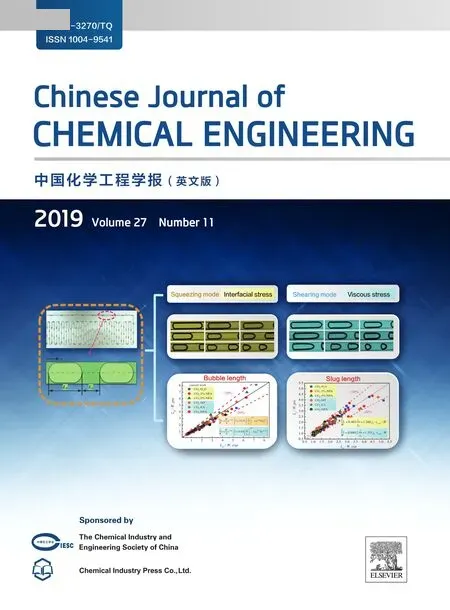 Chinese Journal of Chemical Engineering2019年11期
- Chinese Journal of Chemical Engineering的其它文章
- Fe3O4nanoparticles impregnated eggshell as a novel catalyst for enhanced biodiesel production
- Engineering an ultrathin amorphous TiO2layer for boosting the weatherability of TiO2pigment with high lightening power☆
- Co-pyrolysis characteristics and interaction route between low-rank coals and Shenhua coal direct liquefaction residue☆
- Effect of imidazole based polymer blend electrolytes for dye-sensitized solar cells in energy harvesting window glass applications
- Nanohybrid membrane in algal-membrane photoreactor:Microalgae cultivation and wastewater polishing
- Influence of temperature and Ca(OH)2on releasing tar and coal gas during lignite coal pyrolysis and char gasification☆