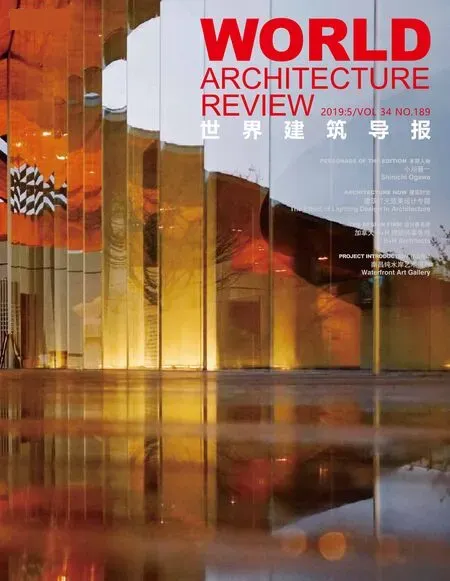
森林中無處不在1
2019-02-14 00:02:46加藤纮一教授工程學博士工程學院建筑系日本東京大學
世界建筑導報 2019年5期
文:加藤纮一教授,工程學博士,工程學院建筑系,日本東京大學
小川晉一之外再無建筑師可稱得上“極簡主義建筑師”。簡約而不簡單。極簡主義代替現代主義。
《看不見的細節》一書收錄了小川晉一根據自己所理解的小型建筑作品設計的作品。另一方面,新書的書名《簡約而不簡單》提到了小川晉一這樣設計的原因。為什么采用簡約結構?“因為簡約而不簡單”他回答道。在本文中,我將通過小川晉一的三篇文章分析他的建筑作品2。
當他說到“簡約而不簡單”的時候,第一時間想到了密斯·凡·德·羅所說的“少即是多”。事實上,小川的風格和密斯的風格有很多共同理念。如果我們認為(普遍的和無所不在的)這兩個詞是近義詞,則密斯所說的“普遍空間”理念和小川提出的“無處不在的房屋3”具有相似性。然而,雖然現代主義在本質上追求通用解決方法,也就是說,將一種完美的解決方法應用于所有方案,且小川晉一的無處不在理論“可適用于任何方案,但是該理論與那些方案之間的關聯性創造了一個在大千世界之中僅能適用于此的空間4”。換言之,同時追求小川建筑理論所提出的普遍性和個體化似乎有些自相矛盾的模糊性。
這種模糊性也是小川建筑中“看不見的”理論中所述的其中一個理論,小川稱其為“多級構造/多層次建筑”。他解釋道:“這是一種多圖像重疊和異質空間概念5”。它與伯納德·屈米于1991年在哥倫比亞大學提出的“六種概念”中的“第4種概念:疊加”極為相似6。
當您單單僅從表面看小川建筑時,第一個浮現在腦海中的印象可能是“這個設計很挑人”或“這個設計很挑生活方式”,事實上,當您看到屋主搬好家具,開始新生活的時候,您就會明白,您的這種第一印象僅僅是一種誤解。小川將其解釋為用于生活的房屋,也就是說“在這間房間里,我們能將各種不同的文化相互融合,比如城市與自然、西方與東方、爵士樂與古典樂,日式料理與西式菜肴7”。小川建筑的模糊性體現了一個事實,即白色的極簡空間乍一看有極強的構造力,但事實上,它是一個可自由創造的空間。這似乎與小川建筑更偏向于“空間”(相比于“形式”而言)的事實有關。當我們提到小川的“窗戶”時,這一點就更加清楚了。
自文藝復興時期起,建筑物正面的入口設計和其結構成為建筑設計的一個最重要的主題。建筑物的正面圖展現了建筑物的外觀(正面)。然而,在小川的建筑中,往往不需要建筑的正面圖,而重要的是從平面圖和截面圖中所得出的室內空間。
小川建筑的整體樣式可大體分為兩種:一種是由矩形平面和長軸方向上的橫斷面組成的作為一個整體的開放式結構的內部空間,另一種是由在短軸方向上的數個橫斷面和狹長的空間內的多重開放式結構組成。后者就是小川所說的“箱形涵洞8”,其朝向外面或外面的封閉式庭院。前者則適用于森林或山上的房屋,面向林木或大海等的自然環境。在這一風格中,室內空間本身就成為該建筑的正面。總體來看,其通過“看不見的細節”的設計理念,最大化地采用了窗戶作為一個整體的橫斷面。也許這種樣式在2007年為卡爾文·克萊恩展所設計的“房屋”得到了最清晰的展示。該理念被稱為“森林中的玻璃屋”,時裝展的參觀者被看作是森林中的樹木。
極簡主義是材料的藝術。“空間”和“材料”是極簡結構必須考慮的兩方面。此外,必須采用“細節9”處理將材料相融合來構建建筑體系。在小川建筑中的這三個要素中,“細節”是看不見的,“材料”則含蓄地表達了其質感和物質性。因此,“因為空間可被轉化為建筑外觀,所以空間本身不僅僅是內部結構。”小川建筑設計的精髓在一個于,其不是一個“通過建筑形式定義生活的理想狀態10”的“正規”建筑,它更像是一個“可以根據主體擴展而不斷變化的、擁抱人類生活的”“空間11”建筑。
注釋:
1這篇文章為小川的第二本書(作品集)《簡約而不簡單》(2014)所作。
2小川晉一“改變主題/超級交通/八個編碼”(SD,1999年6月,第10-11頁);小川晉一 “真正的手跡/無處不在的房屋”(Kenchiku Bunka,2001年10月,第82-83頁);小川晉一“住宅的不均勻布局/簡約×不簡單”(Jutakutokushu,2003年4月,第58頁)。
3小川(2001)和小川(2003)
4小川(2003)。
5小川(1999)。
6伯納德·屈米,“六種概念”(A+U,1994年3月)
7小川(2003)。
8箱形涵洞是一種混凝土構建的暗道。它是否被隱喻為這種正面的空間圖象?
9彼得·卒姆托將“細節”定義為:“成功的細節不僅僅有裝飾的作用。他們不會破壞房間的整體性,也不具有娛樂價值。它們促使人們形成一種“細節融入于房屋”的理解(彼得·卒姆托建筑思考,Birkh?use,擴充版第3版,2010年,第15頁)
10小川(2003)。
11小川(2003)。
No architect deserves the title of “minimalist” much like Shinichi Ogawa. Not simple,but minimal. Not modernism, but minimalism.
The previous book, Invisible Detail was a collection of his works based on the concept of HOW Shinichi Ogawa realized his minimal architectural works. On the other hand, the title of this new book, Minimal is Maximal refers to WHY. Why Minimal Architecture ? "Because minimal is maximal" he said. In this paper, I would like to consider Ogawa’s architecture based on his own three articles2.
The first thing that comes to mind when he sais, "Minimal is Maximal" is the similarity to Mies van der Rohe's "Less is More". Indeed, it would be easy to fi nd a common idea between Ogawa's style and Mies'. The concept of “universal space”,which is often associated with Mies, and Ogawa’s "ubiquitous house3" appear to be similar if we consider the two words (universal and ubiquitous) synonymous.However, while modernism pursued a universal solution in its essence, that is to say, tacitly searched for an ideal solution applicable to all, the ubiquitous of Shinichi OGAWA is "having a neutrality that can exist anywhere but its relevance to that place creates a space that cannot exist elsewhere in the world but only here4". That is to say, there seems to be a self-contradictory ambiguity which pursues to be both universal and individual at the base of the philosophy of Ogawa’s architecture.
This ambiguity is one of the "invisible" concepts in Ogawa’s architecture. Ogawa himself called it "poly-construction / multi-layered architecture". He explained,"Concept of overlapping, and heterogeneous areas of various images5". It bears a strong resemblance to the “4th concept: Superimposition" out of the lecture "Six Concepts" given by Bernard Tschumi at Columbia University in 19916.
The fi rst impression that "It is likely to choose residents" or "likely to regulate the way of living" that sometimes appears when you look at Ogawa’s architecture superficially, can be understood as a mere misunderstanding, after you see the people who live there putting their furniture and starting their life. Ogawa himself described this as a house for living which "we can connect many things to each other in various cultures, such as cities and nature, the West and the East, jazz and classical music, and Japanese and Western food7". The ambiguity of Ogawa’s architecture is re fl ected in the fact that the white, minimalist space, which at fi rst glance appears to have a strong architectural force, is actually a space for allowing freedom. This seems to be related to the fact that Ogawa’s architecture is more architecture of “space” than that of “form”. This becomes even clearer when we consider the problem of the Ogawa’s “window”.
The design of the openings in the fa?ade and its composition have been the most important theme of architectural design since the Renaissance. The elevation of the building was indeed its face (fa?ade). However, in Ogawa’s architecture, an elevation is almost unnecessary. What matters is the interior space that emerges from the plan and the cross section.
The overall image of Ogawa’s architecture can be roughly divided into two types:a type that has an inner space with a rectangular plane and a cross-section in the major axis direction is an overall opening, and a type that has several cross-sections in the minor axis direction and a multilayer opening in the slender space. The latter is what Ogawa calls the “box culvert8”, and it opens to outside or to the courtyard which is the enclosed outside. The former stands in the forest or on the hill, opening to nature such as forest trees or the sea. The interior space itself becomes the fa?ade in this type. It is an overall cross section with the maximized window realized by the "Invisible Detail". Perhaps this is most clearly shown in the 2007 "The House"designed for the Calvin Klein show. The concept was "Glass House in the Forest"and visitors to the fashion show were regarded as forest trees.
Minimalism is the art of materials. What will come to the extremely minimal architecture are “Space” and “Material”. In addition, there must be “Detail9” that connect materials together to build architecture. Among the three elements, in Ogawa’s architecture, “Detail” is invisible, and “Material” expresses modestly its texture and materiality. What appears as a result is “Space itself, and the space is transformed into the appearance of architecture, not just inside. The essence of Ogawa’s architectural design is that it is not a “formal” architecture like "de fi ning a beautiful ideal image of life by the form of architecture10" but a “space” architecture that "can be modi fi ed as an extension of the body and embraces the human life11".
1 This article is dedicated to Ogawa’s second book (collection of works), Minimal is Maximal (2014).
2 Shinichi Ogawa "Transforming Body / Super Traffic / Eight Codes" (SD June, 1999, pp. 10-11); Shinichi Ogawa"Real Script / Ubiquitous House" (Kenchiku Bunka, October 2001, pp. 82-83); Shinichi Ogawa "Dwellings for uneven distribution / MINIMAL x MAXIMAL", (Jutakutokushu, April 2003, p 58).
3 Ogawa (2001) and Ogawa (2003).
4 Ogawa (2003).
5 Ogawa (1999).
6 Bernard Tschumi, “Six concepts” (A+U, March 1994)
7 Ogawa (2003).
8 The box culvert is a concrete constructed underdrain. Has it ever been given as a metaphor such positive spatial image ?
9 Peter Zumthor de fi nes the “Detail” as follows: “Details, when they are successful, are not mere decoration.They do not distract or entertain. They lead to an understanding of the whole of which they are inherent part.” (P.Zumthor Thinking Architecture, Birkh?user, 3rd expanded edition, 2010, p.15)
10 Ogawa (2003).
11 Ogawa (2003).
猜你喜歡
北方建筑(2021年6期)2021-12-31 03:03:54
家庭影院技術(2020年10期)2020-12-14 07:53:50
文苑(2020年10期)2020-11-07 03:15:36
現代裝飾(2020年6期)2020-06-22 08:43:12
小學生優秀作文(低年級)(2018年10期)2018-10-13 01:56:50
藝術啟蒙(2018年7期)2018-08-23 09:14:18
海峽姐妹(2017年7期)2017-07-31 19:08:17
Coco薇(2017年5期)2017-06-05 08:53:16
Coco薇(2016年10期)2016-11-29 19:59:58
少兒科學周刊·兒童版(2015年6期)2015-11-24 03:49:38