
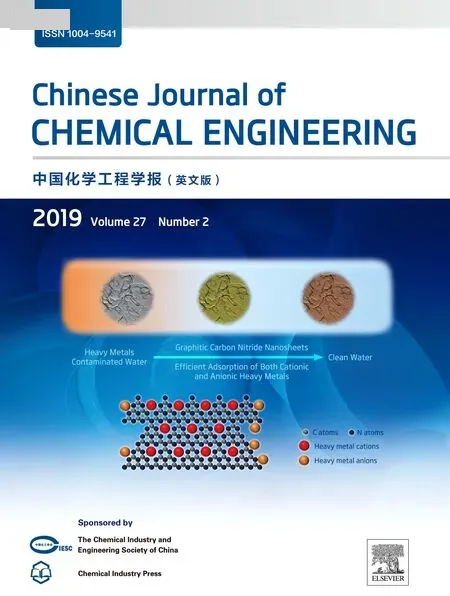
Superior adsorption performance of graphitic carbon nitride nanosheets for both cationic and anionic heavy metals from wastewater☆
2019-03-20 06:47:12GangXiaoYaoqiangWangShengnanXuPeifengLiChenYangYuJinQiufengSunHaijiaSu
Gang Xiao,Yaoqiang Wang,Shengnan Xu,Peifeng Li,Chen Yang,Yu Jin,Qiufeng Sun,Haijia Su*
State Key Laboratory of Chemical Resource Engineering,Beijing Advanced Innovation Center for Soft Matter Science and Engineering(BAIC-SM),Beijing University of Chemical Technology,Beijing 100029,China
Keywords:g-C3N4nanosheets Nanomaterials Adsorption Heavy metals Wastewater
A B S T R A C T Water pollution caused by highly toxic Cd(II),Pb(II),and Cr(VI)is a serious problem.In the present work,a green and low-cost adsorbent of g-C3N4nanosheets was developed with superior capacity for both cationic and anionic heavy metals.The adsorbent was easily fabricated through one-step calcination of guanidine hydrochloride with thickness less than 1.6 nm and specific surface area of 111.2 m2·g?1.Kinetic and isotherm studies suggest that the adsorption is an endothermic chemisorption process,occurring on the energetically heterogeneous surfacebasedon a hybridmechanism ofmultilayerand monolayeradsorption.The tri-s-triazine units and surface N-containing groups of g-C3N4nanosheets are proposed to be responsible for the adsorption process.Further study on pH demonstrates that electrostatic interaction plays an important role.The maximum adsorption capacity of Cd(II),Pb(II),and Cr(VI)on g-C3N4nanosheets is 123.205 mg·g?1,136.571 mg·g?1,and 684.451 mg·g?1,respectively.The better adsorption performance of the adsorbent than that of the recently reported nanomaterials and low-cost adsorbents proves its great application potential in the removal of heavy metal contaminants from wastewater.The present paper developed a promising adsorbent which will certainly find applications in wastewater treatment and also provides guiding significance in designing adsorption processes.
1.Introduction
Water pollution has become a serious problem all over the world,especially in the developing countries like China[1].Amongthe various pollutants in water,heavy metals,which are mainly discharged by industrial activities such as mining and metallurgy,represent the most hazardous ones because they are highly toxic even at dilute concentration,are non-biodegradable,and will accumulate through the food chain[2,3].Cd(II),Pb(II),and Cr(VI)are the most commonly existent heavy metals with the highest toxicity in wastewater[4-6].For protecting the human health,these heavy metals should be removed from wastewater before discharge.
Various methods have been applied for the removal of heavy metals from wastewater,such as chemical precipitation,adsorption,ionexchange,electrochemical deposition,and membrane separation[7-9].Among these methods,adsorption has been recognized to be a promising technology in wastewater treatment and possesses several advantages such as simplicity in operation,low cost,and high efficiency in a wide concentration range[10,11].A variety of low-cost materials have been adopted as adsorbents for heavy metals,such as activated carbon,clays,biopolymers,and industrial and agricultural wastes[3,12-14].Other than these traditional adsorbent materials,many nanostructured materials have been developed recently for the adsorption of heavy metals such as nano-sized metals,carbon nanotube,graphene,and various nanocomposites[15-17].Although they feature larger specific area,higher reactivity and faster kinetics than these traditional adsorbents,the nanostructured adsorbents suffer from high cost and complicated fabrication procedures,which restrict their commercial applications[18,19].Therefore,novel nanomaterials which are low-cost and easy to be fabricated are still highly required to be developed as adsorbents for the removal of heavy metals from wastewater.
Graphitic carbon nitride(g-C3N4)has attracted greatattention in recent years in catalysis field,especially in photocatalysis,because of its unique structure and semiconductor properties[20,21].It is the most stable allotrope of carbon nitride under ambient conditions with stacked layer structures.g-C3N4is only composed of earth-abundant carbon and nitrogen elements,and can be easily fabricated through the thermalcondensationofseverallow-costnitrogen-richprecursors,such as cyanamide,dicyandiamide,melamine,urea,and guanidine hydrochloride[22].g-C3N4consists of highly ordered tri-s-triazine units which contains negatively charged functionalities because of the six nitrogen lone-pair electrons[23].Those functional groups are regarded as suitable sites for capturing metal ions and have been successfully used to synthesize well-dispersed metal nanocatalysts,or even single atom catalysts[24].Furthermore,the surface amino groups of g-C3N4are also active in adsorbingvarious metals[25].Therefore,g-C3N4is expected to be a low-cost,environmentally friendly,and efficient adsorbent for metals.However,the application of g-C3N4for heavy metals adsorption has been rarely reported till now.
Inthepresentpaper,g-C3N4nanosheetsweresynthesizedbysimply calcinationofguanidinehydrochlorideandshowedsuperioradsorption capacity forbothcationic andanionic heavymetalcontaminants,Cd(II),Pb(II),and Cr(VI).AFM,TEM,N2adsorption/desorption analysis,XRD,and FT-IRwere employed to characterizethemorphology and structure of the as-synthesized g-C3N4nanosheets.The adsorption kinetics and isotherms for these three heavy metals were studied systematically using several well-established models.The effect of pH value on the adsorption capacities and the reusability of the adsorbent were also investigated.
2.Materials and Methods
2.1.Materials
Guanidine hydrochloride(AR,99.0%),Cd(NO3)2·4H2O(AR,99.0%),Pb(NO3)2(AR,99.0%),K2Cr2O7(AR,99.8%),and Ca(NO3)2·4H2O(AR,99.0%)were purchased from Aladdin?(Shanghai,China).HCl(AR,36.0%-38.0%)and NaOH(AR,98.0%)were provided by Beijing Chemical Works(China).All the chemicals were used as received.Deionized water was used throughout all the experiments.
2.2.Synthesis and characterization of g-C3N4nanosheets
A facile one-step calcination of guanidine hydrochloride was adopted to synthesize the g-C3N4nanosheets[26].Typically,5 g of guanidine hydrochloride was put into a 25 ml alumina crucible with a cover,and then heated to 600°C in a muffle furnace for 4 h at a ramp of 10 °C·min?1under air.The resultant yellow powder(~0.47 g)was collected as the adsorbent without further treatment.
The surface morphology and roughness of the synthesized g-C3N4nanosheets were studied using an atomic force microscope(AFM,VEECO Multimode 8,Bruker,Germany),operating in scan mode with a scan rate of 0.977 Hz and sample/linevalue of 512.Transmission electron microscopy(TEM)was performed on a JEM-2100 microscope(JEOL,Japan)to characterize the morphology and structure of the sample.The nitrogen sorption isotherms of g-C3N4nanosheets were obtained at 77 K using an Autosorb-1-C chemisorption/physisorption analyzer(Quantachrome,USA).PowderX-raydiffraction(XRD)pattern was collected on an Ultima IV diffractometer(Rigaku,Japan)to determine the crystal phases of the sample.Infrared spectrum analysis was performed on KBr discs with a 2 wt%finely ground sample using a Fourier transform infrared(FT-IR)spectrometer(Thermo Nicolet 6700,USA)and the spectrum was recorded in the wavenumber region of 4000-400 cm?1.The Zeta potential measurement was carried out on a SZ-100 dynamic light scattering nanoparticle analyzer(Horiba Scientific,Japan).
2.3.Adsorption experiments
The adsorption properties of the as-synthesized g-C3N4nanosheets for Cd(II),Pb(II),and Cr(VI)were studied using batch adsorption mode.Typically,20 mg of the adsorbent was added into conical flasks containing 20 ml of heavy metal solution with determined concentration.Then the flasks were shaken in a thermostatic shaker at a fixed agitation speed of 200 rpm.After certain times,the solution was collected to analyze the concentration of the heavy metals using an atomic absorption spectrophotometer(Varian SpectrAA55-B,Palo Alto,USA).The adsorption capacity of the heavy metals on the g-C3N4 nanosheets was calculated as:

where qtis the adsorption capacity at a certain time t(mg·g?1),C0and Ctaretheinitialandfinalconcentrationsoftheheavymetalsata certain time(mg·L?1),respectively,V is the volume of the solution(ml)and M is the weight of the adsorbent(g).
To study the effect of pH,the pH value of the heavy metal solution was adjusted by the addition of HCl or NaOH.The initial concentration of heavy metal ions was 500 mg·L?1and the adsorption experiments were conducted at 25°C for 60 min.The reusability of the adsorbent was assessed by 10 successive cycles of adsorptiondesorption-regeneration experiments for Cd(II)and Pb(II).For each cycle,Cd(II)/Pb(II)solution with an initial concentration of 500 mg·L?1was used and the adsorption was conducted at 25 °C for 60 min.For desorption,20 mg of the adsorbent was added into 20 ml of HCl solution(0.1 mol·L?1)and then stirred at 25 °C for 60 min.After desorption,20 ml of NaOH solution(0.25 mol·L?1)was mixed with 20 ml of the adsorbent to carry out the regeneration at 25°C for 60 min.Before the adsorption experiments,the adsorbent was washed with deionized water until pH neutral and dried at 60°C for 4 h.The adsorption capacities for Cd(II)and Pb(II)were recorded for each cycle.All the adsorption experiments were carried out in triplicate and the average values were reported.
2.4.Adsorption kinetics
The adsorption kinetics study was conducted at 25 °C,35 °C,and 45°C for the three heavy metals with the initial concentration of 100 mg·L?1for different times.The results were analyzed using three kinetic models[27,28]:pseudo-first-order(PFO)model,pseudosecond-order(PSO)model,and Elovich kinetic model,described by the following equations:

where qeand qtare the adsorption capacity at equilibrium and at a certain time t(mg·g?1),respectively,k1is the pseudo-first-order rate constant(min?1),k2is the pseudo-second order rate constant(g·mg?1·min?1),α is the initial adsorption rate(mg·g?1·min?1),and β is the desorption rate constant(g·mg?1).
2.5.Adsorption isotherms
The adsorption isotherm study was conducted at 25 °C,35 °C,and 45°C for the three heavy metals with different initial concentrations for 60 min.The results were analyzed using four isotherm models[27,28]:Langmuir,Freundlich,Redlich-Peterson(R-P),and Khan models,described by the following equations:


where qeand qmare the adsorption capacity at equilibrium and the theoretically maximum adsorption capacity(mg·g?1),respectively,Ceis the concentration of heavy metals in aqueous solution at equilibrium(mg·L?1),KLis the Langmuir constant(L·mg?1)related to the energy of adsorption,Kfis the Freundlich constant,which predicts the quantity of the heavy metals per gram of adsorbent at equilibrium(mg1-1/n·L1/n·g?1),n is an indicative parameter related to the adsorption effectiveness,KRP(L·mg?1)and αRP(LβRP·mg?βRP)are the Redlich-Peterson model constants,βRPis the Redlich-Peterson model exponent which lies between 0 and 1,βK(L·mg?1)is the Khan model constant,and αKis the Khan model exponent.
2.6.Non-linear regression and error analysis
The non-linear regression method was adopted to solve the isotherm and kinetic models by minimizing the root-mean-square error(RMSE)between the predicted values and the experimental data using MATLAB software[29].Furthermore,coefficient of determination(R2)and the non-linear Chi-square(χ2)were also presented to quantitatively evaluate the applicability of the above-mentioned isotherm and kinetic models[27-29].RMSE,R2,and χ2are defined as:

where qi,expand qi,calare the experimental data and the calculated results using the above-mentioned models,respectively,M is the number of measurement,andis the mean value of the experimental data.
3.Results and Discussion
3.1.Characterization of g-C3N4nanosheets

Fig.1.(a)AFM image of the as-synthesized g-C3N4nanosheets with height profiles;(b-c)TEM images of the as-synthesized g-C3N4nanosheet with different resolutions.
The morphology of the as-synthesized g-C3N4 nanosheets was studiedusingAFMandTEMasshowninFig.1.AFMimage(Fig.1(a))reveals that the g-C3N4 sample has a rough surface with a height of less than 1.6 nm,indicating the formation of few layered nanosheets[30].TEM images(Fig.1(b),(c))show the layered structures of the g-C3N4 nanosheets with bended layer-edges formed to reduce the surface energy and improve their stability[26].Moreover,the as-synthesized g-C3N4 nanosheets are transparent to electron beams as shown in Fig.1(b),(c)because of their thin nature[31].
Then the specific surface area,phase structure,and chemical structure of the as-synthesized g-C3N4nanosheets were studied by N2adsorption/desorption analysis,XRD,and FT-IR,respectively.As shown in Fig.2(a),the Brunauer-Emmett-Teller(BET)surface area of the g-C3N4nanosheets is determined to be 111.2 m2·g?1.The XRD pattern(Fig.2(b))reveals a dominant(002)peak at 27.56°and a minor(100)peak at 12.88°,which are due to the graphitic stacking of the conjugated triazine aromatic units and the intra-planar stacking of the periodic tri-s-triazine motifs[32,33].Regarding FT-IR,the spectrum(Fig.2(c))exhibits several characteristic bands of g-C3N4:the characteristic peak terminal cyano groups(C≡N)at 2174.04 cm?1,the band of the typical stretching modes of CN heterocycles in the region of 1650-1200 cm?1with multiple peaks,and the intense band of the out-of-plane bending vibration characteristic of tri-s-triazine rings at 808.81 cm?1[23,33].Furthermore,a broad band in the range of 3500-3000 cm?1is also observed,which can be attributed to the adsorbed moisture,the stretching vibration modes of uncondensed amino groups,or the surface N--H groups[32].The above-mentioned characterization results reveal the successful formation of g-C3N4nanosheets through a facile one-step calcination procedure with guanidine hydrochloride as the precursor.
3.2.Adsorption kinetics
The adsorption kinetics describes the uptake rate of the adsorbate on the adsorbent and is an important characteristic which defi nes the adsorption efficiency and helps to understand the adsorption mechanism[27-29,34].The adsorption kinetic profiles of Cd(II),Pb(II),and Cr(VI)on g-C3N4nanosheets at different temperatures are shown in Fig.3.For all the three heavy metal ions,the adsorption on g-C3N4nanosheets occurred rapidly in the first 20 min.After that,the adsorption capacity increased slightly and reached the equilibrium in about 60 min.This phenomenon is commonly observed in adsorption because the available adsorption sites decrease with increasing the contact time until the equilibrium reaches[35].
In order to evaluate the mechanistic process controlling the adsorption of the heavy metal ions onto g-C3N4nanosheets,three kinetic models containing pseudo-first-order(PFO)model(Eq.(2)),pseudosecond-order(PSO)model(Eq.(3)),and Elovich kinetic model(Eq.(4))were employed to examine the experimental data as shown in Fig.3 and the obtained parameters are presented in Table S1.The lower R2values and higher RMSE and χ2values of the pseudo-firstorder model at all circumstances indicate that this model is not suitable for describing the adsorptionkinetics of theheavy metal ionson g-C3N4nanosheets.The experimental data exhibits good fitting with the pseudo-second-order model and the Elovich model with R2values ranging from 0.770 to 0.963 for the pseudo-second-order model and from 0.750 to 0.989 for the Elovich model,except for Cr(VI)adsorption at 25°C.The pseudo-second-order model assumes that the adsorption is controlled by the chemisorption process based on valence forces by sharing or exchanging electrons between the adsorbent and the heavy metal ions[35].The Elovich model has been widely used for describing theactivatedchemisorptionbasedonthehypothesisthattheadsorbent surface is energetically heterogeneous[27,36,37].So,both mechanisms possibly dominate the chemisorption of heavy metal ions on g-C3N4nanosheets.Furthermore,higher adsorption capacities observed experimentally(Fig.3)andhigheradsorptioncapacityatequilibriumpredicted by the pseudo-second-order model(Table S1)at higher temperature reveal the endothermic nature of the adsorption of heavy metal ions on g-C3N4nanosheets[23].

Fig.2.(a)N2adsorption/desorption isotherms,(b)XRD pattern,and(c)FT-IR spectrum of the as-synthesized g-C3N4nanosheets.

Fig.3.Adsorption kinetics of Cd(II),Pb(II),andCr(VI)on g-C3N4nanosheets atdifferent temperatures:(a)Cd(II)-25 °C,(b)Cd(II)-35 °C,(c)Cd(II)-45 °C,(d)Pb(II)-25 °C,(e)Pb(II)-35 °C,(f)Pb(II)-45 °C,(g)Cr(VI)-25 °C,(h)Cr(VI)-35 °C,(i)Cr(VI)-45 °C.
3.3.Adsorption isotherms
The adsorption isotherm describes the equilibrium distribution of the heavy metal ions between the liquid and the solid phase(adsorbent)at given condition[14,38].It is important to establish an appropriateisothermmodeltopredicttheadsorptionefficiencyanddetermine the adsorption mechanism[3,14].The experimental isotherms were obtained by varying the initial concentration of the heavy metal ions and the results are presented in Fig.4.Four isotherm models containing Langmuir(Eq.(5)),Freundlich(Eq.(6)),Redlich-Peterson(R-P,Eq.(7)),and Khan models(Eq.(8)),were used to fit the experimental data as shown in Fig.4,and the obtained parameters are presented in Table S2.
Langmuir isotherm model has been successfully applied for many monolayer adsorption processes which occur at specific homogeneous sites of the adsorbent without any interaction between the adsorbed molecules[39].For Cd(II)and Pb(II)adsorption,the experimental data exhibits moderate to good fitting with the Langmuir model with R2in the range of 0.558-0.791 for Cd(II)and 0.786-0.807 for Pb(II).Higher values of R2ranging from 0.931 to 0.983 were obtained for Cr(VI)adsorption illustrating the satisfactory applicability of the Langmuir model.The Freundlich isotherm model is used to model the heterogeneous surface adsorption processes,which assumes that the active sites are not energetically equivalent[28,29].As shown in Table S2,the Freundlich model fits the experimental data well with one exception for Pb(II)adsorption at 25°C where R2equals to 0.653.The values of 1/n are all below 1,demonstrating the favorability of these heavy metal ions on g-C3N4nanosheets[28].The two three-parameter isotherm models,Redlich-Peterson and Khan models,incorporate both the Langmuir and Freundlich models,resulting in a hybrid adsorption mechanism,which admits both multilayer and monolayer adsorption[40,41].The Redlich-Peterson isotherm model is applicable in describing the adsorptionequilibriumwithawideconcentrationrange[41].Itapproximates to Henry's law at low adsorbate concentrations,and approaches theFreundlichmodelathighconcentrations[28,40].TheKhanisotherm model was proposed as a generalized model for pure solutions[42].As shown in Fig.4 and Table S2,the experimental data reveals good fitting with both R-P and Khan models.
For Cd(II)and Pb(II)adsorption,higher values of R2and lower values of χ2were observed for the two three-parameter isotherm models,illustrating the better fitness and prediction precision.When considering the two three-parameter isotherm models,Freundlich is better than Langmuir in describing the adsorption of Cd(II)and Pb(II)on g-C3N4nanosheets.And for Cr(VI)adsorption,all the four isotherm models are applicable with high values of R2and low values of χ2.Furthermore,the Freundlich and Redlich-Peterson models cannot be used for predicting the maximum adsorption capacity.The Khan model can be used for predicting the maximum adsorption capacity,but its accuracy is unsatisfactory.Although the Langmuir model cannot fit the experimental data well at some circumstances,it can well predict the maximum adsorption capacity as shown in Fig.4.Therefore,a hybrid mechanism of multilayer and monolayer adsorption is responsible for the observed superior adsorption capacity for these three heavy metals,which possibly results from the multiple functional groups presented on g-C3N4nanosheets.

Fig.4.AdsorptionisothermsofCd(II),Pb(II),andCr(VI)ong-C3N4nanosheetsatdifferenttemperatures:(a)Cd(II)-25 °C,(b)Cd(II)-35 °C,(c)Cd(II)-45 °C,(d)Pb(II)-25 °C,(e)Pb(II)-35 °C,(f)Pb(II)-45 °C,(g)Cr(VI)-25 °C,(h)Cr(VI)-35 °C,(i)Cr(VI)-45 °C.
In order to evaluate the adsorption performance of the assynthesized g-C3N4nanosheets for Cd(II),Pb(II),and Cr(VI),several nanomaterials or low-cost adsorbents reported in recent literatures are referred for comparison on their maximum adsorption capacities.As showninTable1,theas-synthesized g-C3N4nanosheetspossessbetter adsorption performancefor thesethreeheavy metal ionsthanmany other adsorbents.Although the adsorption performance of g-C3N4nanosheets is not as good as some well-structured nanomaterials,the low-cost and environmentally friendly nature and the convenience in synthesis make g-C3N4nanosheets a promising adsorbent for the treatment of wastewater contaminated by highly toxic heavy metal cations and anions.
3.4.Effect of pH
pHhasbeenrecognizedtobeakeyfactorinfluencingtheadsorption processesatthewater-adsorbentinterfaces[23].TheeffectofpHonthe adsorptioncapacitiesforCd(II),Pb(II),andCr(VI)ong-C3N4nanosheets was studied at the pH value ranging from 2 to 10.In order to avoid the precipitation of heavy metal ions,the pH value below 8 was applied for Cd(II),andbelow6wasappliedforPb(II).AsshowninFig.5(a)-(b),the adsorption capacities for the cations,Cd(II)and Pb(II),increase obviously with increasing the pH value.While for Cr(VI),which exists as anions,an opposite trend can be seen in Fig.5c.To further understand the effect of pH value on the adsorption performance,the Zetapotential values of g-C3N4nanosheets were measured at the pH value ranging from 2 to 10.The results are shown in Fig.5d,which illustrates that the isoelectric point of the adsorbent is below 2,and the adsorbent is negatively charged at the experimental pH range.The negative charge is due to the Lewis and Br?nsted basic sites offered by the nitrogen atoms in different forms[21].The above-mentioned results demonstrate that electrostatic interaction plays an important role in the adsorption processes.Although electrostatic repulsion exists between the adsorbent and Cr(VI)anions,strong complexation canform between the surface amino groups and the Cr(VI)anions[25],which is responsible for the observed superior adsorption capacity for Cr(VI).

Table 1 Comparison of the maximum adsorption capacities of Cd(II),Pb(II),and Cr(VI)on the as-synthesized g-C3N4nanosheets with other nanomaterials or low-cost adsorbents reported recently
3.5.Reusability study
Reuse of the adsorbent is of great importance with respect to the practical applications in wastewater treatment.Therefore,the reusability of the as-synthesized g-C3N4nanosheets as adsorbent for heavymetalionswasevaluated.AsshowninFig.5(e)and(f),theadsorbent can be reused for 10 successive cycles and preserve over 80%of its adsorption ability for both Cd(II)and Pb(II).However,in the case of Cr(VI)adsorption,the desorption of Cr(VI)failed and the adsorbent can be hardly regenerated.This is due to the strong complexation between Cr(VI)anions and the adsorbent other than electrostatic interaction as in the case of cationic Cd(II)and Pb(II)adsorption.
3.6.Adsorption mechanism
In order to study the adsorption mechanism,FT-IR analysis was carried out for the adsorbent loaded with different heavy metals.The FT-IR spectra of all the samples(Fig.6)display similar absorption bands which can be attributed to the characteristic modes of g-C3N4(Table 2)as discussed in Section 3.1.Obvious shifts are observed for these peaks as shown in Table 2,illustrating that the tri-s-triazine units and terminal N-containing groups are responsible for the adsorption.Furthermore,the broad band ranging from 3500 cm?1to 3000 cm?1of the heavy metal loaded adsorbent also changed in its peaks when compared with that of the as-synthesized adsorbent as shown in Fig.6(a).This result further suggests that surface amino or N--H groups take part in the adsorption of the heavy metals.As shown in Table 1,the maximum adsorption capacity of Cr(VI)is much higherthanthatofCd(II)andPb(II)ong-C3N4nanosheets.Onepossible reason is that the adsorption of anionic Cr(VI)mainly occurs on the outer surface of g-C3N4nanosheets while cationic Cd(II)and Pb(II)should firstly penetrate between the g-C3N4layers[19,25].The adsorption of Cr(VI)is based on the complexation with surface--NH2and--NH groups,and the adsorption of Cd(II)and Pb(II)mainly occurs on the tri-s-triazine units through electrostatic interaction[19,25].Furthermore,the molar maximum adsorption capacity of Cd(II)is 1.096 mmol·g?1,which is higher than that of Pb(II)(0.659 mmol·g?1).This is because Cd(II)cations are smaller than Pb(II)cations and can more easily penetrate between the g-C3N4layers[19].As discussed above,FT-IR analysis results prove the versatility of the as-synthesized g-C3N4nanosheets in adsorbing both heavy metal cations and anions with the tri-s-triazine units and surface N-containing groups.

Fig.5.The dependence of adsorption capacity for Cd(II)(a),Pb(II)(b),and Cr(VI)(c)on pH value;(d)Zeta potentials of the as-synthesized g-C3N4nanosheets at different pH values;adsorption capacities for Cd(II)(e)and Pb(II)(f)during 10 successive adsorption-desorption-regeneration cycles.

Fig.6.FT-IR spectraofg-C3N4nanosheets adsorbingdifferent heavymetals,Cd(II),Pb(II),andCr(VI)withthe as-synthesizedadsorbentasblankcontrol.(a)Fullspectra;(b)spectrainthe wavenumber range of 1700-1200 cm?1.

Table 2 The wavenumber and assignment of the FT-IR spectra peaks
4.Conclusions
In the present work,anenvironmentally friendly and low-cost adsorbent of g-C3N4nanosheets was developed with superior adsorption capacity for both heavy metal cations and anions when compared with other nanomaterials and low-cost adsorbents reported recently,which isduetothemultiplefunctionalgroups.Themaximumadsorptioncapacity of Cd(II),Pb(II),and Cr(VI)on g-C3N4nanosheets is 123.205 mg·g?1,136.571 mg·g?1,and 684.451 mg·g?1,respectively.The adsorbent can bereusedfor10successivecycleswithpreservingover80%ofitsadsorption ability for cationic Cd(II)and Pb(II).The present paper developed a green and low-cost adsorbent of g-C3N4nanosheets which is promising in the removal of heavy metal cations and anions from wastewater and also provided guidelines for designing and studying an adsorption process.Toachievetherealisticapplicationinwastewatertreatment,finding cheaper raw materials to produce g-C3N4nanomaterials and developing proper reactors should be addressed in the future.
Supplementary Material
Supplementary data tothis article canbe foundonlineathttps://doi.org/10.1016/j.cjche.2018.09.028.
 Chinese Journal of Chemical Engineering2019年2期
- Chinese Journal of Chemical Engineering的其它文章
- Effect of the alkali metal(Li,Na,K)substitution on the geometric,electronic and optical properties of the smallest diamondoid:First principles calculations
- TIPS behavior for IPP/nano-SiO2blend membrane formation and its contribution to membrane morphology and performance☆
- Preparation of new and novel wave like poly(2-anisidine)zirconiumtungstate nanocomposite:Thermal,electrical and ion-selective studies
- Shell powder as a novel bio-filler for thermal insulation coatings☆
- Characterization and analysis of petrochemical wastewater through particle size distribution,biodegradability,and chemical composition☆
- Advances in reduction of NOxand N2O1 emission formation in an oxyfi red fluidized bed boiler☆