
四分院,北京,中國
2019-08-07 07:41:40
世界建筑 2019年7期
建筑設計:跡·建筑事務所
Architect: TAO (Trace Architecture Office)
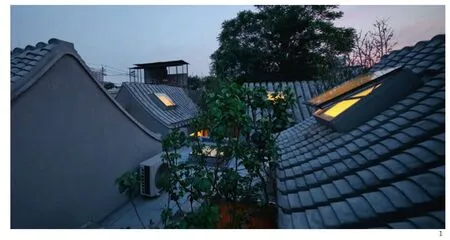
1 新建后外景/Exterior view after renovation

2 小巧卻功能齊全的房間/Small yet functional private space
四分院是一個北京歷史保護區城市更新的實驗項目,一個傳統居住類型的轉化,一種對現代生活模式的應變,一場尺度和建造的實驗。
場地位于白塔寺旁邊的胡同片區之中,屬于北京城區內33片文化保護區之一(阜成門內大街片區)。
傳統四合院里位于中間的院子是當之無愧的中心,所有的房間都朝向它。這種空間布局對應著傳統的家庭生活,不再契合今天青年人的個人生活模式。個人生活的核心是私密性,所以我們的想法是將場地分為4組空間,每組包含一個房間和一個私人小院,它們各自朝向不同的方向,最終共同構成一個風車狀布局。通過這種方式,每個房間和院子的私密性都得到保護。對比于傳統四合院,本項目以四分院命名。從“合”到“分”的變化揭示出社會結構和生活模式在住宅中的轉變。
尺度小巧卻功能齊全,氛圍親密卻向自然開放,現代生活卻具有傳統審美,四分院在北京老城高密度歷史肌理中提供了一種生活的可能。

3 新建后剖面/Section after renovation

4 周邊環境/The surrounding environment

5 風車狀布局/Pinwheel con figuration
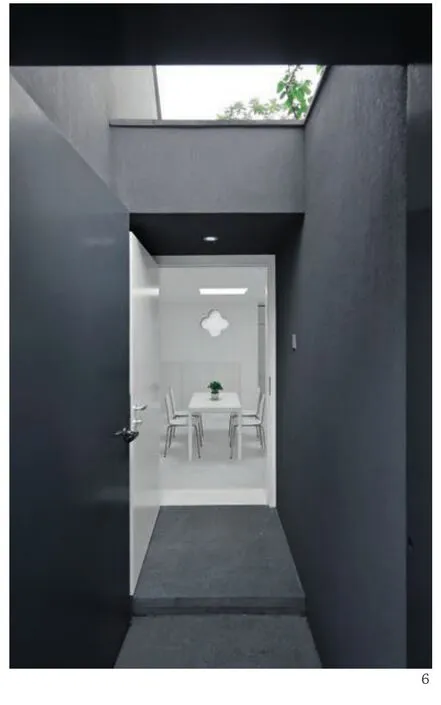
6 入口/Entrance
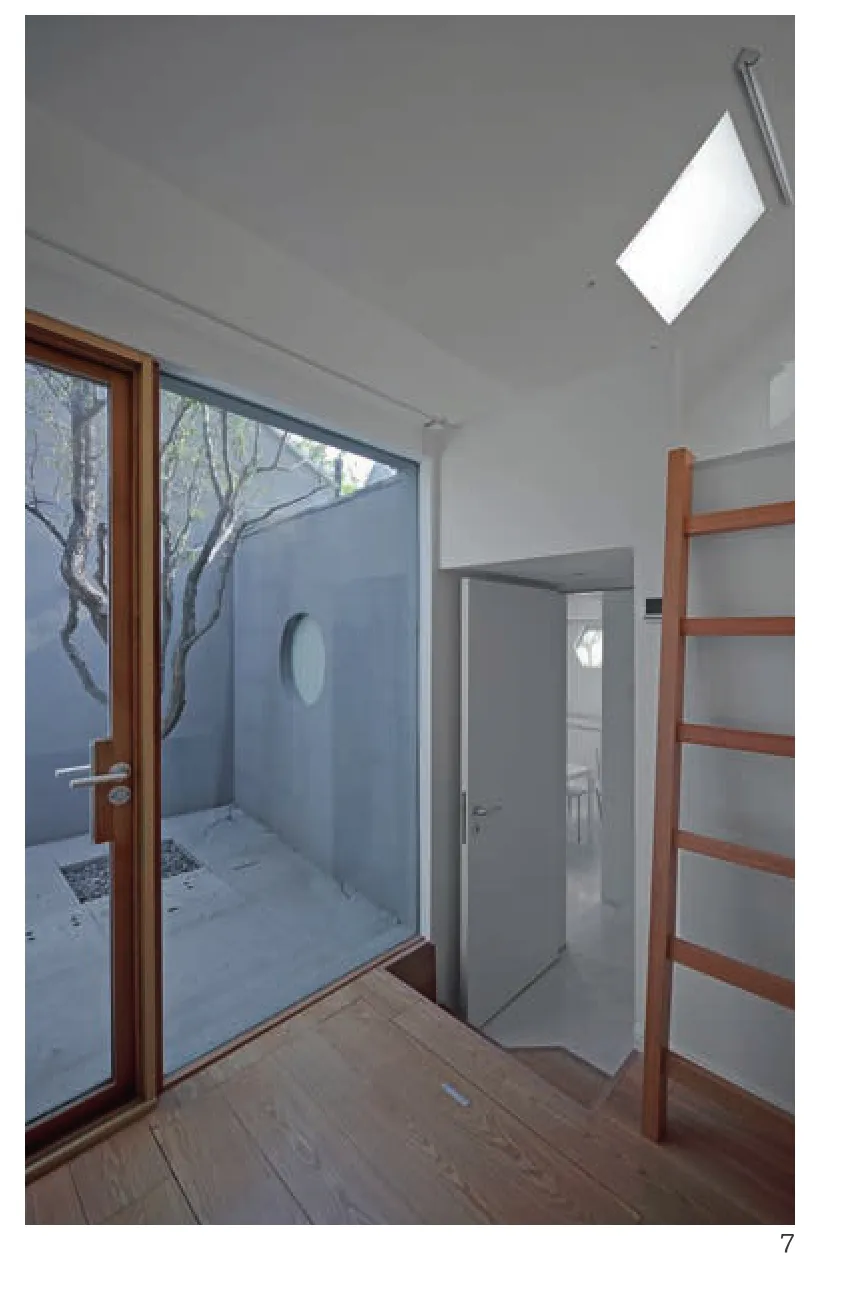
7 進入私人房間/Into each private room
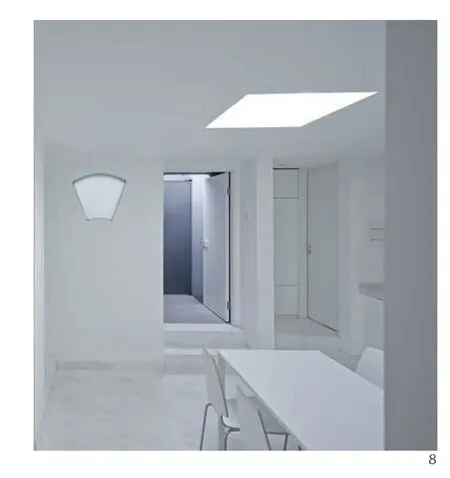
8 享有天光的客廳空間/Living room lit up by skylight
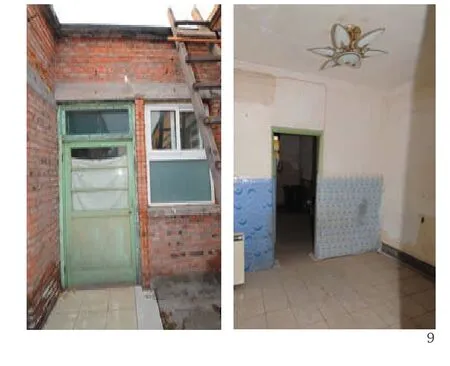
9 院落新建前/Courtyard before renovation
Split Courtyard House is a key urban regeneration project in Beijing, a transformation of traditional typology, an adaptation to new life style,and an experiment on scale and construction.
The site is located in the historic Hutong area near Batasi (Baitasi, built in 1279AD), one of 33 conservation districts of history and culture in Beijing's historic city area.
In traditional courtyard house (Siheyuan), the courtyard is the centre of the house and all rooms face the yard. Such spatial layout is responding to traditional family living, and no longer suitable for today's young individual life style. The core need of individual living now is privacy. So our idea is to divide the site into four sets of spaces, each with a room and a small but private yard. With each set facing a different orientation, together they form a pinwheel configuration on layout. In such way, privacy for each room and yard is ensured. In contrast to traditional courtyard house, this house is named Split Courtyard House (Sifenyuan). In Chinese, the change from "合" (Unity) to "分" (Split)suggests the transformation of social structure and life style in the house.
Small yet functional, intimate yet open to nature, a modern living style yet with attachment to Chinese traditional aesthetics, is what split patio house offers to urban individuals in high density historical context of Beijing's old city.
項目信息/Credits and Data
地點/Location: 宮門口四條24號/No.24 Gongmenkou Sitiao業主/Client: 北京華融金盈投資發展有限公司/Beijing Huarong Jinying Investment Development Co., Ltd.
主持建筑師/Principal Architect: 華黎/HUA Li
設計團隊/Project Team: 張鋒,劉小亞,賴爾遜,劉文娟,伊戈爾·布拉加多·費爾南德斯,張芝明,沈周婭,趙瑋/ZHANG Feng, LIU Xiaoya, LAI Erxun, LIU Wenjuan,Igor Bragado Fernandez, ZHANG Zhiming, SHEN Zhouya,ZHAO Wei
項目功能/Program: 出租公寓/Shared rental house
結構體系/Structural System: 賽木輕鋼墻體系統/Luxwood lightweight wall panel system
建筑面積/Floor Area: 82m2
設計時間/Design Time: 2014.01-2014.06
建造時間/Construction Time: 2015.02-2015.05
評論
青鋒:在CIAM 第二次會議(1929年法蘭克福會議)上討論的最低限度住宅問題,成為賴特抨擊現代主義忽視生活豐富性的罪證之一。但TAO讓我們意識到,最低限度也可以帶來極高的內涵。那些私密的小院,讓人想起在威尼斯城中專門租個花園,并且堅持每天在園內樹下看書的卡洛·斯卡帕。無論如何,TAO探討了怎樣在最低限度的條件下維護我們最珍貴的夢想。這可能是眾多四合院改造設想中最有意義的方案之一。除了成為舉世豪宅與公共設施之外,四分院保留了可承受的院落居住單元的可能性。這種社會意義完全有可能進一步推廣。相比起來,這個項目單一的材質處理有些讓人費解,它們似乎更接近于公寓,而不是院宅。
王碩:如名所示,其從“合”到“分”的概念置換直指生活方式的轉變,并藉此提出一種在低密度老城區新的空間聚合原型。傳統四合院對應其所處時代的傳統家庭結構以及生活方式,而自1960年代起逐漸演變而成的“大雜院”,則是由于四合院——傳統大家庭的對應結構被打破后,自下而上在分租合住的社會結構下重組而形成的空間模式。四分院既提取了當代社會生活中分租合住的結構要素,又在此基礎上梳理并提升出兼具有多個私密性層次和共享性的創新模式,其適應當代青年人生活的原型創新相當于WeWork 之于傳統的單位大院,小中見大。
Comments
QING Feng: The issue of minimal housing, which was discussed at the second CIAM conference in Frankfurt in 1929, became one of Frank Lloyd Wright's critiques of modernism for neglecting the richness of life. But what TAO did makes us realise that the bare minimum can also bring very rich connotation. Those private courtyards are reminiscent of Carlo Scarpa who specially rent a garden in Venice City and read books every day under the tree. In any case, TAO discussed how to maintain our most precious dreams under minimal conditions. It may probably be one of the most meaningful projects in the renovation of courtyards.Apart from becoming world famous mansions or public facilities, Split Courtyard House retains the possibility of affordable residential units, whose social signi ficance is absolutely possible to spread further, while it was somewhat puzzling that the project uses single material and texture, as it seems to be closer to an apartment than a courtyard.(Translated by PANG Lingbo)
WANG SHUO: As the name indicates, the concept replacement from "merge" to "split" directly refers to the change of lifestyle. Based on this, a new prototype of spatial aggregation in the low-density old city is proposed. The "big miscellaneous courtyard" that gradually evolved from the traditional courtyard since the 1960s, corresponding to the traditional family structures and life styles of its era, are the spatial pattern reconstructed in the social structure of "bottom up"shared renting after the breaking of the corresponding structure of the courtyard-traditional big families.On the basis of extracting the structural elements of shared-renting and co-residence in contemporary social life, Split Courtyard House also sorts out and distills an innovative model with multiple levels of privacy and sharing. Its prototype innovation for adapting to the life of contemporary youths is equivalent to that of WeWork for traditional organization courtyards. Much can be seen in little. (Translated by CHEN Yuxiao)
猜你喜歡
哲學評論(2021年2期)2021-08-22 01:53:34
中華詩詞(2019年7期)2019-11-25 01:43:04
模具制造(2019年3期)2019-06-06 02:10:54
少年博覽·小學高年級(2016年12期)2017-01-16 12:48:35
影視與戲劇評論(2016年0期)2016-11-23 05:26:01
特別文摘(2016年19期)2016-10-24 18:38:15
37°女人(2016年5期)2016-05-06 19:44:06
爆笑show(2016年1期)2016-03-04 18:30:28
爆笑show(2015年6期)2015-08-13 01:45:40
文理導航·科普童話(2015年6期)2015-07-29 16:46:21
