
未來之家,北京,中國
2019-08-07 07:41:44
世界建筑 2019年7期
建筑設計:度態建筑
Architects: dot Architects
白塔寺“未來之家”是一個位于北京老城的智能家居實驗項目。甲方是家庭生活領域的互聯網硬件創業公司,委托度態建筑設計一個實驗性的住宅,探索未來年輕人的生活方式。
項目在西城區白塔寺附近,是內城保存較為完好的胡同院落片區。“未來之家”場地非常迷你,院子大約80m2,其中正房30m2,剩下的都是胡同內的違章加建。
在設計的開始,我們確定了3個關鍵詞:家、胡同、未來。
家
未來年輕人的家庭是什么樣子,決定了“未來之家”的空間形態。大齡單身、三口之家、同性伴侶、開放關系……多元化的生活狀態被社會討論和接納。在個人生活之外,職業和社會也對“家”的定義提出了新的挑戰。共享經濟、自由職業和網絡技術,也打破了傳統意義上的“家”和“社會”之間的界限。生活正在被碎片化,而傳統的“幾室幾廳”住宅產品模型也變得僵硬和陳舊。
我們認為“未來之家”應該體現這樣的生活狀態:工作和居住的無縫連接,重視使用的便利而不是物權的占有,強調生活的多元性而不是空間的尺寸,追隨新鮮事物同時又重視生活的質量。
胡同
“未來之家”所在的白塔寺社區是老城胡同保護街區。胡同項目有先天的敏感性和局限,施工需要盡量減少現場機械作業,避免鄰里干擾。另外,在按照政策拆除院子里的違章建筑之后,如何能夠提供基本的廚房和衛生間,來解決胡同生活的基礎設施缺乏問題,也需要設計師考慮。
未來
科技應該服務于人的生活。我們希望“未來之家”的重點落在“家”上,技術消隱在人的生活背后。對應在具體設計策略上,就是盡可能“輕盈”地解決現實的問題。
首先是磚木結構的正房,盡量減少改動,只做必要的修復,更換年久失修的屋頂結構。
正房內拆除原有的室內空間劃分,置入兩個智能移動家具模塊和一個固定模塊。移動模塊可以靈活改變空間狀態,在一個大開間和3個獨立臥室的狀態之中切換,充分考慮了年輕人靈活多樣的生活方式。
移動模塊的操縱是通過智能電視遙控來實現的,這套遙控系統還可以控制燈光、家電和窗簾,實現了家庭環境的軟硬件一體化控制,體現了未來之家的科技水準。
通過軟件來控制模塊化的硬件,以此來解決空間需求,并且最小化地對原有結構造成干擾。這一設計思路也貫徹到院落里新增的廚房衛生間模塊上。這個廚衛模塊采用開源系統的維基房屋體系建造,全球共享設計數據、數控加工、平板包裝、現場施工無需專業工具,手動拼裝,實現修建過程對胡同居民和環境的最小化影響。
一個朋友把“未來之家”項目戲稱為“智能平房”,我們覺得這個名字很貼切,非常接地氣。看多了科幻電影中白色光潔的未來派建筑,坐落在老城胡同中的這個灰磚“未來”小房子很不顯眼。它低調的外觀、謙虛的內涵和豐富的使用狀態,倒真的像北京這個城市的性格。
項目信息/Credits and Data
地點/Location: 宮門口四條42號/No.42 Gongmenkou Sitiao
主持建筑師/Principal Architect: 朵寧/DUO Ning
設計團隊/Design Team: 孫青峰,毛妍妍/SUN Qingfeng,MAO Yanyan
結構顧問/Structure Consultants: 劉粟,維基房屋基金會/LIU Su, WikiHouse Foundation
移動裝置顧問/Mechanic Consultant: 黃竣/HUANG Jun
建筑面積/Built Area: 30m2
設計/Project Design: 度態建筑/dot Architects
網址/Office Website: www.dot-a.net
竣工時間/Completion Time: 2017
攝影/Photos: 吳清山/WU Qingshan
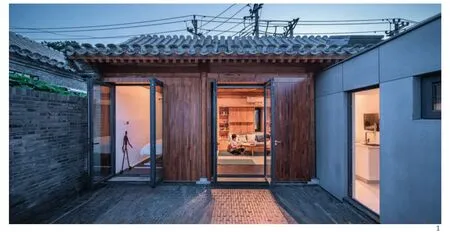
1 改造后外景/Exterior view after renovation
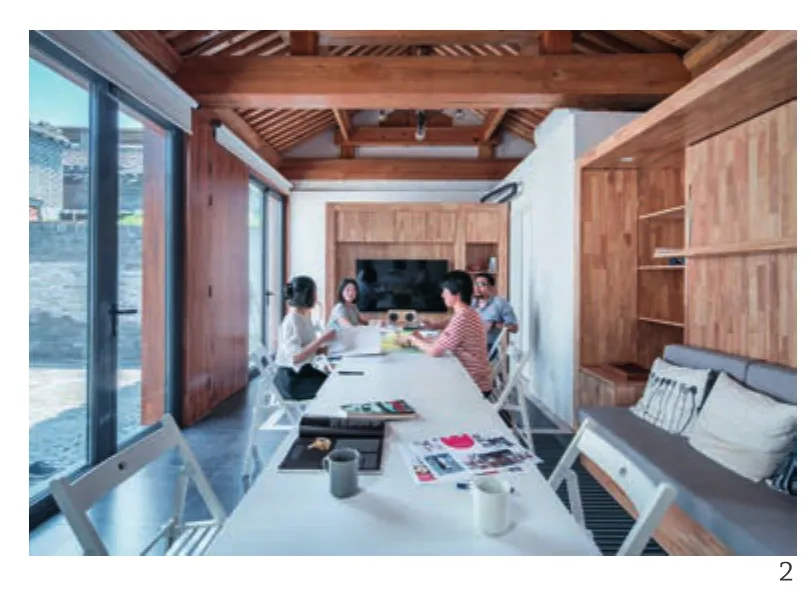
2 改造后內景/Interior views after renovation
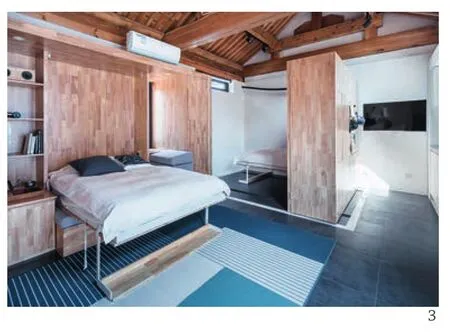
3 改造后內景/Interior views after renovation
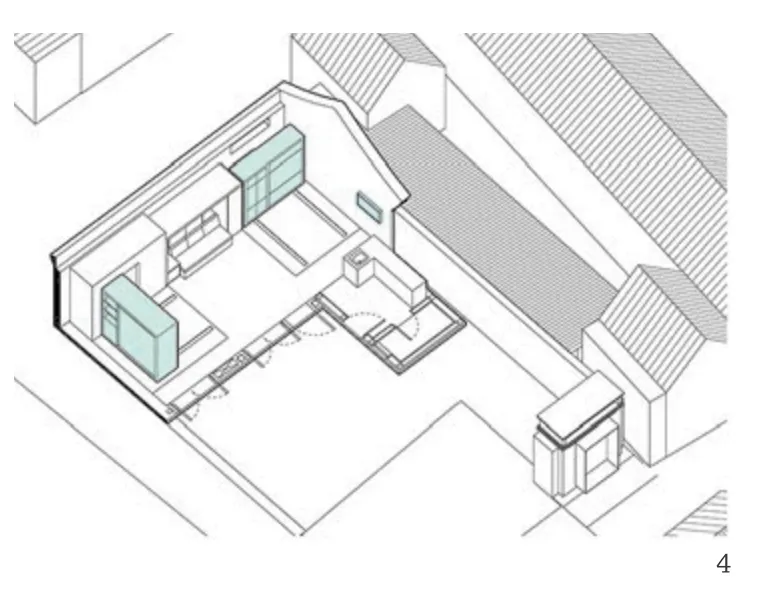
4 家庭辦公室/Home office
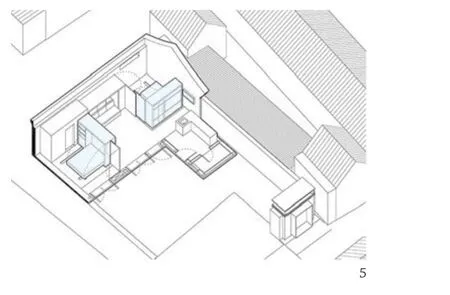
5 兩間臥室/Two bedrooms
Baitasi House of the Future is located in a historic hutong area of Beijing. The client is a tech company focuses on the smart homes. The commission is to create an experimental house that suits the future lifestyles of young people.
Baitasi is one of the well preserved hutong neighbourhoods. The original site had a 30m2house and a 80m2yard cramped with illegal building works.
Our design strategy is focused on three words:home, hutong and future.
Home
When we talk about housing we are talking about home. The society is getting more diversified with proud singles, nuclear family, civil partnership, open relationship, etc. Apart from personal relationship, occupations and the social environment are also changing the definition of home. The boundary between home and society is blurred by the rise of the sharing economy, nomad workers and technology. Our lives are fragmented and can not be accommodated by a fixed layout.
The House of the Future should represent such a lifestyle of young people. They can fluidly shift between work and home. Access and convenience are more important to them than ownership. The possibilities of home space outweigh its physical dimension. They pursue new things while value the quality of life.
Hutong
As the project is located in a historic area which is also a busy neighbourhood, construction activity needs to be minimised. After demolishing all the illegal building works, a lightweight structure unit is inserted to provide the basic facilities for the house.
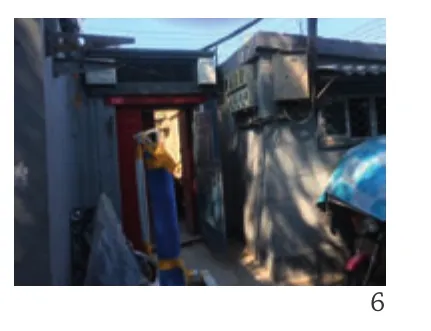
6 改造前外景/Exterior views before renovation
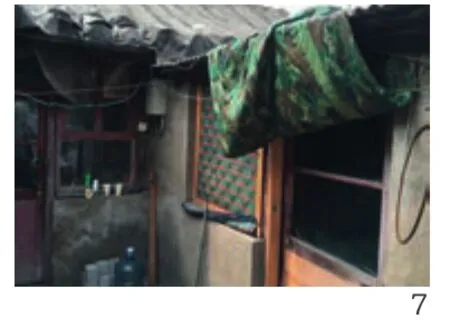
7 改造前外景/Exterior views before renovation
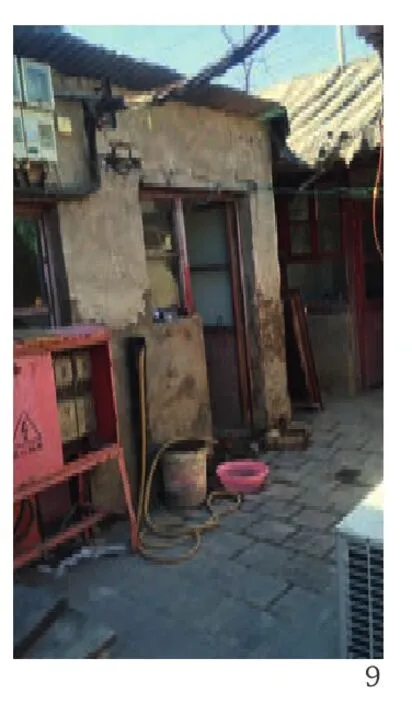
9 改造前外景/Exterior views before renovation

8 改造前外景/Exterior views before renovation
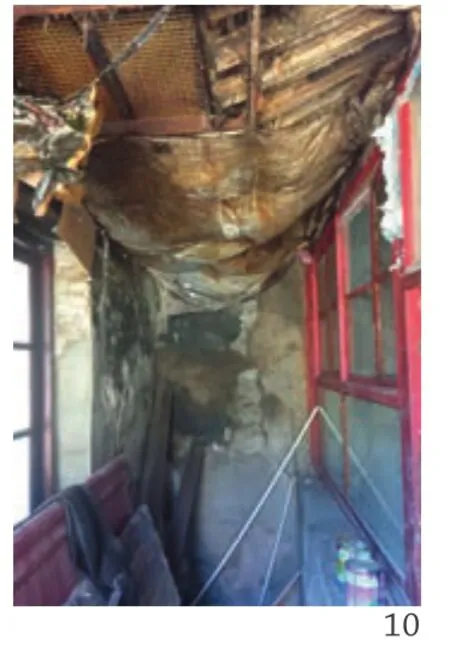
10 改造前內景/Interior view before renovation
Future
Technology should serve people, not the other way around. Although the House of the Future is equipped with many smart devices, we would like the house to be warm and cosy with all the tech hidden behind.
The original house is wood framed. To minimise construction work and reveal the beauty of traditional Chinese wooden structure, we replaced the decayed roof and removed all the interior partitions. Two moveable furniture modules and one fixed module are placed under the new roof.With the moveable modules, the house can have four different layout options. According to the needs of the residents, it can shift from a three bedrooms house to a small office. The fa?ade can be open up to connect the living space and the outdoors.
The moveable modules are controlled by a smart TV. This TV system also controls lighting modes,curtains, security alarm and other home appliances.
Based on the strategy of minimal intervention,we use WikiHouse system for the only new built structure on site. It serves as the kitchen and toilet.The WikiHouse is an open-source project for building houses. It is lightweight and digitally fabricated. Its faster and cleaner construction process suits the crowded and noise sensitive neighbourhood very well.
Compared to many futuristic design, this tiny house is nothing close to future at the first look. But its humble appearance and user adaptive interior may reflect something about the future in the ancient capital.
評論
張昕楠:在未來之家的設計中,預制的集約化家具模塊,一方面帶來了靈活的空間劃分,另一方面也混淆了建筑中空間分割系統與常規理解中家具尺度及意義的分野。這一以“未來”為名的設計策略,實則是對傳統某種回歸;如明、清的床、榻那樣,傳統的家具往往還有著明確定義空間的機能。因而,家具以其引發的身體姿態和物質化的量體,本來就在建筑系統中定義了空間使用者的行為、事件,并參與著空間劃分。
范路:在白塔寺未來之家這一改造項目中,可移動的實木墻壁模塊是關鍵設計要素。這3個模塊整合了床鋪、長椅和隔墻,并可以在兩個相反的方向上移動。它們不僅讓主要室內空間的形態發生變化,更以“時間差”的方式,讓休息睡眠的私密空間和辦公娛樂的公共空間發生重疊,帶來更大的空間使用效率和更多的生活模式。當然,其頂部的空間連通會帶來一些聲音干擾,而喜愛白天睡覺的住戶也會一定程度上降低空間使用的靈活性。
Comments
ZHANG Xinnan: In the design of House of the Future, the premade integrated furniture module both brings about flexible space division and mixes up the differences in either the space cutting system in architecture or the sizes and significance of furniture in conventional understanding. The design strategy,though under the name of "future", is in fact a kind of return to the tradition; as bed and couch in Ming and Qing dynasties, traditional furniture usually defines the function of a space. Therefore, with people's body posture and materialised measurement it triggers off,furniture de fines the activities and incidents of the space users in the architecture system and thus participates the space division. (Translated by QIAN Fang)
FAN Lu: In the renovation project of "House of the Future" in Baitasi district, the interior wood-panelled modules could be regarded as key elements in design.The three modules are integrated with beds, benches and partitions and could move in opposite directions.With these movable modules, the interior space can provide public working space in daytime and private resting space at night. While occasionally, one people's getting up too late in the morning might jeopardize roommates' working schedule.
猜你喜歡
現代裝飾(2020年7期)2020-07-27 01:27:42
流行色(2020年1期)2020-04-28 11:16:38
藝術啟蒙(2018年7期)2018-08-23 09:14:18
海峽姐妹(2017年7期)2017-07-31 19:08:17
Coco薇(2017年5期)2017-06-05 08:53:16
少年博覽·小學高年級(2016年12期)2017-01-16 12:48:35
特別文摘(2016年19期)2016-10-24 18:38:15
37°女人(2016年5期)2016-05-06 19:44:06
爆笑show(2016年1期)2016-03-04 18:30:28
爆笑show(2015年6期)2015-08-13 01:45:40
