
LINKED DESTINIES
2019-09-02 21:09:18ByWeiHongchen
Beijing Review 2019年35期
By Wei Hongchen
Liu Xingliang, a 38-year-old native of Wuhan in Hubei Province, is an amateur wine connoisseur. French red wine is his favorite, next only to spicy dry noodles, the signature local dish. One of his pastimes is to scour the city or surf the Internet for new wine varieties. In the last two years, to his delight, he has discovered several exotic wines right in Wuhan.
“One day in 2017, I spotted many bottles of French wine on the shelves of a supermarket near my home. They are not only rich in varieties and authentic in taste, but also affordable,”Liu told Beijing Review.
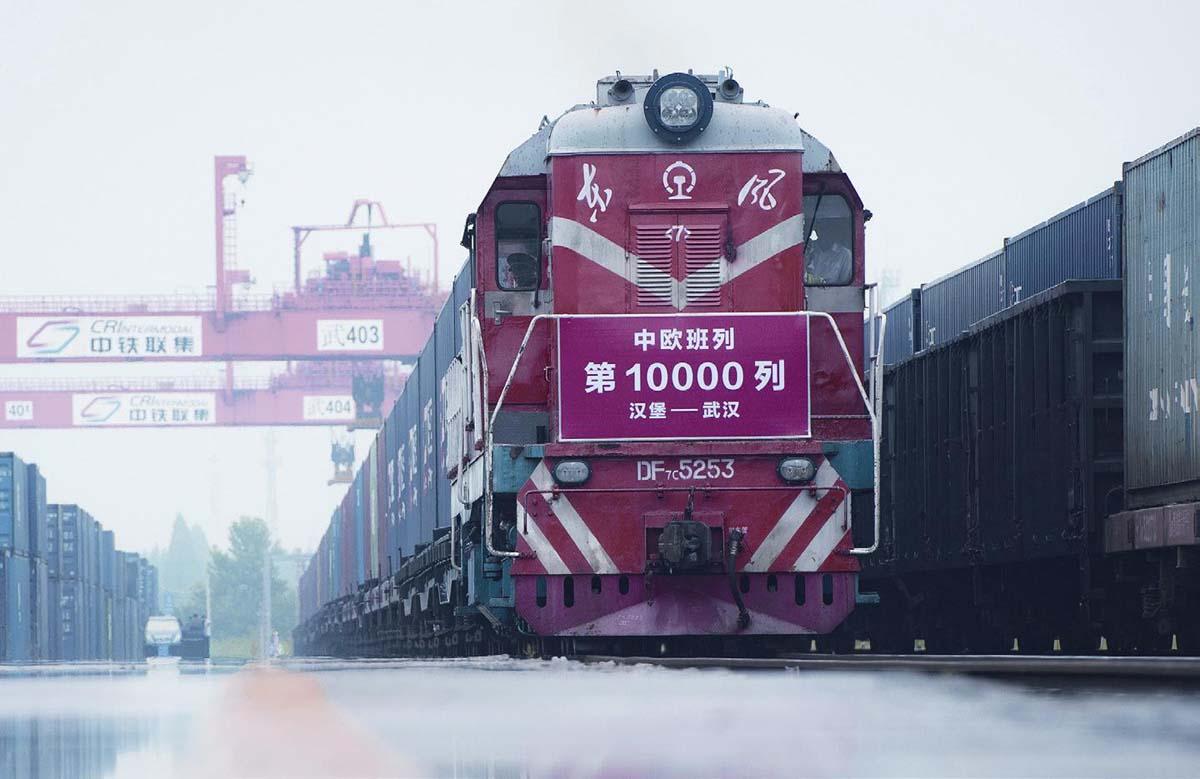
As an increasing number of China-Europe Railway Express trains shuttle between the city and France, wine has become more accessible and affordable in Wuhan, currently at the same price level as in Europe. The shipping time via railway is only one third of water routes, and its cost is about one fifth of that by air, said Wang Lei, Vice General Manager of Wuhan AsiaEurope Logistics Co. Ltd. (WAE), the operator of the trains running between Wuhan and Europe.
However, things werent always so smooth.“During the transportation process, extreme weather is often encountered. Sometimes, the temperature in containers can rise above 50 degrees Celsius in summer or drop below minus 20 degrees Celsius in winter,” Wang Lijun, WAE Chairman, said. “Since food, wine and medicine need to be preserved at certain temperatures, cold chain technology is necessary for their transportation.”
In 2016, a China-Europe Railway Express research team developed cutting-edge cold chain containers. These containers can be tracked 24 hours a day so that the entire transportation process is visible and controllable.
With these containers, French wine, German and Polish beer, Kazakhstans cooking oil, and other daily consumer products are now shipped from Europe and Central Asia to China, while oranges and lobsters from Hubei are shipped to European markets.
Wuhan was a historical bustling commercial hub. It was once the worlds largest tea distribution center, with the tea trade fueling the citys prosperity. Centuries ago, tea and other products from Wuhan were transported abroad along the ancient Silk Road, the Maritime Silk Road and other routes. In the mid-19th century, tea from Wuhan reached Russias St. Petersburg.
Now, railways have brought Wuhan and Europe much closer. In addition, a large French wine bonded warehouse opened in Wuhan on July 10.
“The bonded warehouse can speed up customs clearance and capital turnover, and reduce trade cost; at the same time, consumers can purchase quality products at affordable prices,” said Wang.
Transport arteries
The first China-Europe express freight train was launched in Chongqing on March 19, 2011, and headed to Duisburg, Germany via Xinjiang Uygur Autonomous Region. Carrying locally produced electronic products, the train covered a distance of about 11,000 km in 15 days.
In the ensuing two years, freight trains to Europe were launched in more inland Chinese cities such as Chengdu in Sichuan Province, Zhengzhou in Henan Province, Changsha in Hunan Province and Xian in Shaanxi Province. More than 40 Chinese cities have launched China-Europe Railway Express trains, according to the Ministry of Commerce (MOFCOM).
In addition, since the Belt and Road Initiative was initiated in 2013, the development of China-Europe rail services has been put on a faster track.
On October 24, 2012, the first China-Europe Railway Express train from Wuhan embarked on its maiden journey to the Pardubice Region in the Czech Republic, which lies 10,863 km away. In March 2014, the Wuhan Municipal Government founded the WAE to operate trains traveling between Wuhan and Europe. Over the years, more routes and trains have been added.
Wuhan trains are mainly destined for Germany, France, Russia and Belarus, running along either a southern route that passes through Xinjiang or a northern route that passes through Inner Mongolia Autonomous Region. In the beginning, the freight trains mainly provided customized services to large manufacturing enterprises in Hubei. However, the problem with that operation model was that the cargo loading rate was not high, especially on return trips.
To solve this issue, the WAE changed the model by accepting cargo from small and medium-sized enterprises in 2015. This has not only increased the cargo loading rate and railway revenue, but also reduced the shipping cost for enterprises and helped small and medium-sized enterprises access overseas market.
In 2018, China-Europe Railway Express freight trains made a total of 173 trips from Wuhan to Europe and 245 from Europe to Wuhan, with an average cargo loading rate of 96.3 percent, ranking first in the country, according to data from the WAE.

Moreover, the quantity of return cargo shipped by the trains between Wuhan and Europe ranks first among China-Europe Railway Express trains between Chinese cities and Europe, according to MOFCOM.
Driving development
These trains have strengthened economic and trade ties between Wuhan and Europe. They have also boosted imports and exports and spurred the industrial development of Hubei.
The province is home to many wood processing enterprises. However, the shortage of raw materials hampers the development of local companies such as Fuhan Wood Industry Co. Ltd. Thus, the WAE turned its attention to the Russian Far East, which is rich in timber. In April 2015, the WAE launched the first express railway to transport timber from Russia to China, which runs from Tomsk in Russia to Wuhan through the Manzhouli land port in Inner Mongolia.
Timber shipped from Russia has also attracted enterprises in the downstream industrial chain from Guangdong and Fujian provinces and Inner Mongolia to relocate to Wuhan, boosting the development of the paper industry in Chinas central region.
The WAE also offers customized shipping services for retail enterprises. On October 28, 2017, the first train chartered by Decathlon, the French sporting goods retail giant, transported items it produced and purchased in China to Dourges in France. Benefiting from the customized shipping service, Decathlon decided to bring orders that had been transferred to Viet Nam and other Southeast Asian countries back to Wuhan and neighboring areas, and established its China distribution center in Wuhan.
Decathlon currently has 268 physical stores in China, which is the only market outside France with a whole Decathlon production chain. In Wuhan, the retailer has six stores, a textile mill and a logistics center covering about 80,000 square meters.
Freight transport to Europe does not only cover companies in Hubei. Electronics, fruit, seafood and other products from the Pearl River Delta in south China and the Yangtze River Delta in east China, and even products from Southeast Asian countries are shipped to Wuhan and then loaded onto China-Europe Railway Express trains bound for Europe, said Zheng Li, deputy head of the Freight Department of the China Railway Wuhan Group.
The trains have also benefited companies in other countries. International freight railway transport has not only become a competitive edge for China, but also greatly enhanced the competitiveness of European enterprises cooperating with China, said Xavier Wanderpepen, an employee of the French National Railway Co. in charge of promoting trade with China. He said that in France, large retail chains and automotive groups, among others, need these logistics solutions, and more and more small businesses need this type of fast transport.
Cultural bridge
The express freight trains have also become a bridge for cultural exchanges between China and other countries.
Walking into the WAE office, visitors are greeted by an enormous painting on the wall depicting a China-Europe Railway Express train whizzing by a backdrop featuring landmark structures in Wuhan such as the ancient Yellow Crane Tower. The painting was created by a German girl named Nadine, said Li Jie, a WAE executive.
When Nadine was 11 years old, she learned that oranges and tangerines were shipped to Russia through an express freight train from Wuhan. Thats what inspired her to paint the watercolor, hoping that the citrus fruits would someday be shipped to Germany.
In Hubei, ancient chimes are a famous art form, which the express freight trains are now helping to introduce to a global audience. The heavy chimes used to be shipped abroad by sea, but the cost was high and the shipping time long, and the chimes risked getting rusty in the humid maritime environment. With express trains, shipping has become much more convenient.
The China-Europe Railway Express trains are mobile greeting cards that present Chinese culture and convey Wuhan peoples best wishes to people in countries along the railway lines, Wang concluded.
