PASSING ON THE GREEN BATON
2019-09-09 16:01:20ByLiNan
Beijing Review 2019年36期
By Li Nan


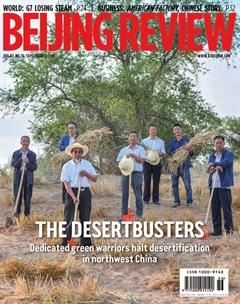
August 21, 2019, will remain a memo- rable date in Guo Wangangs life. On that day, the 67-year-old farmer received a special guest at his “forest farm,” an ecological initiative to prevent desertification. President Xi Jinping came for a visit.
“President Xi plowed the soil and built barriers with us to stabilize the sand,” Guo told Beijing Review. “He also asked us about the quality of the drinking water and our income.”
The Six Old Men
Guos Babusha Forest Farm lies near the Tengger Desert in northwest Chinas Gansu Province, the fourth largest desert in China.“We are ordinary farmers doing an ordinary job,” he said.
Guo is modest. He is actually part of an extraordinary group of dedicated green warriors. Three generations of farmers from six families began rallying in the 1980s to green the Tengger. He is from the second generation of these families. Today, the third generation has joined in. In 38 years, the group has grown 40 million trees, pushing the desert back by 15 km.
Gulang, the county where the forest farm lies, is a key area for monitoring desertification. From the 1960s to the 1980s, it suffered severe desertification as the Tengger expanded rapidly, with sand dunes approaching Guos village at a speed of 7.5 meters per year. Many locals left in the 1960s.
To combat desertification, the ThreeNorth Shelter Forest Program was launched in 1978. Extending from the northeastern to the northwestern tip of the country, it covers more than 40 percent of land area that is prone to erosion and will continue till 2050.
Gulang is in its northwestern part. The locals were given incentives to join the program, which encouraged farmers to be productive in their output while maintaining a unified collective operation. Subsidies were offered for anti-desertification work.
In 1981, Guos father and five other villagers took a contract to green 5,000 hectare. Since their collective age was nearly 300 years, they came to be known as the Six Old Men.
What made them volunteer for such backbreaking work? “The desert had a big impact on our farmland and home. If we couldnt control it, our homes would not exist and we would not survive,” Zhang Runyuan, one of the Six Old Men, told Beijing Review.
It needed enormous effort when they started. The saplings and even the water had to be transported into the desert on the back of donkeys. The only digging tool they had was the old-fashioned spade. None of the six knew anything about fighting desertification and almost 70 percent of the first batch of trees they planted were blown away.
The experience taught them that only the trees planted in grassy areas survived. So they learnt the first lesson: Stabilize the sand first with dry grass; then plant trees. Gradually, more saplings began to survive and there came a time when the once bleak desert was dotted with trees, bushes and grass.
A decade later, by 1991, a 2,800-hectare forest had sprung up. But while the desert turned green, the hair of the Six Old Men had become white. So they agreed that each family would contribute one member to take over the work. In the following years, four of the six passed away.
The turning point
Guo was the first in the second generation to join the green warriors in 1982 after his father fell ill. He had to leave his job in town to work on the farm and it slashed his income by one third.
“In the beginning, I was reluctant to give up my job since I had a family to feed,”Guo said. Besides, life in the desert was tedious. He complained a lot and wanted to escape.
But a catastrophic sandstorm on May 5, 1993, changed his mind. On that afternoon, a sandstorm invaded Gulang when Guo was working on the farm. He was buried under sand and escaped death by a hairs breadth. However, 23 locals died in the storm. From that day, he stopped talking about leaving the farm.
From the early 1990s, sons and sonsin-law from the other five families took up their fathers spades one by one and the second-generation band of six brothers was formed.
They adopted a more efficient way to stabilize the sand. “From the 1990s, we have been building straw barriers to stabilize the sand. The survival rate of trees planted in the barriers is higher,” He Zhongqiang, one of the second generation, told Beijing Review.
By 2000, all the 5,000 hectare in Babusha had been afforested. The vegetation cover increased to 70 percent from less than 3 percent in the 1980s.
He is also making Babusha known to youngsters via social media. He shares videos about the farm on Kuaishou, a leading short video social platform in China. The most popular videos get more than 200,000 views. “Babusha was a desert. Now its green. I hope more people know about it,” he said.
After nearly four decades of efforts, Gulangs environment has improved.“Today, the desert winds are fewer and less fierce. The annual rainfall has increased from 100 mm in the 1980s to 300 mm this year,” Guo Wangang said.
What makes him proud is that those who fled Babusha are now moving back. Today, there are 24 more households. “In the 1960s, we used to be driven away by the desert. Now the story is quite the reverse,” he said.
Oasis against poverty
Planting drought-resistant vegetation in the desert, while it improves the environment, generates little income. How to fight desertification and poverty at the same time has long been a problem for the forest farm.
The biggest crisis erupted in the mid-1990s when the government adjusted its preferential policies and the subsidies to the farm stopped. One of its products, shrub twigs used for building mud houses in northwest China before the 1990s, fell out of favor.
In 1995, the farm was on the brink of bankruptcy. Guo Wangang, who headed the farm, thought of emergency measures like drilling a well and growing cash crops such as wheat, corn, watermelon and tomato. “The biggest hurdle was money. We needed nearly 300,000 yuan ($41,859), an astronomical sum for farmers at that time,”he said.
However, the local bank agreed to give them a loan. The six families contributed either money or labor, and became shareholders of the farm. Two years later, the farm revived.
It also turned to raising poultry. Last year, Guo Xi raised 5,000 chickens, bringing a net income of 200,000 yuan ($27,922).

The farm is now creating jobs for the impoverished in the neighborhood. This year, it rented land from poor farmers in a nearby community and planted drought-resistant cash crops, including medicinal herbs and dates. The community residents were hired as farmhands during the busy seasons.
“We employed 3,000 people from neighboring communities to plant trees this spring. Everyone earned more than 3,000 yuan ($418.8) in two months,” Guo Wangang said. “We found a new way out of poverty by combining afforestation with agriculture and raising fowls.”
“As President Xi says, clear water and lush mountains are invaluable assets,” he said. “And we did it. Planting trees in the desert is not an easy task. But as long as we persist, there will be result.”