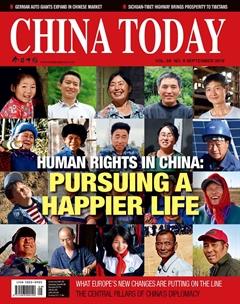
Providing a Happy Life for Chinese People
2019-09-10 21:33:32ByZHANGYONGHE
CHINA TODAY 2019年9期
By ZHANG YONGHE
ON June 25, 1945 the Charter of the United Nations was adopted at the United Nations Conference on International Organization. It articulated a commitment to uphold the human rights of citizens, outlined a broad set of principles relating to achieving “higher standards of living,” and expressed the determination to “employ international machinery for the promotion of the economic and social advancement of all peoples.”However in a time when the world had not quite recovered from the ravages of a world war, the prospect of a “good life” seemed like something far off in the distance for mankind.
After the Universal Declaration of Human Rights was proclaimed by the United Nations General Assembly in 1948, human rights became the values universally recognized and advocated by the international community and common ethical norms of human society. They are also the path and means for humankind to achieve a happy life. The International Covenant on Economic, Social, and Cultural Rights says, “Recognizing that, in accordance with the Universal Declaration of Human Rights, the ideal of free human beings enjoying freedom from fear and want can only be achieved if conditions are created whereby everyone may enjoy his economic, social, and cultural rights, as well as his civil and political rights.”

In December 1986, the General Assembly of the UN passed the Declaration on the Right to Development, which says, “The right to development is an inalienable human right by virtue of which every human person and all peoples are entitled to participate in, contribute to, and enjoy economic, social, cultural, and political development, in which all human rights and fundamental freedoms can be fully realized.” Thereby the UN recognizes that the right to development is a basic human right, and hopes that development guarantees the human rights of all individuals and a good life for the entire human race. In September 2015, the UN adopted the 2030 Agenda for Sustainable Development, which points to the fact that “billions of our citizens continue to live in poverty and are denied a life of dignity,” and envisages “a world free of poverty, hunger, disease, and want, where all life can thrive.” All UN documents on human rights aim to create a better life for mankind, and hence confirm that the essence of the concept of human rights is a happy life.
It is undeniable that each and every country must sanction the ideal that every person should fully enjoy human dignity and rights and show sincerity in making efforts to achieve it. Whats more important than sanctioning the ideal and showing sincerity is transforming the human rights on paper into actions, which requires necessary conditions to make these rights viable in reality.
Before the founding of the Peoples Republic of China (PRC), Chinese people suffered immensely under the oppression of imperialism, feudalism, and bureaucrat-capitalism. For over a century, we struggled to topple these “three mountains” that were towering over us and fought for human rights from one generation to the next. Eventually, we won national independence and liberation, which led to marked improvements in human rights. This however did not mean the full realization of human rights in China –poverty does not disappear overnight, and the economic and social resources needed for higher-level guarantees for human rights were still insufficient. Given these historical and current conditions, subsistence is understandably Chinas top priority. It is our choice to accelerate development on the precondition of ensuring the peoples subsistence and enable them to better enjoy the right to subsistence through development. Because China is a large developing country, it gives priority to rights to subsistence and development among all human rights. As the most populous developing country on earth, China rose on a weak economic foundation, and its development has been uneven. Facing this reality, China must follow its own path of guaranteeing human rights.
Over the past 70 years since 1949, China has explored ways to guarantee and advance human rights. By combining the universal principles of human rights with the prevailing realities of the country, we have blazed a new path for human rights that suits our national conditions. Without the right to subsistence, no other human right is achievable. China believes that only development can guarantee peoples fundamental rights, only development can address the root cause of global challenges, and only development can advance the progress of human society. By protecting and guaranteeing rights to subsistence and development as the first and foremost of human rights, China has made historic leaps from poverty to moderate prosperity, and increasingly enhanced its peoples rights to development in all areas, including economy, politics, culture, social affairs, and environment. Chinese people now live a life of peace, abundance, and dignity, which embodies the essence of socialism with Chinese characteristics, and is also the historic mission of the Communist Party of China.
The exploration and development in the first 30 years of the PRC laid the foundation for protection of the rights to subsistence and development, and reform and opening-up of the following decades has injected new impetus to this cause, creating material conditions for guaranteeing these rights and enabling their higher-level development. Since its reform and opening-up kicked in, China has lifted more than 700 million people out of poverty over the past 40 years, which accounts for 70-plus percent of the worlds poverty reduction. In late 2015, the central authorities released the overall targets of winning the battle against poverty during the 2016-2020 period: By 2020 impoverished people in the countryside will have enough food and clothing and access to compulsory education, basic healthcare, and safe housing; per capita disposable income of farmers living in impoverished regions will grow at a rate higher than the national average level, and the indexes of basic public services for this group are close to the national average level; China will lift all its rural residents living below the current poverty line out of poverty and eliminate poverty in all poor counties and regions.
To meet the above targets, China devised plans on the basis of a survey of its low-income population at the end of 2014. First, it will help 30 million people who are able to work and have skills to shake off poverty through industrial support; second, it will help 10 million rural residents climb out of poverty through employment in non-agricultural sectors; third, it will help another 10 million people come out of poverty by relocating them to sites with more hospitable environments; and fourth, it will grant subsistence allowances to the people who cannot rise beyond poverty on their own. These measures are significant contributions by China to the UN poverty eradication program.
The following figures highlight the achievements China has made in human rights over the past 70 years. With the establishment of the worlds largest social security network, China has significantly increased its peoples life expectancy – from 35 years prior to 1949 to 76.5 years in 2016, among the longest in developing countries; Chinese people have better education – more than 80 percent of the population were illiterate in 1949, and only 20 percent school-age children attended school, but today the net enrollment rate of primary schools stands at 99.88 percent, the completion rate of nineyear compulsory education is 93 percent, and the development of higher education is close to that of moderately developed countries. China National Human Development Report 2016 concludes, “As per the Human Development Report 2015 published by UNDP, Chinas Human Development Index (HDI) reached 0.727 in 2014, ranking 90th among 188 countries/regions, indicating that China has entered a phase of high human development.”
China has intensified efforts to build a better life for its people over the past years, striving to meet both their material concrete needs and institutional needs including democracy, rule of law, equity, and justice. In the latter, the progress has not been smooth, and has been hindered by setbacks. But through incessant efforts, China has greatly improved the civil and political rights of its citizens.
To better protect citizens civil rights, China carried out a series of institutional reforms to combat corruption and regulate the exercise of public power. It has also established a complete legal system in accordance with international human rights conventions and national conditions to guarantee citizensrights, especially in the administrative and judiciary procedures. China follows policies on freedom of religious belief that protect the freedom of religious belief of both its citizens and foreign residents in the country, and protect the legitimate rights of both believers and non-believers.
China works to ensure that all parties enjoy the right to a fair trial. On the basis of generic institutional improvement and innovation, China employs the latest digital technologies to improve judicial services. It has established the worlds largest website for the public to search for court papers, opened smart courts, and continues to explore ways of making judicial services more accessible, transparent, just, and equitable.
To protect citizens political rights, China has increased the transparency of government affairs, and established institutions for the public to oversee the government in various ways to ensure the peoples rights to be informed, to participate, to be heard, and to oversee. China has the worlds largest “we media”community, and its netizens generate as many as 30 billion pieces of information every day. The rapid development of “we media” in China has boosted the realization of various rights of citizens. Meanwhile, the extensive practice of community-level democracy across the country has given rise to a comparatively complete system for community-level democratic self-governance.