
A Study of the Sense Division for Word “Jin” in NCCED Based on Corpus
2019-09-10 07:22:44翟佳慧
新教育論壇 2019年30期
關鍵詞:研究
翟佳慧
Abstract:Using qualitative and quantitative analysis method, this paper analyzes the sense division of item for word “jin” in A New Century Chinese-English Dictionary. After analysis, some problems are found: treatment on the sense division are vague and unprecise; some overlapping phenomenon exist between senses; some senses aren’t included in the dictionary.?The reasons can be counted on: under the influence of the Modern Chinese Dictionary, the bilingual dictionary lost its flexibility in sense arrangement which resulting the compilers pay more attention on the characteristics of the source language. Then, without the support of the corpus, the job of the sense division cannot achieve more precisely. This paper mainly focus on changing the traditional method of sense arrangement and do more contribution in changing the domestic situation: filling the gap between the dictionary-making and the support of linguistic corpus.
Introduction:
During the process of sense description, one of the most challenging parts facing dictionary compilers is sense division of the polysemous words; and actually, the problem of polysemy has also been puzzling other linguistics interested in lexical semantics. Traditionally, semantics and lexicographers tended to tackle this problem basing partially on certain linguistic data and partially on their instinctive judgements. The results of such interpreting, therefore, may be more of the individual scholars’ subjective reflections, instead of the objective descriptions of the polysemous words under consideration. It becomes even more problematic when dealing with the issue of describing polysemous words in Chinese-English dictionary. However, bilingual dictionaries, in practice, may do their sense discrimination based on the sense division of the renferential monolingual dictionaries. That is where the problems arise. With the monolingual reference, the attention of the compilers of bilingual dictionary may mainly focus on the characteristics of the source language instead of target language. The result showed that Chinese monolingual dictionaries are less precise in dealing with the sense discrimination.(see 李仕春,20161) Situations in the domestic development of linguistic corpus were not so good until the 1990s when the technology had been widely used in English dictionary-compilation like: Collins COBUILD English Dictionary based in the COBUILD English corpus (the Bank of English)、Oxford Advanced Learner’s Dictionary、Longman Dictionary of Contemporary English、Chambers Essential English Dictionary. (see 張志毅,2012) Therefore, followed the method of compiling the Chinese monolingual dictionary, situations of Chinese-English dictionary is beyond the optimism. It is necessary to change the traditional sense arrangement which merely based on the Chinese characteristics and sufficiently adopt the linguistics corpus in sense description. What we are going to introduce here is that through the analysis of the corpus which is based pragmatic use of language, the sense division of the bilingual dictionary not only need the monolingual dictionary as reference but with the supplement of the linguistic corpus.
What we are going to do is to change the existing situation in China:that is combine the lexicography with the technology of corpus in Chinese dictionary-making.
Literature Review:
Bilingual dictionaries, in practice, may build their new entry through sense discrimination based on the sense division of the renferential monolingual dictionaries. However, referential materials are not limited in the dictionary,and bilingual dictionaries should pay more attention to the costumed senses supported by the majority of a language community, rather than focusing on the individual uses sharing by only a small group of speakers.(HUANG&CHEN,2001: 190-191) That calls for the support of the corpus which are more authoritative with rich practical sources?of language.
Research Methodology:
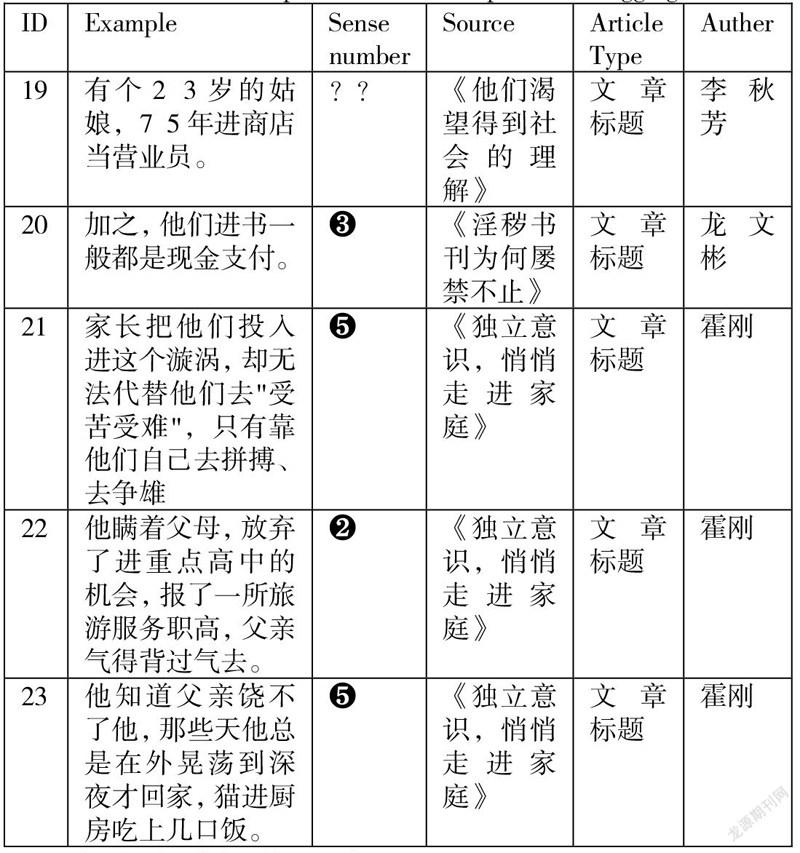
What we use here is the Center for Chinese Linguistic PKU as well as the Contemporary Chinese Dictionary (CCD)as the reference. When we texted the “進” into the corpus, we got 11805 results from which we selected randomly 300 results as the research targets. Since monolingual dictionary is the basic reference material in sense discrimination for bilingual dictionary, we consulted the CCD to examine how it deal with the sense division under the support of the CCL. We tagged the senses for the 300 results in according to the CCD and then we found some problems.Here are part of the tagging results.
Analysis of the Entry “Jin”
進jìn?〈動〉advance; move/march forward; go ahead:e?步;?取;不?則退;前??〈動〉present; submit:e~ 獻;?言?〈動〉enter; come/go/get into:考?大學enter a college || ?醫院be sent to hospital; be hospitalized || 請?! Come in, please! || 我們?屋吧。Let’s go into the house. e?城;?站?〈動〉recruit; receive; admit:今年我們單位不?人。We will not recruit the staff this year. || 我們系?了一名博士。Our department has taken on a new faculty mem?ber with a doctoral degree. e?貨;?款;?項?〈動〉[used after a verb] get into/in;掉?水里fall into the water || 走?辦公室walk into an office ?〈量〉any of the several rows of houses within an old-style residential compound?。
【進逼】jìn bī,〈動〉 close in on/upon; advance on; press on towards; press hard:步步?press forward steadily || 敵人正向我軍The enemy troops were pressing on towards/ closing in upon our troops.
【進兵】jìn bīng〈動〉dispatch troops to attack; (of troops) march on (a place)
【進補】jìn bǔ〈動〉take extra nourishment; take tonic
【進步】jìn bù?〈動〉improve; progress; advance; make progress:?快/慢make rapid/slow progress; progress rap?idly/slowly || 學習?make progress in one’s studies || 人類在?。Mankind is progressing. || 他數學?很快。He is making much headway in maths. ?〈名〉progress; improvement; advancement:妨礙?bar/hamper/hinder the progress (of) II 激勵/加快?stimulate/quicken the progress (of) || 繼續努 力以求更大?strive for more progress || 渴望?desire ad- vance/progress/improvement; be eager about one’s pro?gress 1| 沒有?make no progress || 取得明顯?make decided/ marked progress || 阻礙?block/delay/stunt the progress (of) || 不斷/很大/極大/驚人
的?continued/considerable/tre?mendous/amazing progress || 顯著的?marked/remarkable progress || 科學的?advancement/progress of science; sci?entific progress || 農業技術的?advancement of agricultural technology || 為了社會的?for the advancement of the society ?〈形〉progressive:?力量/思想/團體progressive forces/ ideas/organizations ||?人士progressive personage/element
【迸餐】jincan 〈動〉have a meal:按時?take meals on
Sense division of Chinese-English was greatly influenced under Chinese monolingual dictionary and lost it own flexibility and features. Admittedly, we should adhere to the Chinese monolingual dictionary as criteria because it has achieved its own systematicity in many aspects including the sense division. Just as the six senses arrangement of entry “進” in the NCCED, it was totally correspond with that in CCD. However, the result is that the senses are arranged vaguely and unprecisely. Take the sense ? as example, “進款” has the meaning of “profit or harvest”, just as we found examples in CCL:
某報周末版在名人專訪一欄里,記述了一位當今歌壇大紅大紫日進斗金的女歌星,極翔實地描繪了她出生時的"盛況"
But it was arranged under the sense ? without split it out as another sense. If we students make Chinese translation or English production, we consult the sense ?, we cannot get the precise sense and may make some wrong.
Therefore, bilingual dictionary,as the tool for the English learners as second language or foreigners with English as mother tongue, should not ignore the consideration of English features: sense division is more precise and detailed. (see 李仕春)
Take the phrase “進餐” as the example. The analysis of the corpus CCL tell us that “進” is supposed to have another sense “eat or drink or take” because the examples with this sense count a large part in the research dara almost 7%:
a.A組有16個小時未進食,B組有4個小時未進食,C組則只有1個小時未進食。
b.每次進餐、飲酒,都要往火里投一點酒肉,孝敬火神。
c.藥須由眾醫配合,進服時需人先嘗。
d.每遇太后有恙,憂急異常,甚至不進飲食,太后疾愈,仍復常度。
But the NCCED didn’t give the sense in the entry rather than present it in the phrase “進餐”. The problem arise: how the dictionary treat the other phrases: “進服” “進食” “進飲” ? If the compilers just give every phrase sharing the same sense “take” a place in the dictionary, this way maybe against the economical principle. On the other hand, one of the criteria that what kind of phrases beginning with “進” can gain the place in the dictionary is that the phrase have the collocational potential. However “進餐” doesn’t own this kind of feature.
The last problems: Some senses are not included in the dictionary. According to our analysis on the corpus, some examples cannot find their senses in the dictionary. Those examples without sense?in the corpus count most 12.7%.For example:
a.這屋子進風,王玲身體不不適,便匆忙離開。
b.暴雨過后,家門進水三尺,孩子們趕忙那盆接水。
c.他眼里進沙,急忙喊叫,傍邊女生羞澀著,還是幫忙看了看。
Here we give them a new sense“have” rather than just satisfy the existing sense ?and reasons are followed:
Diffenrent with verb “進” in examples like : “他走進圖書館”(he entered into the library),“進”in here serves as a stative verb. Meanwhile , from the semantic perspective, the agent of the action holds the predicate place instead of subject like “他走進圖書館”. Thus,we give them a new sense: “have or contain” .
Another examples in corpus like these count almost 14.3%:
a.1928年,任光回到闊別的祖國,不久就進了上海百代唱片公司,從此揭開了他的生命史上最見光彩的一頁。
b.1964年初中(學蒙文)畢業就進了內蒙古歌舞團,開始了自己的藝術生涯
c.有些社員,尤其是年青小伙子們,認為生產是苦事,他們想參軍,當機關干部或進工廠,頁俚就常同他們說:"沒人種莊稼,人們吃什么?
Without any proper sense in the dictionary, we attribute a new sense to them: “be employed; be promoted”.
Conclusion:
NCCED as a bilingual dictionary aims at the second language learning and should keep flexible in sense setting instead blindly follow the old-fashioned method as traditional Chinese monolingual dictionary do.
Western English dictionaries (Big Four) made fully use of corpus, and it was proved that the sense division in those dictionaries is more precise thus senses much more than our domestic learner’s dictionaries. Although our domestic corpus-using process has got great process, we still have a long way to go. This paper maybe far from in data collection to demonstrate the problems existing NCCED in sense division and we are not sure that if the conclusion is accessible to other Chinese-English dictionaries. The purpose here serve as a clue to explore further in this research field and hope make some contribution in changing the domestic situation: filling the gap between the dictionary-making and the support of linguistic corpus.
Reference:
[1]陳思,李仕春.語料庫視野下的現代漢語“思”字義項研究[J].成都師范學院學報,2017,33(09):23-26.
[2]胡婷,李仕春.語料庫視野下的現代漢語“說”義項分布研究[J].宜賓學院學報,2017,17(09):112-117.
[3]惠宇,新世紀漢英大詞典[Z].北京外語教學與研究出版社
[4]李仕春.基于語料庫的現代漢語“黃”字義項分布研究[J].中國海洋大學學報(社會科學版),2016(05):103-109.
[5]李仕春.漢英中型語文詞典義項精細度對比研究[J].長江學術,2016(03):122-128.
[6]李仕春,李蓓.語料庫視野下的現代漢語“狗”字義項分布研究[J].北華大學學報(社會科學版),2014,15 (06):9-11.
[7]夏立新,夏韻,李茜.基于語料庫的中國英語學習者動名搭配行為特征的研究——Ability的個案研究[J].外語教學,2014,35(01):68-72.
[8]李仕春.漢英詞典100核心詞釋義對比研究[J].中南大學學報(社會科學版),2013,19(06):252-258.
[9]李仕春.語料庫視野下的現代漢語“綠”字義項分布研究[J].山西大同大學學報(社會科學版),2013,27(05): 62-66+90.
[10]夏立新.把語料庫數據引入到內向型漢英詞典的搭配信息中[J].外國語文,2012,28(03):47-50.
[11]Michael Rundell,夏立新,朱冬生.語料庫詞典學的最新發展和未來趨勢(上)——語料庫數據在學習詞典中的顯性應用[J].辭書研究,2009(03):71-78.
[12]羅良勤. 外向型漢英詞典中多義詞的義項劃分與分辨研究[D].廈門大學,2009.
猜你喜歡
體育科技文獻通報(2022年3期)2022-05-23 13:46:54
天津外國語大學學報(2021年3期)2021-08-13 08:32:18
遼金歷史與考古(2021年0期)2021-07-29 01:06:54
科技傳播(2019年22期)2020-01-14 03:06:54
遼金歷史與考古(2019年0期)2020-01-06 07:45:20
民用飛機設計與研究(2019年4期)2019-05-21 07:21:24
電子制作(2018年11期)2018-08-04 03:26:04
汽車工程學報(2017年2期)2017-07-05 08:13:02
國際商務財會(2017年8期)2017-06-21 06:14:14
電子制作(2017年23期)2017-02-02 07:17:19
