
季銨鹽復合相變材料的相變溫度預測方法
2019-12-02 01:25:01陳威錢靜張偉
當代化工 2019年10期
關鍵詞:質量
陳威 錢靜 張偉
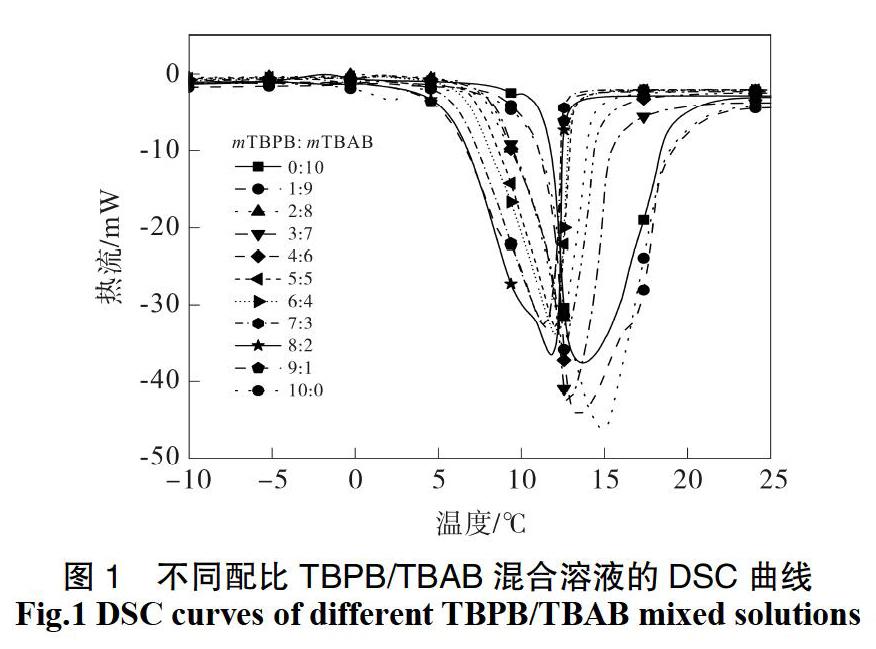
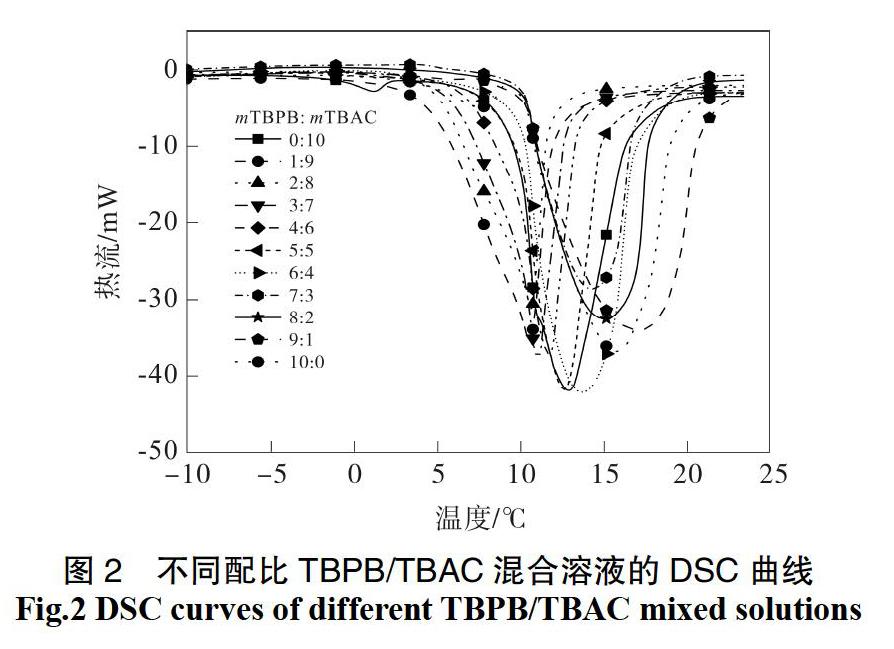
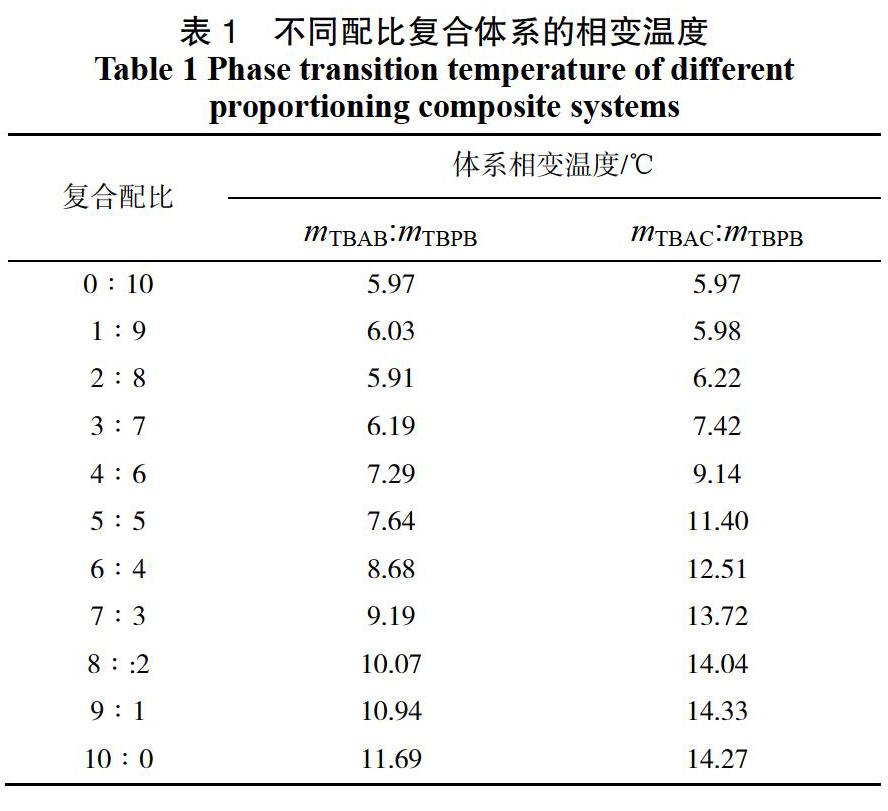
摘? ? ? 要:以典型無機結晶水合鹽四丁基氯化銨(Tetrabutylammonium chloride,TBAC)、四丁基溴化銨(Tetrabutylammonium bromide,TBAB)、四丁基溴化磷(Tetrabutylphosphonium bromide,TBPB)為原料,探究其混合水溶液相變溫度與季銨鹽組分配比的理論關系。差示掃描量熱儀(DSC)測試結果表明,在混合溶液質量分數為40%時,各配比復合體系均表現為唯一的相變峰,融合性良好。TBPB/TBAB和TBPB/TBAC復合體系的相變溫度調節范圍分別為5.91~11.69 ℃和5.92~14.33 ℃。利用Origin軟件對兩種復合體系的季銨鹽組分配比-相變溫度曲線進行擬合,所得預測公式的相關系數R2分別達到0.964 7和0.952 1,預測誤差小于5%。
關? 鍵? 詞:相變儲能;復合相變材料;Asymptotic1擬合;相變溫度預測
中圖分類號:TQ050.4+3? ? ? ?文獻標識碼: A? ? ? ?文章編號: 1671-0460(2019)10-2183-04
Abstract: The typical inorganic crystalline hydrated salt tetrabutylammonium chloride (TBAC), tetrabutylammo -nium bromide (TBAB) and tetrabutylphosphonium bromide (TBPB) were used as raw materials to explore the theoretical relationship between the phase transition temperature of the aqueous solution and the distribution ratio of the quaternary ammonium salt group. The results of differential scanning calorimetry (DSC) showed that the phase ratio of TBPB/TBAB and TBPB/TBAC composite system was the only phase change peak when the mixed solution mass fraction was 40%. The ranges were 5.91 to 11.69 ℃ and 5.92 to 14.33 ℃, respectively. The quaternary ammonium salt group distribution ratio-phase transformation temperature curves of the two composite systems were fitted by using the Origin software. The correlation coefficient R2 of the obtained prediction formula reached 0.964 7 and 0.952 1, respectively, and the prediction error was less than 5%.
Key words: Phase change energy storage; Composite phase change material; Asymptotic1 fitting; Phase transition temperature prediction
相變材料通過物態轉變進行能量儲放,可以解決能量供求在時間和空間上的矛盾[1]。在實際應用中,要求相變材料具備適宜相變溫度、相變潛熱大、性能穩定、導熱性能良好等特點,但單一相變材料往往無法同時滿足上述條件,因而需要多種相變材料進行復合以達到要求[2]。
具有適宜相變溫度是制備復合相變材料的重要一環,也為復合相變材料各組分的選取提供了一項參考。但復合相變材料的配制絕大部分還停留在盲目試錯的階段,對材料選取具有指導意義的理論尚不充分。張寅平等[3]根據熱力學第二定律和相平衡理論對(準)共晶系的熔點和融解熱進行了分析預測, 得到了共晶混合物熔點、 融解熱與組分物性間的關系。柯慧珍等[4]和Li等[5]根據Schrader公式計算多元脂肪酸低共熔質量配比,再以此為指導,通過實驗和DSC測試得到實際配比,結果表明吻合度較高。Pan[6]等通過分析二元共晶合金相變中熵及焓等狀態量的變化特點,推導出低熔點合金熔點和相變潛熱預測模型。結果表明,15種低熔點合金熔點和相變潛熱的計算值與DSC測試結果具有較好的一致性。上述研究都在一定范圍內為復合相變材料的配制和“設計”提供了理論參考,但其適用范圍有局限性,尚有許多新材料和復合特性需要進行研究和補充。
大部分季銨鹽具有良好的水溶性,其水溶液相變潛熱值可以達到190 J/g以上,遠遠優于普通的水合鹽相變蓄冷材料[7]。季銨鹽水溶液相變溫度對體系質量分數十分敏感,蓄冷范圍為0~26 ℃,是應用前景巨大的蓄冷材料[8]。對于單一季銨鹽水溶液的相變特性,已有大量文獻進行了探究。朱華[9]在文獻中提到,TBAB水溶液相變溫度為0~12 ℃,相變潛熱為180~190 J/g,并在質量分數為41%時形成唯一的相變峰。謝應明等[10]通過研究發現,TBAC溶液的相變溫度隨質量分數增加而升高,并在質量分數為40%時趨于穩定。Takuya等[11]在文獻中提到,TBPB水合物在質量分數為33%~35%時相變溫度最高,并在35%時達到相變潛熱峰值214 J/g。對于季銨鹽二元混合溶液的蓄冷特性,目前已有的文獻十分有限。Motoi Oshima等[12]通過研究表明,隨著TBAB組分含量的增加,TBAB/ TBAC混合溶液體系的相變溫度由15 ℃逐漸降低為12.3 ℃。Wang等[8]通過對TBAF(Tetrabutylammonium fluoride ,四丁基氟化銨)、TBAB、TBPB單一及二元混合溶液的水合物形成行為進行探究,得出結論:三種物質單一及二元混合溶液的相變溫度,均隨溶液質量分數增大而增大。同一質量分數條件下,二元混合溶液的相變溫度隨高熔點組分的比例增加而增加。由此可知,季銨鹽組分配比與二元復配溶液的相變溫度反映出一定的規律,但其理論關系需要繼續探究。
參考文獻:
[1]? 張仁元. 相變材料與相變儲能技術[M]. 北京:科學出版社,2009:10-11.
[2] 焦華. 溶膠-凝膠法制備復合相變PEG/SiO2的實驗研究[J]. 當代化工, 2018, 47(4): 739-741.
[3] 張寅平, 蘇躍紅, 葛新石.(準)共晶系相變材料融點及融解熱的理論預測[J]. 中國科學技術大學學報, 1995 (04): 474-478.
[4] 柯惠珍, 李永貴. 脂肪酸多元低共熔物的共晶質量比例、儲熱性能及其應用[J]. 材料科學與工程學報, 2018,36(1):82-86.
[5] Li M , Kao H , Wu Z , et al. Study on preparation and thermal property of binary fatty acid and the binary fatty acids/diatomite composite phase change materials[J]. Applied Energy, 2011, 88(5):1606-1612.
[6] Pan A , Wang J , Zhang X . Prediction of Melting Temperature and Latent Heat for Low-melting Metal PCMs[J]. Rare Metal Materials and Engineering, 2016, 45 (4): 874-880.
[7] 孫志高,江承明,孫立. 新型空調蓄冷材料四丁基溴化銨-水相變條件和相變熱實驗研究[J]. 制冷學報,2009,30 (5):24-26.
[8] WANG X L,DENNIS M. An Experimental Study on the Formation Behaviour of Single And Binary Hydrates of TBAB, TBAF and TBPB for Cold Storage Air Conditioning Applications[J]. Chemical Engineering Science, 2015,137:938-946.
[9] 朱華. 相變材料的熱物性測量和流動傳熱特性研究[D]. 上海:上海交通大學, 2015.
[10]謝應明,魏晶晶,劉道平,時競競,劉妮,祁影霞.四丁基氯化銨水合物的蓄冷特性[J].化工學報,2010,61(S2):77-80.
[11]SUGINAKA T,SAKAMOTO H,IINO K,et al. Thermodynamic Properties of Ionic Semiclathrate Hydrate Formed with Tetrabuty -lphosphonium Bromide[J]. Fluid Phase Equilibria,2012,317(1):25-28.
[12]Dissociation behaviour of (tetra-n-butylammonium bromide+tetra- n-butylammonium chloride) mixed semiclathrate hydrate systems[J]. The Journal of Chemical Thermodynamics, 2015, 90:277-281.
[13]謝應明, 魏晶晶, 劉道平. 蓄冷新工質—四丁基氯化銨水合物的蓄冷特性實驗研究[C].全國制冷空調新技術研討會, 2010.
[14]Lin W , Dalmazzone D , Walter Fürst, et al. Accurate DSC measure -ment of the phase transition temperature in the TBPB–water system[J]. Journal of Chemical Thermodynamics, 2013, 61 (61): 132- 137.
猜你喜歡
中學生數理化·中考版(2022年10期)2022-11-10 09:37:42
中學生數理化·八年級物理人教版(2022年12期)2022-02-14 07:08:42
中學生數理化·八年級物理人教版(2021年12期)2021-12-31 03:23:08
中學生數理化·中考版(2020年10期)2020-11-27 01:59:48
中國生殖健康(2019年2期)2019-08-23 08:12:08
石油化工建設(2018年6期)2018-04-22 03:16:54
產品可靠性報告(2017年7期)2017-09-05 09:49:12
中學生數理化·八年級物理人教版(2017年12期)2017-04-18 12:59:38
汽車觀察(2016年3期)2016-02-28 13:16:26
民生周刊(2014年7期)2014-03-28 01:30:54
