
Towards a BRICS Law
2019-12-17 07:58:58ByROSTAMJ.NEUWIRTH
CHINA TODAY 2019年11期
By ROSTAM J. NEUWIRTH

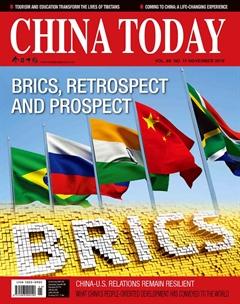
ON November 13-14, 2019, the 11th BRICS annual summit of the heads of state and heads of government of the five member states Brazil, Russia, India, China, and South Africa will be held in Brasilia, Brazil. This event marks the anniversary of 10 successful BRICS summits and presents an opportunity to take stock of past achievements and assess present challenges. More importantly though, it will provide a chance to open a new chapter in future cooperation between the BRICS countries, which should take into account the rule of law and various related legal instruments.
During the past decade, both the evolution of BRICS cooperation and recent global developments confirm the urgent need of efforts to reinforce and better coordinate the existing formats of BRICS cooperation, which so far has been organized primarily as a “cooperation and dialogue platform” without major institutional support. Essentially, this means that the main driver of their ongoing cooperation are the annual BRICS summits and meetings by BRICS ministers which include such areas as foreign affairs, trade, agricul- ture, science and technology, and innovation. It should be pointed out that already a vast amount of BRICS texts and materials have been adopted, mostly in the form of declarations, memoranda of understanding or joint statements. Strictly legal aspects of BRICS cooperation have so far been rare, with the exception of the 2014 Agreement establishing the New Development Bank (NDB) and related agreements, which created the so-called BRICS Bank as a permanent institution in Shanghai, China. Additionally, only two more binding agreements have been signed. One of these is the Contingent Reserve Arrangement, a support mechanism through liquidity and precautionary instruments in response to the actual or potential short-term balance of payments, and another being the so-called BRICS Agreement on Culture. Even the BRICS Legal Forum has only directly produced five legally nonbinding declarations.
This leaves BRICS cooperation with a rather loose institutional and organizational framework of cooperation, as compared to other international cooperation initiatives. Yet, this can be both an advantage and a disadvantage, depending on the challenges that the respective context poses. It can mean greater flexibility, for instance, to respond more rapidly to a particular problem, while the same framework can lead to its neglect or, in a worst case scenario, even spell the end of BRICS altogether.
The parallel desire for flexibility and security, sometimes expressed by way of the oxymoron “flexicurity,” however, is difficult to fulfill. This is where the function of law may enter the picture. One of laws central functions is to reconcile opposites, to solve the paradox that the only constant appears to be change, which is usually a cause of uncertainty and unpredictability.
Equally important, especially for BRICS, is that the law can provide the mortar that holds the bricks of different layers of life, particularly politics and economics, together, especially in turbulent times characterized by rapid and drastic change. This is also of great relevance to the governance of global affairs under the aegis of various multilateral organizations, such as the United Nations (UN), and the World Trade Organization (WTO). Unfortunately, these two organizations, representing two pillars of global governance, namely the political and economic, were separated at birth following the failure of the 1947 Havana Charter to establish an International Trade Organization, and have not been reconciled since then.
Since that time, the global community and its widely fragmented international legal system is struggling to reconcile various trade or economic issues with so-called “non-trade issues.” In the current complex and rapidly changing times, the lack of a sound and consistent legal framework may lead to serious conflicts between different policy goals. This is of utmost importance, especially when it comes to realizing the 2030 Agenda for Sustainable Development Goals (SDGs), which consist of a subset of 17 areas, all need to be addressed in the spirit of a winwin scenario and not a zero-sum game. This is to say that the coherence which safeguards the successful realization of one policy goal, does not neutralize or even jeopardize the successful realization of another, or all the remaining policy goals.
It is in the difficult task of dealing with rapid change and complexity that law and the rule of law can provide important solutions to the serious problems encountered. When formulated in a consistent manner, the rule of law can perform important functions in this regard. These functions include, firstly, a simplification of existing agreements, laws or regula- tions, which after some time tend to become obsolete and fragmented. Law can also provide continuity in change, notably when providing institutional support and sound procedural rules to be followed in case of sudden changes in context. With the help of the rule of law, the levels of legal certainty and predictability are also improved, which allows everyone to better predict the consequences of decisions made and actions that follow.
Finally, the law can help to bring simplicity to complexity, when it is used to consolidate existing rules or mere political statements repeatedly laid down in declarations and other non-binding documents through codification. It is no coincidence that the legal term “codification” resembles the term “coding”used in computer science, as both use language to deal with “big data” and consolidate large volumes of information in a coherent set of documents or files.
Based on these considerations and useful functions provided by law, in the short term, BRICS need to see that the existing BRICS texts and materials are made available in an authentic, clear, and consistent manner, perhaps through an official BRICS website or even in the form of a virtual BRICS secretariat. This requires some sound research on the different sources of law, as new technologies also raise the question of admitting new sources (e.g. artificial intelligence) and subjects of law (e.g. animals and trees) to the realm of public international law. Moreover, the eventual categorization of BRICS law sources must take place in close alignment with the principal goals formulated by the BRICS countries.
In order to assist the functioning of the proposed virtual BRICS secretariat and other related BRICS institutions, including the New Development Bank(NDB), the BRICS countries should also envisage the adoption of a short legal text, in the form of a charter, or perhaps called the “BRICS Analects,” extracting and collecting the fundamental objectives and principles formulated in the numerous BRICS declarations and action plans.
Basically such a coherent legal framework, it is argued, would be fit to bring greater simplicity to a growing complexity of the different policy areas. It would equally provide continuity in times of rapid change and allow the BRICS countries to harmonize regulatory efforts globally while maintaining their flexibility and regulatory diversity domestically.
After all, the BRICS cooperation has proven already that differences in geography and history, trade and economics, culture and language, or law and politics, are not an obstacle to joining efforts in tackling the great problems of the world. On the contrary, these differences mark an incentive to make a difference in the global governance, because novel strategies, different from those that failed in the past, are needed if we want to succeed in realizing the Sustainable Development Goals and secure the survival of the planet and its inhabitants for future generations.
Lastly, it is important to note that law plays an important role in organizing the future, as it lays the foundations for the future global political and economic order. Similar to science fiction, law can– through the rule of law and related instruments– function like a self-fulfilling prophecy and help to predict the future by regulating and thereby creating it.
ROSTAM J. NEUWIRTH is professor of law and head of the Department of Global Legal Studies at University of Macau(China).
- CHINA TODAY的其它文章
- Learning from China’s Experience for Greater Development
- Xi, Modi Meet to Promote China-India Mutual Learning for Shared Prosperity
- The“Clay Palm”Houses of the Yi Ethnic Minority
- Leveraging the Strength of the Belt and Road Initiative to Enhance Overseas Presence
- China-U.S.Relations Remain Resilient
- Seventy Years On:China’s Growth Keeps Soaring