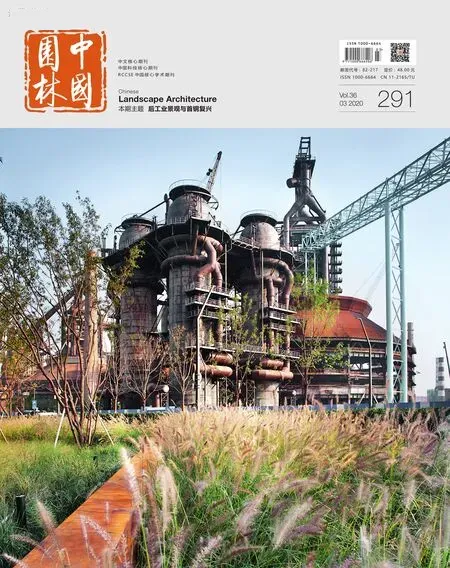
Historical Objects and Post-Industrial Landscape
2020-01-17 14:41:53ZHUYufan
中國園林 2020年3期
ZHU Yufan
Daniel Bell perceived the arrival of the "postindustrial society" in the late 1950s.It appears that the global configuration of great industrial civilization formed after accumulation over 200 years changed constantly.However,it is still unexpected how deep and profound its changes are,how far-reaching the consequent social impacts are,and how widespread those impacts are.Naturally,the most direct impact is on the old industries themselves.Due to industrial transformation,a large number of factories have reduced production,gone bankrupt and shut down.The social image of the great machine age with numerous chimneys erected all around has gradually become something that only exists in our memory.In the predicament where the world is faced with a shortage of land resources,it has become an inevitable worldwide issue how we should utilize and recycle such large reserves of "injured" lands.
Richard Haag and Peter Latz,and their own practices in the 20thcentury,have empirically made landscape architects with professional thinking an important force in the efforts to solve those industrial transformation issues mentioned previously.Subsequently,the "post-industrial landscape" has become a specialized word with an implication of recovery.InManufactured Sites,Niall Kirkwood explicitly refers to the "post-industrial landscape" as means of restoring various derelict artificial sites,including infrastructure,drosscape,landfills,and industrial sites.The concept of the "post-industrial landscape" itself is corresponding to the concept of the post-industrial society.Therefore,the "industries" involved in the "post-industrial landscape" refers not only to industries in a narrow sense,but also to the industrial system represented by largescale industries.Consequently,the "post-industrial landscape" can have a greater denotation,with the goals of ecological restoration and humanisticregenerationintegrated into the sites.It has become a kind of symbolic and professional type in the 21stcentury.
The history of the dereliction of post-industrial sites is "fresh".From material media to human beings,the carriers of feeling and memory have not been completely lost.It is precisely because of the quality of being "fresh" that their value was once extremely neglected.We see the possibility of any extent for the historical objects in those post-industrial sites,between being completely preserved and being completely "destroyed",before and even after the design.At such a moment,the reason for making the choice lies in the revaluation of those derelict sites during design.The problem of how to look at the remains of existing site context,that is,how to look at the site history,is how to construct the design's conception of history.What we need is to develop an awareness of projecting history of design objects.
1 Design Consensus on Consideration of Sites as Historical Objects
John Dixon Hunt,an American landscape historian,wroteHistorical Groundin 2014,on account of the neglect of historical factors from the perspective of modernism,in which he specifically explores how the contemporary landscape architects are inspired by the history of sites and represent it.Hunt's insight on history is obviously profound.He adopted the word "ground" with a clear conceptual tendency to build consensus.Therefore,have we reached a common ground on the role of "site history"?
Site history can be roughly divided into two parts (natural and artificial) including visible and invisible things and objects.We,through the current situations,bothexamine the past and perceive the future.However,the recognition of the historical value of siteshas always been a bottleneck.It is easy to enter a vicious circle of alienation,and the basis for consensus is far from being established within the profession.When a site enters a design state,it means that it will usher in a great change.It seems that it is commonly seen to design by "crushing" the old with the new.However,the trend of dynamic design,with a compatible juxtaposition of the old and the new,gradually emerged in the second half of the 20thcentury,due to the change of concepts and subject to the comprehensive cost to be paid.That trend takes therepresentation of the new and the old together as its pattern of manifestation.In essence,it has explored even more deeply the way of value reversionfor the"old",gradually enabling the public not only to accept the harmonious compatibility between the old and the new,but also begin to accept the conflicting,even fiercely conflicting juxtaposition of the old and the new.Either the old or the new exists,but indeed they become perfect when they are together with each other.
Hunt was trying to prove the success of so many remembered cases in the history of modern and contemporary landscape architecture is due to the designer's awareness of the importance ofrevealing the site history,and such historic significance is not in a narrow sense but on a very diversified "ground",which is a reference plane that regards history as having extensive flexibility.Essentially,his research is intended to emphasize the importance of history to the present.If the historical information in a site is valuable,the designer may be the most direct and important linker to reconnect it with contemporary life and activate it,andsurely,he/she is also likely to be a destroyer.
As a base point,the existing site contexthas its own thickness,as a result of the occurrence and development of past events.A site itself has a "thickness".The richness of its historical connotation is far beyond imagination.Therefore,we correspondingly need to have the awareness and ability to read the sites.Obviously,when the site history in our eyes is flat,it will be difficult for the design to display the thickness and depth related to its own development law.Such thickness is the important foundation for the construction of the structural relationship in contemporary design.
To establishthe overall concept that the design sites are regarded as historical objects,first identifying a site before design with a conceptual "archaeologicalsite"in consciousness,is intended to interpret the original information of the site and its historical logic to establish a more detailed,comprehensive and systematic examination mechanism,so that it can have restrictions which can generate traits on the later design results.The design is mainly oriented to new requirements,and the design process is to some extent the process of finding anchor points.To understand the site history is not to confine ourselves.Nonetheless,if we stand in awe of the site history,the sites themselves may provide anchor points sequentially.The responsibility of design is to make transformations.When the past and the future can improve each other,inheritance is achieved.
2 Three Traits of Post-industrial Landscape
If"consideration of design sites as historical objects"can be regarded as a universal design concept,then we will try to project that concept onto design sites directly affected by industrial culture after the human industrial revolutions,especially by that of the great machine age.
Here,we should thank Haag and Latz again for their pioneering work as landscape architects in the second half of the 20thcentury.Owing to their achievements,it now seems that we no longer need to convince the public whether there are any contemporary values in industrial things,from individual ones to systematic ones,which have been abandoned by contemporary life.However,the indepth cognition of the post-industry as a culture is far from exhaustive,as once the traits are lost,the genetic identity is lost.The following paragraphs will focus on exploring the three important traits,of the post-industrial landscape represented by industrial remains,as historical objects and the mechanism for their correlation with design.
2.1 "Great machine"
As Bell predicted,the great machine industry age before the Modern Industry has passed,nevertheless,it has an extremely distinctively visual feature of landscape,that is,"great machine".A machine is referred to as a tool,a device or equipment that efficiently uses energy transfer to achieve a specific purpose.A factory is the site to accommodate these machine systems.From the overall system to the part unit,the existence of all industrial things has logical roots that are clearly related to the production purpose.The factory is a "great machine" in itself.The great machine has huge complexity and systematicness.The image of the large iron and steel factory represented by metal smelting is the most classic landscape business card in the great machine industry age.Besides the overall impression of the vast and complicated group of machines,the linear characteristics are the space system that deserves more attention.
The trait of "great machine" of industrial remains means that design isactivelyrelated to the complex system context behind industrial remains (no matter how much remains).Whether industrial remains will be preserved and how they are reused depends on thenew positioningof the land to a large extent.Once the positioning is clear,the overall trend of these remains will be determined to some extent.After that,the cost became the key factor,since maintaining the operation of the "great machine" requires enormous funds.Dismantling is not only a matter of concept,but also a product under the balance of economic laws.However,if the integrity of industrial remains is very low,the trait of "great machine" of the site makes it difficult to completely erase the traces of its industrial structure logic.Revaluation is still the core,and the ability of understanding concepts and designs will be the factors restricting the protection.
Taking the post-industrial site as a historical object means that a new planning and design method witha high degree of interactionbetweentop-down and bottom-upconcepts is needed.It is especially important that in the early planning stage designer needs to avoid concepts to transcendental idealism,and more emphasis shall be placed on the local concern and consideration of the overall system potential of industrial remains as the "great machine".The construction system of industrial remains isselfconsistentin the site,while the overall depth and tension from the"authenticity"of the original industrial design plus the erosion by time are much better than any designer's new work.Therefore,it would be quite wise and intelligent for the designer to start with the remains and compatible with new functions.The "juxtaposition" of the old and the new is widely used as the design method.
2.2 Super attributes
When the experiencers approach the viewing platform,the pit body of Huangshi Tieshan strip pit stretching 2 kilometers with a fall of 400 meters comes into view; when the experiencers board the top of the transformers-like Shougang's 3 blast furnaces and look around the quondam iron and steel empire,their uncontrollable reaction are very similar and collective,exactly the same as the collective awe and silence expressed by the visitors who enter the Rome's Pantheon and the Court of the Myrtle Trees of Alhambra Palace.There is always such a super attribute of really high-quality things making the audience have similar feelings across gender,belief,nationality,culture and so on.
Post-industrial landscape has a super attribute,which issublime.An article by Edmund Burke in the 18thcentury Picturesque era made a contribution to human aesthetics—"grand","infinite","continuous","fear" and "power" etc.become the most intrinsic characteristics of industrial aesthetics.
The background of sublime of the post-industrial reliques comes from the industrial civilization because the spatial scale of the industrial construction system is far beyond the routine of civil use in the first place.Under the oppression of a huge scale,when facing industrial facilities or buildings (from individual to system),people will feel the same insignificance and weakness as when facing the mountains and floods in nature.However,in the internal space of these industrial buildings or facilities,it is easy to obtain a sublime and sacred feeling similar to that in religious space.No matter inside or outside space,the "sublime" has not subsided in the later decadence of industry,but has been strengthened to a certain extent,which can be called the sense of holy land in industrial ruins.However,all these are created by human beings.The sublime of industrial and postindustrial landscapes also implies the worship of human beings for their great power (scientific and technological ability).As for the "sublime" originated from industry,the body and the soul are immortal,but they are not unlimited.Its fragility lies in the fact that once it loses the support of the body space to a certain extent,the "soul" will disperse.
Has the industry produced new traits and values after entering the post-industrial social state? The overall simplification and even extinction of the industrial production system,and the sharp decline in human influence (management intensity) lead to thatnature eventually "takes over" the site step by step.The "industrial nature" and the "monument" of industry (faded over the years) form the origin from which a complete post-industrial landscapeis perceived.The blending of the"decadence"of artificial work (the industry) and the"wild"of nature,bringing us a temperament that we cannot accommodate with traditional garden aesthetics,has allowed its "sublime" to reach the peak.
The questioning of the "wilderness" in the High Line Park in New York reflects that the real "wild" is the most vulnerable when a post-industrial site is being transformed into an urban public space.Since most people still cannot accept that nature completely takes over,in its true sense,places like urban parks,a kind of intermediate state appears,like "controlled wild" created by designers like Piet Oudolf,but it is undeniable that the original "sublime" in post-industrial sites is weakened after the realization of the design.
On the other hand,the "sublime" set up by the Landscape Park Duisburg-Nord,which was designed 30 years ago,is an insuperable monumental work in the post-industrial landscape up to now.Latz not only developed the systematic value of the industrial remains,but also transcendentally considered industrial facilities,derived plantings,water system,topography and promenade as a whole as historical objects to demonstrate a new approach to Designin-Layers of post-industrial landscape.He also paid special attention to the value of "wild" and of "industrial nature" and insisted that "wild" could coexist with the domesticated colors in gardens and parks,thus establishing European standards for postindustrial landscape and being widely recognized by the academic community worldwide.
As the origin of the post-industrial landscape design,the mixture of the derelictreliques of humanities and nature in the post-industrial site is fascinating,with the super attribute of "sublime",reflecting the eternal philosophical proposition of the relationship between human and nature.
2.3 Culture (from technology to humanity)
As a product of the development of science and technology in the machine age,industrial remains carry their own "instruction manual".Corresponding to the traits of "great machine",the post-industrial site contains a large amount of systematic industrial historical information (explicit or implicit).Ideally,we would enjoy an "industrial museum" full of science and technology.However,the common reality is that most of the remains are in ruins and the system is dismembered,like those discarded commodities,and only a few people may know the reason why they exist as part of the system and how they operate.The instruction manual for use is the key to understand the normal and effective operation of the machine,is a kind of surface logic,and is also the most acceptable medium among the relevant industrial professional informationconverted by design.
The "instruction manual" seems to be an operation guide only related to the operation of disciplined machines,but it will eventually be included in the overall category of "industrial culture".However,compared with the research of material entities,such as the academic accumulation from investigation,research and protection of industrial heritage,the cultural research,software part of industrial research,is far from being paid enough attention.However,the significance of the research and construction of "industrial culture" is far-reaching.In the context of globalization,cultural convergence has become a common problem.Since the industry is one of the most direct drivers of globalization,the homogenization of industrial landscape itself is the most obvious.It can be said thatthe convergence is in the dilemma when the post-industrial landscape is in the ascendant.The key to getting out of convergence will largely depend on the depth of the designers' understanding of industrial culture,and cultural perspective and dimension are needed in terms of the value of industrial remains.People in different regions will form different industrial cultures.Although differentiation is absolutely weak in the production-oriented active industrial age,the human factor in industrial culture will provide a strong differentiation foundation for the revival of the postindustrial landscape.
People who have lived through the old industrial age will feel nostalgic about specific industrial remains,but after all,these people are very few.Most of the people facing the post-industrial landscape are people who have no experience in specific places.As we know,historical statements require high-quality media,which is also the limitation of history reuse.The spatial response of texts is the advantage of the designers.It does not seem to be the designers' duty to trace the industrial cultural depth of the site history,but the designers need to make a difference.
It is necessary to reiterate the emphasis on the historical value of the site from the perspective of design,that is,to explore the original industrial cultural logic of the post-industrial site,from technology to human beings,in order to provide more possible anchor points against changes of demands in the future world.
3 Conclusion
Although the landscape architecture industry has 60 years of professional accumulation,the post-industrial landscape from the perspective of historical objects shows panorama,globality,and diversity.The revival path of post-industrial landscape should correspond to a wider spectrum and more possibilities,rather than a search for the so-called only correct ultimate model.The exploration of the world's post-industrial landscape is far from over.In particular,history has proved countlessly that every classic design that changes the course of historical development relies on design as the intuitive endowment of a human being,and sites that are regarded as historical objects provide infinite resources to inspire design intuition.
Like the Renaissance,the post-industrial landscape emphasizes that the regeneration of industrial civilization is intended to enlighten the new civilization.
In the great machine-industry age,the rise and fall,and transformation of industrial civilization are like the Ship of Theseus navigating through the tide of history,and the post-industrial landscape is only a glimpse.The body is in succession,but life never stops.