
Lili Town:A Reclusive Place of Pear Blossoms
2020-03-23 09:34:34BYZHAOYANQING
CHINA TODAY
2020年3期
BY ZHAO YANQING
LILI Town is a charming river town in Su-
zhou, east Chinas Jiangsu Province. Before the Tang Dynasty (618-907), it was known as Lihua Village, which means a village of pear blossoms. According to folklore, the place got its name because it was surrounded by pear blossoms every spring. However, after the Tang Dynasty, local residents fell victim to frequent floods. Luckily, an official named Li solved the problem by dredging the river, earning the gratitude of the people who named the village Lili in his honor.
Verandas
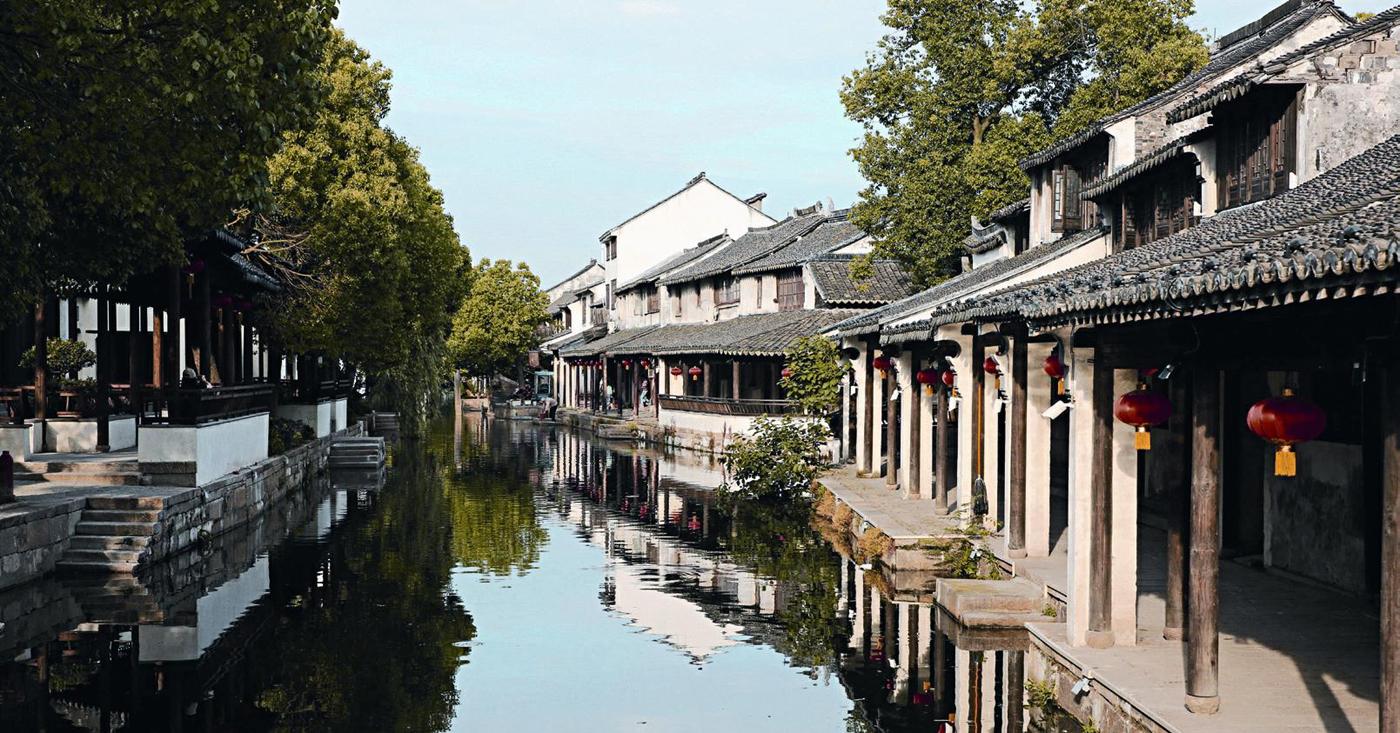
The first thing that greets the eyes of visitors to Lili is a waterway flanked with ancient dwellings, the roofs of which protrude and form a long veranda.
Verandas became popular in Lili during the Yuan Dynasty (1271-1368). Populous and wealthy, the southern Yangtze River region was a business hub. During the Yuan Dynasty, stores emerged on both sides of the waterway in Lili. Business owners built the verandas to shelter passers-by from the sun and rain, as well as to display their signature products.
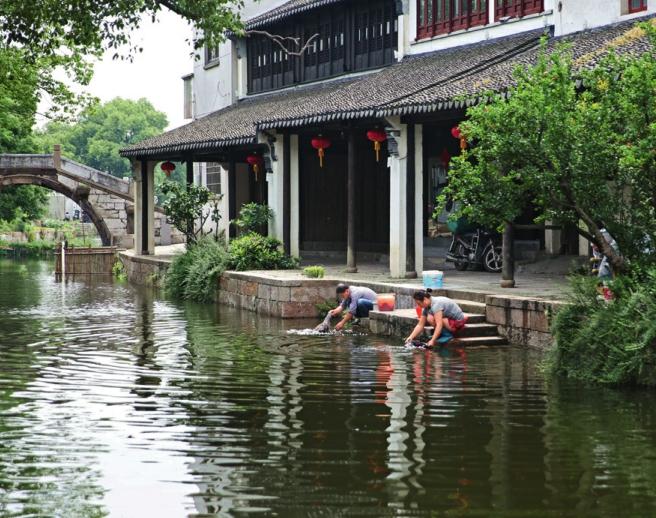
The verandas integrate elements of commercial culture, folk culture, and architectural culture. In the morning light many scenes illustrate the local life. Housewives begin doing their laundry at the waters edge. The elderly venture out to catch up with the latest chatter and are occasionally joined by passers-by. Sudden bursts of laughter scare away birds on a tree, and a boatman is illuminated by the light as he pushes his pole into the water. Looking across the water, the shimmering reflection of the black and white staggered houses is dotted with red lanterns, creating a picture postcard scene that delights locals and visitors alike.
Revetment and Jetties
The solid revetment (retaining wall) in Lili Town is unique. Locals drive piles into the waterbed and then place slabs of stone within the pile structure to build the revetment. Compared with those made with earth, it is less prone to deteriorate, sink, or slide away. Although it is expensive and labor-consuming, the stone revetment provides a more stable construction.
There is a often told folktale about the revetment. A store owner had a daughter who played by the riverside and fell into the water due to loosening slabs. As a result of the accident, she lost an arm. The father felt guilty that he had not maintained the revetment when it was time to do so. He then figured out how to build a stronger revetment and others followed his method.
Jetties in Lili are dense and diverse. There is one almost every 20 steps. In the past, jetties were important to businesses and households. People loaded and unloaded goods there as well as did their laundry. A writer once wrote, “Jetties were part of the bad old days. At first, they were seven or eight steps above the water. When spring came, the water level rose and reclaimed the steps one by one. Year after year, we watched as the jetty was lost and regained along with the rise and fall of the water level.”
Mooring Stones
Mooring stones are the most beautiful and unique heritage in Lili.
A mooring stone is the pivot point where a boat can be tied. Its use in Lili started in the Ming Dynasty (1368-1644) and reached its height of popularity during the Republic of China period (1912-1949). Today, there remain 200 to 300 holed mooring stones in water.
A typical cubic mooring stone in Lili usually is 30 to 40 cm tall. But the carved stone at the town center is 43 cm tall and was used by local people as a measurement for the waterline. It is called “the stone that tells happiness or sorrow.” There are patterns of a gourd and a bat on the stone, and when the waterline reached the middle of the gourd there was great joy, as people would be happy because it meant the rainwater was just enough for a good harvest. When the waterline was lower than the bottom of the gourd people became worried, as it might indicate a drought. When the waterline was higher than the bat carving, people would be upset and lament that there would be no blessing and no harvest, as in the year it was very likely that farmers would suffer from floods.
Carvings on the mooring stones reflect peoples thinking. Pairs of peaches or oranges represent good luck and longevity. Pairs of swords or rhino horns, people believed, could ward off evil spirits. The carving depicting three crossed spears and battleaxes put into a vase reflected ancient peoples yearning for a successful official career. Liu Hai, a legendary celestial being of wealth, was also a theme of mooring stone carvings.
Craftsmen in Lili began carving cartoon images on stones some 100 years ago or even earlier. Figures they carved evolved from people standing or sitting to more active depictions of people. Some even had fox faces or childrens smiling faces. The regions south of the Yangtze River were rich in silk and silkworms, and naturally these also became an important theme for carvings on mooring stones. These beautiful carvings reflected the manual dexterity of ancient craftsmen and the colorful inner world of local people.
Ancient Bridges
The river running through Lili is called Lichuan. In ancient times, people lived by the river and developed businesses there. As early as the Southern Song Dynasty (1127-1276), Lili was a renowned town with booming trade. In the early Ming Dynasty(1368-1644), the focus of business centered around food and there were also sales of silk and cotton. With the establishment of the riverside commercial street many local people amassed a small fortune. They then funded the building and restoration of bridges. At its height, Lili had more than 30 bridges of various styles. Some were owned by temples, and some were funded by rich individuals. A total of 12 such bridges survive to this day, most of which are in their original form.
The Green Dragon Bridge in the east of the town was protected by an iron and wooden gate in the water, which opened in the morning and closed in the evening to restrict the entry of boats from other places. The same protective measures were also built around bridges in the other three areas of the town. Lili suffered no destruction during the Chinese Peoples War of Resistance against Japanese Aggression(1931-1945) and people said this was because of the protection of the water gates.
Dwellings in Alleys
As a trading center in the regions south of the Yangtze River, Lili was also home to an influential fair. Land by the riverside was expensive and people built houses behind the shops along the street for storing goods or living. Generation after generation, the houses extended behind each other, one after another forming deep alleyways.
Some alleys featured impressive mansions and were named after local wealthy families, while others were named after the type of trade that took place there. For example, there was Alley of Zhou Family or Alley of Dye House. The alleys were paved with slabs of stone, under which were sewers. Moss covering the slabs added a natural touch to the ancient alleys.
Local people often rented houses located by the riverside to businesspeople. Early in the morning, as the wooden gate boards were opened, stores started their days business. A variety of goods were put in front of the gates, reducing the space for pedestrians and making the veranda even narrower. However, people didnt mind and found the setup easier to look for their favorite goods. The veranda then turned into a harmonious and prosperous place.
The mansions hiding deep in the alleys were much quieter. One of these is the former residence of Liu Yazi, a patriotic politician who spent most of his time in the town between 1899 and 1928. Now a cultural site under state protection, it was first built by senior official Zhou Yuanli during the reign of Emperor Qianlong in the Qing Dynasty (1644-1911). The symmetrical residential compound, with six rows of houses, reflects the typical architectural style of the Qing Dynasty and was one of the best architectural examples in the regions south of the Yangtze River.
The tile carvings at the fourth metal gate depict a scene of birds paying homage to the phoenix on the upper part and a scene of an underwater dragon palace on the lower part. Both of them are from Chinese fairy tales. There are patterns of fish, dragon, shrimp, coral, and water ripples. The lifelike honeycomb holes of the coral and vivid fish seemingly ready to jump into the viewers arms show the exquisite craftsmanship of ancient people.
Lili is a dream-like water town. There are a Christian church standing in harmony with the old town, a Chinese-style memorial gate, a grand mansion of an ancient senior official, exquisite private gardens, a bustling riverside commercial street, craftsmen sticking to the tradition, and hospitable residents. It is also a place to de-stress and allows todays visitors a chance to retreat from their bustling urban life.
登錄APP查看全文
