采伐干擾對興安落葉松林土壤化學性質的影響
2020-04-16 13:05:00包田梅鐵牛
森林工程 2020年2期
包田梅 鐵牛

摘 要:? 本文針對內蒙古大興安嶺興安落葉松林采伐跡地不同恢復年限的土壤化學指標的變化進行研宄,是為天然林自我恢復情況進行評價,為內蒙古大興安嶺林區的經營管理提供依據。實驗用土壤的pH,及全碳、全氮、全磷、全鉀的含量,按照《森林土壤實驗教程》和《土壤農化分析》計算。采用單因素方差(ANOVA)分析(SPPS 13.0軟件)研究采伐干擾對土壤化學性質的影響。結果表明:①對比興安落葉松天然林(對照樣地)和皆伐、漸伐兩種不同采伐干擾跡地興安落葉松林土壤pH、全碳和其他營養成分之問的差異。得到漸伐和皆伐對土壤化學性質有顯著性差異(P<0.05);皆伐與土壤全氮含量呈極顯著的正相關關系(P<0.01),與土壤含碳量和pH呈顯著的正相關關系(P<0.05)。②比較不同年份采伐方式對土壤理化性質的顯著性, 1987年的采伐跡地與2014年的采伐跡地有一定的差異, 2009年與1987年、2014年的采伐跡地差異不明顯。得到結論是:森林采伐干擾能降低土壤的pH,客觀上使土壤養分得到增加,或許有利于森林自然更新。采伐干擾明顯影響土壤碳和其它營養元素的平衡。
關鍵詞: 采伐干擾;興安落葉松林;不同年份;土壤養分
中圖分類號 :S718.5?? ??文獻標識碼 :A ???文章編號 :1006-8023(2020)02-0001-05
Effect of Logging Interference on the Chemical Properties of the Soil of Xingan Larch Forest
BAO Tianmei, TIE Niu*
(Forestry College, Inner Mongolia Agricultural University, Hohhot 010109, China)
Abstract: This paper studies and discusses the changes of soil chemical indexes in different recovery years of Xingan larch forest in Daxinganling, Inner Mongolia, in order to evaluate the self recovery of natural forest and provide basis for the management of Daxinganling forest in Inner Mongolia. The pH, C content, whole nitrogen, whole phosphorus and whole potassium content of the soil used in the experiment were calculated according to the Forest Soil Experiment Tutorial and the Soil Agroization Analysis. The effects of logging interference on the chemical properties of soil were studied using a single-factor variance (ANOVA) analysis (SPPS 13.0 software). Results showed that: ① comparing the differences in soil pH, soil C and other nutrients in Xingan larch natural forest and two different interference plots of clear cut and gradual cut, it is found that clear cut and gradual cut have significant differences in soil chemical properties (P<0.05). Clear cut has an extreme significant positive correlation with soil total nitrogen (P<0.01), and a significant positive correlation with soil carbon content and pH (P<0.05).② Comparing the significance of different cutting methods on soil physical and chemical properties in different years, there is a certain gap between the logging sites in 1987 and 2014, while the differences between the logging sites in 2009, 1987 and 2014 are not significant. Conclusion: deforestation interference can reduce the pH of soil, objectively increase soil nutrients, and may be conducive to the natural renewal of forests. Logging interference significantly affects the balance of soil carbon and other nutrients
Keywords: Logging interference; Xingan larch; different years; soil nutrients
0 引言
不同的土壤理化性質改變了土壤養分狀況,反之又作用于群落內的諸多生態過程[1],這間接影響了地上植被生物多樣性和群落演替進程。劉道錕等[2]研究認為,物種豐富度指數與林地土壤容重存在正相關關系,與土壤含水量及養分呈顯著負相關關系;盛茂銀等[3]測定土壤有機質、氮素、鉀素、持水狀況、孔隙度和植物多樣性均勻度指數等指標,結果表明,土壤理化性質與植物多樣性指數具有明顯的相關性;羅亞勇等[4]研究表明,青藏高原東緣高寒草甸退化過程中,植物多樣性和土壤碳、氮的含量存在明顯的負相關;文海燕等[5]研究了科爾沁退化沙質草地不同沙漠化階段物種多樣性的變化,結果表明有機碳、全氮、全磷、有效氮與植物多樣性存在顯著或極顯著相關[6]。
1 材料與方法
1.1 研究區概況
研究地區位于內蒙古大興安嶺根河林業局境內的約安里林場29林班和30林班、烏力庫瑪林場122林班和123林班,以及內蒙古根河林業局潮查林場[2]。海拔最高為1 116 m,最低為944.6 m。地理坐標為122°14′~125°07′E,50°49′~51°08′N。土壤主要為棕色針葉林土。常見植物有:興安落葉松 (Larix gmelinii)、白樺(Betula platyphylla)、山楊(Populus davidiana)、蒙古櫟(Quercus mongolica)和樟子松(Pinus sylvestris var. mongolica)[3]。林下物種豐富多樣,常見的有:杜香(Ledum palustre)、杜鵑(Rhododendron dauricum)、唐松草(Thalictrum baicaleuse)、越橘(Vaccinium vitis-idaea)、大野豌豆(Viciagigautea)、石蕊(Cladonia rangiferina)、小葉樟(Deyeuxia angsdorffii)、林問荊(Equisetum silvaticum)和紅花鹿蹄草(Pyrola incarnata)。
1.2 樣本采集與處理
2018年8月,在研究地區,選擇1987年、2009年、2014年進行皆伐或漸伐的興安落葉松林采伐跡地上,分別設置40 m×40 m的固定樣地6塊,同時在采伐跡地附近未采伐區域設置對照樣地3塊,共9塊樣地,隨后展開外業調查。
在上述3個年份的森林中設置的樣地中,每個樣地的0~20 cm土層中進行多點(5個)混合取樣,土壤采集后將其中的根系等植物殘體和石子去除,過2 mm篩,混合均勻后自然風干。
1.3 測定方法與原理
本文選取用于研究分析的土壤理化性質有pH、土壤有機質、全氮和全磷。
具體方法參照《土壤分析技術規范》和《土壤理化分析》等,具體測量方法:土壤pH用電位法;有機質用重鉻酸鉀氧化-外加熱法;全氮用凱式定氮法;全磷用氫氧化鈉熔融后鉬銻抗比色法。
實驗用土壤的pH,及全碳、全氮、全磷、全鉀的含量按照《森林土壤實驗教程》和《土壤農化分析》計算。采用單因素方差(ANOVA)分析(SPPS 13.0軟件)研究采伐干擾對土壤化學性質的影響。
2 結果與分析
2.1 不同年份不同采伐方式對土壤化學性質的顯著性分析
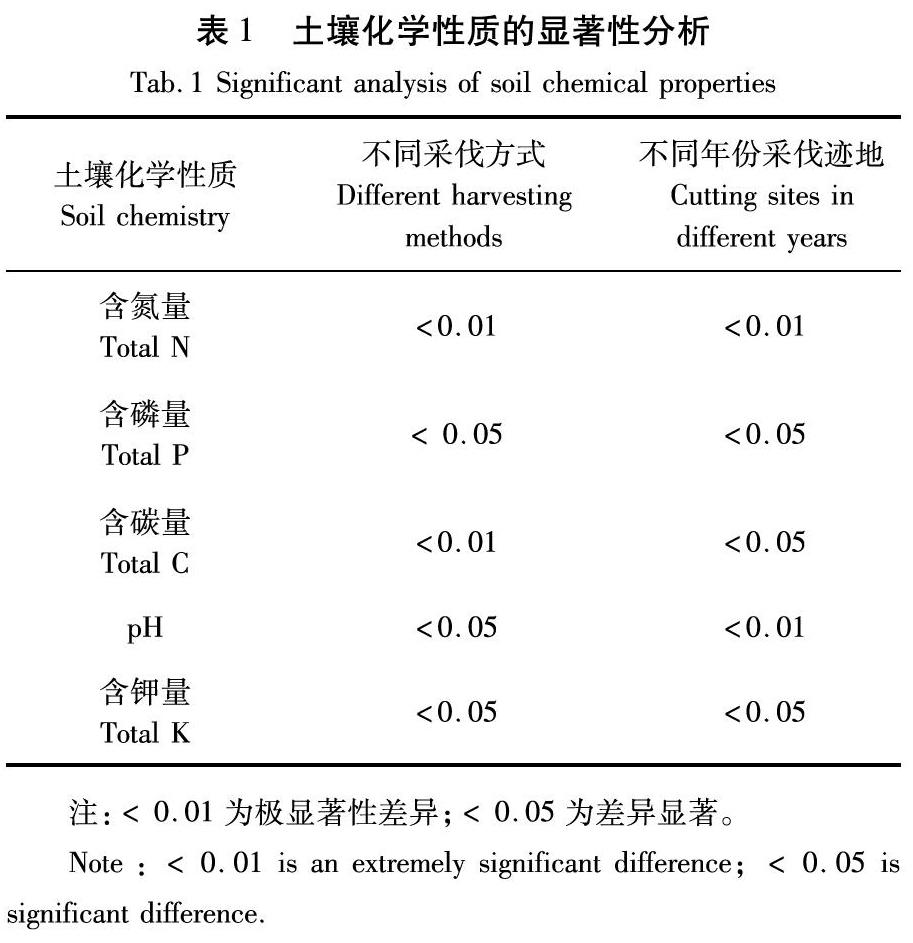
從表1中明顯看出這與Giai等[7]研究結果符合。不管是采伐方式還是采伐年份對土壤理化性質有一定的顯著性。不同采伐方式對土壤的含碳量和含氮量有極顯著性。不同采伐年份對土壤的pH和含氮量有極顯著性差異。
2.2 不同采伐方式對土壤化學性質的影響
2.2.1 1987年不同采伐方式對土壤化學性質的影響
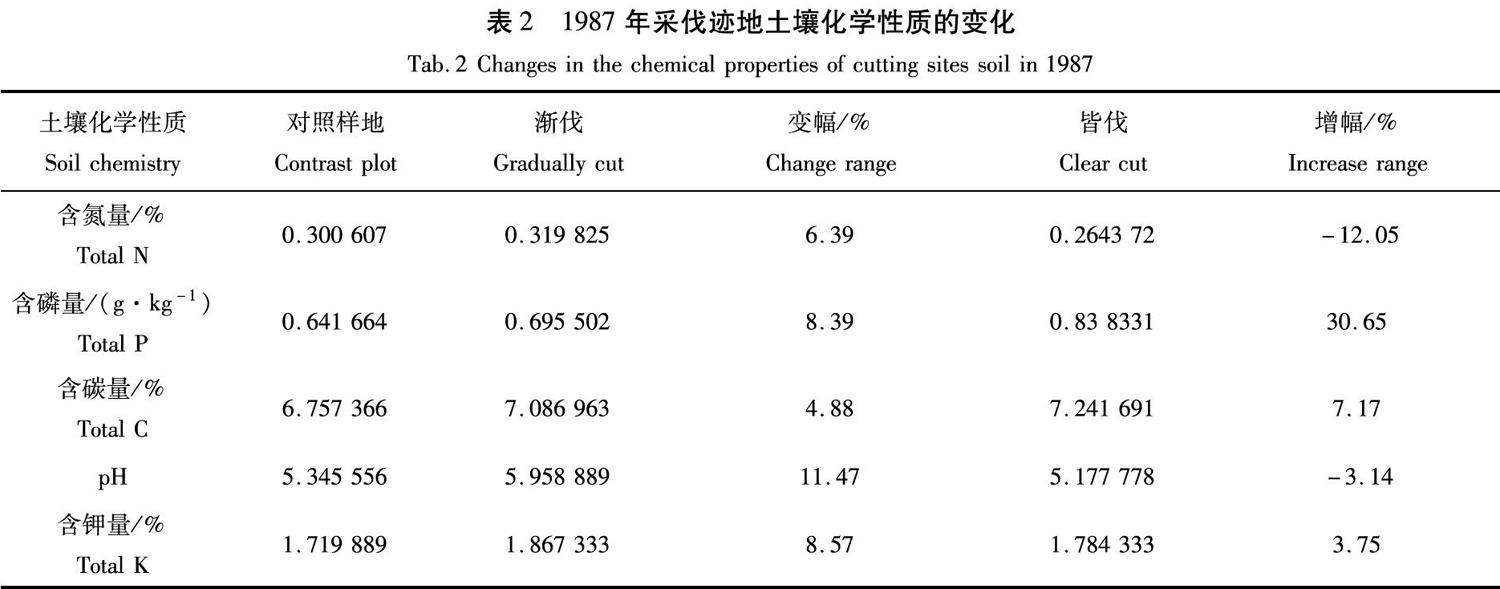
從表2中明顯看出,1987年漸伐樣地的所有養分都是增加的趨勢,而皆伐樣地的全氮和pH是減少的趨勢。從這可以看出來漸伐方式對興安落葉松環境和基質中營養和水分的有效性或多或少地有所提高,從而導致土壤的養分也有所增加。 很多研究表明森林進行皆伐后土壤表層pH逐漸減小,原因是皆伐干擾后硝化作用持續增加,然后樹枝上的酸性有機物質將從枝條上淋洗下來,從而導致了pH大量減小趨勢,這與于楠楠等[8]研究結果相似。森林采伐后全氮含量的變化是一個非常復雜過程,采伐干擾對于土壤全氮含量有著很多種影響,比如由于立地條件、樹種不同和采伐方式不同等的差異而不同,從而全氮量漸伐方式下增加6.39%,而皆伐方式下全氮量下降12.05%。
2.2.2 2009年不同采伐方式對土壤化學性質的影響
從表3中看出來,2009年的漸伐方式和皆伐方式的土壤養分明是呈下降的趨勢。從結果分析出,森林漸伐作業后,土壤全氮、全磷、全碳、pH、全鉀的含量分別降低80.07%、 52.13%、64.70%、 3.69%、9.41%。森林皆伐作業后,采伐跡地土壤全氮、全磷、全碳、全鉀的含量分別降低92.587%、65.82%、95.05%、4.83%。森林采伐后,有機質分解加快從而導致枯枝落葉也分解快,采伐不久后土壤養分會逐漸增加,但由于不能被植物充分利用跟隨徑流而流失。其他有采伐后對林地水熱條件有所影響,地表溫度升高,采伐剩余物、原有枯枝落葉和死地被物分解迅速,但由于森林受采伐干擾后形成很多林窗,林下植被受到破壞影響,極大地降低了林冠對雨水的截留消能作用,降水產生的林地雨水徑流增大,使林地有機物礦化釋放的可溶性養分遭受淋失和引起水土流失,土壤養分含量因此而下降,這與BAI等[9]研究相符。
2.2.3 2014年不同采伐方式對土壤化學性質的影響
從表4中分析得到漸伐和皆伐作業下采伐跡地有一定的差距。漸伐跡地全氮含量增加19.01%,而皆伐跡地全氮含量減少20.56%;全碳也一樣漸伐跡地增加26.31%,而皆伐樣地的減少39.16%。但是對漸伐樣地土壤中的氮素絕大部分是有機氮 (98%以上),故土壤中全氮含量與全碳成正相關,即全碳增加,全氮量也增加。皆伐樣地也一樣,即全碳減少,而全氮量也減少。全磷對森林系統起限制作用,全磷能對植物生長起限制作用,還可能對生態系統內其他成分和生態過程起限制作用。森林采伐對土壤全磷含量影響的研究目前較少,Francos等[10]的研究指出,得到干擾后的生態系統中土壤磷的含量有所增加;本文的研究結果是干擾后興安落葉松林土壤磷含量與興安落葉松天然林土壤磷含量相比呈現逐漸降低的趨勢,不同生態系統土壤磷含量的變化非常復雜而差異明顯。
2.3 不同年份采伐跡地對土壤化學性質的影響
從圖1中看出來,3個不同年份中含碳量和pH有所區別,其他指標:全氮、全磷和全鉀含量幾乎沒有差異。
從圖2中分析,皆伐跡地的化學性質有所區別。采伐后 37 a,也就是說1987年的土壤全氮、全磷、全碳、pH和全鉀與對照樣地相比,含量接近于對照樣地,這與Gómez等[11]研究結果相似。而2009年的差異最大,主要是含碳量差異最大,這可能與樹種和立地條件有關。2014年的差異不是很明顯,因為采伐不久的森林處于剛更新階段,所以土壤化學性質跟對照林樣地也比較接近[12-13]。
3 結論與討論
研究表明,興安落葉松林的采伐干擾影響了土壤的化學性質,森林采伐干擾能降低土壤的pH,客觀上使土壤養分得到增加,或許有利于森林自然更新。采伐干擾明顯影響了土壤碳和其他營養元素的平衡[14-15]。
采伐干擾也同樣影響土壤全氮含量,即隨著興安落葉松林干擾次數的增加,興安落葉松林土壤的氮含量逐漸降低。與興安落葉松天然林相比,采伐后的興安落葉松林隨著采伐干擾次數的增加土壤磷的含量逐漸降低[16]。采伐后森林土壤鉀含量的變化趨勢與氮、磷含量的變化趨勢一致[17-18]。森林采伐對土壤養分具有不利的影響,采伐方式的不同對土壤養分的影響程度也不同。采伐年份對土壤的全碳量有明顯影響,對其他土壤養分影響不明顯[19-20]。
【參 考 文 獻】
[1]? 逄世良,焦德志.扎龍濕地植物群落結構及其與土壤因子關系[J].齊齊哈爾大學學報(自然科學版),2018,34(6):82-85.
PANG S L, JIAO D Z. Relationship between plant community structure and soil factors in Zhalong wetland[J]. Journal of Qiqihar University (Natural Science Edition), 2018, 34(6):82-85.
[2]? 劉道錕,孫海龍,甘秋妹,等.大興安嶺干旱陽坡不同植被退化階段土壤理化性質與物種多樣性研究[J].森林工程,2016,32(2):1-6.
LIU D K, SUN H L, GAN Q M, et al. Soil physicochemical properties and plant species diversity of different vegetation degradation stages in arid sunny-slope of Great Xingan Mountains[J]. Forest Engineering,2016, 32(2):1-6.
[3]? 盛茂銀,熊康寧,崔高仰,等.貴州喀斯特石漠化地區植物多樣性與土壤理化性質[J].生態學報,2015,35(2): 434-448.
SHENG M Y, XIONG K N, CUI G Y, et al. Plant diversity and soil physical-chemical properties in karst rocky desertification ecosystem of Guizhou, China[J]. Acta Ecologica Sinica, 2015, 35(2):434-448.
[4]? 羅亞勇,孟慶濤,張靜輝,等.青藏高原東緣高寒草甸退化過程中植物群落物種多樣性、生產力與土壤特性的關系[J].冰川凍土,2014,36(5):1298-1305.
LUO Y Y, MENG Q T, ZHANG J H, et al. Species diversity and biomass in relation to soil properties of alpine meadows in the eastern Tibetan Plateau in different degradation stage[J]. Journal of Glaciology and Geocryology,2014, 36(5):1298-1305.
[5]? 文海燕,傅華,趙哈林.退化沙質草地枯物群落物種多樣性與土壤肥力的關系[J].草業科學,2008,25(10):6-9.
WEN H Y, FU H, ZHAO H L. The relationship between plant species biodiversity and soil fertility in degraded sandy grassland[J]. Pratacultural Science, 2008, 25(10):6-9.
[6]? 郭泉水,王德藝.霧靈山落葉闊葉林采伐跡地物種多樣性和植物種群動態變化研究[J].應用生態學報,1999,10(6):645-649.
GUO Q S, WANG D Y. Species diversity and population dynamics of plants on deciduous broad-leaved forest slash at Wuling Mountain[J]. Chinese Journal of Applied Ecology, 1999, 10(6):645-649.
[7]? GIAI C, BOERNER R E J. Effects of ecological restoration on microbial activity, microbial functional diversity, and soil organic matter in mixed-oak forests of southern Ohio, USA[J]. Applied Soil Ecology, 2007, 35(2): 281-290.
[8]? 于楠楠, 馬世明, 劉瑞龍, 等. 內蒙古蘇木山華北落葉松人工林土壤養分變化規律[J]. 干旱區資源與環境, 2019, 33(11): 190-194.
YU N N, MA S M, LIU R L, et al. Changes of soil nutrients for Larix princiois-rupprechtii plantation in Sumushan, Inner Mongolia[J]. Journal of Arid Land Resources and Environment, 2019, 33(11): 190-194.
[9]? BAI S H, DEMPSEY R, REVERCHON F, et al. Effects of forest thinning on soil-plant carbon and nitrogen dynamics[J]. Plant and Soil, 2017, 411(1/2): 437-449.
[10]? FRANCOS M, STEFANUTO E B, UBEDA X, et al. Long-term impact of prescribed fire on soil chemical properties in a wildland-urban interface. Northeastern Iberian Peninsula[J]. Science of the Total Environment, 2019, 689:305-311.
[11]? GOMEZSANCHEZ E, LUCASBORJA M E, PLAZAALVAREZ P A, et al. Effects of post-fire hillslope stabilisation techniques on chemical, physico-chemical and microbiological soil properties in mediterranean forest ecosystems[J]. Journal of Environmental Management, 2019, 246:229-238.
[12]? YANG H T, AN F H, YANG F, et al. The impact of irrigation on yield of alfalfa and soil chemical properties of saline-sodic soils[J]. PeerJ, 2019, 7:7148.
[13]? ILEK A, KUCZA J, SZOSTEK M. The effect of the bulk density and the decomposition index of organic matter on the water storage capacity of the surface layers of forest soils[J]. Geoderma, 2017, 285: 27-34.
[14]? 呂剛, 王婷, 李葉鑫, 等. 樟子松固沙林更新跡地草本植物多樣性及其對土壤理化性質的影響[J]. 生態學報, 2017, 37(24): 8294-8303.
LV G, WANG T, LI Y X, et al. Herbaceous plant diversity and soil physicochemical properties on the regeneration slash of Pinus sylvestris var.mongolica[J]. Acta Ecologica Sinica, 2017, 37(24): 8294-8303.
[15]? 魏強, 凌雷, 柴春山, 等. 甘肅興隆山森林演替過程中的土壤理化性質[J]. 生態學報, 2012, 32(15): 4700-4713.
WEI Q, LING L, CHAI C S, et al. Soil physical and chemical properties in forest succession process in Xinglong Mountain of Gansu[J]. Acta Ecologica Sinica, 2012, 32(15): 4700-4713.
[16]? RAFEAL R, FERNANDEZ-MARCOS M L F, COCCO S, et al. Benefits of biochars and NPK fertilizers for soil quality and growth of cowpea (Vigna unguiculate L. Walp.) in an acid arenosol[J]. Pedosphere, 2019, 29(3):311-333.
[17]? IWUAGWU M O, OKPARA D A, OGBONNA N C, et al. Soil chemical properties and nutrient composition of cocoyam grown in an organically fertilized soil[J]. Communications in Soil Science and Plant Analysis, 2019, 50(16): 1955-1965.
[18]? MISHARA G, DAS P K, BORAH R, et al. Investigation of phytosociological parameters and physico-chemical properties of soil in tropical semi-evergreen forests of Eastern Himalaya[J]. Journal of Forestry Research, 2017, 28(3):513-520.
[19]? OLIVEIRA S P, CANDIDO M J D, WEBER O B, et al. Conversion of forest into irrigated pasture I. Changes in the chemical and biological properties of the soil[J]. Catena, 2016, 137:508-516.
[20]? ZAK D R, HOLMES W E, WHITE D C, et al. Plant diversity, soil microbial communities, and ecosystem function: are there any links?[J]. Ecology, 2003, 84(8): 2042-2050.