污泥厭氧消化過程的流變規律與脫水性能
2020-04-24 08:27:18曹秀芹王浩冉朱開金任曉莉
農業工程學報 2020年5期
曹秀芹,王浩冉,江 坤,柳 婷,朱開金,任曉莉
污泥厭氧消化過程的流變規律與脫水性能
曹秀芹1,2,王浩冉2,江 坤3,柳 婷2,朱開金4,任曉莉4
(1. 北京建筑大學城市雨水系統與水環境省部共建教育部重點實驗室,北京 100044;2. 北京建筑大學環境與能源工程學院,北京 100044;3. 中鐵上海設計院集團有限公司,上海 200070;4. 太原工業學院,太原 030008)
為闡明厭氧消化過程中污泥流變學與污泥理化性能(脫水性能)之間的關聯及低溫水解預處理對污泥厭氧消化產氣的影響,對常規污泥及低溫熱水解預處理污泥進行厭氧消化試驗,結果表明試驗結束時,低溫熱水解-厭氧消化的揮發性固體(volatile solids, VS)去除水平較常規厭氧消化污泥提高3.7個百分點,低溫熱水解預處理也使得消化污泥的脫水性提高1.59%;污泥屈服應力分別了降低了64.51%和71.47%;稠度系數分別減小了90.94%和92.83%,污泥流動性增強。整個消化過程VS/總固體(total solids, TS)和屈服應力隨時間的變化均呈對數下降趨勢;通過線性方程擬合和皮爾遜相關性分析表明,屈服應力與VS/TS、屈服應力變化與脫水性能改善兩兩間的擬合優度(R)均大于0.94,表明在厭氧消化過程中屈服應力、屈服應力變化與污泥VS/TS、脫水性能具有較好的線性關系。研究結果從流變學角度為厭氧消化過程中的監控和優化提供新思路和理論依據。
污泥;厭氧消化;低溫熱水解;屈服應力;脫水性能
0 引 言
統計表明,2017年中國城鎮廢水排放總量達到了6 996 609.97萬t[1]。2020年污泥產量將達到6 000萬t[2]。21世紀廢水處理廠產生的污泥已使污泥的處理和處置成為關鍵的環境問題之一[3]。通常,厭氧消化(anaerobic digesters,AD)由于具有減少污泥的質量和體積,產生甲烷等能源氣體,以及改善污泥的脫水性等優點[4-5],被廣泛應用于污水污泥的處理。相關研究表明,由于厭氧消化受到有機物水解速率低的限制,為了增強污水污泥的溶解性進一步促進AD過程,多種預處理如:堿、熱、超聲波、臭氧、酶、電化學等被成功應用[6-7]。實踐表明,污泥通過熱水解預處理,可以提高消化效率,增加沼氣產量,同時還可提高有機負荷率[8-9]。
消化池內物料的均質化和產氣均依賴于污泥黏度和結構特征,污泥流變影響著厭氧降解的功能和產氣效率[10],且消化過程中污泥的有效混合已被認為是實現最佳過程性能的關鍵物理操作[11]。同時,污泥處理高效設計和運行需要準確預測不同設備(如泵、換熱器和混合系統)的流體動力學功能,而預測這些過程的正確流動行為需要對污泥流變學有準確的認識[12-15]。因此更好地了解厭氧消化過程中污泥的流變行為有助于改善其設計和運行。
近年來,相關研究者已開始嘗試在厭氧消化、熱水解預處理等技術中建立污泥流變參數與污泥理化參數之間的關系。曹秀芹等[16]通過低溫熱水解-厭氧消化工藝中污泥的流變特性分析表明,極限黏度與總固體含量(total solids, TS)之間呈指數關系;Kevin等[17]報道了污泥隨著熱水解溫度的升高,儲存模量(storage moduli,′)和損失模量(loss moduli,″)逐漸升高,并對含固率(7%~13%)的污泥,建立不同熱水解條件下污泥含固率與極限黏度、流變特性指數,稠度系數的預測方程;Zhang等[18]發現厭氧消化過程中,儲存模量′與有機物濃度呈線性關系;Mori等[19]報道在厭氧消化后,表觀黏度和屈服應力隨著有機物含量的減少而降低。Pevere等[20]和Dai等[21]建議流變學表征可用過程控制方法來監測反應器中消化進行時污泥的變化,但并未給出特定的流變參數。然而對于污泥厭氧消化過程中有機物可降解性、污泥理化特性和流變性能之間的相互關系缺乏全面的研究,缺少流變性參數是否能夠描述厭氧消化性能的進一步探究。
本文將常規厭氧消化污泥和低溫熱水解-厭氧消化污泥進行厭氧消化試驗,檢測厭氧消化過程中污泥的理化特性如:揮發性脂肪酸(volatile fatty acids, VFAs)、pH值、VS/TS(volatile solids, VS; total solids, TS)等、流變特性和脫水特性,建立污泥厭氧消化期間流變特征與表征過程性能(效率)的特征理化參數間的關系,以期為評價和監測AD進程(性能)提供流變學的控制指標。同時考慮污泥脫水的巨大成本,研究消化過程中污泥流變與脫水之間的關系,提高對污泥流變性和脫水性之間關系的認識與理解,為進一步探索如何控制優化污泥脫水提供理論基礎。
1 材料與方法
1.1 樣品來源及預處理
接種污泥取自北京某污水廠中試厭氧消化反應罐,原污泥取自污水廠脫水污泥。首先預培養種泥除去其殘留可生物降解有機物,預培養在35 ℃水浴中進行2 d。接種污泥的基本理化指標如表1所示。
1.2 試驗設計與方法
為了比較不同基質對厭氧消化中流變和理化性質改變的影響,本研究共設置2個處理,分別以原污泥和低溫熱水解污泥作為基質(稱常規厭氧消化和低溫熱水解-厭氧消化)。污泥低溫熱水解條件:在實驗室可智能控溫的小型試熱反應釜中進行污泥的熱水解試驗,工作時維持反應釜內攪拌轉速為36 r/min,溫度為90 ℃,熱解時長48 h。基質與種泥的混合比例為2∶1 (質量比)[6],試驗設置3個平行組,每組包括8個平行反應器以定期地評估理化性質(如VFAs、pH值、VS/TS等)和流變特性。本試驗厭氧消化反應器為實驗室小試反應器,反應器體積為500 mL,試驗前充入氮氣,保持反應器內良好的厭氧環境,反應器內溫度為(37±1)℃,整個消化試驗運行20 d。厭氧消化前基質的基本理化性質如表1所示。
1.2.1 常規理化指標的分析方法
總氨氮(total ammonia nitrogen content, TAN)由2種主要形式組成,即自由氨(free ammonia nitrogen content, FAN)和銨根離子(NH4+),其各自的相對含量與溫度、pH值有關[22]。基于溫度和pH值,FAN濃度可以通過式(1)計算獲得[23]:

式中FAN為自由氨的質量濃度,mg/L;TAN是總氨質量濃度,mg/L;(K)表示開爾文溫度,K。
基于VS去除水平(removal level based on VS, VSr)通過式(2)計算[24],假設不可降解物質(無機部分)的質量是恒定的。

式中VSt表示消化第d污泥中的VS/TS值,VS0表示厭氧消化啟動時污泥中的VS/TS值。
1.2.2 污泥脫水指標的分析方法
試驗引入離心脫水方法,這種方法作為可濾性測量的可靠替代被廣泛接受[25-26]。使用污泥離心過濾后所得泥餅的含固率TSt(TSt:表示厭氧消化第天,污泥離心脫水泥餅的固體含量)來判斷污泥的脫水性。本研究中,選擇離心轉速為10 000 r/min,離心時間20 min,將離心后的污泥通過0.45m孔徑的微孔纖維濾膜以得到離心脫水過濾泥餅[6]。
1.2.3 污泥流變指標的分析方法
使用HAAKE Viscotester 550旋轉黏度計(德國Haake 公司)測定污泥流變特性,由于實際測量過程中樣品溫度難以維持在(37±1) ℃,測量選用比較常用且經典的(20±0.1) ℃[27]。所有樣品在測試前均先使用0.6 mm的篩子進行過濾[28],減小污泥由大顆粒導致的試驗誤差。對于每組流變試驗,將50 mL污泥樣品引入杯形為圓柱形幾何形狀(內徑29 mm,外徑32 mm,長度44 mm),流變儀剪切速率設定為在180 s內由0增大到1 000 s-1,由剪切速率掃描試驗獲得污泥流動曲線。由于Herschel-Bulkley (H-B) 模型涵蓋了假塑性、剪切稀化和屈服應力這些特性,且能夠較好描述靜止和流動條件下污泥的流變行為[29],其模型表達式如式(3)所示。使用H-B模型對不同厭氧發酵時間污泥獲得的污泥流動曲線進行擬合。

式中表示剪切應力,Pa;0表示屈服應力,Pa;稱為流體稠度系數(fluid consistency index),反映材料黏性的大小,Pa·sn;表示剪切速率,s-1;表示流動指數。
1.3 測定指標及方法
污泥pH值采用Mettler-Toledo-210型pH計測定。TS,VS根據質量法測定,為避免吸水,將殘留物立即置于干燥器中以達到室溫(25±1) ℃。然后將干燥的樣品在馬弗爐中550 ℃下燃燒2 h,其后質量的減輕用于計算VS/TS。在測量溶解性有機物之前,先將污泥樣品在10 000 r/min下離心處理20 min,然后將上清液通過孔徑為0.45m的微纖維濾膜以收獲濾液,所得濾液用于后續溶解性有機物含量的測定。揮發性脂肪酸(VFAs)含量通過配備火焰離子化檢測器(FID)和毛細管柱(Rtx-WAX,0.25 mm×30 m)的日本島津GC-2010 Plus氣相色譜儀測量,N2用作載氣,流量為30 mL/min,濾液預先用甲酸酸化將pH值調節至2.0。進樣口和檢測器的工作溫度分別為210 ℃和250 ℃,柱溫為100 ℃(保持1 min),并在10 min增加至210 ℃(保持1 min)。氨氮含量(TAN)通過納氏試劑測定,以上所有指標測定每次共需要抽取污泥樣品50 mL。
1.4 數據處理方法
試驗前期每隔2 d取樣一次,隨著系統逐漸穩定每隔3 d取樣一次,最后一次取樣在第20天,第21天結束厭氧消化試驗。

2 結果與分析
2.1 污泥厭氧消化性能
隨著厭氧消化過程的進行,反應器中各項理化指標隨消化時間改變如圖1所示。
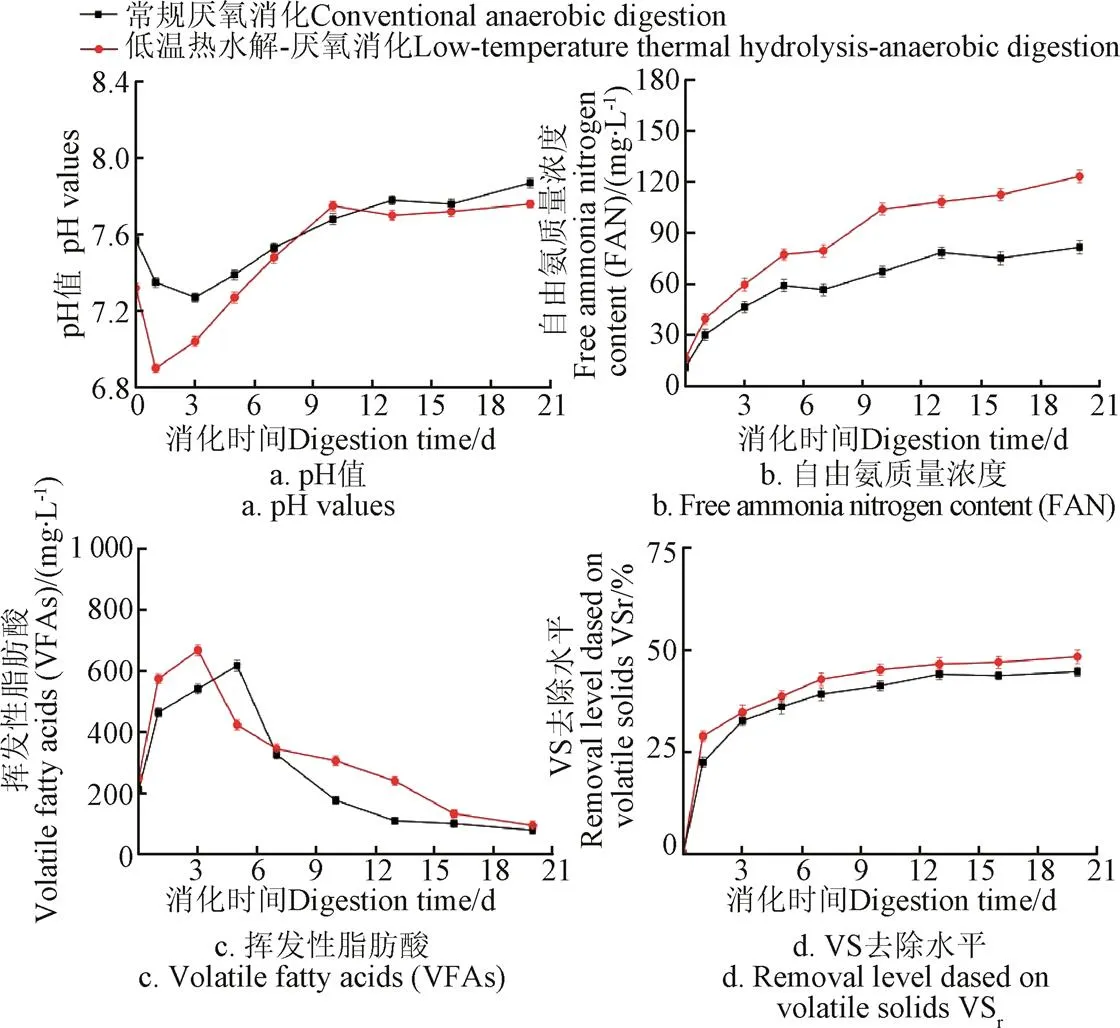
圖1 厭氧消化過程中pH值,FAN,VFAs和VSr隨消化時間的變化
對產酸微生物和產甲烷菌而言,其最適pH值分別在5~8.5和6.5~7.8范圍之間[30-31]。圖1顯示出厭氧消化過程中pH值的變化,在整個厭氧消化過程中,pH值均維持在6.8~7.9之間,雖在厭氧消化進行到18 d時,常規厭氧消化的pH值超過7.8,但國內相關研究表明,厭氧消化過程中大多數細菌可以在pH值為5~8.5的范圍內生長良好[32]。試驗中pH值波動在厭氧消化允許的范圍之內。
厭氧消化過程易受某些累積化學物質(如鈉、鉀、銨鹽等)抑制,這些鹽類會引起毒性效應從而對微生物起到抑制作用,其中FAN被認為是最主要的抑制劑[33]。隨著消化時間的延長,由于含氮有機物質如蛋白質等的降解,FAN濃度先上升然后逐漸達到穩定,之后維持在某一范圍內上下浮動。同時,由圖1可知,低溫熱水解污泥中的FAN濃度只是比常規厭氧消化污泥稍有增加,說明90 ℃低溫熱水解有改善蛋白質由顆粒狀向溶解態的水解作用,蛋白質大部分被溶解而不是降解[34]試驗中FAN的濃度位于10~130 mg/L之間,低于Mccarty等[35]所報道的抑制水平150 mg/L。
VFAs在厭氧消化過程中變化如圖1所示,常規厭氧消化和低溫熱水解厭氧消化在0~5 d和0~3 d內VFAs濃度顯著增加,這一階段VFAs的積累也導致了厭氧消化前期pH值的下降。低溫熱水解污泥先于常規厭氧消化污泥2 d達到VFAs的最大值,原因是低溫熱水解加速了水解這一限速步驟,縮短了厭氧消化的運行時間[36]。之后隨著消化過程的繼續進行,VFAs被不斷轉化為CO2和CH4,其濃度隨之下降,最后達到一個較低的水平。在厭氧消化之前。低溫熱水解污泥中的VFAs含量比常規厭氧消化污泥中的要高,原因可能是由于脂質的降解所引起的[37],由于熱處理的作用,長鏈脂肪酸可能被還原成較低分子量的脂肪酸,而它們本身可以在低鏈脂肪酸中被降解[9]。VFAs的產生也可能源于少量蛋白質降解[38]。
如圖1所示,隨著消化時間的不斷延長,VS去除水平逐漸升高,并最終趨于平衡,表示隨消化過程進行,有機物逐漸被微生物分解后趨于穩定化。研究表明,在污泥厭氧消化期間,VS減少量在30%~45%的范圍內[39],本試驗中常規厭氧消化的最終VS去除率為44.6%。低溫熱水解-厭氧消化的最終VS去除水平達到48.3%,較常規厭氧消化污泥高3.7個百分點。厭氧消化產生的氣體體積與VS降解呈正相關[40],預示著低溫熱水解預處理后,污泥具有更高的沼氣產量。
2.2 厭氧消化過程中污泥脫水性能
對于不包含預處理過程的常規厭氧消化單元而言,消化產物的脫水性隨著消化過程的繼續而不斷惡化[41],也有報道脫水性得到了改善[42]。其他研究人員發現了厭氧消化期間污泥的脫水性不穩定:出現一開始有所改善隨后惡化[4],一開始惡化隨后改善[43],或保持大致不變等情況[44]。但是,當超聲波或低溫熱水解等預處理應用于厭氧消化時,普遍認為消化物的脫水性可以得到改善[6]。
試驗采用離心脫水的方法來評價厭氧消化對污泥脫水性的作用。隨著消化過程的進行,消化污泥的脫水性隨時間的改變如圖2所示。

注:TS0是厭氧消化啟動時,污泥離心脫水泥餅的固體含量;TSt是厭氧消化第t天,污泥離心脫水泥餅的固體含量。
由圖2可知,消化污泥的脫水能力均隨著消化持續時間的延伸而得到改善,這表明厭氧消化增強了污泥的脫水性。消化污泥中揮發性有機固體主要成分是多糖和蛋白質等物質,能夠顯著影響污泥網絡強度和結合水含量[45],由于消化過程使得VS不斷被溶解或去除,導致結合水得到釋放,污泥結構變得更為松散流動性能加強,引起脫水能力的提升。Dai等[21]使用熱重分析儀(純氮氣載氣系統)測量了厭氧消化前后污泥中的水分分布情況,發現經過厭氧處理后污泥中的結合水和表面水的含量減少,而自由水和間隙水所占的比例增加,有利于脫水的進行。本試驗在整個消化過程中,低溫熱水解-厭氧消化中TSt/TS0的值均高于常規厭氧消化,污泥低溫熱水解預處理厭氧消化后,較常規厭氧消化污泥的脫水性提高1.59%。
2.3 厭氧消化過程中污泥流變特性的改變
根據旋轉粘度計法,獲得在不同厭氧消化時間內污泥流動曲線圖,使用 Herschel-Bulkley模型對污泥流動曲線進行擬合,擬合情況如表2和表3所示。

表2 常規厭氧消化污泥流動曲線H-B模型擬合
注:0t為厭氧消化第天污泥屈服應力,Pa;為流體稠度系數;為流動指數;2為擬合優度,下同。
Note:0tis the yield stress of sludge when anaerobic digestion in thedays, Pa;is dimensionless consistency coefficient;is consistency index;2is goodness of fit, the same below.
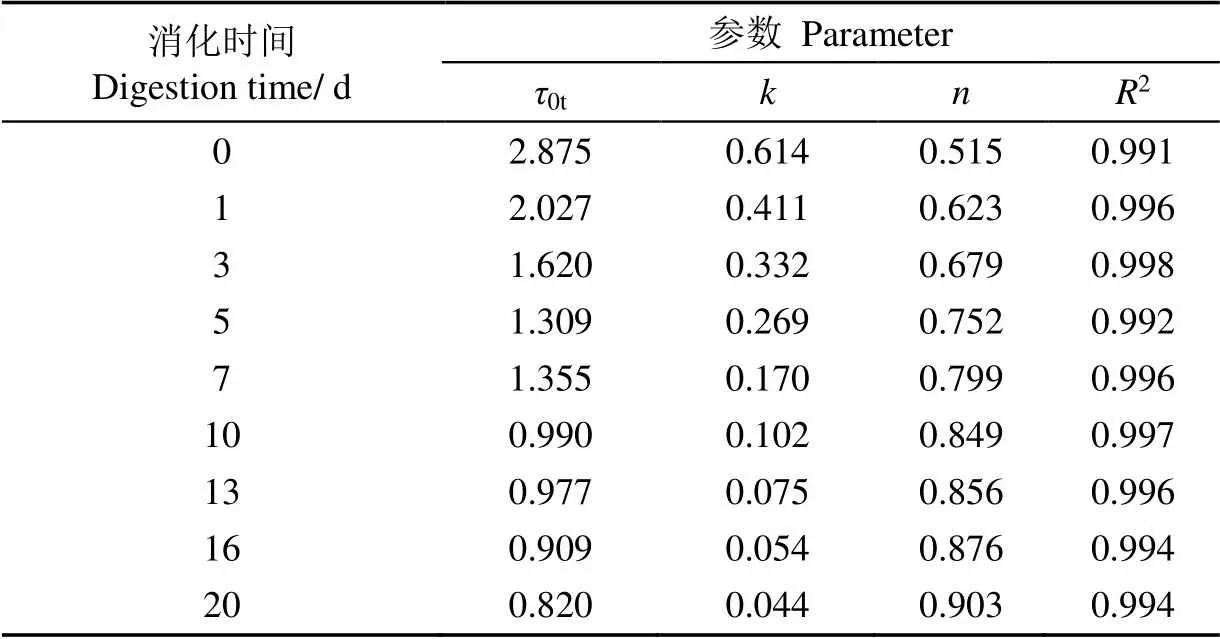
表3 低溫熱水解-厭氧消化污泥流動曲線H-B模型擬合
從表2和表3中可以看出,伴隨厭氧消化持續時間的不斷增長,屈服應力(0t)和流體稠度系數()不斷降低,而流動指數()值持續上升,說明污泥經過厭氧消化后流動性變好。低溫熱水解-厭氧消化污泥和常規厭氧消化污泥在第20 天的屈服應力較在初始時的屈服應力分別了降低了64.51%和71.47%。經20 d厭氧消化后,低溫熱水解預處理厭氧消化污泥τ0t值較常規厭氧消化污泥減少42.41%。低溫熱水解-厭氧消化污泥和常規厭氧消化污泥在第20天的稠度系數()較在初始時的稠度系數分別了降低了90.94%和92.83%。經20 d厭氧消化后,低溫熱水解預處理厭氧消化污泥值較常規厭氧消化污泥減少24.13%。且整個厭氧消化過程中,低溫熱水解預處理污泥較傳統常規污泥的流動性增強,可能是低溫熱水解-厭氧消化污泥較常規厭氧消化污泥VS去除率較高的原因之一。
研究表明固體含量是影響污泥流變性的一個最主要的因素[14,46],這是因為固體含量的增加可以減少污泥顆粒之間的距離,增加他們之間的相互作用,并隨后增強污泥在受到剪切時的流動阻力[47]。伴隨厭氧消化的進行,VS不斷被降解去除,導致固體含量持續減小,這可能是引起污泥流動性能改善的主要原因。Dai等[21]揭示了厭氧消化處理可以改變污泥中的水分分布,使結合水和表面水的含量減少,同時增加了自由水和間隙水的含量,這也是引起污泥流動性改善的原因之一。
2.4 厭氧消化過程中污泥流變特性與理化指標關系
本研究中選擇屈服應力作為考察厭氧消化過程的特征流變參數。同時,有針對地選擇VS/TS比值作為監測消化進程的特征理化參數,探究消化過程中污泥的特征流變和理化參數間的關系。
伴隨消化過程的進行,污泥的VS/TS比值、0t(0t表示厭氧消化第天污泥屈服應力)隨消化時間的改變分別如圖3和圖4所示。可以看出,在整個厭氧消化期間,VS/TS比值不斷降低,同時屈服應力也不斷減小。消化過程使VS不斷被降解去除,造成系統內的TS含量的下降,而TS含量與屈服應力值呈正相關,從而引起消化過程屈服應力的降低。通過數據擬合,伴隨消化過程中,污泥VS/TS比值與0t均大致遵循對數下降的趨勢,擬合優度均達到0.98以上。對數方程擬合式如圖3、圖4所示。
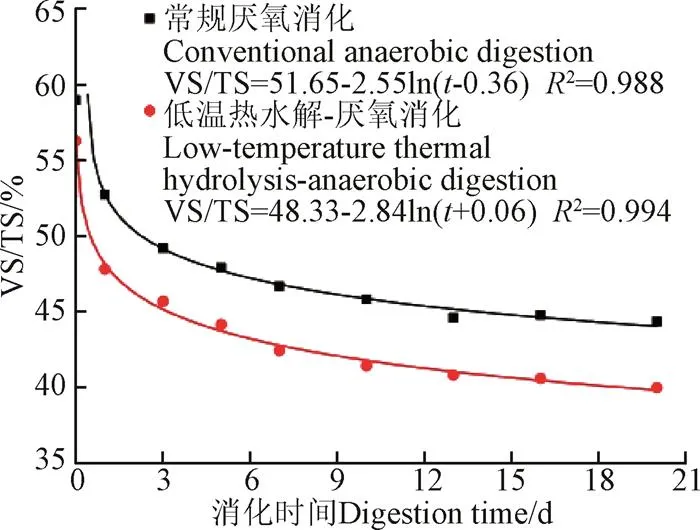
圖3 厭氧消化過程VS/TS的變化
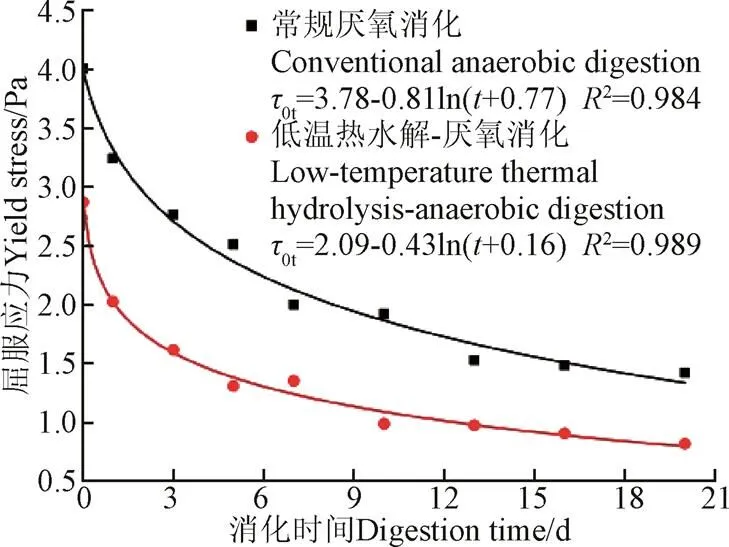
圖4 厭氧消化過程屈服應力的改變
作對應不同消化時間的屈服應力(0t)和VS/TS比值的圖,如圖5所示。結果發現,0t和VS/TS之間存在著線性關系,擬合方程如圖5所示,擬合優度2在0.94以上,表明污泥中的VS主要影響污泥0t,同時0t的改變也可以反映VS的變化。如圖6所示,消化過程中污泥屈服應力變化(0t/00)和脫水性能(TSt/TS0)的改變存在線性關系,擬合方程如圖6所示,擬合優度R2在0.97以上,表明0t/00與TSt/TS0具有很強的相關性。
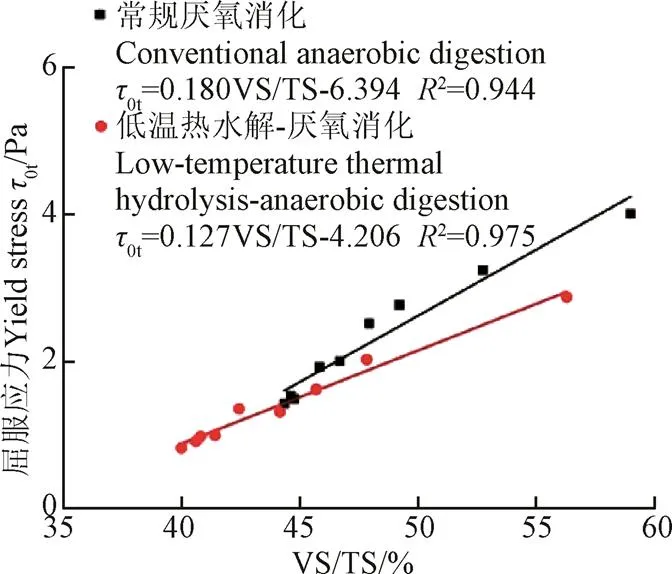
圖5 屈服應力τ0t和VS/TS關系
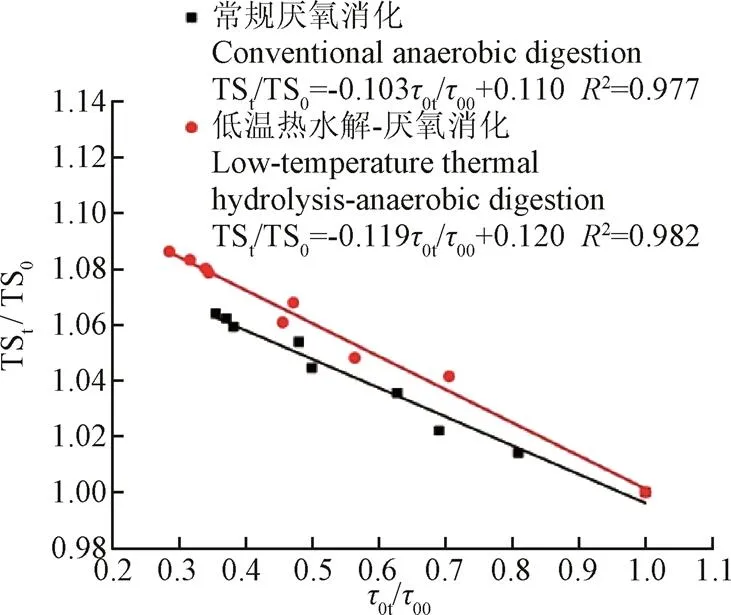
注:τ00為厭氧消化啟動時污泥屈服應力,Pa。
為全面了解污泥流變性(0t、0t/00)和理化性質(VS/TS、TSt/TS0)之間的關系,使用Pearson相關性進行了總體交互作用的統計研究。統計概率是通過線性回歸得到的,每個相關性的置信限度為95%。當值小于0.05時,驗證各參數之間的相關性[48],結果如表4所示。
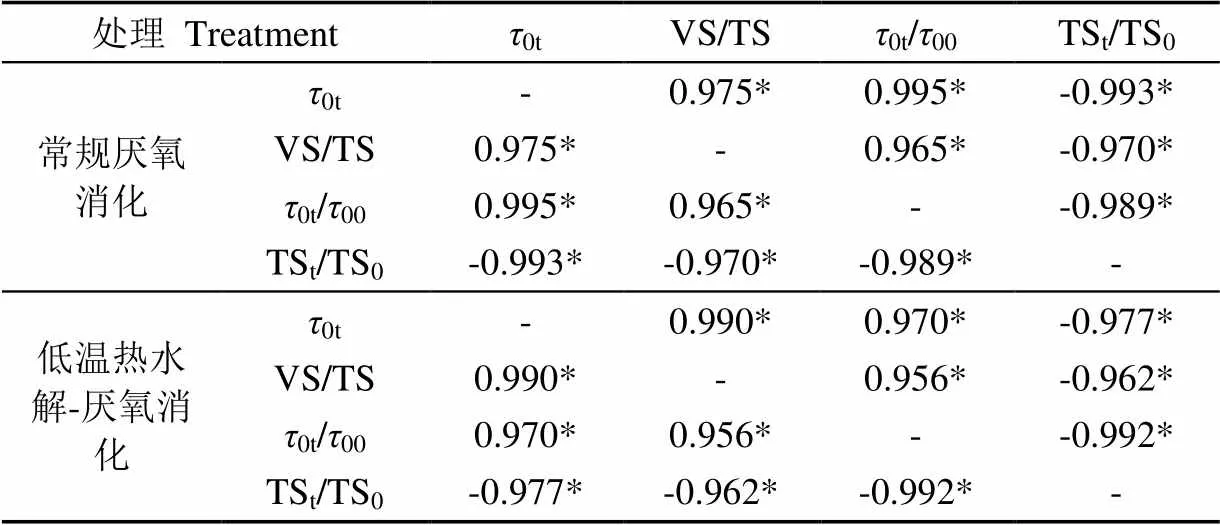
表4 不同污泥理化性質與流變性能皮爾遜相關性
注:*在0.01級別(雙尾)相關性顯著;(+):正相關;(-):負相關;
Note: *. Correlation is significant at the 0.01 level (2-tailed). (+) Positive correlation; (-) Negative correlation.
由表4可知,在常規厭氧消化污泥反應過程中,屈服應力與VS/TS(=0.975,<0.01)、0t/00與TSt/TS0(=?0.989,<0.01)兩者之間有較強的相關性;在低溫熱水解-厭氧消化污泥反應過程中,0t與VS/TS(=0.990,<0.01)、0t/00與TSt/TS0(=?0.992,<0.01)兩者之間有較強的相關性。表明在厭氧消化過程中屈服應力、屈服應力變化與污泥VS/TS、脫水性能具有較好的線性關系,建議實際工程中通過改變攪拌(包括機械攪拌、氣體攪拌等)的速率,可控制反應器內部剪切應力;改善污泥厭氧消化性能;提高污泥脫水性能的效果。本文從流變學角度為厭氧消化過程中的監控和優化提供新思路和理論依據。
3 結 論
1)常規厭氧消化的最終VSr為44.6%,低溫熱水解-厭氧消化的最終VSr為48.3%,較常規厭氧消化污泥高3.7個百分點;在整個厭氧消化過程中,低溫熱水解-厭氧消化中TSt/TS0的值均高于常規厭氧消化,低溫熱水解預處理使得消化物的脫水性提高1.59%。表明低溫熱水解預處理有助于厭氧消化產氣效率及污泥脫水性能的提高。
2)經低溫熱水解處理污泥,在整個厭氧消化過程中,污泥的0t值均小于常規厭氧消化污泥,表明低溫熱水解-消化污泥在厭氧消化過程中的流動性能優于常規厭氧消化污泥;常規厭氧消化和低溫熱水解-厭氧消化污泥結束后,其τ分別了降低了64.47%和71.51%;值分別減小了90.94%和92.83%,污泥流動性增強。
3)在整個消化過程中,VS/TS(volatile solids/total solids)和屈服應力隨時間的變化均呈對數下降趨勢;通過線性方程擬合和皮爾遜相關性統計研究表明,厭氧消化過程中,0t與VS/TS、0t/00與TSt/TS0兩者間的擬合優度2均大于0.94,皮爾遜相關性分析表明在厭氧消化過程中屈服應力、屈服應力變化與污泥VS/TS值、脫水性能具有較好的線性關系。由于厭氧消化的復雜性,后續試驗將采用相關試驗和方法驗證流變學指標作為監控優化指標的可行性;并進一步探究厭氧消化過程中污泥不同形態水分的變化規律與污泥流變學之間的關系,闡明厭氧消化過程中污泥流變學與脫水性能變化機理。
[1] 國家統計局,國家環境保護總局. 中國環境統計年鑒2017[M]. 北京:中國統計出版社,2017.
[2] 戴曉虎. 我國城鎮污泥處理處置現狀及思考[J]. 給水排水,2012,38(2):1-5.
[3] Chen S, Li N, Dong B, et al. New insights into the enhanced performance of high solid anaerobic digestion with dewatered sludge by thermal hydrolysis: Organic matter degradation and methanogenic pathways[J]. J Hazard Mater, 2018, 342(15): 1-9.
[4] Kopp J, Miiller J, Dichtl N, et al. Anaerobic digestion and dewatering characteristics of mechanically disintegrated excess sludge [J]. Water Science & Technology, 1997, 36(11): 129-136.
[5] 曹秀芹,袁海光,趙振東,等. 黃原膠溶液模擬消化污泥流動性能分析[J]. 農業工程學報,2017,33(15):260-265.
Cao Xiuqin, Yuan Haiguang, Zhao Zhendong, et al. Analysis on xanthan gum solution to simulate flow performance of digestion sludge[J]. Transactions of the Chinese Society of Agricultural Engineering (Transactions of the CSAE), 2017, 33(15): 26-265. (in Chinese with English abstract)
[6] Zhang J, Li N, Dai X, et al. Enhanced dewaterability of sludge during anaerobic digestion with thermal hydrolysis pretreatment: New insights through structure evolution[J]. Water Research, 2017, 131(15): 177-185.
[7] 陳文賓,胡慶昊,徐國想,等. 微氧預處理對有機廢水厭氧消化產甲烷的影響[J]. 農業工程學報,2010,26(11):256-259.
Chen Wenbin, Hu Qinghao, Xu Guoxiang, et al. Effect of micro-aerobic pretreatment on anaerobic digestion of organic wastewaters for methane production[J]. Transactions of the Chinese Society of Agricultural Engineering (Transactions of the CSAE), 2010, 26(11): 256-259. (in Chinese with English abstract)
[8] Morgan-Sagastume F, Pratt S, Karlsson A, et al. Production of volatile fatty acids by fermentation of waste activated sludge pre-treated in full-scale thermal hydrolysis plants[J]. Bioresource Technology, 2011, 102(3): 3089-3097.
[9] Appels L, Degrève J, Bruggen B V D, et al. Influence of low temperature thermal pre-treatment on sludge solubilisation, heavy metal release and anaerobic digestion[J]. Bioresource Technology, 2010, 101(15): 5743-5748.
[10] Dieudé-Fauvel E, Héritier P, Chanet M, et al. Modelling the rheological properties of sludge during anaerobic digestion in a batch reactor by using electrical measurements[J]. Water Research, 2014, 51(15): 104-112.
[11] Wu B X. Computational fluid dynamics investigation of turbulence models for non-newtonian fluid flow in anaerobic digesters[J]. Environmental Science & Technology, 2010, 44(23): 8989-8995.
[12] Farno E, Baudez J C, Parthasarathy R, et al. Rheological characterisation of thermally-treated anaerobic digested sludge: Impact of temperature and thermal history[J]. Water Res, 2014, 56(2): 156-161.
[13] Nicky E, Flora M, Dong Y S, et al. Rheological characterisation of municipal sludge: A review[J]. Water Res, 2013, 47(15): 5493-5510.
[14] Urrea J L, Collado S, Laca A, et al. Rheological behaviour of activated sludge treated by thermal hydrolysis[J]. Journal of Water Process Engineering, 2014, 5: 153-159.
[15] Nicky E, Flora M, Paul S. The laminar/turbulent transition in a sludge pipeline[J]. Water Science & Technology A Journal of the International Association on Water Pollution Research, 2012, 65(4): 697-702.
[16] 曹秀芹,王鑫,蔣竹荷,等. 高含固污泥在熱水解-厭氧消化工藝中的流變特性分析[J]. 環境工程學報,2017,11(4):2493-2498.
Cao Xiuqin, Wang Xin, Jiang Zhuhe, et, al. Analysis on rheological characterization of high solid sludge in process of thermal hydrolysis-anaerobic digestion[J]. Chinese Journal of Environmental Engineering, 2017, 11(4): 2493-2498. (in Chinese with English abstract).
[17] Kevin H, Ehsan F, Saeid B, et al. Rheological characterization of thermal hydrolysed waste activated sludge[J]. Water Res, 2019, 156: 445-455.
[18] Zhang J, Haward S J, Wu Z, et al. Evolution of rheological characteristics of high-solid municipal sludge during anaerobic digestion[J]. Applied Rheology, 2016, 26(3): 32937.
[19] Mori M, Isaac J, Seyssiecq I, et al. Effect of measuring geometries and of exocellular polymeric substances on the rheological behaviour of sewage sludge[J]. Chemical Engineering Research & Design, 2008, 86(6): 554-559.
[20] Pevere A, Guibaud G, Hullebusch E V, et al. Viscosity evolution of anaerobic granular sludge[J]. Biochemical Engineering Journal, 2006, 27(3): 315-322.
[21] Dai X, Gai X, Dong B. Rheology evolution of sludge through high-solid anaerobic digestion[J]. Bioresource Technology, 2014, 174: 6-10.
[22] Siles J A, Brekelmans J, Martín M A, et al. Impact of ammonia and sulphate concentration on thermophilic anaerobic digestion[J]. Bioresour Technol, 2010, 101(23): 9040-9048.
[23] 段妮娜,董濱,李江華,等. 污泥和餐廚垃圾聯合干法中溫厭氧消化性能研究[J]. 環境科學,2013,34(1):321-327.
Duan Nina, Dong Bin, Li Jianghua, et, al. High-solids anaerobic co-digestion of sludge and kitchen garbage under mesophilic conditions[J]. Environmental Science, 2013, 34(1): 321-327. (in Chinese with English abstract).
[24] Konrad K, Marc W, Manfred L, et al. Mono fermentation of grass silage by means of loop reactors[J]. Bioresource Technology, 2009, 100(23): 5934-5940.
[25] Hidaka T, Arai S, Okamoto S, et al. Anaerobic co-digestion of sewage sludge with shredded grass from public green spaces[J]. Bioresource Technology, 2013, 130(1): 667-672.
[26] Feng Guohong, Guo Yabing, Tan Wei. Effects of thermal hydrolysis temperature on physical characteristics of municipal sludge[J]. Water Science & Technology: A Journal of the International Association on Water Pollution Research, 2015, 72(11): 2018-2026.
[27] 陸軍,陳潔,盛奎川,等. 超高壓處理玉米醇溶蛋白的流變性和熱特性分析[J]. 農業工程學報,2013,29(5):259-265.
Lu Jun, Chen Jie, Sheng Kuichuan, et, al. Rheological properties and calorimetric analysis on zein under high pressure treatment[J]. Transactions of the Chinese Society of Agricultural Engineering (Transactions of the CSAE), 2013, 29(5): 259-265. (in Chinese with English abstract)
[28] Feng G, Liu L, Wei T. Effect of thermal hydrolysis on rheological behavior of municipal sludge[J]. Industrial & Engineering Chemistry Research, 2014, 53(27): 11185-11192.
[29] Hong E, Yeneneh A M, Sen T K, et al. A comprehensive review on rheological studies of sludge from various sections of municipal wastewater treatment plants for enhancement of process performance[J]. Advances in Colloid & Interface Science, 2018, 257: 19-23.
[30] Fang W, Zhang P, Zhang G, et al. Effect of alkaline addition on anaerobic sludge digestion with combined pretreatment of alkaline and high pressure homogenization[J]. Bioresour Technol, 2014, 168: 167-172.
[31] Luo Qingming, Li Xiujin, Zhu Baoning, et, al. Anaerobic biogasification of NaOH-treated corn stalk[J]. Transactions of the Chinese Society of Agricultural Engineering (Transactions of the CSAE), 2005, 21(2): 111-115.
羅慶明,李秀金,朱保寧,等. NaOH處理玉米秸稈厭氧生物氣化試驗研究(英文)[J]. 農業工程學報,2005,21(2):111-115. (in English with Chinese abstract)
[32] 韓玉偉. 北京城市污泥熱水解:厭氧消化組合工藝效能研究[D]. 北京:北京工業大學,2016.
Han Yuwei. Efficicencies of Thermal Hydrolysis-Anaerobic Digestion of Municipal Sludge in Beijing[D]. Beijing: Beijing University of Technology, 2016. (in Chinese with English abstract)
[33] Jin R, Huang G, Ma C, et al. Ammonia inhibition of anaerobic digestion[J]. Industrial Water Treatment, 2010, 30(4): 9-12.
[34] 曹秀芹,柳婷,江坤,等. 低溫熱水解處理對污泥流變特性的影響[J]. 環境工程,2019,37(12):104-108.
Cao Xiuqin, Liu Ting, Jiang Kun, et al. Effect of low-temperaturethermal hydrolysis process on sludge rheology[J]. Environmental Engineering, 2019, 37(12): 104-108. (in Chinese with English abstract)
[35] Mccarty R L, Mckinney R E. Salt Toxicity in Anaerobic Digestion [J]. Water Pollution Control Federation, 1961, 33(4): 399-415.
[36] Lise Appels, Jan Degrève, Bart Van der Bruggen, et al. Influence of low temperature thermal pre-treatment on sludge solubilisation, heavy metal release and anaerobic digestion[J]. Bioresource Technology, 2010, 101(15): 5743-5748.
[37] Shanableh A, Jomaa S. Production and transformation of volatile fatty acids from sludge subjected to hydrothermal treatment[J]. Water Science & Technology, 2001, 44(10): 129-135.
[38] Bougrier C, Delgenès J P, Carrère H. Effects of thermal treatments on five different waste activated sludge samples solubilisation, physical properties and anaerobic digestion[J]. Chemical Engineering Journal, 2008, 139(2): 236-244.
[39] Habiba L, Hassib B, Moktar H. Improvement of activated sludge stabilisation and filterability during anaerobic digestion by fruit and vegetable waste addition[J]. Bioresource Technology, 2009, 100(4): 1555-1560.
[40] Xue Y, Liu H, Chen S, et al. Effects of thermal hydrolysis on organic matter solubilization and anaerobic digestion of high solid sludge[J]. Chemical Engineering Journal, 2015, 264: 174-180.
[41] Houghton J I, Quarmby J, Stephenson T. The impact of digestion on sludge dewaterability[J]. Process Safety & Environmental Protection, 2000, 78(2): 153-159.
[42] Li X Y, Yang S F. Influence of loosely bound extracellular polymeric substances (EPS) on the flocculation, sedimentation and dewaterability of activated sludge[J]. Water Res, 2007, 41(5): 1022-1030.
[43] Miron Y, Zeeman G, Lier J B V, et al. The role of sludge retention time in the hydrolysis and acidification of lipids, carbohydrates and proteins during digestion of primary sludge in CSTR systems[J]. Water Res, 2000, 34(5): 1705-1713.
[44] Jensen P D, Astals S, Lu Y, et al. Anaerobic codigestion of sewage sludge and glycerol, focusing on process kinetics, microbial dynamics and sludge dewaterability[J]. Water Res, 2014, 67: 355-366.
[45] Neyens E, Baeyens J. A review of thermal sludge pre-treatment processes to improve dewaterability[J]. J Hazard Mater, 2003, 98(1): 51-67.
[46] Cao X, Jiang K, Xin W, et al. Effect of total suspended solids and various treatment on rheological characteristics of municipal sludge[J]. Research on Chemical Intermediates, 2018, 44(6): 1-16.
[47] Tang B, Zhang Z. Essence of disposing the excess sludge and optimizing the operation of wastewater treatment: rheological behavior and microbial ecosystem[J]. Chemosphere, 2014, 105(4): 1-13.
[48] Miryahyaei S, Olinga K, Abdul Muthalib F A, et al. Impact of rheological properties of substrate on anaerobic digestion and digestate dewaterability: New insights through rheological and physico-chemical interaction[J]. Water Res, 2018, 150(1): 56-67.
Rheology and dewaterability of sludge during anaerobic digestion
Cao Xiuqin1,2, Wang Haoran2, Jiang Kun3, Liu Ting2, Zhu Kaijin4, Ren Xiaoli4
(1.100044;2.100044; 3.200070; 4.030008)
Biogas is one of the most hopeful renewable energy sources in the world. The anaerobic digestion (AD) process has been studied intensively over the last few decades, its application on biomass and solid waste digestion, as well as in wastewater treatment, agriculture. In order to gain a comprehensive insight, the interactive relationship between substrate rheology, physicochemical properties, and biogas production as well sludge dewaterability was investigated. Anaerobic digestion experiments were performed on conventional sludge and low temperature thermal hydrolysis pretreatment sludge. The experiment lasted for 20 days. Rheological indicators and physical and chemical indicators of conventional sludge and low temperature thermal sludge were determined by the rotational viscometer method and standard method during anaerobic digestion. The results showed that the pH value was maintained 6.8 to 7.9, which was within the allowable range of anaerobic digestion. The concentration of Free Ammonia (FAN) is between 10-130 mg/L, which was lower than the inhibition level of anaerobic digestion. The content of VFAs (Volatile Fatty Acid) in low temperature thermal hydrolysis sludge was higher than that in conventional anaerobic digestion sludge. The final Volatile solids removal level (VSr) of low temperature thermal hydrolysis-anaerobic digestion reached was 48.3%, and it was higher than conventional anaerobic digestion (44.6%). The dewaterability of sludge increased with the anaerobic time during the AD, andthe low temperature thermal pretreatment increased the dewaterability of digestion by 1.59%, which demonstrated the improved dewaterability of low temperature thermally hydrolysis treated sludge. After the conventional anaerobic digestion and the low temperature thermal digestion, the yield stress of the sludge decreased by 64.51% and 71.47%, respectively. The consistency coefficient decreased by 90.94% and 92.83%, respectively. It implied the sludge fluidity significantly enhanced.During the whole digestion process, the VS/ Total solids (TS) and yield stress (0t) showed a logarithmic downward trend with time. Using the linear equation fitting and Pearson correlation statistics analysis, the correlation between rheological (yield stress and yield stress change) and physicochemical parameters (VS/TS and dewaterability) were investigated. The results showed that all the goodness of fit (2) were greater than 0.94. During the whole conventional anaerobic digestion, the yield stress was positively and strongly correlated with VS/TS value (=0.975,<0.01), and the yield stress change was negatively and strongly correlated with dewaterability (=-0.989,<0.01). During low temperature thermal hydrolysis anaerobic digestion, the yield stress was positively and strongly correlated with VS/TS value (=0.990,<0.01), and the yield stress change was negatively and strongly correlated with dewaterability improved (=-0.992,<0.01). It is implied that there is a strong correlation between sludge yield stress and sludge VS/TS value. From the perspective of rheology, it provided the new ideas and theoretical basis for monitoring and optimization in the process of anaerobic digestion. In this study, the theoretical basis and feasibility of rheological control indicators for evaluating and monitoring low temperature thermal hydrolysis and anaerobic digestion processes (performance) were provided. Finally, the future work should focus on investigating the specific effects of specific ingredients (including polysaccharides, proteins, lipids, humic acids, glycoproteins, etc.) in EPS on sludge dehydration, and exploring the different forms of water in the sludge during anaerobic digestion, to reveal the relationship between the change law and sludge rheology, and clarifying the mechanism of sludge rheology and dehydration performance during anaerobic digestion. At the same time, the research on the influence of rheology on the level of chemistry and microorganism also needs to make progress.
sludge; anaerobic digestion; low temperature thermal hydrolysis; yield stress; dewaterability
2019-11-06
2020-02-20
北京建筑大學市屬高校基本科研業務費專項資金資助(X18182),山西省重點研發計劃項目(201803D31074)。
曹秀芹,教授,主要從事污泥及固體廢棄物資源化利用、CFD 數值模擬等方面研究。Email:caoxiuqin@bucea.edu.cn
10.11975/j.issn.1002-6819.2020.05.027
X703
A
1002-6819(2020)-05-0233-08
曹秀芹,王浩冉,江 坤,柳 婷,朱開金,任曉莉. 污泥厭氧消化過程的流變規律與脫水性能[J]. 農業工程學報,2020,36(5):233-240. doi:10.11975/j.issn.1002-6819.2020.05.027 http://www.tcsae.org
Cao Xiuqin, Wang Haoran, Jiang Kun, Liu Ting, Zhu Kaijin, Ren Xiaoli. Rheology and dewaterability of sludge during anaerobic digestion[J]. Transactions of the Chinese Society of Agricultural Engineering (Transactions of the CSAE), 2020, 36(5): 233-240. (in Chinese with English abstract) doi:10.11975/j.issn.1002-6819.2020.05.027 http://www.tcsae.org