
在線旁路近紅外實時監測糞污厭氧發酵揮發性脂肪酸含量
2020-07-10 05:04:50黃圓萍沈廣輝韓魯佳楊增玲
農業工程學報 2020年10期
關鍵詞:檢測
梁 浩,黃圓萍,沈廣輝,韓魯佳,楊增玲
在線旁路近紅外實時監測糞污厭氧發酵揮發性脂肪酸含量
梁浩,黃圓萍,沈廣輝,韓魯佳,楊增玲※
(中國農業大學工學院,北京 100083)
厭氧發酵是畜禽糞污資源化利用的重要途徑之一,揮發性脂肪酸作為重要的中間產物,可以很好地反映有機物質的降解過程,對其進行實時檢測對在線監控發酵進程具有重要意義。該研究在已有實驗室型厭氧發酵系統上、基于在線旁路檢測方式設計了近紅外實時檢測裝置及發酵液循環回路系統,探討對乙酸、丙酸、異丁酸、丁酸、異戊酸、戊酸等單一揮發性脂肪酸和總揮發性脂肪酸進行在線實時檢測的可行性。檢測結果表明,所設計的在線檢測方案和定標模型對揮發性脂肪酸含量的實時檢測效果良好,即使對濃度含量較低(萬分之五)的異丁酸仍能實現較準確的檢測,結果分別為:乙酸的2=0.811,RPD=2.055,RSD=2.288%;丙酸的2=0.849,RPD=2.116,RSD=2.195%;異丁酸的2=0.968,RPD=5.555,RSD=2.132%;丁酸的2=0.889,RPD=2.701,RSD=1.846%;異戊酸的2=0.940,RPD=3.843,RSD=3.444%;戊酸的2=0.889,RPD=2.751,RSD=2.387%;總揮發性脂肪酸的2=0.734,RPD=1.846,RSD=2.150%。基于該研究提出的在線檢測方案,近紅外光譜技術能夠實現厭氧發酵過程中揮發性脂肪酸的快速、在線、實時檢測,可為今后沼氣工程在線監測提供參考。
糞;發酵;近紅外光譜;在線旁路;糞污厭氧發酵;揮發性脂肪酸;實時動態檢測
0 引 言
厭氧發酵是畜禽糞污資源化利用的重要途徑之一[1],但發酵過程受物料的性質、運行條件等眾多因素影響,其過程表現出極強的非線性、多變性和復雜性。揮發性脂肪酸(Volatile Fatty Acid,VFA)作為重要的中間產物,可以很好地反映有機物質的降解過程[2-3],對其進行實時檢測對在線監控發酵進程具有重要意義。
VFA主要包括:乙酸、丙酸、異丁酸、丁酸、異戊酸、戊酸,其傳統測定方法主要有比色法[4]、蒸餾法[5]、滴定法[6]、液相色譜法[7]和氣相色譜法[8]等。上述方法雖然測量精度較高,但需要將樣品取回實驗室進行分析,難以實現現場的實時分析,其在線實時檢測裝置和方法已經受到國外學者廣泛關注。Pind等[9]在發酵反應器內設計了旋轉微過濾系統,可利用氣相色譜傳感器實時在線檢測發酵過程產生的乙酸、丙酸、異丁酸和異戊酸的含量,但此裝置操作繁瑣且存在過濾系統易堵塞等問題。近紅外光譜技術作為一種適于在線/現場快速分析的技術,近年來在食品、醫藥、石化、農業等領域均取得良好的應用[10]。Stockl等[11]基于實驗室型厭氧發酵系統,利用近紅外光譜在線檢測了厭氧發酵過程中的丙酸、揮發性脂肪酸、總無機碳(Total Inorganic Carbon,TIC)以及VFA/TIC的變化。Ward等[12]基于中試規模發酵裝置,采用近紅外光譜在線檢測了發酵過程中的乙酸、丙酸和TVFA的含量。Jacobi等[13]在1MW的沼氣工廠搭建近紅外在線檢測系統,對TVFA、乙酸和丙酸進行檢測,但預測精度并不理想。綜上,國外研究學者已經基于近紅外光譜技術,在不同規模反應器上探討了近紅外光譜在線檢測揮發性脂肪酸的可行性,取得了較好的效果,但是目前的研究還存在檢測的揮發性脂肪酸種類不全,和模型精度需要進一步提高等問題。而國內尚未檢索到糞污厭氧發酵過程揮發性脂肪酸含量實時在線檢測的研究。因此,本研究在已有實驗室型厭氧發酵系統上基于近紅外光譜技術設計在線檢測裝置及發酵液循環回路系統,探討對乙酸、丙酸、異丁酸、丁酸、異戊酸、戊酸等單一揮發性脂肪酸和總揮發性脂肪酸進行在線實時檢測的可行性。
1 材料與方法
1.1 在線檢測裝置及發酵液循環回路系統
圖1(黑色線部分)為課題組自主設計的實驗室型厭氧發酵裝置,本裝置主要包括厭氧發酵反應器(反應器罐體、電機、攪拌軸、攪拌葉片)、循環加熱裝置(加熱柜、控制面板、橡膠軟管)和控制系統(控制柜、間歇或連續設定按鈕、風機開關、顯示面板、調速旋鈕、設置面板、啟動或急停按鈕)3部分。反應器罐體全容積為10 L,實際操作容積為8 L。反應器罐體上下分別布置進料口、出料口、出氣口。為實現氣液分散、料液懸浮、混勻、傳熱、傳質等,采用軸流型攪拌器,依靠軸向流攪拌器的主體對流作用使全部液體周期性混合[14]。此外,本系統采用雙層水浴保溫設計,通過外部循環加熱裝置,形成熱流體換熱持續讓反應器處于恒溫狀態。在反應器內安裝溫度傳感器(PT100),實時檢測反應器內液體的溫度。
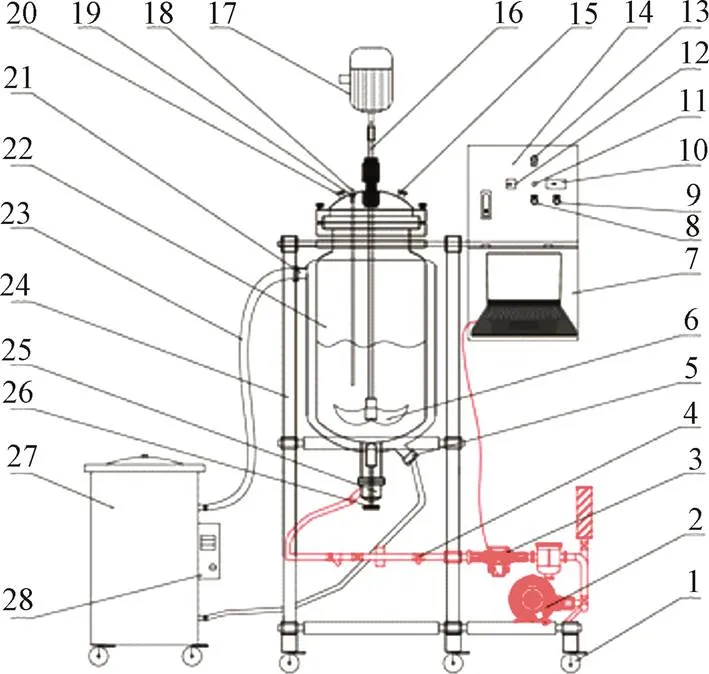
1.萬向輪 2.風機 3.在線檢測裝置 4.取樣口 5.進水口 6.攪拌葉片 7.PC機 8.間歇或連續設定按鈕 9.風機開關 10.顯示面板 11.調速旋鈕 12.設置面板 13.啟動或急停按鈕14.控制柜 15.出氣口 16.攪拌軸 17.電機 18.溫度傳感器 19.溫度傳感器端口 20.進料口 21.出水口 22.反應器罐體 23.橡膠軟管 24.支架 25.出料口 26.螺旋閥門 27.加熱柜 28.控制面板
為實現基于近紅外光譜技術的在線實時檢測,在實驗室型厭氧發酵裝置上設計了在線檢測裝置和發酵液的循環回路系統(圖1淺色線部分)。在線檢測裝置利用近紅外探頭在線實時獲得厭氧發酵液的近紅外光譜,主要包括:外部結構、流通通道、上下固定裝置、近紅外探頭、反射板、透光片,其具體結構示意圖詳見圖2。此裝置在設計時考慮發酵液的特性,采用透反射方式采集光譜信息,可最大程度獲取發酵液的光譜信息。此外,本裝置各部分均可拆卸,便于使用。

1,5.上下固定裝置 2,4.上下外部結構 3.流通通道 6.反射板 7,8.透光片 9.近紅外探頭


1.風機 4.空氣過濾器 5.儲液罐 6.近紅外探頭 7.在線檢測裝置 8.取樣口 10.反應器 11.螺旋閥門 12.Y型過濾器 14.外部水源 2、3、9、13、15、16、17、18.球形閥門
上述提出的在線旁路檢測方案結合透反射光譜采集方式,可盡量避免在線分析對光譜信息的影響,保證獲得信噪比滿足分析要求的發酵液光譜信息。
1.2 試驗材料
豬糞取自北京郊區北郎中村養豬廠,接種物為取自北郎中村附近沼氣站的沼液。豬糞和接種物的基本性質如表1所示。豬糞、接種物和去離子水配成總固體含量(Total Solid,TS)為8%的混合液體8 kg,倒入厭氧發酵反應器內,注意保證反應器的厭氧環境。攪拌轉子的轉速為40 rad/min,反應器溫度控制在40 ℃左右[15],厭氧發酵試驗為期60 d。

表1 豬糞和接種物的基本性質
1.3 在線光譜信息采集
將近紅外探頭MicroNIR PAT-U(Viavi Solutions,美國),置于透光片下方,其波長范圍為950~1 650 nm(10 526~6 061 cm-1),采樣間隔6.2 nm,積分時間設置為7.2 ms,掃描次數100次。光源為雙集成真空鎢燈,128線元非制冷InGaAs光電二極管陣列檢測器,16位模數轉換器,每次試驗前采集暗電流,并使用聚四氟乙烯板采集背景光譜。
從發酵第1天開始,每天10:30定時采集光譜,采集時,打開發酵液循環回路系統對應的閥門,讓發酵液流過在線檢測位點,每隔大約1 min采集1條光譜,每天采集3條光譜,60 d累計采集180條光譜,光譜數據存儲于PC機中。在采集光譜的同時,從取樣口獲得收集完光譜信息的發酵液樣品,轉移至離心管,冷凍貯藏于?18 ℃的冰箱中,用于后續揮發性脂肪酸含量的實驗室分析。
1.4 分析方法
1.4.1 實驗室分析
豬糞、接種物的總固體(TS)和揮發性固體(Volatile Solid,VS)參照ASTM-D5142方法采用工業分析儀(YX-GYFX7705,中國)測得[16]。豬糞C/N值參照ASTM-D5373&D4239方法采用元素分析儀(Elementar Vario Macro,德國)測得[17]。
發酵液中單一揮發性脂肪酸采用GC(GC-2014C,Shimadzu,日本)測定。樣品制備過程:取樣品至離心管中在12 000 r/min下離心15 min,取離心后的上清液通過0.45m聚醚砜濾膜,加入無水甲酸,調節pH值在2~3之間,再過0.22m的聚四氟乙烯濾膜,置于氣相進樣瓶,冷藏(4 ℃)保存待用。GC的設定參數為:火焰離子化檢測器;DB-wax毛細管柱30 m×0.25 mm×0.25m;載氣:高純氮;流速:40 mL/min;分離比:30;柱子起始溫度:60 ℃(保持2 min),以10 ℃/min的增速到140 ℃,然后以20 ℃/min增到230 ℃(保持5 min),注射器和檢測器的溫度分別為230、250℃[18]。通過測定色譜純級的乙酸、丙酸、異丁酸、丁酸、異戊酸、戊酸標準液繪制標準曲線,其中總揮發性脂肪酸是這6種單一揮發性脂肪酸的總和,利用已知標準品的濃度計算各單一揮發性脂肪酸的濃度。
1.4.2試驗數據分析
本試驗中所有的近紅外定量分析模型運用偏最小二乘回歸算法(Partial Least Squares Regression,PLSR)在MATLAB R2015a(Mathworks,美國)軟件上進行。具體建模過程:樣品原始光譜數據經標準化(Autoscale)、標準正態變換(Standard Normal Variate Transformation,SNV)、一階導數(1st Derivative,1stD)、平滑等不同預處理算法處理,實驗室分析值經過標準化算法處理;校正集采用百葉窗交互驗證(Venetian Blinds Cross Validation),使用PLSR算法將預處理后的光譜與實驗室分析值進行相互關聯,建立各個揮發性脂肪酸的定量分析模型。使用決定系數(Coefficient of Determination,2)、均方根誤差(Root Mean Square Error,RMSE)、相對分析誤差(Relative Percent Deviation,RPD)及相對標準偏差(Relative Standard Deviation,RSD)對模型效果進行評價。決定系數反映了近紅外預測值和實驗室測定值之間的相關關系,其值范圍為0至1,越接近1,預測精度越高,2、2cv、2分別為定標、交互驗證、外部獨立驗證的決定系數;均方根誤差主要反映了近紅外預測值和實驗室測定值之間的誤差,RMSEC、RMSECV、RMSEP分別為定標、交互驗證和外部獨立驗證的均方根誤差。上述指標用于判斷模型的精確度和穩健性,比如2和2cv、RMSEC和RMSECV接近,說明模型穩健性好;2和2、RMSEC和RMSEP接近,說明模型精確度高[19]。RSD<10%,且RPD>2.5,說明定量分析模型效果良好,預測精度高;RSD<10%,且1.5
2 結果與討論
2.1 脂肪酸在線實時預測模型的建立
本研究共收集180個樣品,從每天的3個樣品中隨機選擇2個作為校正集,共120個樣品,剩下1個作為獨立外部預測集,共60個樣品。圖4顯示了校正集樣品和預測集樣品在光譜空間的分布,其分布基本均勻且一致。從表2可看出,校正集與預測集各化學指標含量分布基本一致。樣品分集合理,預測集樣品具有一定代表性,能夠對校正模型進行評估。與Stockl等[11-13]報道的揮發性脂肪酸含量相比,本文的揮發性脂肪酸含量尤其是乙酸、丙酸、丁酸等,含量較高、范圍變化較小,這與本批試驗只進行了60 d,且試驗一直處于處在水解酸化和乙酸化階段有關[21]。脂肪酸含量較高利于近紅外模型的建立,但是范圍變化較小又不利于近紅外模型的建立。

圖4 校正集樣品與預測集樣品在第一和第二主成分得分的空間分布圖

表2 建模樣品數據的統計分析結果
注:表中1代表校正集;2代表預測集;代表樣品數。
Note: 1 represents calibration set; 2 represents prediction set;represents sample numbers.
基于PLS算法構建發酵液乙酸、丙酸、異丁酸、丁酸、異戊酸、戊酸、總揮發性脂肪酸的近紅外模型,檢測結果如表3所示。乙酸、丙酸、異丁酸、丁酸、異戊酸、戊酸、總揮發性脂肪酸的預測集決定系數2分別為0.811、0.849、0.968、0.889、0.940、0.889、0.734,預測集的RMSEP分別為0.213、0.077、0.013、0.086、0.036、0.041、0.446 mg/mL,預測集相對分析誤差RPD分別為2.055、2.116、5.555、2.701、3.843、2.751、1.846。乙酸的分析精度較Jacobi等[13]的結果(2=0.69,RPD=1.81)高,丙酸的結果(2=0.89,RPD=2.89)相當;與Ward等[12]的結果(乙酸:2cv=0.84,RPD=1.83丙酸:2cv=0.83,RPD=1.79,TVFA:2=0.84,RPD=1.82)相比,本文的分析精度均較高;Stockl等[11]利用Krapf等[22-23]建立的校正模型開展試驗進行驗證,校正模型直接預測丙酸的2=0.78,預測精度低于本研究結果;去除其試驗中高濃度樣品(樣品的丙酸濃度值超過校正模型的濃度范圍)后,2=0.85,與本研究結果相當。
綜上分析結果表明:異丁酸、丁酸、異戊酸、戊酸的RSD<10%,且RPD>2.5,其定量分析模型預測精度高,因此可以實時檢測厭氧發酵過程中這些成分的變化;乙酸、丙酸、總揮發性脂肪酸的RSD<10%,1.5 表3 基于PLS的揮發性脂肪酸近紅外在線檢測模型效果 注:表中下標代表校正集;cv代表交互驗證;代表預測集。 Note:represents calibration set; cv represents cross-validation set;represents prediction set. 圖5顯示了NIRS預測值與實驗室分析值之間的散點圖、NIRS預測值與實驗室分析值隨厭氧發酵時間變化的線圖。由圖可知,NIRS的預測效果與實驗室分析結果相近,變化趨勢基本一致。值得提出的是,圖5c中可以看出,NIRS在預測較低濃度(0.336~0.705 mg/mL,含量大約在萬分之五)的異丁酸時,近紅外光譜的檢測仍能表現出優良的預測精度,擬合效果好。由于本次試驗一直處在水解酸化和乙酸化階段,各類揮發性脂肪酸含量一直處在高值,變化幅度較小;完全的發酵過程中其揮發性脂肪酸的含量變化幅度會更大,將更加有利于NIRS模型的建立。 為了檢驗近紅外方法與實驗室分析值之間的差異性,對驗證結果進行偏差分析,結果如表4所示,由表可知,近紅外預測值與參考方法平均相對偏差分別為:乙酸為1.823%,丙酸為1.777%,異丁酸為1.630%、丁酸為1.492%、異戊酸為2.712%、戊酸為1.820%、TVFA為1.780%,均能滿足實際工程的應用要求。 圖5 近紅外預測值與試驗分析值之間的散點圖和濃度隨時間變化圖 表4 厭氧發酵過程揮發性脂肪酸NIRS方法與實驗室分析值之間的偏差分析 對厭氧發酵過程揮發性脂肪酸的實時檢測,可以很好地反映有機物質的降解過程,對發酵過程的在線監控具有重要意義。本文提出的在線旁路檢測方案結合透反射光譜采集方式,可盡量避免在線分析對光譜信息的影響,基于此設計的近紅外實時動態檢測裝置及發酵液循環回路系統,可實現厭氧發酵過程中乙酸、丙酸、異丁酸、丁酸、異戊酸、戊酸等單一揮發性脂肪酸和總揮發性脂肪酸的快速、在線、實時檢測。 但目前的研究還僅是實驗室規模下的初步試驗研究,且目前的試驗還不是完整的厭氧發酵過程,因此還需要開展進一步的驗證研究工作。然而,基于近紅外光譜技術的優點,本文的研究可以預期此技術具有一定的應用前景,可嘗試在具備安裝在線旁路系統的大型沼氣工程上開展應用研究,實現近紅外技術對沼氣工程的長期檢測,為調控厭氧發酵過程提供實時的數據支撐,以期能為企業創收。 [1] 史風梅,徐洪濤,盧玢宇,等. 溫度對養殖廢水厭氧發酵初期產酸的影響及其原因分析[J]. 農業工程學報,2018,34(增刊1):42-47. Shi Fengmei, Xu Hongtao, Lu Binyu, et al. Effects of temperature on production of volatile fatty acids in mesophilic anaerobic fermentation of swine wastewater and its cause analysis[J]. Transactions of the Chinese Society of Agricultural Engineering (Transactions of the CSAE), 2018, 34(Supp.1): 42-47. (in Chinese with English abstract) [2] 董保成,趙立欣,宋成軍,等. 固態厭氧消化過程中有機質、有機酸和產氣量空間異質性[J]. 農業工程學報,2013,29(18):234-240. Dong Baocheng, Zhao Lixin, Song Chengjun, et al. Spatial heterogeneity of organic matter, organic acids and biogas production during solid-state anaerobic digestion process[J]. Transactions of the Chinese Society of Agricultural Engineering (Transactions of the CSAE), 2013, 29(18): 234-240. (in Chinese with English abstract) [3] 王祥錕,閔祥發,李建政,等. 產氫產乙酸和產甲烷反應對厭氧消化的限速作用[J]. 中國環境科學,2016,36(10):2997-3002. Wang Xiangkun, Min Xiangfa, Li Jianzheng, et al. Rate-limiting of hydrogen-producing acetogenesis to anaerobic digestion compared with methanogenesis[J]. China Environmental Science, 2016, 36(10): 2997-3002. (in Chinese with English abstract) [4] 嚴梅榮. 比色法測定糧食脂肪酸值的研究[J]. 糧食儲藏,2007,36(3):43-45. Yan Meirong. Study on colorimetric determination of fatty acid value in grain[J]. Grain Storage, 2007, 36(3): 43-45. (in Chinese with English abstract) [5] 牛曉君,王萍. 蒸餾法測定污水中脂肪酸方法的改進[J]. 環境技術,2000(2):33-35. Niu Xiaojun, Wang Ping. Improvement of VFA’s determinaton in domestic wastewater by distillaton[J]. Environmental Technology, 2000(2): 33-35. (in Chinese with English abstract) [6] 劉芳,張萬欽,吳樹彪,等. 厭氧發酵中揮發酸含量與碳酸氫鹽堿度的滴定法修正[J]. 農業機械學報,2013,44(9):91-96,106. Liu Fang, Zhang Wanqin, Wu Shubiao, et al. Titration method for total inorganic carbon and volatile fatty acids determination in anaerobic digestion[J]. Transactions of the Chinese Society for Agricultural Machinery, 2013, 44(9): 91-96, 106. (in Chinese with English abstract) [7] 孫緒順,褚春鳳,李春杰. 反相高效液相色譜測定厭氧反應上清液中揮發性脂肪酸[J]. 凈水技術,2009,28(5):64-66. Sun Xushun, Chu Chunfeng, Li Chunjie. Determination of volatile fatty acids in anaerobic reaction by high performance liquid chromatography[J]. Water Purification Technology, 2009, 28(5): 64-66. (in Chinese with English abstract) [8] 劉艷玲,任南琪,劉敏,等. 氣相色譜法厭氧反應器中的揮發性脂肪酸(VFA)[J]. 哈爾濱建筑大學學報,2000(6):31-34. Liu Yanling, Ren Nanqi, Liu Min, et al. Analysis of volatile fatty acid (VFA) in anaerobic bio-reactor by gas chromatography[J]. Journal of Harbin University of Civil Engineering and Architecture, 2000(6): 31-34. (in Chinese with English abstract) [9] Pind Peter F, Angelidaki Irini, Ahring Birgitte K. A new VFA sensor technique for anaerobic reactor systems[J]. Biotechnology and Bioengineering, 2003, 82(1): 54-61. [10] Ozaki Yukihiro. Near-infrared spectroscopy-its versatility in analytical chemistry[J]. Analytical Sciences, 2012, 28: 545-563. [11] Stockl Andrea, Lichti Fabian. Near-infrared spectroscopy (NIRS) for a real time monitoring of the biogas process[J]. Bioresource Technology, 2018, 247: 1249-1252. [12] Ward Alastair James, Bruni Emiliano, Lykkegaard Morten K, et al. Real time monitoring of a biogas digester with gas chromatography, near-infrared spectroscopy, and membrane-inlet mass spectrometry[J]. Bioresource Technology, 2011, 102(5): 4098-4103. [13] Jacobi H Fabian, Moschner Christian R, Hartung Eberhard. Use of near infrared spectroscopy in monitoring of volatile fatty acids in anaerobic digestion[J]. Water Science and Technology, 2009, 60(2): 339-346. [14] 黃志堅,蘇楊,孟繩續. 發酵罐攪拌裝置的優化設計[J]. 化學工程,2009,37(9):24-27. Huang Zhijian, Su Yang, Meng Shengxu. Optimum design for fermentation tank agitator[J]. Chemical Engineering (China), 2009, 37(9): 24-27. (in Chinese with English abstract) [15] 王曉嬌,楊改河,馮永忠,等. 雞糞、豬糞與秸稈混合厭氧發酵配比參數優化[J]. 農業機械學報,2013,44(11):133-138. Wang Xiaojiao, Yang Gaihe, Feng Yongzhong, et al. Optimization of ration of feeding substrates in anaerobic co-digestion of chicken manure, swine manure and straw[J]. Transactions of the Chinese Society for Agricultural Machinery, 2013, 44(11): 133-138. (in Chinese with English abstract) [16] 馬秋林,韓魯佳,黃光群. 油菜秸稈燃燒特性及其主要氣體產物表征分析[J]. 農業機械學報,2014,45(Z1):196-201. Ma Qiulin, Han Lujia, Huang Guangqun. Quantitative Characterization of rape straw combustion and gas emissions using TG / DSC-FTIR-MS technology[J]. Transactions of the Chinese Society for Agricultural Machinery, 2014, 45(Z1): 196-201. (in Chinese with English abstract) [17] 周思邈,韓魯佳,楊增玲,等. 碳化溫度對畜禽糞便水熱炭燃燒特性的影響[J]. 農業工程學報,2017,33(23):233-240. Zhou Simiao, Han Lujia, Yang Zengling, et al. Influence of hydrothermal carbonization temperature on combustion characteristics of livestock and poultry manures[J]. Transactions of the Chinese Society of Agricultural Engineering (Transactions of the CSAE), 2017, 33(23): 233-240. (in Chinese with English abstract) [18] Zuo Zhuang, Wu Shubiao, Zhang Wanqin, et al. Effects of organic loading rate and effluent recirculation on the performance of two-stage anaerobic digestion of vegetable waste[J]. Bioresource Technology, 2013, 146(10): 556-561. [19] 褚小立. 化學計量學方法與分子光譜分析技術[M]. 北京:化學工業出版社,2011. [20] 彭彥昆. 農畜產品品質安全光學無損快速檢測技術[M]. 北京:科學出版社,2016. [21] 郭建斌,董仁杰,程輝彩,等. 溫度與有機負荷對豬糞厭氧發酵過程的影響[J]. 農業工程學報,2011,27(12):227-232. Guo Jianbin, Dong Renjie, Cheng Huicai, et al. Effect of temperature and organic loading rates on anaerobic digestion of pig manure[J]. Transactions of the Chinese Society of Agricultural Engineering (Transactions of the CSAE), 2011, 27(12): 227-232. (in Chinese with English abstract) [22] Krapf L Christian, Nast Dieter, Gronauer Andreas, et al. Transfer of a near infrared spectroscopy laboratory application to an online process analyser for in situ monitoring of anaerobic digestion[J]. Bioresource Technology, 2013, 129: 39-50. [23] Krapf L Christian, Heuwinkel Hauke, Schmidhalter Urs, et al. The potential for online monitoring of short-term process dynamics in anaerobic digestion using near-infrared spectroscopy[J]. Biomass and Bioenergy, 2013, 48: 224-230. Near-infrared real-time online bypass detection of volatile fatty acids in anaerobic fermentation of manure Liang Hao, Huang Yuanping, Sheng Guanghui, Han Lujia, Yang Zengling※ (,100083,) Anaerobic fermentation is one of the important ways for the utilization of livestock and poultry manure resources. As an important intermediate product, volatile fatty acids can well reflect the degradation process of organic substances, and its real-time detection is of great significance for online monitoring of the fermentation process. In this study, a near-infrared real-time dynamic detection device and a digestate circulation loop system were designed based on an online bypass detection method on an existing laboratory-type anaerobic fermentation system, and the feasibility of online and real-time detection of total volatile fatty acids and individual volatile fatty acids such as acetic acid, propionic acid, isobutyric acid, butyric acid, isovaleric acid, valeric acid and TVFA were investigated. Specifically, the online bypass system includes an online detection device and a digestate circulation loop system. The core of the online detection device is to use the near infrared spectrometer (MicroNIR pat-u, 950-1 650 nm) to collect the optical information of digestate online in real time. The spectral acquisition mode is transflectance mode, which can obtain the spectral information of digestate to the greatest extent. The digestate circulation loop system is able to drain the digestate to the online detection site. After the detection, the loop system is cleaned by water and dried by hot air, so as to avoid the cross contamination between the two measurements and ensure the correct optical information collected by the spectrometer each time. This study takes pig manure anaerobic fermentation process as the research object. The experiment lasts for 60 days. The optical information of the anaerobic fermentation process is collected daily by the near-infrared spectrometer of the online bypass system, and the digestate samples are collected for chemical analysis at the same time. The volatile fatty acid content determined by gas chromatography and the collected optical information of digestate were used to establish a quantitative analysis model. Finally, the quantitative analysis model was used to realize the dynamic detection of volatile fatty acids in the anaerobic fermentation process, in which the chemometrics algorithms were used including the spectrum preprocessing algorithm (1st derivative, Autoscale, SNV) and partial least squares modeling algorithm.The results show that the designed online detection scheme and calibration model have a good effect on the dynamic real-time detection of volatile fatty acid content, and even if the concentration of isobutyric acid is relatively low (5/10 000), it can still achieve a more accurate detection. The results were that the R2p=0.811, RPD=2.055 and RSD=2.288% for the acetic acid, the R2p=0.849, RPD=2.116 and RSD=2.195% for the propionic acid, the R2p=0.968, RPD=5.555 and RSD=2.132% for the isobutyric acid, the R2p=0.889, RPD=2.701 and RSD=1.846% for the butyric acid, the R2p=0.94, RPD=3.843 and RSD=3.444% for the isovaleric acid, the R2p=0.889, RPD=2.751 and RSD=2.387% for the valeric acid, the R2p=0.734, RPD=1.846 and RSD=2.150% for the total volatile fatty acids. Based on the online detection scheme proposed in this study, near-infrared spectroscopy technology can achieve fast, online, and real-time dynamic detection of volatile fatty acids in the anaerobic fermentation process. In the next step, this research can be carried out in a plant-scale biogas project with online bypass system, so as to realize the long-term detection of biogas project by near-infrared technology, providing real-time data support for regulating anaerobic fermentation process, generating income for enterprises and reducing economic losses. manure; fermentation; near-infrared spectroscopy; online bypass; anaerobic fermentation of manure; volatile fatty acids; real-time dynamic detection 梁浩,黃圓萍,沈廣輝,等. 在線旁路近紅外實時監測糞污厭氧發酵揮發性脂肪酸含量[J]. 農業工程學報,2020,36(10):220-226.doi:10.11975/j.issn.1002-6819.2020.10.027 http://www.tcsae.org Liang Hao, Huang Yuanping, Sheng Guanghui, et al. Near-infrared real-time online bypass detection of volatile fatty acids in anaerobic fermentation of manure[J]. Transactions of the Chinese Society of Agricultural Engineering (Transactions of the CSAE), 2020, 36(10): 220-226. (in Chinese with English abstract) doi:10.11975/j.issn.1002-6819.2020.10.027 http://www.tcsae.org 2020-01-13 2020-03-02 國家奶牛產業技術體系(CARS-36);教育部創新團隊發展計劃項目(IRT-17R105) 梁浩,博士生,主要從事生物質工程研究。Email:lianghaocau@163.com 楊增玲,教授,博士生導師,主要從事生物質工程研究。Email:yangzengling@cau.edu.cn 10.11975/j.issn.1002-6819.2020.10.027 S210.3 A 1002-6819(2020)-10-0220-07
2.2 揮發性脂肪酸在線實時預測模型的驗證


3 結 論
猜你喜歡
中國設備工程(2022年12期)2022-07-11 04:33:00
中學生數理化·七年級數學人教版(2021年6期)2021-11-22 07:50:58
中學生數理化·七年級數學人教版(2021年6期)2021-11-22 07:50:58
中學生數理化·七年級數學人教版(2021年6期)2021-11-22 07:50:58
中學生數理化·七年級數學人教版(2020年12期)2021-01-18 06:57:46
中學生數理化·七年級數學人教版(2020年12期)2021-01-18 06:57:46
中學生數理化·七年級數學人教版(2019年9期)2019-11-25 07:34:36
中學生數理化·七年級數學人教版(2019年9期)2019-11-25 07:34:34
中學生數理化·七年級數學人教版(2019年12期)2019-05-21 02:53:50
中學生數理化·七年級數學人教版(2019年12期)2019-05-21 02:53:48
