New Level of“The Governance of China”
2020-08-06 14:20:04
CHINA TODAY 2020年8期
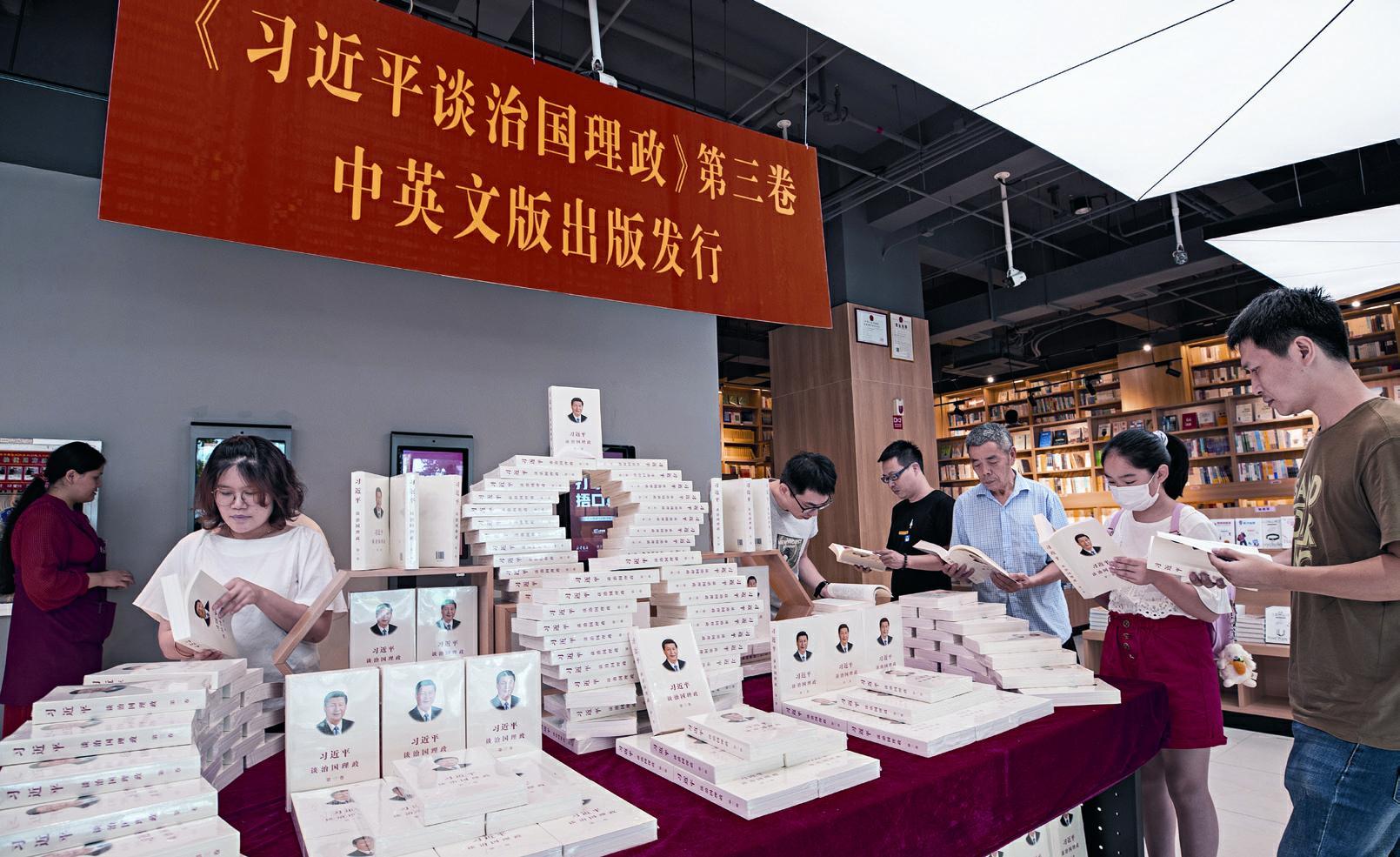

THE third volume of Xi Jinping: The Governance of China, published on June 30, contains a compilation of 92 of General Secretary Xi Jinpings spoken and written works including reports, addresses, talks, speeches, written instructions, and letters from October 18, 2017 to January 13, 2020. It vividly records the governance practices of the Communist Party of China (CPC) Central Committee with Comrade Xi Jinping at the core since the 19th CPC National Congress. It highlights the latest achievements in adapting Marxism to the Chinese context, embodies the increasingly mature governance of China, and the far-reaching impact of the world view of building a community with a shared future for mankind, and is an authoritative work that comprehensively and systematically reflects Xi Jinping Thought on Socialism with Chinese Characteristics for a New Era.
Adapting Marxism to the Chinese Context
As General Secretary Xi Jinping put it, “Marxism, the first ideology for the liberation of the people themselves, is a theory of the people. Marxism, though wideranging and profound, can be summed up in a sentence– an unremitting struggle for human liberation.” Unsatisfied with the easy life his parents had provided for him, young Marx, with great aspirations that “only when people work for the perfection of their contemporaries and their happiness can they achieve perfection,” set out on a revolutionary path and “betrayed” his familys class and worked for the benefit of the masses. Marx encountered hardships from an errant life and suffered poverty and illness, but he never managed to scrape a living in capitalist society. If Marx wanted anything in return for his suffering, he made this expectation clear in the afterword to the second German edition of Das Kapital, Volume I: “That Das Kapital rapidly gained popularity in wide circles of the German working class is the best reward for my work.” Throughout his life, Marx devoted himself to persistently striving for the liberation of humanity.
Marxism is and will continue to be the guiding theory for the CPC and China. It is the formidable theoretical tool which we use to understand the world, grasp its underlying patterns, pursue truth, and transform the world. Integrated with the practical issues in Chinas reform and opening-up as well as socialist modernization, Chinas Marxism has taken shape.
“The development of Marxism has long been closely linked with the core issues of the peoples revolution, construction, and reformative practices in the course of adapting Marxism to the Chinese conditions,” said Wang Weiguang, former president of the Chinese Academy of Social Sciences and professor at the University of Chinese Academy of Social Sciences. During the period of the New Democratic Revolution, our Party correctly analyzed the overall contradiction of the semicolonial and semi-feudal Chinese society, and won the New Democratic Revolution. After the founding of the Peoples Republic of China, especially after the establishment of the basic system of socialism in China, the eighth CPC National Congress clearly pointed out, “The contradiction between the peoples demand for the establishment of an advanced industrialized country and the situation of a backward agricultural country has risen to become Chinas principal contradiction, and the major contradiction in our country has already come between the peoples need for rapid economic and cultural development and the inability of our present economy and culture to meet that need.”
After the Third Plenary Session of the 11th CPC Central Committee, the Party systematically analyzed Chinas principal contradiction in the primary stage of socialism, further refined the expression put forward at the eighth CPC National Congress, and proposed, “The principal contradiction facing Chinese society is between the ever-growing material and cultural needs of the people and the backwardness of social production.”As socialism with Chinese characteristics has entered a new era, the principal contradiction facing Chinese society has evolved. What we now face is the contradiction between unbalanced and inadequate development and the peoples ever-growing needs for a better life.”
Following a people-centered development philosophy, the CPC focuses on the most immediate, most realistic issues that concern people the most, which guarantees and improves peoples livelihoods and also promotes social fairness and justice. In recent years, China has made steady progress in ensuring peoples access to childcare, education, employment, medical services, elderly care, housing, and social assistance at a higher level, so that the gains of development can benefit all its people. Over the past four decades, great strides have been made in Chinas economic and social development. According to current UN standards, more than 700 million Chinese people have been lifted out of poverty, accounting for more than 70 percent of the global total over the same period. The Chinese govern- ment has decided to lift all rural residents living below the current poverty line out of poverty by the end of 2020. This “Chinese miracle” in the history of human poverty reduction is the best illustration of the Chinese Communists passion for the people.
Reform and Opening-up as a Driving Force
Behind the economic miracle is the CPCs continuous efforts to modernize Chinas system and capacity for governance.
Since the 18th National Congress of the CPC, with a view to complete the building of a moderately prosperous society in all respects, accelerate socialist modernization and achieve the great rejuvenation of the Chinese nation, the CPC has made forward-looking plans for the future with a strong sense of historical mission and emphasis on strengthening awareness of problems, and has implemented the five-sphere integrated plan and the four-pronged comprehensive strategy in a coordinated way. The CPC Central Committee with Comrade Xi Jinping at its core has set forth a new vision that features innovative, coordinated, green, open, and shared development as a way to address development problems, overcome development difficulties, and strengthen development advantages.
As the second largest economy in the world, China has the worlds largest middle-income population, and contributes to more than a third of total global economic growth each year, becoming an important engine of world economic growth. At present, Chinas economy is transitioning from a phase of rapid growth to a stage of high-quality development. The report of 19th CPC National Congress put forward that, building on continued efforts to sustain development, China must devote great energy to addressing development imbalances and inadequacies, and push hard to improve the quality and effect of development. With this, China will be better placed to meet the ever-growing economic, political, cultural, social, and ecological needs of its people, and to promote well-rounded human development and all-round social progress.
Reform and opening-up are the source of vitality for the development and progress of contemporary China. General Secretary Xi Jinping has stressed that “to develop a market economy under socialism is a great pioneering undertaking.” The system of socialist market economy has surpassed both the traditional planned economy and the capitalist market economy. It is not the simple combination of socialism and market economy, but the reconstruction of mechanisms and systems. That is why Chinas socialist market economy system has produced a remarkable success story in practice.
General Secretary Xi Jinping has repeatedly stressed,“It makes clear that the defining feature of socialism with Chinese characteristics is the leadership of the Communist Party of China; the greatest strength of the system of socialism with Chinese characteristics is the leadership of the Communist Party of China.” As stated by Professor Zhou Wen of the Marxism Research Institute of Fudan University, “Acting on the principle of encouraging initiative from all sectors with concentrated efforts for big and key projects, the Party, as the core of leadership, commands the overall situation and mobilizes all parties to work in the same direction, manifesting effective organization and mobilization ability, as well as long-term planning, overall coordination, decision-making, and execution capabilities.”
Looking back on the past 40 years of reform and opening-up, the Chinese path of development has brought about numerous noteworthy achievements in the large infrastructure projects such as high-speed rail, highway networks, the West–East Gas Pipeline Project, the South-to-North Water Diversion Project, promotion of renewable energy, and the development of digital technologies. China has also made remarkable breakthroughs in major scientific and technological achievements, such as the manned deep-sea submersible Jiaolong, the space station program Tiangong, the five-hundred-meter wide aperture spherical telescope Eye of Heaven, dark matter particle explorer satellite Wukong, the worlds first quantum communications satellite Micius, large passenger aircraft, and 5G. The political leadership and state power of Chinas ruling party have played a very important role throughout the process.
Since 2020, China has demonstrated the institutional advantages of socialism with Chinese characteristics in the fight against COVID-19. Under the unified leadership of the CPC Central Committee, the Party organizations at all levels have been actively implementing epidemic prevention and control, adhering to the nonprofit principle of medical and health services, and pooling the spirit and will of the entire nation.
Whole-Process Democracy
General Secretary Xi Jinping has pointed out,“Whether the people enjoy democratic rights will not only depend on whether they have the right to vote during elections, but also on whether they have the right to participate continuously in the day-to-day political life. It depends on whether the people have the right to hold democratic elections, and also on whether the people have the right to make democratic decisions, conduct democratic management, and exercise democratic supervision.” Socialist democracy needs both complete institutional procedures and participatory practices. Both require that democracy be embodied in the whole process from the election to the decision-making, management, and supervision in terms of institutions and operations, so as to realize a complete chain of democracy and prevent the problems that importance is attached only to the election process but not to the process of democratic decision-making, management, and supervision.
The CPC attaches great importance to the protection of the peoples right to democratic election. It clearly requires that the proportion of deputies from the general public be ensured in the election of new members of Party committees, the peoples congresses, governments and the Chinese Peoples Political Consultative Conference (CPPCC) at all levels, and that Party and government officials and business leaders do not usurp the seats that should be allocated to average citizens.
While paying attention to democratic elections, the CPC has paid greater attention to safeguarding the peoples rights to democratic decision-making, management, and supervision. Many measures have been taken to promote democratic decision-making. For example, governments at all levels must report to the peoples congress at the corresponding level before making major decisions, and expand channels for citizens to participate in legislation in an orderly way through discussions, hearings, assessments, and the publication of draft laws. Party committees at all levels incorporate CPPCC political consultation as an important part of their decision-making process. In order to promote democratic management, China has not only improved the democratic management system of rural village committees, but also improved the institution of democratic management in enterprises, public institutions, government organs, and social organizations, so as to fully arouse the enthusiasm of the public for democratic management. To promote democratic supervision, power must be exercised in an open, transparent, and standardized manner. China now strives to make open Party affairs, government affairs, and the judiciary affaris so that the people can supervise them closely and conveniently.
These rights have also been fully guaranteed in the building of grassroots democracy. For example, by improving the democratic management system of enterprises and public institutions, which is primarily in the form of workers congresses, the rights of workers to know, participate, express, and supervise are more effectively implemented, and the rights of workers to make democratic decisions, manage, and supervise are effectively protected. The all-round development of all aspects of democracy ensures the implementation of wholeprocess democracy through system building.
“The most important part of building peoples democracy is upholding and improving the system of the peoples congress and promoting the extensive, multi-tiered, and institutionalized development of consultative democracy. Electoral democracy and consultative democracy are two important forms of socialist democracy with Chinese characteristics: The people exercise their right to vote in elections; people from all sectors of society undertake extensive deliberations before major decisions are made. Electoral democracy and consultative democracy do not replace or negate each other, but complement each other. The perfect combination of the two constitutes the institutional features and strengths of Chinas socialist democracy,” said Xin Xiangyang, deputy director of the Institute of Marxism at the Chinese Academy of Social Sciences.
The peoples congress system is Chinas fundamental political system and capacity for governance. China upholds that all state power belongs to the people, upholds the principal status of the people, and supports and ensures that the people exercise state power through peoples congresses. Peoples congresses at various levels are constituted through democratic elections. They are responsible to the people and subject to their supervision. The administrative, judicial, and procuratorial organs of the state at all levels are elected by the peoples congresses and are responsible and subject to supervision by the peoples congresses. Deputies to peoples congresses at all levels must faithfully represent the interests and will of the people and exercise state power in accordance with the law. State organs at all levels and their functionaries perform their duties and serve the people.
Consultative democracy is a model and strength unique to Chinas socialist democracy. The essence of the peoples democracy is that the people get to discuss their own affairs. We should continue to have more consultation; the more in-depth discussions we have, the better; and we should insist on consultation before and during the implementation of decisions to find the broadest common ground of the whole society.
As General Secretary Xi Jinping said, “The best way to evaluate whether a countrys political system is democratic and efficient is to observe whether the succession of its leading body is orderly and in line with the law, whether all people can manage state affairs and social, economic, and cultural affairs in conformity with legal provisions, whether the public can express their requirements without hindrance, whether all sectors can efficiently participate in the countrys political affairs, whether national decisions can be made in a rational, democratic way, whether professionals in all fields can be part of the team of the national leadership and administrative systems through fair competition, whether the ruling party can serve as the leader in state affairs in accordance with the Constitution and laws, and whether the exercise of power can be kept under effective restraint and supervision.”
Building a Peaceful and Better World
General Secretary Xi Jinping pointed out, “All countries, big or small, strong or weak, rich or poor, must treat each other as equals. We need to help each other achieve sound development as we work to ensure our own development. The world will be a better place only when everyone is better off.” Chinas development poses no threat to others and Chinas rejuvenation will only expand the convergence of interests with other countries. Through the Belt and Road Initiative, China has brought much-needed capital, know-how, development achievements, and poverty-alleviation experience gained in its modernization drive to other developing and less developed countries.
When some Western countries claim that a strong nation is bound to seek hegemony, the rise of major countries inevitably engender plunder and war, and powerhouse equals “great power” and “hegemony;”Chinese civilization, with thousands of years of history, proposed the building of a community with a shared future for mankind with strong cohesion, continuity, inclusiveness, and openness. No matter what stage of development it reaches, China will never seek hegemony or engage in expansion, which demonstrates Chinas strength and commitment as a major country in the face of global uncertainty.
In the report to the 19th CPC National Congress, General Secretary Xi Jinping called on people of all countries to work together to build a community with a shared future for mankind. He said we should stick together through thick and thin, promote trade and investment liberalization and facilitation, and make economic globalization more open, inclusive, and balanced so that its benefits are shared by all. We should respect the diversity of civilizations. In handling relations among civilizations, we should replace estrangement with exchange, clashes with mutual learning, and superiority with coexistence. Not only has China made a huge contribution to the world through its own development, but it has also made its due contribution to the common progress of human society with the world in mind.