Sri Lanka Poised for an Economic Takeoff via BRI
2020-08-06 14:20:04BystaffreporterZHANGHUI
CHINA TODAY 2020年8期
By staff reporter ZHANG HUI
“The Pathfinder Foundation is currently in the process of translating into Sinhala and publishing the book titled Prevention and Control of COVID-19 by Dr. Zhang Wenhong, one of the most respected medical professionals in China. This book should be a hand-book for all Sri Lankans, especially students at all levels,” said Luxman Siriwardena, president of the Sri Lanka-based Pathfinder Foundation, at the first conference of the China-Sri Lanka Political Parties Belt and Road Consultation Mechanism on June 11, 2020. He indicated, “The health procedures recommended by the book are beneficial for more than just coping with COVID-19, but are also essential in sustaining a healthy Sri Lankan society.”
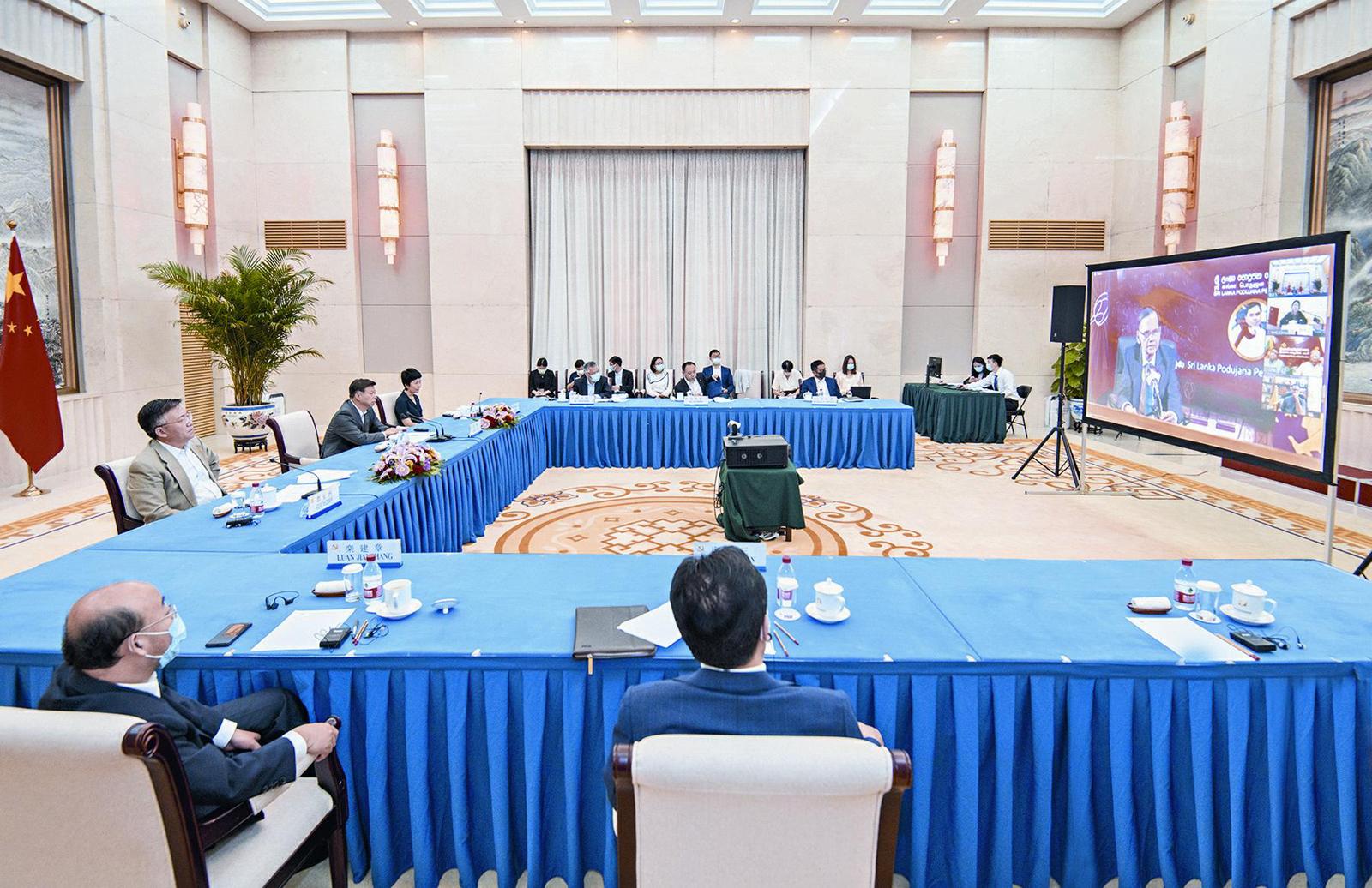
The conference via video link was themed “Working Together to Promote Economic Development and Improve Peoples Lives Through Belt and Road Cooperation.” Song Tao, minister of the International Department of the Central Committee of the Communist Party of China (CPC), and leaders of Sri Lankas major political parties, as well as those from think tanks and the business community of the two countries attended the virtual meeting.
Noting the recent telephone conversation between Chinese President Xi Jinping and Sri Lankan President Gotabaya Rajapaksa, Song Tao noted that the two leaders had reached an important consensus on the joint fight against COVID-19 and advancing joint construction of the Belt and Road. He indicated that the CPC intends to implement the important consensus reached by the two state leaders together with political parties of Sri Lanka, strengthen exchanges on governance, promote bilateral cooperation in fields across the board, and contribute to the high-quality construction of the Belt and Road. The conference passed the China-Sri Lanka Political Parties Joint Statement in Support of High-Quality Belt and Road Cooperation.
As COVID-19 still rages on across the globe, the Belt and Road Initiative(BRI) is becoming a bridge and platform for countries along the routes to connect with each other and communicate about measures of fighting the novel coronavirus and rebooting their economies. In fact, the BRI projects are also becoming engines that drive global economic growth. During the first quarter of 2020, bucking the trend, Chinas investment to countries along the Belt and Road increased by 11.7 percent, and its trade with countries along the routes rose by 3.2 percent, buttressing these countries in battling COVID-19 and recovering their economies.
A Silk Road of Health
At the meeting, director of the International Cooperation Department of National Health Commission of China Zhang Yang briefed attendees on Chinas major experiences in COVID-19 prevention and control. Zhang noted that China and Sri Lanka could carry out cooperation in such fields as epidemic prevention and control, public health system building, and personnel training in light of the goals on public health set by the UN 2030 Agenda for Sustainable Development. Zhang indicated that China welcomes Sri Lankas participation in the Belt and Road cooperation network for public health and the relevant cooperation platforms such as the federation of cooperative hospitals and the association for medical personnel training.
According to Liang Yi, the CEO of Huawei Sri Lanka, during the epidemic outbreak, Huawei contributed cuttingedge ICT solutions to Sri Lanka, including telehealth collaboration solutions and AI quantification platforms. This helped improve the work efficiency of frontline medical experts while minimizing their risk of contacting the virus.
Dr. G. Weerasinghe, director of the International Department of the Communist Party of Sri Lanka, said that despite the encouraging progress some countries have made in containing the novel coronavirus, including China and Sri Lanka, a vaccine will still be the key in totally removing the threat of COVID-19. “In this regards, we sincerely appreciate the statement made by Comrade Xi Jinping at the virtual opening session of the 73rd World Health Assembly, about ensuring availability and accessibility of vaccines against COVID-19 in developing countries when they are available in China, which will be made a global public good,” Dr. G. Weerasinghe said. In addition, he thought Chinas commitment to provide US $2 billion over two years to help with the COVID-19 response as well as economic and social development in affected countries, especially developing countries, is of paramount importance to the developing world. This fully embodies the concept that China champions of jointly building a community with a shared future for mankind.
Chairman of Sri Lanka Podujana Peramuna (also known as Sri Lanka Peoples Front) G. L. Peiris said that exchanges on epidemic prevention and control, economic recovery, and BRI cooperation are important for the related countries to emerge from the threat of COVID-19. “Its important to learn from each others experience. Although we cant copy a countrys model given different domestic circumstances, we can learn about the core value that has guided a countrys successful practices. The value can be shared and adopted,”Peiris pointed out.
The Dream of Digitalization
Many Sri Lankan attendees at the conference indicated their expectation for more cooperation with China in the digitalization field. “Digitalization will play a key role in Sri Lankas economic development. All sectors of our society are looking forward to the transformation brought about by digitalization,”Peiris said.
Peiris considers Sri Lankas human resources as the countrys real strength. However, statistical data show that the country has an exceptionally low rate of tertiary education admission, for its level of economic development with its gross enrollment ratio for higher learning institutions only reaching close to 20 percent in 2015. Many have identified this as a roadblock to the improvement of Sri Lankas economic competitiveness.
“Information technology is creating new platforms for people to receive education. I think in this regard, we should learn more from China and adapt its experience to the circumstances in our country,” said Peiris. He lauded Chinas amazing progress in developing vocational education and promoting longdistance learning via Internet, TV, and radio. “Only as more and more people get the chance to receive professional training and improve their capacity, can our economic development continue to gather momentum,” Peiris pointed out.
According to Liang Yi, Huawei Sri Lanka has been focusing on the cultivation of local ICT talents by introducing initiatives like Seeds for the Future, jointly building innovation labs in top local universities, and providing ICT training to its local partners. “Telecommunication technology plays a crucial role in sharpening a countrys competitive edge. We hope we can contribute our part to Sri Lanka in this field,” Liang said. According to a research jointly carried out by Oxford Economics and Huawei in 2017, the digital economy growth rate is 2.5 times that of the overall GDP; the long-term return due to ICT investment is 6.7 times the return on non-ICT investment.
According to statistics of the Telecommunications Regulatory Commission of Sri Lanka, there are over 14.5 million people unable to access the Internet, representing about 60 percent of Sri Lanka population. “We have been working hard to fill the gap in Sri Lanka through innovation,” Liang said. Over the past two decades, Huawei has participated in the countrys telecommunication network building partnering with Sri Lankans telecom operators. In 2013, Huawei helped Sri Lanka to become the first country in South Asia to commercially launch 4G. In 2019, supported by Huawei, Sri Lanka became the first nation to have a live demonstration of 5G technology in the region.
Promising Cooperation Prospects
As one of the first countries that publicly showed their support of the China-proposed BRI, Sri Lanka is now seeing the tangible benefits brought by the BRI projects. “In spite of the antiChina, anti-BRI campaigns based on fake news and falsification of facts, it is now well demonstrated that the BRI related projects in Sri Lanka are bringing in progress and prosperity to the people of Sri Lanka,” Luxman Siriwardena said.
According to Qu Fengjie, a researcher with National Development and Reform Commission of China, Puttalam Coalfired Power Plant contracted by China Machinery Engineering Corporation, which started operating in 2015, now provides 50 percent of the needed electricity in the country, thus removing the bottleneck to Sri Lankas economic development, and enabling the countrys electricity price drop by 25 percent. Another representative BRI project in Sri Lanka is the Colombo Port City Project, which is expected to create about 83,000 jobs for locals after its completion.
At the conference, Sri Lankan attendees all showed their anticipation for more investment from China in fields across the board including education, health care, finance, telecommunication, and infrastructure.
The problem of capital shortage for infrastructure investment in countries along the Belt and Road is quite common and striking, and Sri Lanka is no exception, Qu Fengjie pointed out.“China alone cant meet all the capital needs. As a result, countries concerned in advancing the joint construction of the Belt and Road are exploring new mechanisms for financing and investment,” Qu said. Apart from establishing Silk Road Fund and seeking cooperation with international financial institutions, bilateral and multilateral funds are being tried to support the BRI projects, according to Qu.
“Previously we emphasized more alignment in strategies, planning, and project implementation among related countries. In the future, well pay more attention to docking of their rules, including those in the financial fields,” Qu remarked.
“The Belt and Road Initiative rooted in the ancient Silk Road spirit of mutual trust, equality, and inclusiveness is bearing bountiful fruits in the modern circumstances. I would like to be a particular champion of the contributions that China has made to the development of infrastructure in our country, which is transforming the economic landscape of Sri Lanka,”said Peiris at the conference.
General Secretary of the Communist Party of Sri Lanka D.E.W. Gunasekara pointed out that in a multi-polar world, the only way out is international cooperation. “We are happy to see that the Chinese government has opted for cooperation over confrontation. In this context, the BRI, which embraces nearly 150 countries, provides the best viable platform for international cooperation. Its cooperation projects have convincingly proved its potentiality and viability,” said Gunasekara. He believes that the initiative fits in well for the postCOVID-19 economic revival, social stability, and global governance.