
苦苣苔科植物Lysionotusbijantiae的名實訂正
2020-12-14 03:59:42蔡磊BORAHDipankar刀志靈溫放
廣西植物 2020年10期
蔡磊 BORAHDipankar 刀志靈 溫放
摘 要:? ?通過查閱相關文獻和標本,作者發現近期發表的苦苣苔科吊石苣苔屬植物一新種——Lysionotus bijantiae D. Borah & A. Joe實為鑒定錯誤,應是漢克苣苔屬的長圓葉漢克苣苔\[Henckelia oblongifolia (Roxb.) D. J. Middleton & Mich. MOller\] \[原長圓葉唇柱苣苔Chirita oblongifolia (Roxb.) Sinclair\]。Lysionotus bijantiae的模式標本采集于中國西藏東南部地區的喜馬拉雅南坡,該地區苦苣苔植物多樣性較為豐富。作者因其花具2枚發育雄蕊而將其歸于吊石苣苔屬,花萼分裂不達基部而與吊石苣苔屬其他相關種類比較,而忽略了其種子先端不具附屬物的特征。通過電鏡掃描觀察到,該種在墨脫境內居群以及其模式產地居群的種子均無附屬物,從而證實了該種不是吊石苣苔屬的物種,而是屬于漢克苣苔屬。因此,作者將Lysionotus bijantiae處理為Henckelia oblongifolia的新異名,同時提供了長圓葉漢克苣苔的彩色圖片(含種子掃描圖)、選定模式標本,并給出了吊石苣苔屬和漢克苣苔屬的區分方法和主要識別特征,不僅為這兩個屬的物種鑒定提供了參考,而且避免更多的物種分類混淆問題出現。
關鍵詞:? 苦苣苔科, 吊石苣苔屬, 漢克苣苔屬, 新異名
1 Introduction
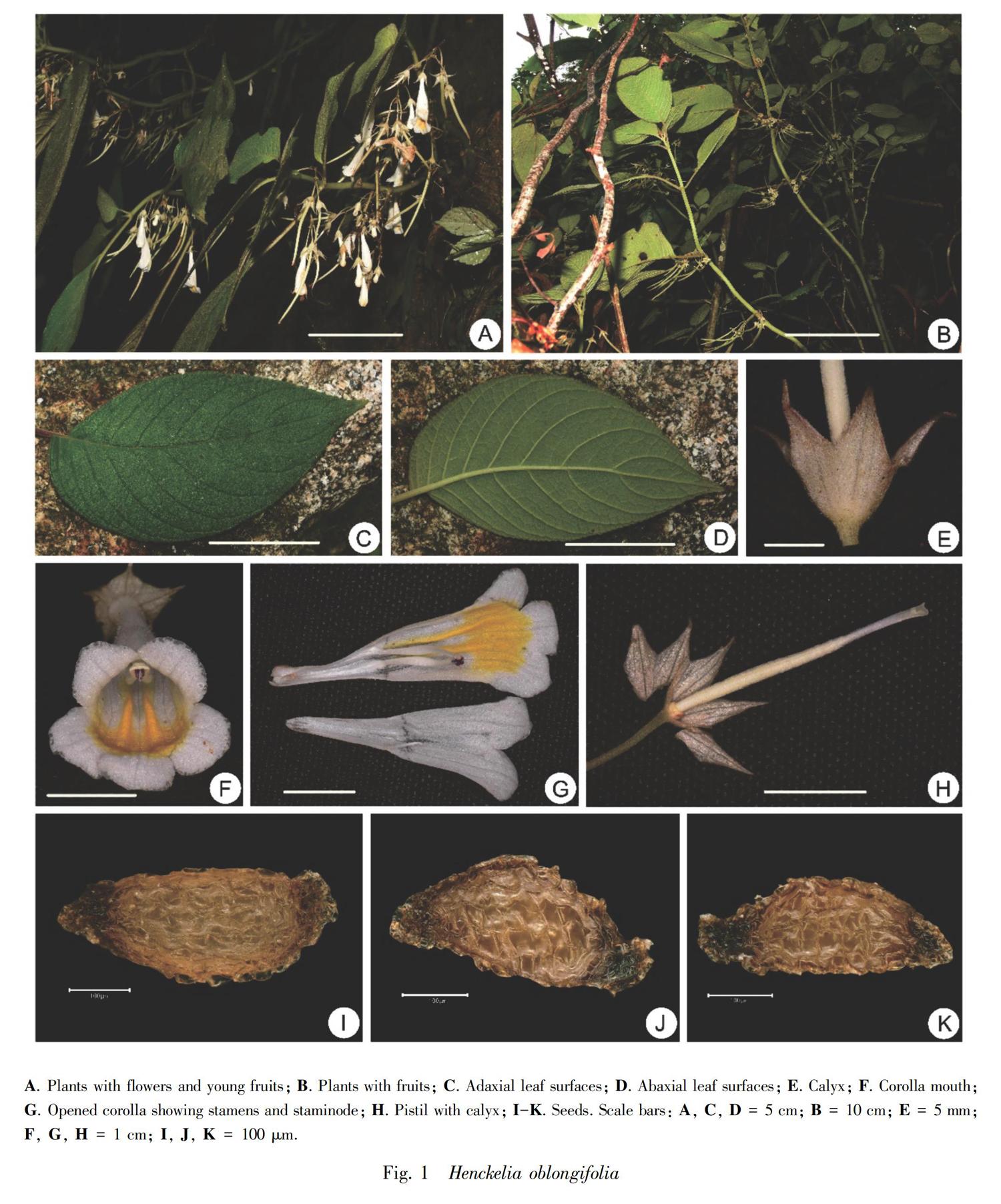
Recently, a new Gesneriaceae species, Lysionotus bijantiae D. Borah & A. Joe from the southern slopes of the Himalayas was described, and only based on morphological characters (Borah & Joe, 2018). The authors pointed out that the new species differed from Lysionotus gamosepalus W. T. Wang in having erect sub-shrub habit, pubescent stem/leaves/peduncles/petioles, lanceolate and villous bracts, hairy calyx, cream corolla, curved filaments, connective not prolonged into an appendage, and cream and pubescent pistil. The description and the color plates are clear. The characters listed in the description make this plant a good new species of Lysionotus D. Don, but that is not the case after other key features are examined more carefully. For example, the authors described as “seeds numerous with hair-like appendages on each end”, but did not provide images of seeds for this species in the paper. However, seeds from the mature capsules respectively collected from the type locality in 2020 and Motuo County, Xizang Autonomous Region, China in 2017 both have no appendages at either end of the seeds, which indicates the new species does not belong to the genus Lysionotus. In addition, there are three staminodes, and not two as reported in the original description, with a middle staminode significantly smaller than the others on the sides, therefore extremely easy to neglect. The species is also mistakenly identified as Henckelia anachoreta (Hance) D. J. Middleton & Mich. MOller in the taxonomic account from Northeast India, although the color plate clearly showed its morphological character (Sinha & Datta, 2016). These characters mentioned above are not in accordance with the new species of Lysionotus but well identical with Henckelia oblongifolia (Roxb.) D. J. Middleton & Mich. MOller (Wang et al., 1990, 1998; Weber et al., 2011) (Fig. 1).
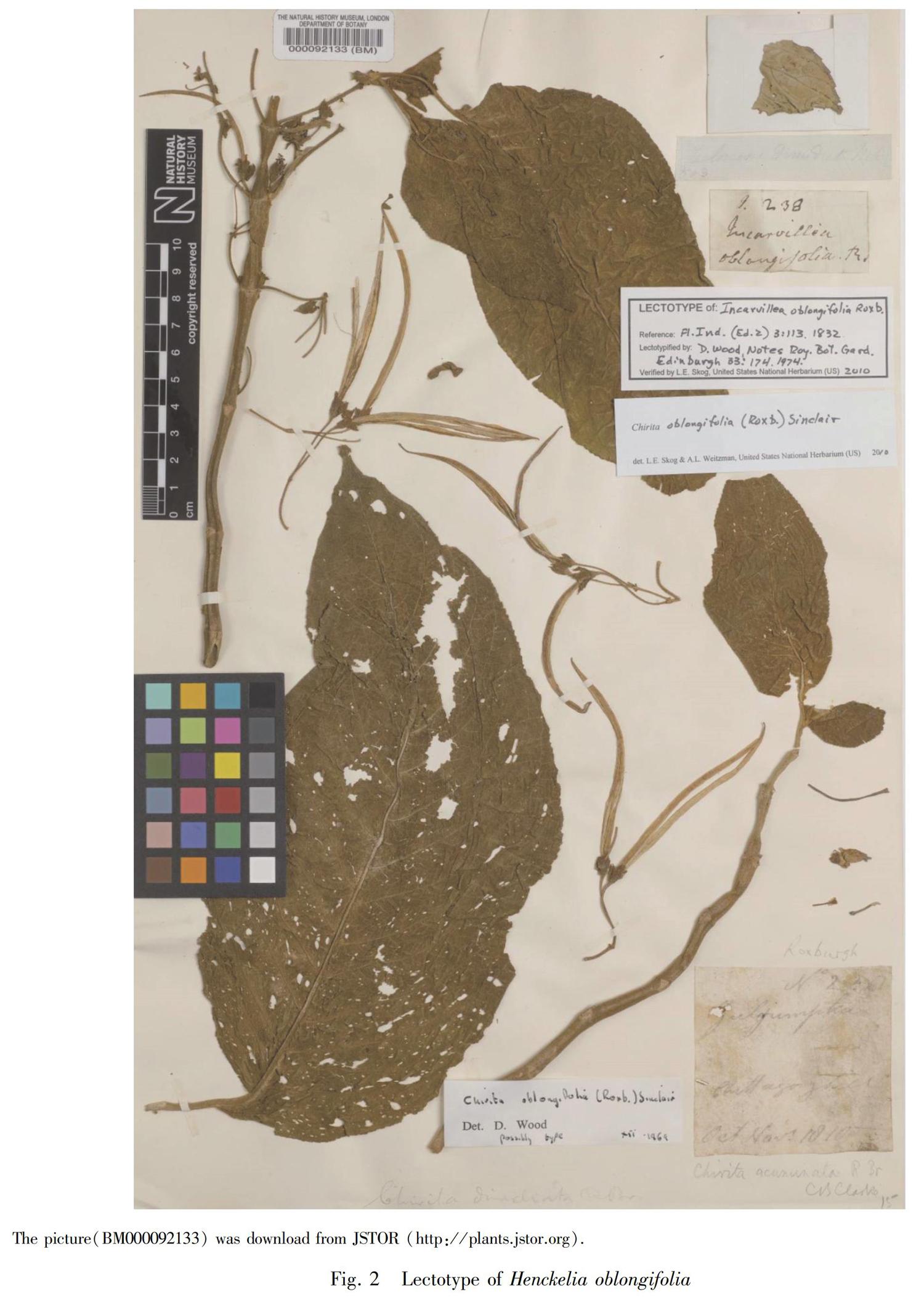
The genus Henckelia Spreng. now consists of more than 60 species mainly distributed in South, Southeast Asia and adjacent areas after the remodeling and summary (Weber et al., 2011; Ranasinghe et al., 2016). Thirty-three species are known to occur in India (Janeeha & Nampy, 2015; MOller et al., 2017; Borah et al., 2019) and 26 species in China (MOller et al., 2016; Xu et al., 2017; Cai et al., 2019; Wen et al., 2019; Yang et al., 2019). A comparison of relevant images (Fig.1), specimens (Fig.2) and literature/monographs/local floras confirms that Lysionotus bijantiae is conspecific with Henckelia oblongifolia.
2 Taxonomic treatment
Henckelia oblongifolia? (Roxb.) D. J. Middleton & Mich. MOller, Taxon. 60: 776. 2011. Chirita oblongifolia (Roxb.) J.Sinclair, in Bull. Bot. Soc. Bengal. 9: 102. 1957; Chirita oblongifolia (Roxb.) B. L.Burtt, in Notes. Roy. Bot. Gard. Edinb. 22: 307. 1958, comb. superfl; Wood, 1. c. 33 (1): 174. 1974; Wang, in Bull. Bot. Res. 5(3): 70. 1985. Incarvillea oblongifolia Roxb. Fl. Ind. ed., 2, 3: 113. 1832. Chirita acuminata Wall. ex R.Br., in Cyrtandreae: 117. 1839, nom. nud.; Chirita acuminata Steud., in Nomencl. Bot., ed. 2, 1: 351. 1840, nom. nud.
Lysionotus bijantiae? D.Borah & A.Joe, Taiwania 63(3): 232, 2018,? syn. nov.? “ Type: INDIA.? Arunachal Pradesh. Lower Subansiri District, Potin, 27°33′88.75″ N, 93°79′79.64″ E, 22 Oct. 2017, Dipankar Borah 121989 (holotype CALI; isotypes CALI, ARUN)”.
The type information was cited from the paper (Borah & Joe, 2018), the initial longitude in the coordinates obviously inaccurate because of the emergence of 79′, and the coordinates should be revised to “27°20′13.03″ N, 93°47′24.51″ E” after the confirmation. The original record showed that the type specimen was collected from India. However, when the revised coordinates (“27°20′13.03″ N, 93°47′24.51″ E”) were marked on the online database of the map (Map World, 2020), the site was located in Cuona County, Xizang Autonomous Region, China. Therefore, we dispute the type locality information in the initial description. Here, we just focus on solving the scientific problem and treat Lysionotus bijantiae as a new synonym of Henckelia oblongifolia.
Lectotype: BANGLADESH.? Chittagong, October 1810, Roxburgh 238 (BM!). (Lectotypified by Wood in Notes. Roy. Bot. Gard. Edinb. 33: 174. 1974).
Phenology:? Flowering from August to October; fruiting from September to December.
Distribution:? Bangladesh, Bhutan, China (Xizang and Yunnan), Northeast India and North Myanmar.
Specimens examined: CHINA.? Xizang: Motuo County, Bangxin, Lanlong-Yajiang, 1 100 m, 28 December 1982, B. Li S.? & S. Z. Cheng 02324 (PE); Beibeng, 750 m, 17 August 1974, Qingzangdui 4307 (KUN); Beibeng, Xigong Lake, 1 500 m, 10 March 1983, B.S. Li & S. Z. Cheng 02900 (PE); Beibeng-Motuo, 960 m, 4 August 1974, Qingzangdui 1550 (PE); Damu-103k, 1 400 m, 29 October 1982, B.S. Li & S. Z. Cheng 01560 (PE); East of Dexing Bridge, 870 m, 8 February 1983, B.S. Li & S. Z. Cheng 03554 (PE); Miri-Motuo, 750 m, 5 September 1974, Qingzangdui 5055 (KUN); Motuo-Dexing Bridge, 736 m, 9 October 2017, L. Cai & Z. L. Dao CL009 (KUN); Xianaba-Damu,1 900 m, 26 October 1982, B.S. Li & S.Z. Cheng 01364 (PE); Ximeng River, 900 m, 22 August 1980, W. L. Chen 14459 (PE); Yarang River, 900 m, 10 September, W.L. Chen 15047 (PE). Yunnan: Gongshan County, Dulong River, Dadieshui, 1 300 m, 18 December 1990, Dulongjiangkaochadui 1173 (KUN); Gongshan County, Dulong River, Qinlangdang, 1 300 m, 10 March 1991, Dulongjiangkaochadui 4464 (KUN); Kiukiang Valley, South Kongpong, 1 200 m, 26 September 1938, T.T. Yu 20458 (PE, E).? BANGLADESH . East Bengal, April 1863, Herbarium of the late East India Company 3829 (P); Kelaciili, 8 December 1944, J. Sinclair 3853 (E); Pundua, F. De
Silva 802 (K).? BHUTAN.? Near Zimgang, shongar Chu nr Mongar, 1 475 m, 15 June 1979, A.J.C. Grierson & D.G. Long 1964 (E).? INDIA.? Assam, Dehho, 700 ft. (ca. 213 m), 29 March 1895, 11044 (P); Assam, Haflong, 2 500 m, August 1908, William G Craib 192 (E); Assam, Master (P); Niwoa to Wawa, 1 441 m, 2 September 1958, G. Panigrahi 15046 (E); 5 000 ft. (ca. 1 524 m), 1 September 1892, Dr King (E, P); Pynursla, 25 November 1956, G. Panigrahi 4633 (E); Pynursla, Khasi, Hills, 4 000 ft. (ca. 1 219 m), 23 August 1949, T.R. Chand 2059 (E); Lower Subansiri District, Potin, 1 Nov. 2017, D. Borah 121990 (CALI); Lower Subansiri District, Potin, 21 Jan. 2020, D. Borah 5067 (HAU 2029).? MYANMAR.? Kachin State: Ndum-Zup to Hpuginhku, 6 000-6 500 ft. (ca. 1 830-1 980 m), 30 December 1961, J. Keenan, U Tun Aung & Tha Hla 3092 (E); Namnca to Nammuca, 1 000 ft. (ca. 305 m), 1910, J.H. Lace 5187 (E); Sorrounds of Hpuginhku 5 000 ft. (ca. 1 524 m), February 1962, J. Keenan, U Tun Aung & Tha Hla 3691 (E); Upper Burma: Nwai Valley, 9 September 1914, F. Kingdon-Ward 1931 (E); Upper Chinawin: Kodan Channg near Yeson Camp, 800 ft. (ca. 244 m), 26 November 1917, C. Gilbert Rongers 1023 (E); Valley of the Nam Tamai, 3 September 1937, F. Kingdon-Ward 13122 (E).? Country of origin:? not specified: P03884206 (P); P03884207 (P); P03884209 (P); P03884210 (P); P03884213 (P); P038842134 (P).
3 Notes
In the traditional classification of Chinese Gesneriaceae, the genus Lysionotus was deposited into Trib. Trichosporeae Fritsch, Subfam. Cyrtandroideae Burnett, based on the understanding that seeds of all species of Lysionotus have appendages at each end of
the spindly seed. In Henckelia, there are no appendages on the apexes of the seed (Wang et al., 1990, 1998; Li & Wang, 2005). The scanned seed morphology of this species shows that it should not belong to Lysionotus because it lacks appendages at each end of the seed. The species, Lysionotus bijantiae, cannot be distinguished from other many collected specimens of Henckelia oblongifolia from Bangladesh, Bhutan, China, India and Myanmar, which are stored in BM, CALI, HAU, KUN, PE, E and P.
Lysionotus was once divided into three sections, Sect. Didymocarpoides W. T. Wang, Sect. Lysionotus and Sect. Cyathjocalyx W. T. Wang (Wang, 1983). The vast majority of Lysionotus species share a special character: leaves usually many, along stem, whorled by three ones. Although the description of three species in Sect. Didymocarpoides [Lysionotus longipedunculatus (W. T. Wang) W. T. Wang, L. oblongifolius W. T. Wang and L. denticulosus W. T. Wang)]show their leaves are opposite, but their leaves are usually whorled after carefully observation for specimens and living plants in the field (Li & Wang, 2005). There are a few species, L. wilsonii Rehd., L. sulphureus Hand.-Mazz., L. kwangsiensis W. T. Wang in Sect. Lysionotus and only one species, L. chingii Chun ex W. T. Wang, in Sect. Cyathjocalyx having opposite leaves (Wang, 1975a, b). Furthermore, the key characters to distinguish Sect. Didymocarpoides from other two sections are as below: erect subshrub, no phellem on stem, chartaceous leaf blades, smaller flowers, calyx 5-sect from base, shorter subulate appendages (0.1-0.25 mm long) on the apexes of the seed. So, although Lysionotus bijantiae looks like a member of Sect. Didymocarpoides in appearance, it is entirely different from Lysionotus because of the lack of appendages at each end of the seed.
Acknowledgements? We are grateful to Mr. Lianyi Li for scanning the seeds of this species, and we thank Momang Taram and Rubu Rinyo for their help in the field. Sincere thanks are given to Michael MOller, the Royal Botanic Garden Edinburgh, Stephen Maciejewski, the Gesneriad Society and Michael Lo-Furno, Temple University for their assistance on species identification, editing and providing valuable suggestions.
References:
BO RAH D, JOE A, 2018. A new species of Lysionotus (Gesneriaceae) from Notheastern India [J]. Taiwania, 63(3): 232-234.
BORAH D, TARAM M, JOE A, et al., 2019. Henckelia collegii-sancti-thomasii: A new species of Henckelia (Gesneriaceae) from northeastern India? [J]. Phytotaxa, 415(4): 247-251.
CAI L, LIU DT, ZHANG P, et al., 2019. Two new species of Henckelia (Gesneriaceae) from southeastern Yunnan, China? [J]. PhytoKeys, 130: 151-160.
JANEEHA AP, NAMPY S, 2015. Henckelia brateata, a new species of Gesneriaceae from S Western Ghats, India and lectotypification of Didymocarpus humboldtianus (H. humboldtiana)? [J]. Willdenowia, 45(1): 53-59.
LI ZY, WANG YZ, 2005. Plants of Gesneriaceae in China [M]. Zhengzhou: Henan Science and Technology Publishing House: 1-721.? [李振宇, 王印政, 2005. 中國苦苣苔科植物 [M]. 鄭州: 河南科學技術出版社: 1-721.]
MAP WORLD, 2020. National Platform for Common Geospatial Information Services (China) [DB/OL]. http://www.tianditu.gov.cn.? [天地圖,? 2020. 國家地理信息公共服務平臺 [DB/OL]. http://www.tianditu.gov.cn]
MOLLER M, NAMPY S, JANEESHA AP, et al., 2017. The Gesneriaceae of India: Consequences of updated generic concepts and new family classification? [J]. Rheedea, 27(1): 23-41.
MOLLER M, WEI YG, WEN F, et al., 2016. You win some you lose some: Updated generic delineations and classification of Gesneriaceae—implications for the family in China [J]. Guihaia, 36(1): 44-60.? [MOLLER M, 韋毅剛, 溫放, 等, 2016. 得與失: 苦苣苔科新的屬級界定與分類系統——中國該科植物之變遷? [J]. 廣西植物, 36(1): 44-60.]
RANASINGHE S, MILNE R, JAYASEKARA R, et al., 2016. Henckelia wijesundarae, a new endemic species from Sri Lanka, and lectotypification of Chirita walkerae and C. walkerae var. parviflora? [J]. Willdenowia, 46(2): 213-224.
SINHA BK, DATTA S, 2016. Taxonomic account on the family Gesneriaceae in Northeast India? [J]. Nelumbo, 58:1-43.
WANG WT, 1975a. Notulae de Gesneriaceis Sinensibus [J]. Acta Phytotax Sin, 13(2): 62-70.? [王文采, 1975. 中國苦苣苔科的研究 [J]. 植物分類學報, 13(2): 62-70.]
WANG WT, 1975b. Notulae de Gesneriaceis Sinensibus (Continued)? [J]. Acta Phytotax Sin, 13(3): 97-105.? [王文采, 1975. 中國苦苣苔科植物的研究(續)? [J]. 植物分類學報, 13(3): 97-105.]
WANG WT, 1983.Revisio Lysionoti Sinici (Gesneriaceae)? [J]. Guihaia, 3(4): 249-284.? [王文采, 1983. 中國吊石苣苔屬校訂 [J]. 廣西植物, 3(4): 249-284.]
WANG WT, PAN KY, LI ZY, 1990. Gesneriaceae? [M]// WANG WT. Flora Reipublicae Popularis Sinicae. Beijing: Science Press, 69: 398.? [王文采, 潘開玉, 李振宇, 1990. 苦苣苔科 [M]// 王文采. 中國植物志. 北京: 科學出版社, 69: 398.]
WANG WT, PAN KY, LI ZY, 1998. Gesneriaceae? [M]//WU ZY, RAVEN PH. Flora of China. Beijing: Science Press; St. Louis: Missouri Botanical Garden Press, 18: 342.
WEBER A, MIDDLETON DJ, FORREST A, et al., 2011. Molecular systematics and remodeling of Chirita and associated genera (Gesneriaceae)? [J]. Taxon, 60(3): 767-790.
WEN F, LI S, XIN ZB, et al., 2019. The updated plant list of Gesneriaceae in China under the new Chinese naming rules? [J]. Guangxi Sci, 26(1): 37-63.? [溫放, 黎舒, 辛子兵, 等, 2019. 新中文命名規則下的最新中國苦苣苔科植物名錄 [J]. 廣西科學, 26(1): 37-63.]
XU WB, GUO J, PAN B, et al., 2017. Diversity and distribution of Gesneriaceae in China [J]. Guihaia, 37(10): 1219-1226.? [許為斌, 郭婧, 盤波, 等, 2017. 中國苦苣苔科植物的多樣性與地理分布 [J]. 廣西植物, 37(10): 1219-1226.]
YANG B, DING HB, FU KC, et al., 2019. Four new species of Gesneriaceae from Yunnan, Southwest China? [J]. PhytoKeys, 130: 183-203.
( 責任編輯 周翠鳴 )
