
三模Tucker積張量秩的一些性質(zhì)
2021-01-04 08:05:32張雙韓樂(lè)
高師理科學(xué)刊 2020年11期
張雙,韓樂(lè)
三模Tucker積張量秩的一些性質(zhì)
張雙,韓樂(lè)
(華南理工大學(xué) 數(shù)學(xué)學(xué)院,廣東 廣州 510640)
張量Tubal秩的定義不止一種,但本質(zhì)上是用離散傅立葉變換矩陣對(duì)原始張量做三模Tucker積得到一個(gè)復(fù)張量,這個(gè)復(fù)張量所有前片秩的最大值就是張量Tubal秩.借助三模Tucker積從代數(shù)角度研究三階張量Tubal秩的計(jì)算,并給出原始張量與變換后的復(fù)張量之間CP秩、Tucker秩的關(guān)系.
Tucker積;Tubal秩;CP秩;Tucker秩
1 引言及預(yù)備知識(shí)
在計(jì)算機(jī)視覺(jué)和信號(hào)處理領(lǐng)域,有大量的多模態(tài)數(shù)據(jù)需要被分析和處理.作為向量和矩陣的高階推廣,張量可以更便利地對(duì)多模態(tài)數(shù)據(jù)進(jìn)行數(shù)學(xué)建模和分析.張量學(xué)習(xí)、張量?jī)?yōu)化受到越來(lái)越多國(guó)內(nèi)外學(xué)者的關(guān)注,在計(jì)算機(jī)視覺(jué)、機(jī)器學(xué)習(xí)、信號(hào)處理和模式識(shí)別等領(lǐng)域得到廣泛的應(yīng)用[1-4].
張量的主要應(yīng)用之一是張量低秩恢復(fù),它離不開(kāi)張量秩的定義.為了避免矩陣展開(kāi)破壞張量數(shù)據(jù)的內(nèi)在結(jié)構(gòu),Kilmer[5]等對(duì)三階張量沿著第三維做離散傅立葉變換,提出了張量奇異值分解(t-SVD),并衍生出了一些新的張量秩[6-7].對(duì)于一個(gè)原始的三階張量,沿張量的第三維做離散傅立葉變換可以得到一個(gè)同樣大小的復(fù)張量,這個(gè)復(fù)張量所有前片的秩形成的向量是原始張量的Multi秩,所有前片秩的最大值稱為原始張量的Tubal秩.自然地,可以用傅立葉域上每個(gè)前片的核范數(shù)近似它的秩,文獻(xiàn)[8-9]相應(yīng)地給出了一種張量Tubal秩的凸代理,一經(jīng)提出就受到機(jī)器學(xué)習(xí)領(lǐng)域研究學(xué)者的關(guān)注,在張量完全、子空間聚類和張量低秩稀疏分解等方面取得了一些研究成果[10-14].
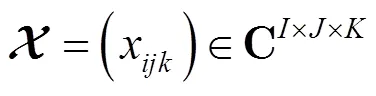
然而,對(duì)于張量Tubal秩的直接計(jì)算的研究,目前基本處于空白狀態(tài).本文從代數(shù)的角度研究了三階張量Tubal秩的計(jì)算,利用三模Tucker積與張量第三維上離散傅立葉變換的關(guān)系,刻畫了一些計(jì)算張量Tubal秩的條件,在這些條件下,不需要對(duì)原始張量第三維做離散傅立葉變換就可以確定三階張量的Tubal秩.另外,還討論了離散傅里葉變換前后張量的Tucker秩和CP秩的關(guān)系.雖然對(duì)于多個(gè)前片的三階張量未能給出理論分析,但對(duì)公開(kāi)數(shù)據(jù)集waterSurface和hall進(jìn)行了測(cè)試,從數(shù)值上驗(yàn)證了多個(gè)前片的三階張量有類似于2個(gè)前片的三階張量的性質(zhì).




2 主要結(jié)果及證明
3 數(shù)值模擬


表1 實(shí)驗(yàn)結(jié)果
4結(jié)語(yǔ)
本文利用張量第三維上離散傅立葉變換與張量三模Tucker積的關(guān)系,主要刻畫了一些張量Tubal秩計(jì)算的充分條件.在這些條件下,不需要對(duì)原始張量的第三維做離散傅立葉變換就可以確定三階張量的Tubal秩.對(duì)于多個(gè)前片的三階張量雖然未能給出理論分析,但對(duì)張量數(shù)據(jù)waterSurface和hall的數(shù)值測(cè)試顯示多個(gè)前片的三階張量也有類似于2個(gè)前片的三階張量的性質(zhì).
[1] Cichocki A,Mandic D,Lathauwer L,et al.Tensor decompositions for signal processing applications:from two-way to multiway component analysis[J].IEEE Signal Processing Magazine,2015,32(2):145-163
[2] Qi L,Chen Y,Bakshi M,et al.Triple Decomposition and Tensor Recovery of Third Order Tensors[J].a(chǎn)rXiv,2020:2002.02259
[3] Kamal M H,Heshmat B,Raskar R,et al.Tensor low-rank and sparse light field photography[J].Computer vision and image understanding,2016,145(4):172-181
[4] Liu Y,Long Z,Huang H,et al.Low CP rank and Tucker rank tensor completion for estimating missing components in image data[J].IEEE Transactions on Circuits and Systems for Video Technology,2020,30(4):944- 954
[5] Kilmer M E,Martin C D.Factorization strategies for third-order tensor[J].Linear Algebra and Its Applications,2011,435(3): 641-658
[6] Kilmer M E,Braman K,Hao N.Third order tensors as operators on matrices:a theoretical and computational framework with applications in imaging[J].SIAM Journal on Matrix Analysis & Applications,2013,34(1):148-172
[7] Lu C,F(xiàn)eng J,Chen Y,et al.Tensor Robust Principal Component Analysis:Exact Recovery of Corrupted Low-Rank Tensors via Convex Optimization[C]//IEEE International Conference on Computer Vision and Pattern Recognition,Las Vegas:IEEE,2016:249-257
[8] Zhang Z,Ely G,Aeron S,et al.Novel methods for multilinear data completion and de-noising based on tensor-SVD[C]// IEEE Conference on Computer Vision and Pattern Recognition,Columbus:IEEE,2014:42–49
[9] Hao N,Kilmer M E,Braman K,et al.Facial recognition using tensor-tensor decompositions[J].SIAM Journal of Imaging Sciences, 2013,6(1):437-463
[10] Lu C,F(xiàn)eng J,Chen Y,et al.Tensor Robust Principal Component Analysis with A New Tensor Nuclear Norm[J].IEEE Transactions on Pattern Analysis and Machine Intelligence,2020,42(4):925-938
[11] Zhang Z,Aeron S.Exact tensor completion using t-SVD[J].IEEE Transactions on Signal Processing,2017,65(6):1511-1526
[12] Xie Y,Tao D,Zhang W,et al.On unifying multi-view self-representations for clustering by tensor multi-rank minimization[J].International Journal of Computer Vision,2018,126:1157-1179
[13] Kolda T,Bader B.Tensor decompositions and applications[J].SIAM Review,2009,51(3):455-500
[14] Wang A,Song X,Wu X,et al.Robust low-tubal-rank tensor completion[C]//IEEE International Conference on Acoustics,Speech and Signal Processing,Brighton:IEEE,2019:32-36
[15] Jiang B,Yang F,Zhang S.Tensor and its tucker core:The invariance relationships[J].Numerical Linear Algebra with Applications,2017,24(3):1-13
Some properties of the tensor rank under 3-mode Tucker product
ZHANG Shuang,HAN Le
(School of Mathematics,South China University of Technology,Guangzhou 510640,China)
Although there are some definitions of the Tubal rank,in essence,the Tubal rank of tensor is the maximum of the ranks of the frontal slices of a complex tensor,that is obtained by the 3-mode Tucker product with the discrete Fourier Transformation.The calculation of the Tubal rank of the third-order tensors is researched from the algebraic perspective by means of the 3-mode Tucker product,and the relationships of CP rank and Tucker rank between the original tensor and the complex tensor was given.
Tucker product;Tubal rank;CP rank;Tucker rank
O151
A
10.3969/j.issn.1007-9831.2020.11.004
1007-9831(2020)11-0014-05
2020-06-27
教育部人文社科青年基金資助項(xiàng)目(17YJC630026);華南理工大學(xué)研究生全英文課程建設(shè)項(xiàng)目(Y2181421)
張雙(1995-),女,四川達(dá)州人,在讀碩士研究生,從事張量?jī)?yōu)化研究.E-mail:zhshuangs@163.com
