
The Collocational Behavior and Semantic Preference of Near-synonyms in Maritime English
——A Case Study on the Usage of“marine”vs.“maritime”in World Englishes via Linguistic Motion Chart
2021-01-11 03:08:32
Proceedings of Northeast Asia International Symposium on Linguistics,Literature and Teaching 2020年0期
Dalian Maritime University,Liaoning,China Email:jackmqn@dlmu.edu.cn;weihua.luo@dlmu.edu.cn
[Abstract]Based on GloWbE corpus,this study explores the collocational behavior and semantic preference of two near-synonyms —“marine”vs.“maritime”among 15 English varieties,and the results are visualized via linguistic motion chart.It is shown that overall speaking,“marine”mainly collocates with nouns that are related to the sea per se,such as“life”,“biology”,“environment”,whereas“maritime”is usually followed by nouns that are related to human activities,such as“museum”,“organization”,“security”.In addition,there are some slight differences in the semantic features of these two words’nominal collocates between L1 and L2 countries/regions.In those L2 varieties,greater attention is paid to maritime security and education,which displays their unswerving determination to safeguard their sovereignty and territorial integrity.
[Keywords]Maritime English;collocational behavior;semantic preference;linguistic motion chart;GloWbE corpus
Introduction
During the author’s 10-year teaching and research experience,the word choice between/among a set of nearsynonyms always proves to be a thorny issue.After consulting several thesauri or usage dictionaries,things may become even more complicated:some of the explanations are even contradictory to one another,and what seems to be perfectly explained etymologically may in fact run counter to its usage in present-day English due to semantic change.Besides,the usage of one and the same word may not necessarily be the same in different English varieties.All this necessitates a corpus-based study on a set of near-synonyms to explore their differences in present-day English.
When the author was recruited as a novice teacher at DMU,the then vice president made a brief introduction to the historical development of our university in his welcoming speech,and he mentioned in passing the motivation for the change of our school name from“Dalian Marine College”to“Dalian Maritime University”in the year 1994,which,according to him,reflects the changes in our school-running principles — from a technical school specializing in navigation and marine engineering only to a multi-disciplinary,world-renowned,research-teaching university.Layman to English linguistics though he is,his explanation on the long-term goal of our university may well be in line with the lexical differences betweenmarineandmaritime.Thus aroused the author’s curiosity on the differences between these two near-synonyms.
According to Smith’s(1871)authoritative synonym dictionary,both these two words are derived from Latin mare,meaning“belonging to the sea”,with only a slight difference in emphasis:marine(Latin:marinus)depicts the simplest aspect or natural state belonging to the sea,whereasmaritime(Latin:maritimus)means“belonging to the sea as it is employed by man,or in relation to the life of man”.However,since this dictionary was compiled almost 150 years ago,with only a few authentic example sentences from the real-world,whether it can truly reflect the semantic differences in present-day English is left to doubt.Moreover,it is well-known that maritime English is English for specific purposes(ESP),which means in order to ensure effective communication for seafarers all over the world,sometimes we have to lower the standard.Therefore,whether such semantic differences are also recognized by other non-native English speakers still remains to be further observed.On these bases,the present research aims to explore the differences betweenmarineandmaritimein 15 English varieties through their collocational behavior and semantic preference by means of GloWbE corpus data.
Theoretical Framework
Linguistically speaking,absolute synonyms are non-existent,in that it does not conform to“the principle of language economy”(Martinet,1962),and is against Bloomfield’s(1933)claim that each linguistic form has a constant and specific meaning(i.e.:“the principle of‘one form-one meaning’”).On this account,most scholars believe that there are only near-synonyms in language.In other words,if two words are roughly the same in denotation and can be used almost interchangeably,then they must differ in connotation at different levels,such as formality,style,implicature,register,to name just a few.DiMarco et al.(1993)summarizes 12 dimensions of connotational difference,such as formality,abstractness,semantic prosody,emphasis.In terms of semantic prosody,it is mainly collocational:the semantic features of a set of high-frequency collocates for the node word is exactly the latter’s semantic prosody.According to Partington(2004),this concept can be subdivided into three types:positive,negative,and neutral;or to put it another way:with a favorable,unfavorable or neutral prosody.Another closely related concept is semantic preference,which is defined as a lexical set of frequently occurring collocates sharing some semantic feature(Stubbs,2002).According to Sinclair(1996),semantic prosody is at a further stage of abstraction than semantic preference①It should be noted that this claim is not widely accepted.Some scholars prefer to take semantic prosody as a sub-category(or a special case)of semantic preference..The former dictates the general environment which constrains the preferential choices of the node word,whereas the latter contributes powerfully to building semantic prosody(Xiao&McEnery,2006).
Now in the era of“big data”,linguistic studies is gradually witnessing an empirical-quantitative turn,and many scholars are beginning to use large-scale corpus data to explore the semantic preference of near-synonyms.More precisely,by analyzing the semantic features of the high-frequency collocates for each node word,their differences can be disclosed.This idea can be dated back to the American structuralist Z.Harris’s(1954)“distributional semantics”,and J.R.Firth’s(1957)famous quote“You shall know a word by the company it keeps”.Meanwhile,Wittgenstein(1953)also has a similar claim:“Meaning is use”.Following the same vein,this research attempts to explore the semantic preference ofmarineandmaritimevia their collocational behavior,in order to disclose the semantic differences between these two words.
Corpus and Data Collection
The corpus used in this research is Global Web-based English Corpus(henceforce GloWbE).It was released in April 2013 by Mark Davies,professor of corpus linguistics at Brigham Young University(BYU),with 1.9 billion words of text in the year 2012-2013 from 20 countries and regions,six of which are from the“inner circle”(see Kachru et al.,1985),namely the United States,Great Britain,Australia,Ireland,Canada and New Zealand,the other 14 from the“outer circle”,including Hong Kong,India,Philippines and other countries where English are used as a second language.The texts in the corpus are retrieved from the URLs of over 1.8 million web pages in these 20 countries,and 40% come from fomal written texts,the other 60% informal blogs and other web-based English such as newspapers,magazines,company websites from Google general search(Cf.Davies & Fuchs,2015).Compared with another widely used corpus — the International Corpus of English(ICE),GloWbE is much larger in size,thus enabling the study of some low-frequency language phenomena.As with other online mega-corpora from
In order to explore the distributional features of the high-frequency nominal collocates of marine and maritime in World Englishes,the author used“compare”function in the online search interface,and restricted the collocates to singular nouns only(i.e.:lemmatized forms).The span was set to one word to the right(R1),with a threshold value of 5 hits in each sub-corpus.Due to the space limitation for visualization,only 15 English varieties were selected,and then the raw frequencies of R1 collocates of these two near-synonyms were registered respectively.Since the size of each sub-corpus is slightly different,the author used normalized frequency per million word instead,and the results for data retrieval were saved in an Excel worksheet.
Research Methodology
In order to display the semantic features of the high-frequency R1 nominal collocates ofmarineandmaritimein 15 English varieties,the author uses linguistic motion chart for data visualization.This technique was popularized by Hans Rosling in his 2006 TED talks on the social and economic development of some representative countries during the past 50 years with a series of animated bubble chart(Gesmann & De Castillo,2011).Later on,inspired by this TED talk,Hilpert(2011)was the first to apply this visualization tool to the study of historical linguistics,especially with bivariate corpus data.Hence,it was renamed“linguistic motion chart”.Due to the space limitation in journal articles,the dynamic changes of a certain linguistic phenomenon are usually visualized as a sequence of static scatterplots in parallel in a two-dimensional space with{plot}function in R programming.
Recently,this research method is widely adopted in the study of the collocational behavior of two near-synonyms,such as Primahadi-Wijaya-R&Rajeg’s(2014)study on the diachronic changes in the nominal collocational profile of two temperature adjectives in English,i.e.:hotvs.warm,Hilpert’s study on the collocational preference and the frequency distribution ofmayandmight[ This is an unpublished study.For further details,see Hilpert’s personal website:http://members.unine.ch/martin.hilpert/motion.html.],Pichler’s(2016)research on several pairs of near-synonyms in English in different word classes,such asawarevs.conscious,tryvs.attempt,ragevs.wrath.However,all these studies are from a diachronic perspective.In order to further extend the use of motion chart,this research is a synchronic one,exploring the semantic difference betweenmarineandmaritimein World Englishes operationalized by their R1 nominal collocates.In order to make the charts legible and comparable,only 15 out of 20 countries/regions are selected,with 5 ESL countries excluded either because the frequencies of R1 collocates for both these two words are too low or because the frequency of a certain collocate is too high to be observed in the graph.
Data Analysis and Discussion
As is shown in Figure 1 below,the collocational preferences of these two near-synonyms in 15 English varieties are displayed in a series of bubble charts.The x and y axes in each graph represent the normalized frequencies per million word of R1 nominal collocates ofmarineandmaritimerespectively in each English variety,and the bubble size represents the joint frequency of a certain collocate for both these two near-synonyms.In order to make the graph interpretable,some of the most important collocates are marked and highlighted in dark grey,with other less important ones downplayed in the background in light grey,unmarked.Overall,among all the 15 English varieties selected in this study,the most frequently used R1 nominal collocates withmarineincludelife,park,environment,area,biology,world,and those withmaritimetypically involvemuseum,security,safety,organization,industry,law.The number of collocates that display an equal frequency distribution with both these two node words is rather limited,with only several barely legible ones,if any,on the lower-left corner.Thus,it is safe to conclude thatmarineandmaritimehave quite a definite semantic division of labor.The former mainly concerns descriptions of the sea itself,be it on the surface or in the bottom,as is exemplified by collocations likemarine life,marine world;whereas the latter has a much broader coverage,involving various kinds of human activities related to the sea,as is shown in the typical collocations such asmaritime affairs,maritime law,maritime disputes,etc.This is roughly in accordance with Smith’s(1871)distinction aforementioned.
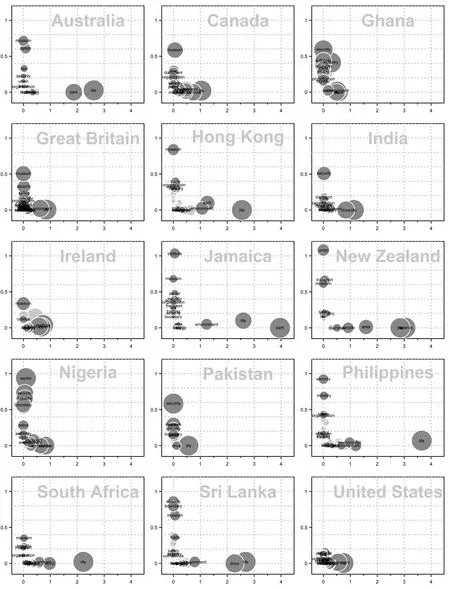
Figure 1 Frequency distribution of R1 collocates of marine and maritime in GloWbE in 15 varieties of English
After comparing the usage of these two near-synonyms across all the 15 English varieties,some slight differences are identified.In terms of the 6“inner circle”English varieties,American English does not show any semantic preference toward either of these two node words,and both of them are rarely used,since all the bubbles are squeezed in the lower-left corner of the graph; in British English,Ireland English,Australian English and Canadian English,the usage distribution is quite similar:marineusually collocates withlife,andmaritimewithmuseum;In New Zealand English,marine reserveandmaritime unionare the most frequently used collocations respectively.Besides,as far as organizations and educational institutions are concerned,almost all these six countries prefer to usemaritime,as is shown in the typical collocations such asmaritime college/university/academy,with the only exception of Ireland,wheremarine institutecan also be observed,though relatively low in frequency.For those“outer circle”countries such as Ghana,India,Sri Lanka,Philippines and Pakistan where English is used as an official language,the most typical collocate withmaritimeissecurity,andmaritime boundaryis alsocommonerthan those L1 countries.This shows that all these countries attach great importance to the security of their territorial seas,as well as the prevention of possible disputes across their national borders.In addition,the variety of nominal collocates in these L2 countries/regions is also wider than that in L1 countries,such asmaritime piracyin Ghanaian English andmaritime patrolin Nigerian English.This linguistic evidence indirectly displays their unswerving determination to safeguard their sovereignty and territorial integrity,with an attendant devotion to and investment in maritime education.
To take Jamaica as an example,as a country in the West Indies,it boasts unparalleled geographical advantages with an abundance of natural resources,which is reflected in the number and variety of nominal collocates with bothmarineandmaritime.Among all the collocates ofmaritime,the most frequently used ismaritime institute(see Figure 2 below),and its frequency in Jamaican English is far higher than that in the other 14 English varieties in the“outer circle”.Other highly frequent collocations includemaritime industry/authority/law/organization/training,which are all closely related to maritime affairs.This shows the government’s serious attention to the education of its seafarers.Apart from that,the nominal collocate that ranks second formaritime is museum,displaying the country’s great emphasis on the inheritance and promotion of sea-related culture.In terms of the collocates of marine,interestingly,unlike the other 14 English varieties,the one that ranks highest is notlife,butpark.After consulting some documentation,it is found that there is a large national park called“Montego Bay Marine Park”on Jamaica’s north coast,which was set up to preserve the natural environment in the area and to educate the surrounding community of the importance of the marine resource.Such a landmark is a further evidence of the country’s great devotion to its sea-related cultural construction.
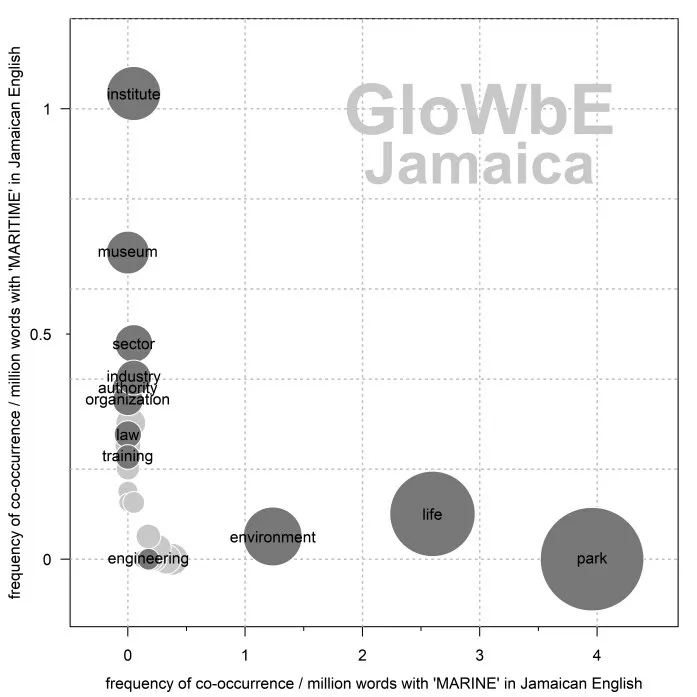
Figure 2 Frequency distribution of R1 collocates of marine and maritime in Jamaican English
Implications and Conclusion
This study explores the collocational behavior and semantic preference ofmarineandmaritimein 15 English varieties in GloWbE corpus.The results show thatmarinemainly collocates with nouns that are related to the seaper se,such aslife,biology,andenvironment,whereasmaritimeusually collocates with nouns that are related to human activities especially nouns related to organizations or institution.For those L2 countries,maritime securityis often put to the top priority,followed bymartime boundaryand other collocations involving sea-related affairs such asmaritime piracyandmaritime patrol.In Jamaican English,particularly,the most frequently used collocation ismaritime institute,which fully displays its emphasis on maritime education.
The visualization tool(i.e.:linguistic motion chart)adopted in this research is also applicable to the study of other near-synonyms in maritime English,such as“captainvs.shipmaster”,“sailorvs.navigator”,“navalvs.nautical”.In addition,this study also displays the importance of linguistic context(i.e.:collocations)in the teaching and research of near-synonyms.However,as a case study,it inevitably suffers from several drawbacks.First,given that the corpus data in GloWbE can only reflect the usage features in L1 or L2 countries and regions,whether such generalizations are still valid in other EFL countries remain to be further explored.Second,as a general corpus,GloWbE cannot fully represent the use ofmarineandmaritimeprecisely in maritime English.Third,apart from geographical reasons,other socio-cultural factors may also influence the collocational behavior and semantic preference of these two near-synonyms,such as gender,speaker age,educational background.Last but not least,some of the raw frequencies of nominal collocates are in low values,so that after normalization,their differences may be amplified in the motion chart.In further studies,if other corpora can be adopted as a cross-validation,then the results will be more persuasive.
Acknowledgments
The research work reported in this article was partially supported by“the Fundamental Research Funds for the Central Universities”(Grant No.3132020270).
 Proceedings of Northeast Asia International Symposium on Linguistics,Literature and Teaching2020年0期
- Proceedings of Northeast Asia International Symposium on Linguistics,Literature and Teaching的其它文章
- Exploration of the SPOC-based Blended Teaching Model:Case Study of Business English Course
- Reducing Students’Foreign Language Speaking Anxiety Through Drama Performance
- An Action Research on Blended Learning through News Broadcasts in EFL Listening Context
- Growth Mindset in Teaching
- A Study on Corpus Stylistics Assisted English and American Literature Teaching
- Promoting Architectural Values in Culturebound Scenery in Tourist Destinations