
Superconducting anisotropy and vortex pinning in CaKFe4As4 and KCa2Fe4As4F2?
2021-03-11 08:33:48Yu于奧博Huang黃喆Zhang張馳Wu吳宇峰Wang王騰Xie謝濤Liu劉暢Li李浩Peng彭煒Luo羅會(huì)仟Mu牟剛Xiao肖宏You尤立星andHu胡濤
Chinese Physics B 2021年2期
A B Yu(于奧博), Z Huang(黃喆), C Zhang(張馳), Y F Wu(吳宇峰), T Wang(王騰),T Xie(謝濤), C Liu(劉暢), H Li(李浩), W Peng(彭煒), H Q Luo(羅會(huì)仟),7,G Mu(牟剛), H Xiao(肖宏), L X You(尤立星), and T Hu(胡濤),?
1State Key Laboratory of Functional Materials for Informatics,Shanghai Institute of Microsystem and Information Technology,Chinese Academy of Sciences,Shanghai 200050,China
2Beijing Academy of Quantum Information Sciences,Beijing 100193,China
3Center for High Pressure Science and Technology Advanced Research,Beijing 100094,China
4CAS Center for Excellence in Superconducting Electronics(CENSE),Shanghai 200050,China
5University of Chinese Academy of Sciences,Beijing 100049,China
6Beijing National Laboratory for Condensed Matter Physics,Institute of Physics,Chinese Academy of Sciences,Beijing 100190,China
7Songshan Lake Materials Laboratory,Dongguan 523808,China
Keywords: iron based superconductors,vortex pinning,anisotropy
1. Introduction
Vortex pinning governing the critical current density(Jc)is crucial to the practical applications of superconducting materials. Jcis defined as the maximum electrical current density that sustains superconductivity without resistance,that is,increasing the current density beyond Jcwill lead to the depinning of the vortices and consequently to the disappearance of zero resistance. The study of vortex pinning and Jcenhancement is therefore carried out intensively.[1–4]In a real superconductor, vortex pinning is closely related to the defect structure in the material and the properties of the vortex matter.[1]Thus one can improve the value of Jcby the fabrication of superlattices,[5]irradiation,[6,7]and introduction of stacking faults.[8]In particular, for high temperature cuprate superconductors, the layered structure has a dramatic influence on properties of the vortex matter.[1,9]Pancake vortices arise in each CuO2layer of cuprates, the interaction between which is found to enhance the vortex pinning.[9,10]For a material with weak interlayer interaction, the superconductivity is highly anisotropic and the vortex line is highly flexible,which can be deformed easily. While in the strong interlayer interaction case, the superconductor has moderately anisotropic vortices.[9,10]Consequently, the interlayer interaction determines superconducting anisotropy and significantly affects the Jcin layered structure superconductors.[1,9]
The iron based superconductors(FeSCs)are a new class of high transition temperature(Tc)superconductors[11,12]with a generally smaller superconducting anisotropy than cuprates.This system attracts a lot of research interest because of its outstanding properties[13,14]like high Tc, large upper critical field, and high Jc. Similar to cuprates, FeSCs reveal a layered structure, with FeAs superconducting layers alternating with the insulating layers or other conducting layers, which leads to the different anisotropy among different systems.[15]For example,in the bilayer FeSC CaKFe4As4(Fe1144),FeAs layers are separated by Ca and K atoms along c axes,[16]which leads to a small anisotropy γ ≈3 near Tc.[17,18]Meanwhile, a high Jc,[19,20]combined with the high upper critical field[17]and the unconventional superconductivity,[19]is also observed in Fe1144. In contrast, in another newly discovered bilayer FeSC KCa2Fe4As4F2(Fe12442), the FeAs layers are alternately separated by conductive K and insulating CaF2layers,[21]which results in a relatively weaker interlayer interaction than that in Fe1144. The properties of 12442 family[22–25]are close to those of bilayer cuprates and it is a well connector between FeSCs and cuprates. Our previous work[26,27]showed that the γ of Fe12442 is ~15 near Tc,which is much larger than that of Fe1144. Such distinct superconducting anisotropies in these two bilayer systems provide an unique opportunity to understand the role of interlayer interaction in the vortex pinning of FeSCs.
2. Experiment
The single crystals of CaKFe4As4and KCa2Fe4As4F2are grown by using the self-flux method.[17,28,29]Sharp superconducting transition at Tcin resistance and magnetization measurements shows a high-quality of our single crystal samples.The angular(θ)dependent torque is measured at different temperatures and applied magnetic fields by using piezoresistive torque magnetometer in the Quantum Design physical property measurement system(PPMS).θ is the angle between the applied field and c axes of the single crystal. The temperature dependent 4-wire resistance measurements are performed by the resistance bridge options of PPMS with 0 T ≤H ≤9 T at a heating rate 1 K/min. The magnetic moment measurements are carried out by using magnetic property measurement systems (MPMS) with H =10 Oe applied along c axes of the single crystal. The transport data of Fe12442 in the paper are taken from our previous work.[26]
3. Results and discussion
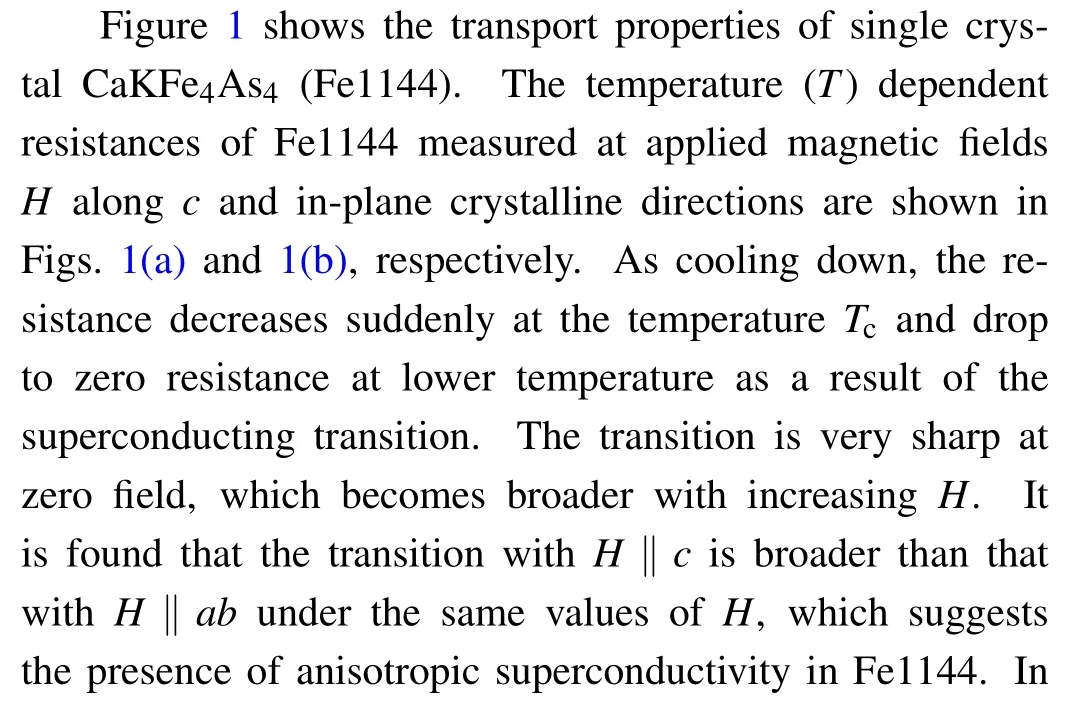
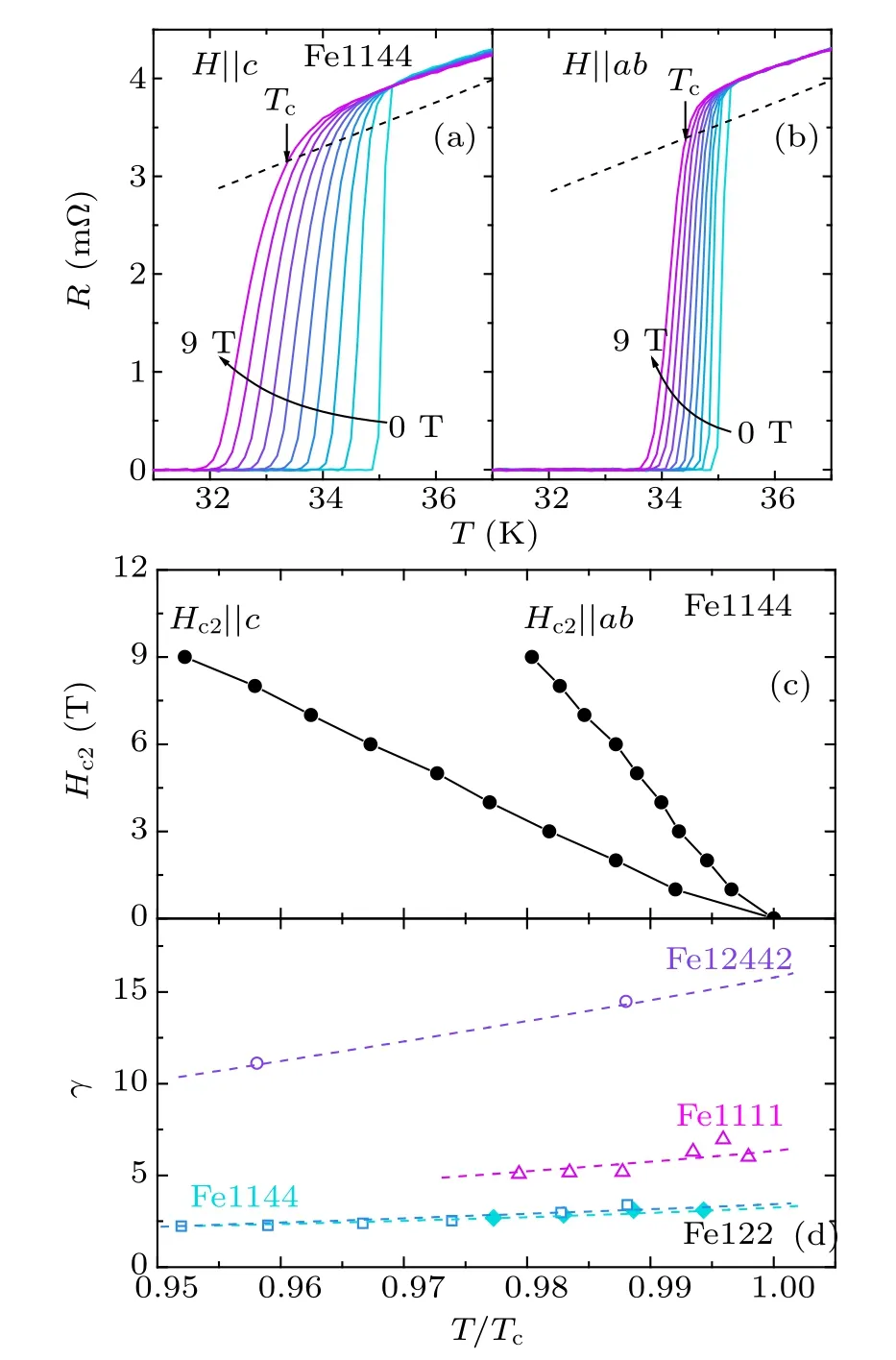
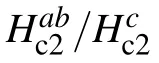
Fig.1. Temperature T dependence of resistance R of CaKFe4As4 at different applied magnetic fields H with H ‖ c (a) and H ‖ ab (b).(c) T dependent of upper critical field Hc2 for CaKFe4As4 at H ‖ c and H ‖ ab. (d) The upper critical field anisotropy parameter γ = of CaKFe4As4, KCa2Fe4As4F2,[26] Ba0.72K0.28Fe2As2,[15]and NdFeAsO0.82F0.18.[30] The dashed lines are guides to the eyes.
In order to investigate the correlation between superconducting anisotropy and vortex pinning,we study the thermally activated flux-flow (TAFF) behavior in FeSCs. Based on the TAFF model ρ(H,T)=ρ0exp(?U/kBT),one can acquire the thermal activation energy U from the slope of liner portion of Arrhenius plot ln(ρ/ρ0) versus T?1, where ρ0is a factor independent of the magnetic field and kBis the Boltzmann constant. Figures 2(a) and 2(b) show the resistance Arrhenius plots of Fe1144 and Fe12442 single crystals for magnetic field along c-axes of the samples with 1 T ≤H ≤9 T. The obtained thermal activation energy U at different magnetic fields is shown in Fig.2(c), along with that of Fe1111 and Fe122.[15,35]The relationship of γ and U for four single crystals is plotted in Fig.2(d). Error bars are given by mean deviation. Figure 2(d)shows that the average U in the investigated H range of these FeSCs samples is anti-correlated with their superconducting anisotropy γ. For Fe12442 and Fe1144, the anti-correlated relation is independent of samples as shown in Fig.A1.Interestingly,such an anti-correlated relationship was also observed at T =0 K in series BaFe2?xNixAs2,where the one that exhibits the maximum Jc[36]has the smallest γ.[37]In general,many factors,such as disorder landscape,defect,and other material parameters, have important influences on vortex pinning of superconductors. However, the revealed anticorrelated relationship between U and γ here suggests that the interlayer interaction can not be neglected in vortex pinning in FeSCs. In addition, it is worth noting that the anisotropy of Fe1144 is almost the same as that of Fe122 while the pinning energy of Fe1144 is slightly larger than that of Fe122 as shown in Fig.2(d).It may reflect that besides the interlayer interaction, the unique inherent defect structure of Fe1144 also significantly enhances the Jc.[20]

Fig.2. Arrhenius plots obtained from R vs. T under H ‖ c for CaKFe4As4 (a)and KCa2Fe4As4F2 (b). (c)The H dependence of thermal activation energy U for Fe1144 (our data), Fe12442 (our data),Fe122,[15] and Fe1111.[35] (d) The γ vs. U. Error bars are mean deviation and the dash lines are guides to the eyes.
Furthermore,compared with the transport measurements,magnetic torque is sensitive to the magnetic anisotropy of materials. By using torque measurements,one can obtain the superconductivity anisotropy γ and Jcsimultaneously. That is,the reversible part of magnetic torque reflects the equilibrium state and is determined by the thermodynamic parameters and their anisotropy,[38]while the irreversible part reflects the nonequilibrium state resulting from vortex pinning,whose amplitude is governed by the critical current density Jc.[39,40]
The torque of a sample with magnetic moment M in magnetic field H can be expressed as

For the anisotropic materials whose moment and field are noncollinear,the magnitude of torque is[31]
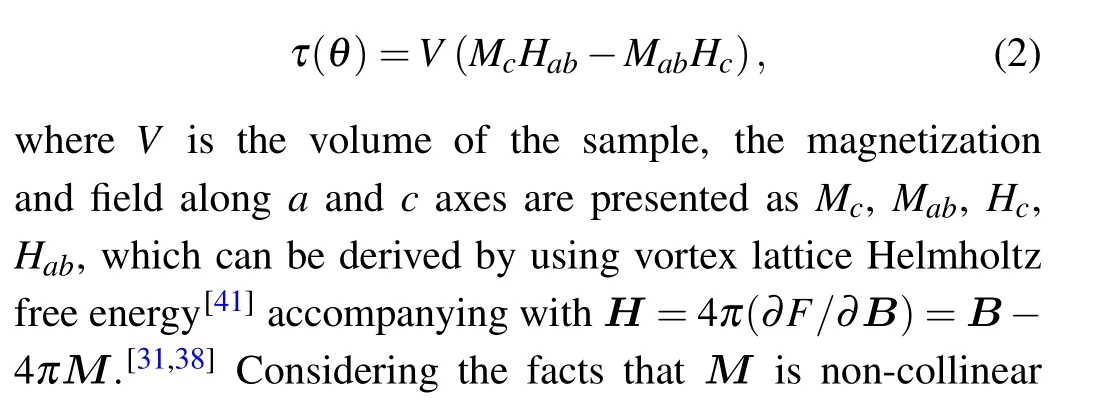
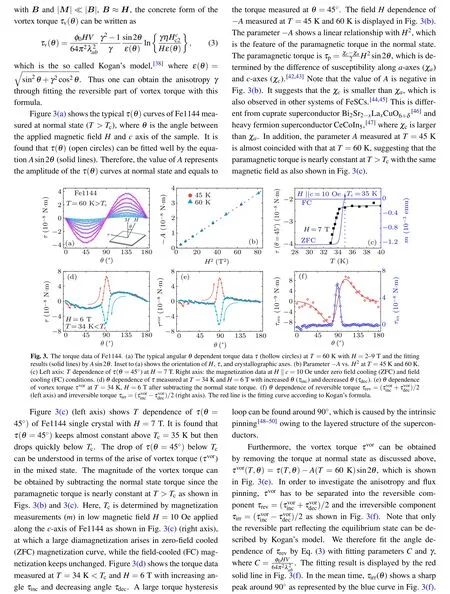
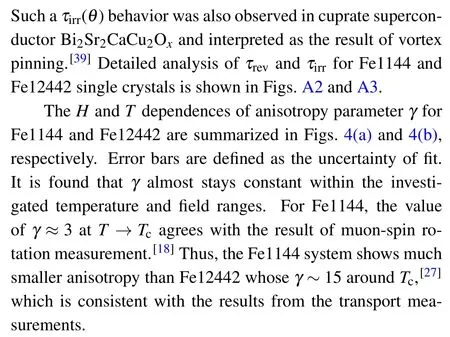
Fig.4. Anisotropy parameters γ of Fe1144 and Fe12442 obtained from torque measurements. (a) H dependence of γ at the reduced temperature T/Tc=0.97. (b)T dependence of γ for H=7 T.Error bars are the uncertainty of fit and the dash lines are guide to the eyes.
On the other hand, the irreversible part τirris related to Jc,[39,40]that is,

whereV is the volume of the single crystal and r is sample’s diameter(given that the sample has a cylinder shape,V =πr2d,d is the thickness of the single crystal). For two-dimensional(2D)superconductors,Abrikosov lattice is only related to the perpendicular component of the magnetic field (H cosθ).[51]Then the critical current density in 2D regime can be expressed as Jc(θ,H)=Jc(H cosθ).[39]Thus it is convenient to plot Jcvs. H cosθ. Figure 5(a)shows H cosθ dependence of Jcmeasured at temperature T/Tc= 0.97 under different fields. The solid squares are the Jcfrom the torque measurements while the solid stars from magnetization measurements in previous report.[20]And the hollow circles are data for Fe12442. It is found that the Jcs measured at different H do not scale with each other but show a decreasing tendency with the increase of H. It suggests that Fe1144 is not a 2D superconductor in consistent with the fact that γ ≈3. Jcmeasured at H =2 T is roughly comparable with the value from previous report,[20](the small deviation may be caused by differences of the measure method and sample’s shape),suggesting that the Jccalculated based on Eq.(4)is reasonable. Note that,Jcof Fe12442 is located at the bottom left corner of Fig.5(a), suggesting a much lower critical current density as compared with Fe1144.Similar results can be found in Fig.5(b),where Jcis measured at different reduced temperature(T/Tc)and H=7 T.The solid stars are data measured at T =33 K with T/Tc=0.938 from the previous magnetization measurements,[20]which are close to our data measured at the same T/Tc. It is also found that Jcin Fe1144 at the investigated ranges is much higher than that in Fe12442 (hollow circles) at lower reduced T/Tc. Therefore, vortex pinning in Fe1144 is much stronger than that in Fe12442. The high Jcin Fe1144 was interpreted in terms of the unique defect structure which leads to the advantageous vortex pinning properties.[20]While according to the discussion above,the interlayer interaction may also involve in vortex pinning in Fe1144 and Fe12442.
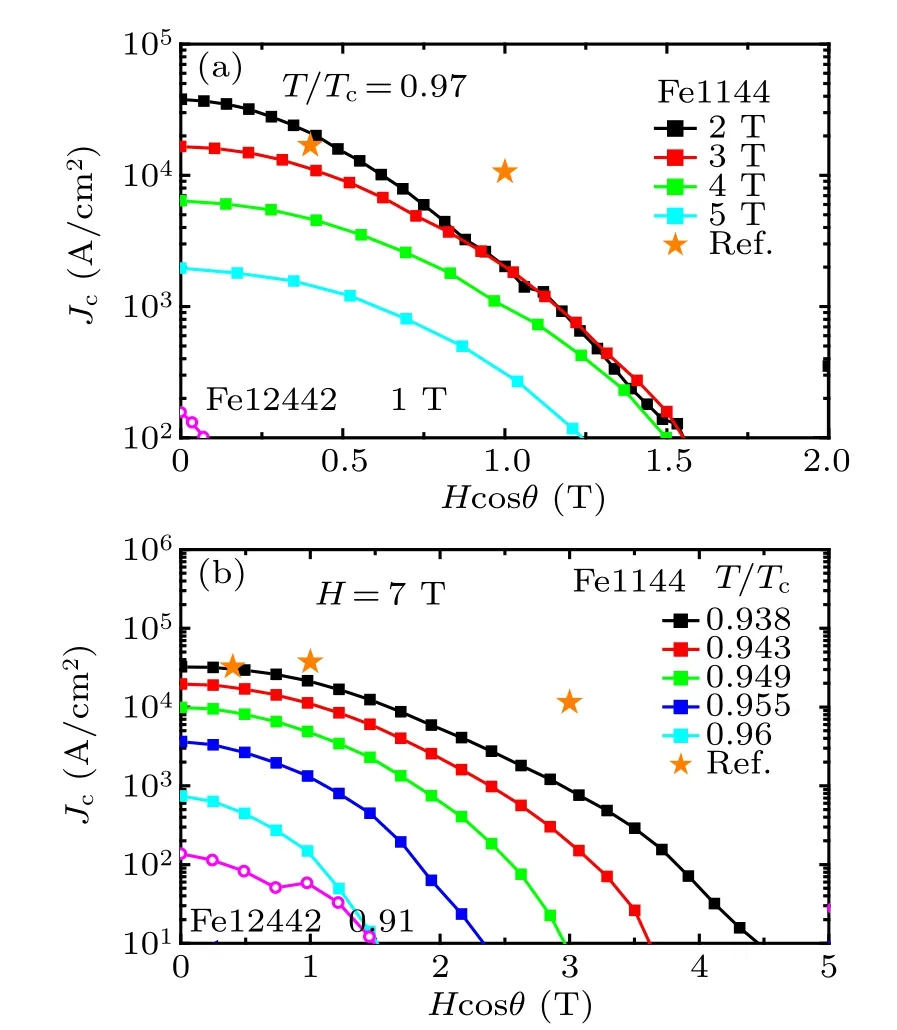
Fig.5. The critical current density Jc of Fe1144 (solid squares) and Fe12442 (hollow circles) as a function of H cosθ at T/Tc =0.97 (a)and H=7 T(b). Solid stars are data taken from Ref.[20].
4. Conclusion
In summary,we have presented a detailed electrical transport and angular dependent torque investigation on Fe1144 and Fe12442 single crystals. In the resistance measurements,the anisotropy parameter of upper critical field γ around Tcof Fe1144 is about 3, which is clearly smaller than that of Fe12442 (γ ≈15). By transforming resistance–temperature(R–T)curves to the Arrhenius plots, we find that Fe1144 has a larger activation energy than Fe12442. In combination with the literature data, we conclude that the FeSC with a smaller anisotropy exhibits a stronger vortex pinning. The magnetic torque measurements further confirm this result. At temperature T →Tc, γ ≈3 for Fe1144 and γ ≈15 for Fe12442 are obtained by fitting reversible torque using the Kogan’s model.Besides,the critical current density in Fe1144 is much higher than that in Fe12442 at the same reduced temperature and magnetic field. Our results suggest that the interlayer interaction may also take action on vortex pinning in FeSCs.
Appendix A
The obtained TAFF energies of two single crystals at different magnetic fields are summarized in Fig.A1. We find that TAFF energy U/kB(solid points)ranges from 22671 K to 5202 K for Fe1144,which is a little larger than the U/kBcalculated from previous report for Fe1144 (hollow points).[52]The value of U/kBfor Fe12442 single crystal(solid points)is ranging from 1661 K to 315 K,which is also a little larger than that of polycrystal(hollow points).[21]The difference of U between our results and literature most likely results from the different disorder landscape, defect, and quality of different samples,e.g.,our samples are single crystal while the sample in literature is polycrystal.
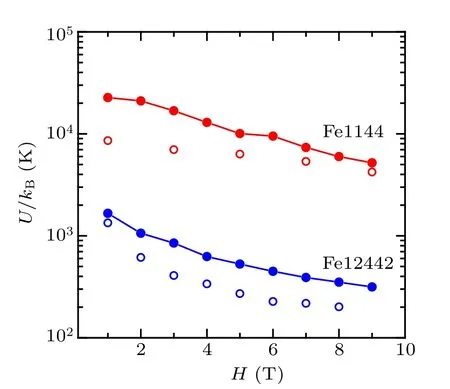
Fig.A1. The H dependence of activation energy U obtain from our data(solid points)and literature(hollow points). The blue and red hollows are the activation energy of Fe1144 single crystal[52]and Fe12442 polycrystal data,[21] respectively.
Nevertheless both of our data and literature show that the TAFF energy U in Fe1144 is much larger than that in Fe12442.Thus our results suggest that the interlayer interaction may play a crucial role in vortex pinning in Fe12442 and Fe1144.
Figures A2(a)–A2(d) show the τrev= (τinc+τdec)/2(empty circles)of Fe1144 and Fe12442,where the irreversible part has been masked, and the fitting results (solid lines)by Kogan’s model[38]at different temperatures and magnetic fields.
Figures A3(a) and A3(b) show the τirr=(τinc?τdec)/2 of Fe1144 and Fe12442 at different temperatures and magnetic fields. Sharp peaks are observed around 90?, which are caused by the vortex pinning as the case of cuprate superconductor Bi2Sr2CaCu2Ox.[39]Fe1144 shows a higher peak than Fe12442 at the same magnetic field and reduced T/Tc, suggesting that the vortex pinning in Fe1144 is stronger than that in Fe12442.
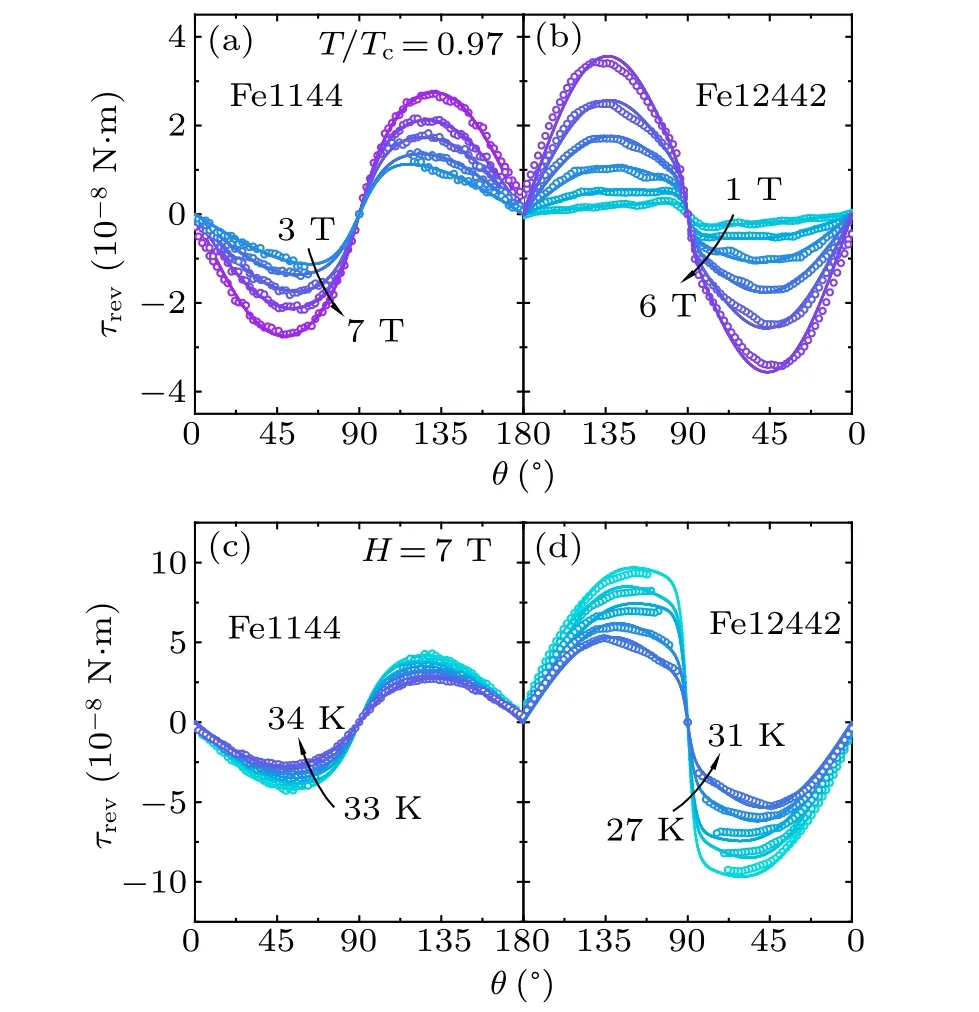
Fig.A2. The τrev (circles) and Kogan’s model fitting curves (lines) at different temperatures and magnetic fields of CaKFe4As4 [(a)and(c)]and KCa2Fe4As4F2 [(b)and(d)].
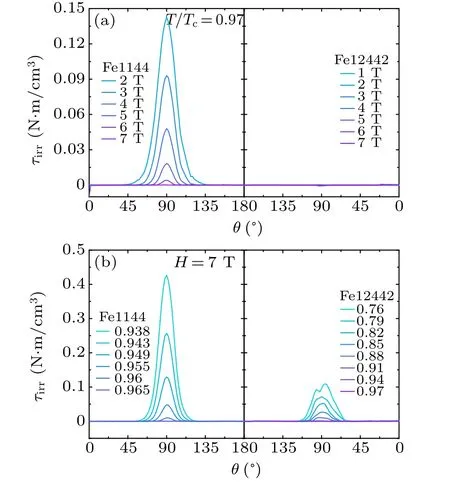
Fig.A3. Irreversible torque τirr of CaKFe4As4 and KCa2Fe4As4F2 as a function of angle θ measured at T/Tc =0.97 for different magnetic fields(a)and H=7 T for different temperatures(b).
- Chinese Physics B的其它文章
- Statistical potentials for 3D structure evaluation:From proteins to RNAs?
- Identification of denatured and normal biological tissues based on compressed sensing and refined composite multi-scale fuzzy entropy during high intensity focused ultrasound treatment?
- Folding nucleus and unfolding dynamics of protein 2GB1?
- Quantitative coherence analysis of dual phase grating x-ray interferometry with source grating?
- An electromagnetic view of relay time in propagation of neural signals?
- Negative photoconductivity in low-dimensional materials?