
Efficient loading of ultracold sodium atoms in an optical dipole trap from a high power fiber laser?
2021-03-19 03:20:14JingXu徐靜WenLiangLiu劉文良NingXuanZheng鄭寧宣YuQingLi李玉清JiZhouWu武寄洲PengLi李鵬YongMingFu付永明JieMa馬杰LianTuanXiao肖連團(tuán)andSuoTangJia賈鎖堂
Chinese Physics B 2021年3期
Jing Xu(徐靜), Wen-Liang Liu(劉文良),2, Ning-Xuan Zheng(鄭寧宣), Yu-Qing Li(李玉清),2,Ji-Zhou Wu(武寄洲),2,?, Peng Li(李鵬), Yong-Ming Fu(付永明),Jie Ma(馬杰),2, Lian-Tuan Xiao(肖連團(tuán)),2, and Suo-Tang Jia(賈鎖堂),2
1State Key Laboratory of Quantum Optics and Quantum Optics Devices,Institute of Laser Spectroscopy,College of Physics and Electronics Engineering,Shanxi University,Taiyuan 030006,China
2Collaborative Innovation Center of Extreme Optics,Shanxi University,Taiyuan 030006,China
Keywords: optical dipole trap,laser cooling,high power fiber laser
1. Introduction
The Bose-Einstein condensate (BEC) of neutral atomic gases has drawn considerable scientific interest since its first production in 1995,[1,2]owing to its macroscopic quantum coherence properties. Quantum degenerate gases, including the BEC and the subsequently developed Fermi gases,[3]have served as powerful platforms for research into precision measurements,[4-6]the simulation of many-body quantum systems,[7-9]quantum entanglement,[10-12]and so on.Furthermore, the manipulation of BEC has been achieved by tuning the atomic interactions.[13-15]Previously, the conventional method to produce the BEC was radio-frequency enforced evaporative cooling within magnetic traps.[16]Shortly thereafter,the BEC was realized by all optical approaches using high quality fiber lasers, through which different atomic species have been condensed. Such as,in 2005,an87Rb BEC was reached in an all optical dipole trap (ODT), which was constructed by a pair of crossed 1.06μm YAG laser beams.[17]Later, pure52Cr condensates were produced with up to 105atoms in an ODT.[18]In addition,a crossed ODT that formed from a multifrequency fiber laser with a central wavelength of 1070 nm has been utilized to condense the87Rb atoms,[19]an87Rb BEC was realized in a hybrid trap which is composed of a quadrupole magnetic trap and a one-beam optical dipole trap,[20]a misaligned crossed-beam far off-resonance optical-dipole trap(FORT,1565 nm)for a87Rb BEC,[21]and a ODT generated by a tightly focused trap from a CO2laser near 10.6μm for168Er BEC.[22]
There are several advantages to achieving the BEC via all-optical means in an ODT generated from fiber lasers instead of using a magnetic trap. Firstly, the ODT setup is comparatively simple and easy to build,especially with flexible configurations and full optical accesses. Furthermore,the ODT enables relatively high repetition rates in comparison to the magnetic trap, which is often troubled by the eddy current during the manipulation. Finally, compared to a magnetic trap, which usually traps atoms with only one specified Zeeman state,the ODT can simultaneously confine atoms with multiple spin states, thus enabling research into spinorbit coupling,[23]spinor condensates,[24]and multicomponent Fermi degenerate gas.[25]It should be noted that in an ODT, both the atomic density and the atomic collisional rate are substantially enhanced compared with a typical magneticoptical trap(MOT).This is conducive to a forced evaporative cooling that can be manipulated by lowering the power of the laser beams of the ODT,which directly dictates the trap depth U. In addition, the ODT is also a powerful tool for studying molecular samples of cold atoms generated by photoassociation or Feshbach resonances.[26]
While the ODT has been well utilized in the production of quantum degenerate gases,appropriate trap parameters should be acquired through systematic studies. The relaxation of the trapping potential of the ODT often results in a decrease in the collisional rate during the evaporation process. Furthermore,the volume and depth of the trapping potential in an ODT are indeed smaller than those of a magnetic trap.[27]Heating by the trapping light is also another issue of particular importance for the efficient loading of ultracold atoms in the ODT.[28]The initial conditions of the atom cloud loaded by the ODT are essential for evaporative cooling to effectively condense the atoms.
In this study, we carry out detailed research of the relationship between the experimental parameters of two crossed ODT lasers and the efficient loading of ultracold sodium atoms in the ODT.The experimental results are analyzed by numerical analysis,based on which a scaling law for loading number N,temperature and phase space density(PSD)versus the beam power is demonstrated.Our investigations could be used in the efficient loading of other atomic species in an ODT.
2. Experimental details
The experimental setup is demonstrated in Fig.1(a). The setup is composed of three parts, namely, the oven, intermediate and science chambers. The hot Na atoms ejected from the oven are decelerated by a Zeeman slower before being collected by a MOT at the center of the science chamber with a background pressure of 1.6×10?11mbar, maintained by an ionization pump (Agilent, 150 L/s). The trapping and repumping laser beams for the Na atoms were provided by a tunable, frequency-doubled diode laser (TA-SHG pro, Toptica, 1 W). With the separate adjustments of two acoustooptic modulators (AOMs, AA Opto-electronic), the frequencies of the Na trapping laser were tuned to 15 MHz below the 3S1/2(F =2) →3P3/2(F′=3) hyperfine resonance transitions(Δc=?15 MHz), while the repumping laser was tuned to 5 MHz below the 3S1/2(F =1)→3P3/2(F′=2) transitions, respectively, as shown in Fig.1(b). The dipole trap is created by two crossing laser beams that focused at the center of the MOT volume. The two beams are generated by fiber laser(IPG)with a typical output power of 100 W.
The MOT loading phase is used for rapid loading, typically lasts for ~84 s, leading to an initial atom number of~6.23×10⁹. To prepare loading into the ODT,the MOT was compressed (Compressed MOT, CMOT) and further cooled by an optical molasses to effectively improve the atomic density and achieve precooling of the Na atomic samples. In this case, the number of Na atoms is ~5.1×10⁸. This process is known as polarization gradient cooling and lasts for 20 ms,within which the condensed MOT was 3 ms and the molasses was 17 ms. Meanwhile,the power of the cooling light gradually increases from 4.5 to 15 mW,and the frequency detuning gradually decreases to Δc=?40 MHz. During sub-Doppler cooling stage,the negative detuning of the cooling laser is increased and the intensity is reduced to keep most of the atoms in the velocity capture range of the sub-Doppler process, and at the same time the temperature decreases. The temperature of the Na atomic clouds dropped from 330μK to 45μK.Due to the ac Stark effect of the ODT,the number of atoms loaded into the dipole trap by the linear power ramp is four times than that of a sudden switching on of the power,[29]so a 5 ms ramp stage was set before the ODT loading. The entire time sequence is shown in Fig.2.
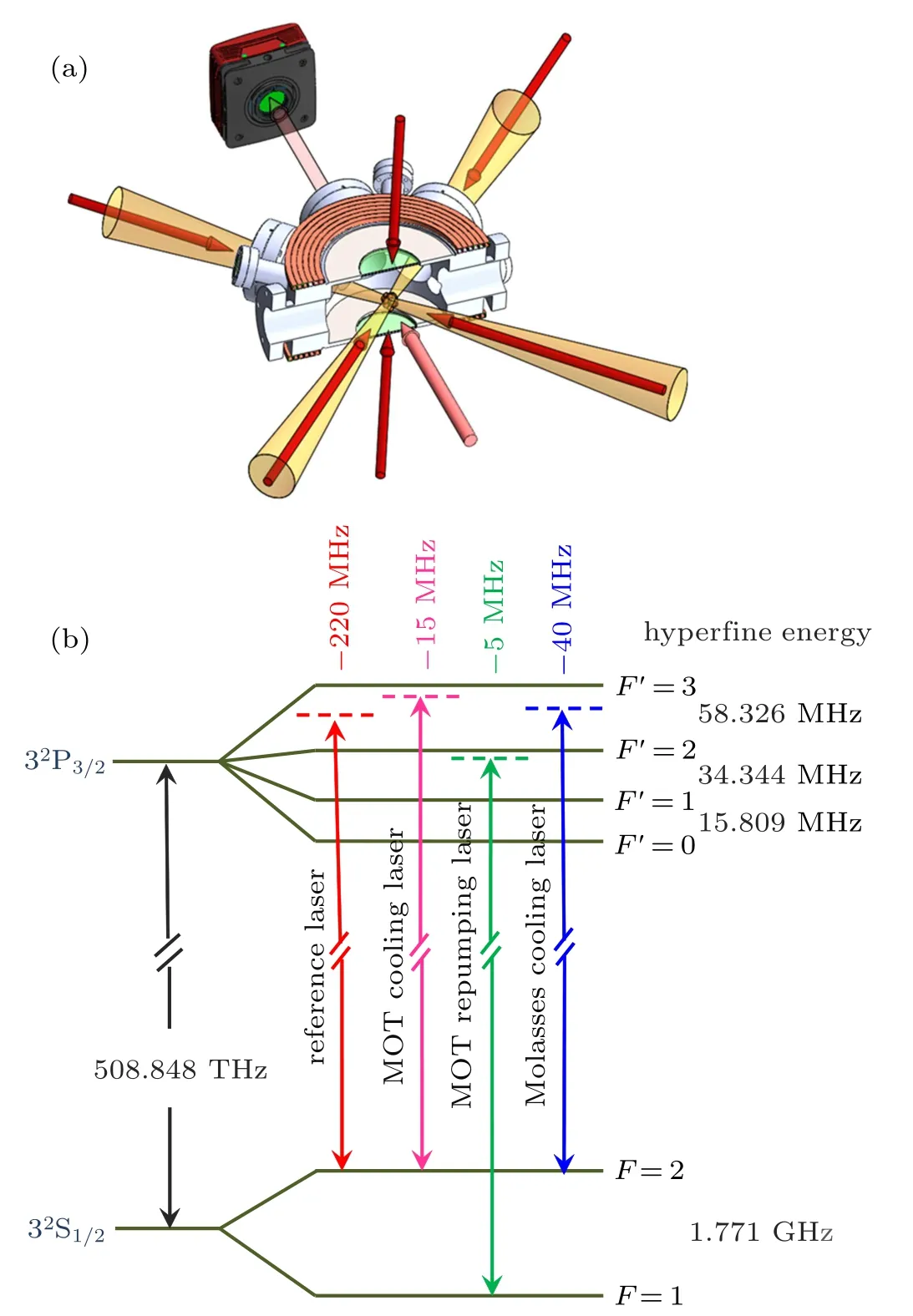
Fig.1. (a) Experimental setup of the crossed ODT with two 1064 nm Gaussian beams orthogonal to each other on the horizontal plane with their focuses coincided. (b)Energy levels of 23Na atoms and frequency detunings of relevant lasers to the resonant transition lines.
A 1064 nm fiber laser served for the building of the ODT.The output of the laser was divided into two beams,each with a power of ~18 W. The two beams went through two different AOMs and the diffracted beams were coupled into singlemode optical fibers and transported into the experimental platform with a power of 13 W and a waist of 30 μm, as shown in Fig.3. In the experiment, the powers of the beams for the crossed dipole trap are of equal intensity. In the experiment,we must suppress the relaxation of the ODT caused by the polarization misalignment.This is important for research involving spinor condensation experiments.[28]The two beams of the ODT must be linearly polarized. A slight change in the elliptically polarized ODT light from linear polarization causes a rapid reduction in the trapped atomic number.[30]Similarly,even a small fraction of circular polarized light leads to a magnetic field large enough to effectively induce an energy shift to compensate the spin-dependent interactions. In contrast, in order to avoid possible interference patterns that could result in substructures of the trap potential, the polarization of the two beams must be perpendicular to each other.[31]We kept the difference of the polarization between the two beams as 5?using a polarization analyzer(NKT).The two Gaussian beams crossed at the center of the chamber with an angle of 90?in the horizontal plane.The laser focal zone was overlapped with the MOT.With these configurations,the ultracold Na atoms were load into the crossed dipole trap. The dipole trap laser was switched on and increased through a slow linear process from 0 to 13 W. The optical dipole trap loading phase lasted for 450 ms,as shown in Fig.2.Detailed properties of atom clouds are obtained through the absorption imaging method. In this study,we measured the relationship between the beam power of the ODT laser and the atomic number,the temperature and the PSD.
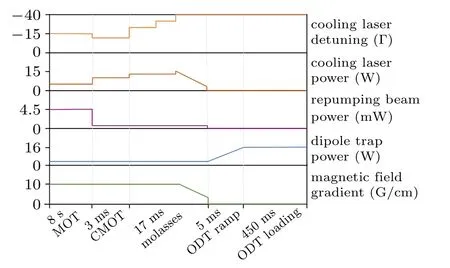
Fig.2. Experimental time sequence showing the detuning and power of the cooling light,the power of the repumping light and ODT light,and the magnetic field gradient of the MOT.

Fig.3. Schematic of the crossed ODT setup.
3. Results and discussion
At a power of 13 W for both trap beams of the ODT, a transverse trapping frequency of ~5 kHz was measured using the parametric excitation technique.[32]With the experimental configuration described above, the trap frequencies were calculated and are in good agreement with the experimental measurements. Figure 4 demonstrates the trapping potential in all spatial directions at a power of 13 W for each trap beam.At this power,the radial frequency is measured to be 4.7 kHz,while the axial frequency is ~35 Hz and the trap depth U0is 477μK.
If U is much larger than the thermal energy of the atomic cloud,it can be approximated as a cylindrical harmonic oscillator and written as


The total atom number in the ODT is given as[31]


In addition, the atomic temperature is also an important starting point for condensation of the atoms. Figure 5(b)demonstrates the temperature of the atoms in the ODT after loading for 450 ms at different trapping beam powers. We find that when increasing the power from 2 W to 13 W,the atomic temperature in the ODT gradually increases from 205 μK to about 508μK.This is a consequence of the large loading rate of the atomic number in the ODT.
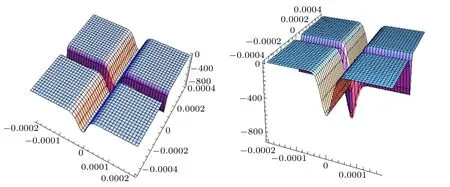
Fig.4. The optical potential produced by the two orthogonal identical laser beams at P=13 W.
The two trapping beams of the ODT cross at the center of the science chamber along the x and y axes, respectively.Thus, the trap frequencies in all three directions are given as follows:
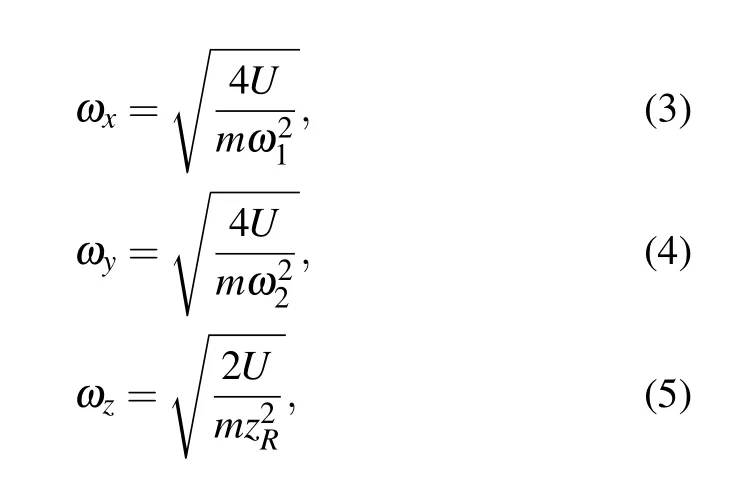
where m is the mass of the atom,zR=πω20/λ is the Rayleigh range, and λ is the laser wavelength of the fiber laser. Thus,the PSD can be expressed as
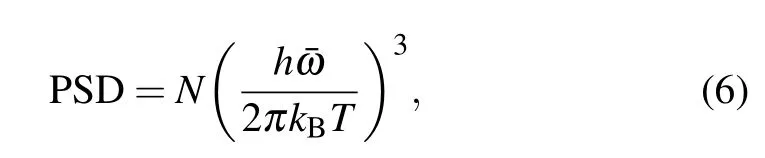
where the mean trap frequency ˉω =(ωx·ωy·ωz)1/3.
The loading process of the ODT determines the initial PSD of the atoms, which in turn dictates if the condensation of the quantum degeneracy gas can be achieved. The corresponding PSDs at different trapping beam powers were calculated using the data points of atomic number and temperature obtained above, as demonstrated in Fig.5(c). Other experimental parameters were also considered. It can be found that the number and temperatures of the atoms loaded in the ODT both increase with beam powers; however, the PSDs do not demonstrate the same tendency. An optimal value at P=9 W can be found in Fig.5(c). When the power of the trapping beam is increased far beyond the optimal value,the PSD drops rapidly.This observation shows that the PSD is sensitive to the deviation of the power from its optimal value. This finding is important for realization of the BEC of atoms.
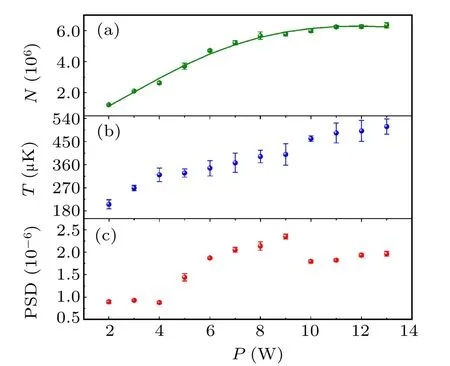
Fig.5. (a)Loading number of atoms as a function of laser power. The green dots are experimental data and the green solid line shows the simulation results. (b)Temperature of the atoms in the trap as a function of laser power when the dipole trap is loaded for 450 ms. (c)Corresponding PSD at different ODT powers.
4. Conclusion
In summary, we have carried out experimental research into the atomic loading of an ODT.The atomic number,temperature and PSD at different laser powers have been systematically investigated. We have theoretically simulated the relationship between the number of loaded atoms and the power and found that it fits well with the experimental results. We then find that the atomic number and temperature increase with increasing power,while the corresponding PSD fluctuates and has an optimal value at a lower power of 9 W. Through these studies, the loading process of ultracold atoms in an ODT has been found. The current study plays an important role in the all-optical production of the BEC of Na atoms and in spin condensate research.

- Chinese Physics B的其它文章
- Nonlocal advantage of quantum coherence in a dephasing channel with memory?
- New DDSCR structure with high holding voltage for robust ESD applications?
- Nonlinear photoncurrent in transition metal dichalcogenide with warping term under illuminating of light?
- Modeling and analysis of car-following behavior considering backward-looking effect?
- DFT study of solvation of Li+/Na+in fluoroethylene carbonate/vinylene carbonate/ethylene sulfite solvents for lithium/sodium-based battery?
- Multi-layer structures including zigzag sculptured thin films for corrosion protection of AISI 304 stainless steel?