Guqin:A Tranquil Sound for A Modern Era
2021-03-24 11:43:46BystaffreporterMENGJIAXIN
CHINA TODAY 2021年2期
By staff reporter MENG JIAXIN
TWO thousand years ago, there lived a Chi- nese musician named Yu Boya. He loved creating music but sadly no one could truly appreciate his music. One day, a woodcutter named Zhong Ziqi listened to Boyas music and told Boya how he saw high mountains and flowing water in his music. Yu was ecstatic over finding someone who shared mutual feelings with him, and then took Zhong as his soulmate in music. On the day Zhong died, Yu smashed his instrument, as he knew never again would he find someone who could so instinctively understand his music.
The musical instrument which Yu played was guqin, a seven-stringed zither. It is a classical Chinese instrument dating back to more than 5,000 years ago. According to legends, the first guqin was made by one of the first kings of ancient China.
Historical Roots
Deemed as instrumental in cultivating individual character and maintaining social order, music was of paramount importance in ancient China, and guqin was a key musical instrument in Chinese culture. The sound of guqin is deep and tranquil, helping to foster character, uphold morality, and enrich learning. Besides, because guqins sound is mellow, it is usually played by one player in solitude or for a few intimate friends, to express ones innermost and profound emotions. When played with lighted incense perfuming the air, guqin music creates an air of serenity and self-contemplation as the player plucks and dampens the strings (made of silk in ancient times and steel nowadays).
As one of the top four classical arts in ancient China, including guqin, chess, calligraphy, and painting, guqin has been historically seen as one of the most important symbols of traditional Chinese culture. It was originally played in the imperial palace, but then gradually common people began to learn how to play it, particularly the literate class. This is evidenced by the fact that it was a beloved instrument of Confucius and many other sages through Chinese history. There has been a number of anecdotes and stories involving guqin, such as the story mentioned above of Boya and Ziqi, stressing the value of peoples connection and mutual understanding. Another famous ancient story involv- ing a guqin was the trick of an empty city. This story tells how Zhuge Liang (181-234), a well-known military adviser during the Three Kingdoms Period, saved a city by simply calmly playing a guqin above the city gate in front of an army of invading soldiers.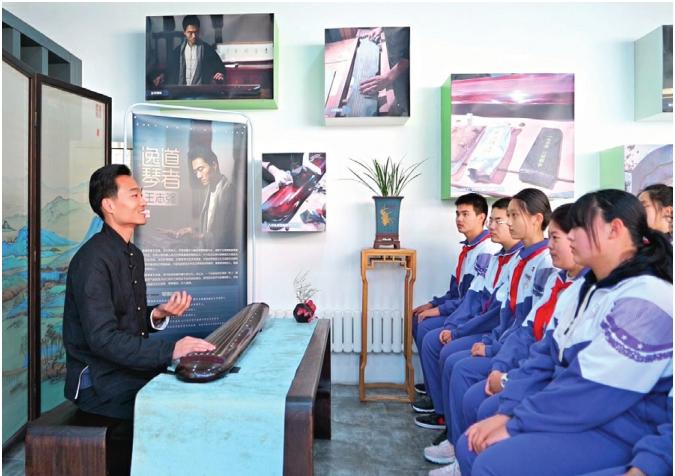
There is a multitude of cosmological insights and cultural meanings embodied in the structure of guqin: the upper round board represents sky while the flat bottom symbolizes the earth; the length of a guqin by Chinese measurements suggests 365 days of a year; 13 finger position indicators (hui) symbolize 12 months plus one leap month. Each part of the guqin is given an anthropomorphic name, such as Forehead, Shoulder and Waist, or a zoomorphic name, like Dragon Pond, Phenix Pool, and Goose Feet.
Passion and Promotion
Wang Zhiqiang is a guqin master, dedicated to preserving and promoting authentic guqin culture in modern China. He believes learning how to play guqin can help people cultivate good manners, maintain a fine mind, and guide peoples behavior. He also thinks that guqin promotes an aesthetic lifestyle, adding more beauty and fun to daily life.
When Wang was a child, he became inspired by a scene in the Romance of Three Kingdoms, a TV drama based on a well-known novel The Three Kingdoms, where Zhuge Liang was playing a guqin on top of a city wall. The music of the guqin so impressed him that he decided to learn how to play it.
Today he travels around delivering lectures and giving guqin performances, and is also devoted to teaching students at schools how to play guqin. Sitting around Wang in the classroom, students listen intently and make earnest efforts to learn guqin finger techniques like plucking and striking. While they practice, they get excited over the music that comes out of the guqin. Students are also greatly interested in making the instrument and wait in line to experience the making process in person, where they grind powder and sand pieces of wood by themselves to make guqin.
Wang is also a master at making guqin and has a guqin workshop, a place where he can immerse himself in the art of making guqin. Since the process of making a guqin involves more than 100 steps and a dozen major techniques, it normally takes at least one year to finish making one. There are dozens of guqin in Wangs workshop, some half-completed ly- ing on tables or drying on the wall, others packed in bags waiting to be picked up by their future owners, and still others are hung on walls for display.
Making a Comeback
For millennia, guqin has played an essential role in Chinese culture. As more and more people are becoming interested in guqin today, the growing number of guqin fans is providing an opportunity for a revival of guqin culture. Because the sound of guqin is long and deep, it creates a sense of tranquility, and the mellow tone helps reduce the stress of modern life by calming peoples minds and relaxing their bodies. Playing guqin enables people to temporally isolate themselves from the hustle and bustle of city life and stay true to themselves. That is why people are so taken with guqin.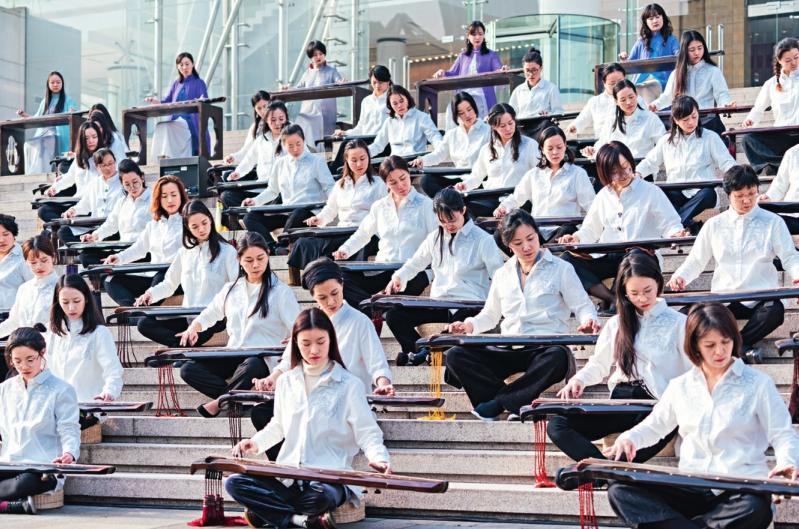
Today, the guqin is played by people of all ages and walks of life, and guqin shows come in a variety of modern forms, thus drawing more attention to this old instrument. Guqin masters livestream or post videos of themselves playing guqin on social platforms, rock bands use guqin as part of their collection of instruments performed on stage, guqin music is added to pop songs, and music groups play pop songs on guqin while dressed in Hanfu (a traditional style of Chinese clothing). These innovative performances of the ancient instrument reflect how guqin is making a comeback, as well as injecting new vitality and inspiration into this old art.
The guqin has been passed down from generation to generation for thousands of years, thus closely interwoven with Chinese culture and values. As a cultural medium for millennia, guqin continues to send out a tranquil sound in this modern era.