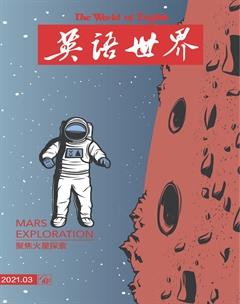
地球人移居火星?
2021-04-08 02:26:47塞巴斯蒂安·埃切韋里
英語世界 2021年3期
關鍵詞:人類
塞巴斯蒂安·埃切韋里

Inspired by science fiction and a strange phenomenon on the Martian surface, researchers have discovered a way that Earth life could survive on the red planet.
A team of scientists at Harvard University, the University of Edinburgh, and NASAs Jet Propulsion Laboratory have found that a material called aerogel1 can trap enough heat from sunlight to create regions of liquid water and Earth-like temperatures on Mars. This technology, they say, could be adapted to build human habitats in the not-so-distant future.
In a new study, the researchers show that placing a thin layer of a translucent aerogel—just a few centimeters thick—atop Mars surface could heat the ground by up to 50 degrees Celsius, or 90 degrees Fahrenheit, or more. This would be enough to thaw2 water previously frozen underground, providing the crucial ingredient to support life.
Just like carbon dioxide and other greenhouse gases, the aerogel allows visible light to pass through and warm up the ground, but makes it harder for infrared light—which humans cannot see, but experience as heat—to escape. Thanks to its unique structure, aerogel produces a much more efficient greenhouse effect than carbon dioxide.
“Jelly3 [is] a structure [made] of a solid filled with [tiny pockets of] liquid. If you suck out all the liquid and replace it with air, you get an aerogel,” said Laura Kerber, a research scientist4 at the Jet Propulsion Laboratory.
These air pockets are the key to heating up Mars. “Air is really bad at conducting heat, but it usually moves around and brings heat from place to place. But since [in the aerogel] its trapped in all these tiny pockets, then [the air] cant mix around, and that makes it a great insulator,” she said. A similar type of aerogel is used to insulate the Curiosity rover currently exploring Mars, as well as deep sea pipes, firefighting equipment, and even houses here on the Earth.
Scientists could deploy the aerogel on a small-scale first and then work up to5 more ambitious projects. “The simplest one... is to make [an aerogel] blanket and allow algae and microbial life [from Earth] to grow. Habitats for humans—it would still absolutely work, but youd have to combine [the aerogel] with other materials,” said Robin Wordsworth, an associate professor of environmental science and engineering at Harvard.
“In its current form, [the aerogel] is pretty brittle,” Kerber said. Mars atmosphere is very thin and toxic to most Earth life, so any habitable structure would have to be airtight. She explained that in the future, tiles made of aerogel sandwiched between strong plexiglass could be used to make a pressurized6 dome for humans.
Because these Earth-life environments would be self-contained7, they would also preserve whatever Martian life that might exist. “Nobody wants to go to Mars and kill the only other life we find by out-competing8 it with Earth life. This is a nice solution; piece by piece, little contained island of habitability, we can live there and [not] mess it up,” Kerber said.
“This, we think, for the first time, is a local and scalable9 way to approach achieving Martian habitability. There are many challenges. But we think it is very exciting that this is now a possibility in our lifetime,” Wordsworth said.
This finding, exciting as it is, is only the latest in a story that began far before humans even walked on the moon.
“The science fiction I started my life with [is] coming true,” said Edward Guinan, a professor of astrophysics and planetary science at Villanova University. For more than a century, science fiction authors have been writing about human settlements on the red planet, depicted as having breathable air, liquid water, and advanced alien life.
Humanitys understanding of Mars took a leap forward in 1965, when the Mariner 4 probe took the first close-up photos and found that Mars was entirely inhospitable to humans—deserted, dry, and with a dangerously thin atmosphere.
But writers and scientists—many inspired by their favorite novels—didnt give up. Instead, they focused on terraforming10: using technology to radically transform Mars into a place where people could survive.
In 1971, Carl Sagan11 proposed vaporizing all of the frozen water12 and carbon dioxide of Mars ice caps. The resulting gas would then heat the planet by the same greenhouse effect behind Earths own global warming crisis. But in 2018, NASA discovered that there was not enough frozen water and carbon dioxide on Mars for this plan to work without incredibly advanced technology.
Harvards Wordsworth felt pushed13 to think practically about terraforming. “[We asked] what actually could work and what couldnt in our lifetime, as opposed to far in the future,” he said.
The direct inspiration for the aerogel project, however, came from Mars itself.
The same heating process “already happens on Mars right now, but with [frozen carbon dioxide]. Its pretty transparent, and accumulates on dunes. The sun shines through, and gas starts forming. And it finally explodes, and you get these geysers14 of [carbon dioxide] that leave black spots. Happens every spring,” said Kerber.
Having studied the Martian surface, Kerber has already discovered the ideal spot to build a human settlement.
“I know where all of the subsurface water is on the planet. Theres this place called Deuteronilus Mensae15. If you want to do this, this is where Id put your domes; this is where theres water close to the surface,” she said.
As for what those living in aerogel-heated habitats on Mars might eat, Guinan and his astrobotany students are working on it. “We have a greenhouse in Villanova. We are growing plants in Martian simulated soil, [and] under the light conditions we get on Mars,” he said.
Guinan already plans for his students to experiment with growing their “Mars Garden” in an aerogel-based greenhouse. “I already bought [aerogel]. We are actually going to try it,” he said.
Having worked in astrophysics for over 50 years, Guinan is hopeful that this new technology will see humans living and growing food on Mars within his lifetime.
Kerber believes that solving the remaining challenges—the largest of which is the trip to Mars itself—is only a matter of funding. “If someone said, ‘Heres a bunch of money, and go do it, wed do it. People think its so far out of reach, or something from a sci-fi film—its not. Let us try,” she said.
受科幻小說和火星表面奇觀的啟發,研究人員發現了一種能讓地球生命在這顆紅色行星上生存的方法。
來自哈佛大學、愛丁堡大學和美國國家航空航天局噴氣推進實驗室的科學家組成的團隊發現,一種叫作氣凝膠的材料能從陽光中捕獲足夠的熱量,在火星上形成液態水區域并達到與地球相近的溫度。他們認為,在不久的將來,就可采用這項技術建設人類棲息地。
在一項新的研究中,研究人員表明,在火星表面鋪上薄薄一層半透明氣凝膠,只要幾厘米厚,就能使地表升溫50攝氏度(90華氏度)甚至更高。這足以融化之前封凍在地下的水,提供維持生命必需的要素。
就像二氧化碳等溫室氣體一樣,氣凝膠允許可見光通過并使地表升溫,但阻礙紅外線逃逸,人類看不見但會感到熱。憑借其獨特的結構,氣凝膠產生溫室效應的效率可遠勝二氧化碳。
噴氣推進實驗室的研究員勞拉·克貝爾說:“液凝膠是一種充滿微小液囊的固體結構。如果把所有液體抽干,并用空氣代替液體,就得到了氣凝膠。”
這些氣囊是加熱火星的關鍵。克貝爾說:“空氣導熱性極差,但通常可以流動,能把熱量帶到各處。而氣凝膠中的空氣被束縛在這些微小的氣囊中,所以無法相互混合,因而成為極好的隔熱材料。”類似的氣凝膠已經應用到目前正在執行火星探索任務的好奇號火星車上,此外還可以應用到深海管道、消防設備乃至地球上的房屋。
科學家可以先小規模應用氣凝膠材料,然后逐步開展更宏大的項目。哈佛大學環境科學與工程副教授羅賓·沃茲沃思說:“最簡單的一種……是制作氣凝膠毯,讓來自地球的藻類和微生物在上面生長。對于人類的棲息地——它也照樣保證能工作,但一定要把氣凝膠和其他材料結合使用。”
“目前這種形態的氣凝膠還相當脆弱。”克貝爾說。火星大氣非常稀薄,而且對大多數地球生命來說都有毒,所以任何宜居建筑都必須建成密閉的。她解釋道,未來,可以把氣凝膠夾在結實的有機玻璃中間制成磚瓦,用來建造供人居住的密封圓頂房屋。
因為地球生命生活的這些環境會自給自足,它們也會保護火星上可能存在的任何生命。克貝爾說:“誰也不想登陸火星后,就讓地球生命憑借競爭優勢殺死我們發現的唯一地外生命。這個解決方案不錯,逐步建成基本自足的宜居小島,我們就能住在那里而不至搞得一團糟。”
“還是頭一次,我們認為這是一種可能實現火星宜居的方式,范圍雖小但可以擴展。困難是很多,但我們認為非常鼓舞人心,因為在我們有生之年很可能實現。”沃茲沃思說。
這一發現雖然令人振奮,但也不過是在人類已開始的一個故事的最新進展踏上月球之前就開始了。
維拉諾瓦大學的天體物理學和行星科學教授愛德華·吉南說:“我從小就喜歡的科幻小說要變成現實了。”一個多世紀來,科幻小說作者不斷講述人類在這顆紅色星球上定居的故事,將火星描繪為有能呼吸的空氣、液態水,甚至還有高級外星生命。
1965年,水手4號火星探測器第一次拍攝到特寫照片,發現火星完全不適宜人類生存——荒涼,干燥,大氣極為稀薄。人類對火星的認識因此發生了一次飛躍。
但是作家和科學家——很多是受到他們喜愛的小說的啟發——沒有放棄。不僅如此,他們還專注于地球化:用技術手段把火星徹底改造成人類能夠生存之地。
1971年,卡爾·薩根建議把火星冰蓋所有水冰和二氧化碳都蒸發掉。就像導致地球自身全球氣候變暖危機的溫室效應一樣,蒸發產生的氣體會引起同樣的效應讓火星變暖。但在2018年,美國國家航空航天局發現,如果沒有非常先進的技術支持,火星上水冰和二氧化碳數量不足以實現這個蒸發計劃。
哈佛大學的沃茲沃思感到形勢緊迫,要實事求是地思考地球化的問題。他說:“我們問的是,在我們有生之年而非遙遠的未來,什么是切實可行的,什么又是行不通的。”
然而,就氣凝膠項目而言,直接的靈感來自火星本身。
克貝爾說,同樣的加熱過程“目前已在火星上發生,不過借助的是固態二氧化碳(干冰)。它非常透明,在沙丘上積聚。陽光穿透干冰,氣體開始形成。最后氣體噴發,產生這些二氧化碳間歇噴泉,留下黑點。這種現象每年春天都會發生”。
通過對火星地表的研究,克貝爾已經發現了建造人類定居點的理想之地。
她說:“我知道火星所有的地下水在哪里。就在那個名叫亞尼羅桌山群的地方。如果想建人類定居點,這就是我推薦建房的地方;這里的地下水離地表很近。”
至于火星上那些住在氣凝膠加熱定居點的居民吃什么,吉南和他的天文植物學學生正開展此項研究。他說:“維拉諾瓦大學有座溫室,我們用模擬的火星土壤栽種植物,光照條件也模擬火星。”
吉南早就計劃讓學生在利用氣凝膠的溫室里開展他們建造“火星花園”的實驗。他說:“我早買好了氣凝膠,實際上我們就要做實驗了。”
吉南已在天體物理學領域工作了50多年,他希望在有生之年,這項新技術能見證人類移居火星并在火星上種植糧食。
克貝爾認為,解決剩下的挑戰——其中最難的是通往火星的旅程——只是資金的問題。她說:“要是有人說‘錢有的是,放手去做吧,我們就會去做。人們認為這實在遙不可及,或者只是科幻電影里的東西——其實不然。我們共同努力吧。” ? ? □
(譯者為“《英語世界》杯”翻譯大賽獲獎者)
猜你喜歡
哈哈畫報(2022年4期)2022-04-19 11:11:50
大科技·百科新說(2021年6期)2021-09-12 02:37:27
英語文摘(2021年2期)2021-07-22 07:56:54
小哥白尼(神奇星球)(2020年8期)2021-01-18 05:13:32
小哥白尼(神奇星球)(2020年8期)2021-01-18 05:13:26
小哥白尼(神奇星球)(2020年7期)2021-01-18 05:07:18
好孩子畫報(2020年5期)2020-06-27 14:08:05
小學科學(學生版)(2020年2期)2020-03-03 13:40:16
作文成功之路·小學版(2019年5期)2019-08-23 08:13:18
意林·全彩Color(2019年6期)2019-07-24 08:13:50