
Long-term trends in a forest ungulate community: park establishment increases numbers, but poaching is a constant threat
2021-04-15 04:36:42RongHou,RafaelReyna-Hurtado,PatrickOmeja等
Zoological Research 2021年2期
DEAR EDITOR
Deforestation represents one of the greatest threats to tropical forest mammals, and the situation is greatly exacerbated by bushmeat hunting.To construct informed conservation plans,information must be gathered about responses to habitat degradation, regeneration, and hunting over a sufficiently long period to allow demographic responses.We quantified changes in the abundance of three commonly occurring ungulate species (i.e., bushbuck,Tragelaphus scriptus; red duiker,Cephalophussp.; blue duiker,Cephalophus monticola)at eight sites in Kibale National Park, Uganda (old growth=3;logged=3; regenerating=2) for 23 years.Changes in abundance (363 surveys totaling 1 450 km) were considered in regard to the park’s management strategy, regional economic indicators, and estimates of illegal hunting.Bushbuck abundance increased in old-growth and logged forests from 1996 to 2009, and then oscillated around this level or declined.Duiker abundance demonstrated a similar pattern, but abundance in the old-growth forests showed a general increase from 1996 to present day.Duiker abundance in the logged forests exhibited an early increase, but subsequent oscillation.Poaching signs per patrol have remained stable over the last decade, despite increases in the size of the surrounding population, cost of living, and cost of schooling, thus reflecting successful efforts in conservation education and enforcement.Our study highlights the positive impact of park establishment, patrol, and conservation efforts on ungulate populations and shows the adaptability of forest mammal populations to different management schemes.
The bushmeat trade is a large industry that continues to devastate many animal populations (Fa et al., 2002; Walsh et al., 2003).It is estimated that 1-3.4 million tons of bushmeat(upper estimate equivalent to some four million cows) are extracted each year from Central Africa alone (Fa et al., 2002;Wilkie & Carpenter, 1999).Such hunting rates are unsustainable and have already resulted in the eradication of entire populations from some countries.For example, in the last 40 years alone, 12 large vertebrate populations have been extirpated from Vietnam (Bennett & Rao, 2002).Determining the impacts of hunting and evaluating the potential interventions can be challenging, particularly for cryptic species that respond slowly to changing hunting pressure.Thus, long-term studies are critical, but obtaining funding for the needed duration is extremely difficult (Chapman et al.,2017).Here, we quantified changes in the abundances of commonly occurring forest ungulate species (i.e., bushbuckTragelaphusscriptus; red duikerCephalophussp.; blue duikerCephalophusmonticola) at eight sites within the Kibale National Park, Uganda (795 km2) for up to 23 years.We estimated abundance along 4 km trails in 1995 and 1996 at three sites and in 2005, 2008, 2014, and 2019 at the same sites and in five new areas (Figure 1A; Table 1).The areas included three old-growth forest sites, three previously logged(in the 1960s) sites, and two regenerating forest sites.Details can be found in previous publications (Chapman et al., 2018).Changes in abundance were considered in view of regional economic indicators and illegal poaching data over 11 years.
We focused on three ungulate species, i.e., bushbuck(Tragelaphusscriptus), red duiker (Cephalophussp.), and blue duiker (Cephalophusmonticola- see Struhsaker (1997)for a discussion on taxonomy).The tracks and dung of the two duiker species can be distinguished when the signs are of good quality; however, quality declines over time and depends on the season and environment.Thus, it was not always possible to identify the signs to species, and we thereforeelected to report a combined duiker value.As our objective was to quantify relative changes in abundance over time, we maintained the same routes, used the same methods in each census, and attempted to sample each transect once a month for 12 months each time.All sites had a section of the transect that was within 300 m of the edge of the reserve or a road,thus variation in the distance from the edge was not considered a confounding factor.Censuses were conducted by two people between 700 and 1 400 h at a speed of approximately 1 km/h.The six-member census team involved the same observers since 1995, except for one member who was replaced in 2019.A variety of methods have been proposed for estimating animal density or abundance from line transects and considerable controversy exists regarding their accuracy for forest dwelling mammals (reviewed by Chapman et al., 2010).Both bushbuck and duiker are cryptic animals that hide or avoid approaching observers, thus we elected to count tracks and dung.A single set of tracts in a line was counted as one sighting.Both dung and tracks were removed to ensure they were not re-counted.We determined changes among years using the Kruskal-Wallis test for the three longest sites sampled in all time periods.

Figure 1 The study sites within Kibale National Park, Uganda and the variation of relative abundance of studied ungulates from 1995 to 2019
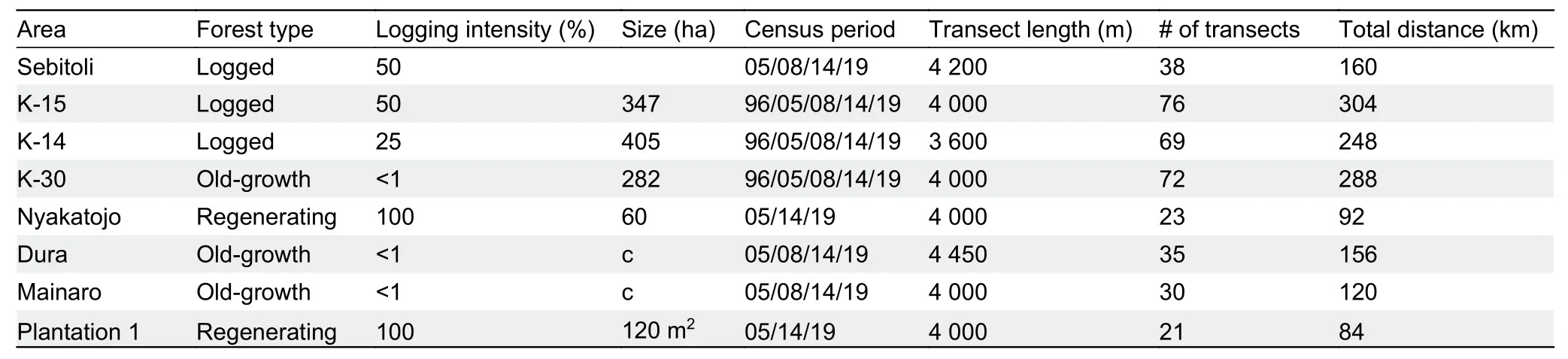
Table 1 Characteristics of ungulate censuses conducted at different locations in Kibale National Park, Uganda (ordered from north to south) at different times
We gathered information on encroachment using Uganda Wildlife Authority (UWA) ranger patrol data (N=266 patrol days in zones near our transects).The UWA sends out patrols to prevent and monitor encroachment into the park on a regular basis (on average 9.2 days a month).Using GIS, we established a 2 km buffer around the transects and considered changes in the number of records of encroaching in this buffer zone to be an indicator of poaching (Figure 1A).The patrol records included any incidence of encroachment, including snares and traps (60.0%), logging, charcoal, and fuelwood collection (18.5%), sightings of hunters (3.0%), non-timber forest products collection (1.8%), incidence of domestic animals in the park (0.9%), and other (15.8%).Rangers used GPS units to record the location of the incidents.We standardized evidence of encroachment by the number of patrols per month.With respect to bushmeat, it is believed that most of the offtake is for subsistence use.A small amount makes it to the local market, but there is no evidence of largescale commercial harvest in the area.
We conducted 363 transect walks covering 1 450 km to assess changes in ungulate abundance (Table 1).The walking effort among areas ranged from 84 km to 304 km.Effort was a function of the year in which we started sampling and the logistics of getting to an area (e.g., the road to P1 was sometimes impassible in the rainy season).
Bushbuck abundance increased in both the old-growth and logged forests of Kanyawara (sites monitored for the longest duration from 1995 to 2009; K30 KW=51.54,P<0.001, K14 KW=38.09,P<0.001, K15 KW=38.23,P<0.001).After 2005,across all sites, abundance either did not vary substantially(K30, Dura, Sebitoli) or declined (K14, K15, PI, and Nyakatojo;Figure 1B).Duiker abundance similarly increased in both oldgrowth and logged forests of Kanyawara (sites monitored for the longest duration from 1995 to 2009; K30 KW=65.02,P<0.001, K14 KW=20.79,P<0.001, K15 KW=41.54,P<0.001).In general, duiker abundance in the old-growth forests of K30 and Mainaro showed an increase from 1995 to present day.Duikers in the logged forests of K15, K14, and Sebitoli exhibited an early increase, then subsequent oscillation.
The bushbuck and duiker species showed relatively high abundances when they were first evaluated in the early regenerating forests of P1 and Nyakatojo, but subsequently declined over the next two surveys (Figure 1B).This is likely because these species do well in early colonizing forests(Lwanga, 2006), but decline when the forests start to mature.Interestingly, when comparing old-growth, logged, and regenerating sites, similar abundance estimates were observed within each regardless of their histories (Figure 1B;bushbuck KW=2.77,P=0.251; duiker KW 1.62,P=0.559 tested for three sites with the longest duration).
Overall, the number of ranger patrols that found snares or traps per month was remarkably stable between 2005 and 2016, except for late 2014 in Sebitoli when there was a considerable spike (three times greater than the average;Supplementary Figure S1).In the old-growth forest sites, the number of snares detected per patrol was consistently low in all time periods.The lightly logged forest of K14 followed the same pattern as the old-growth areas.The regenerating forest sites showed consistently low numbers of incidents over the years.In contrast, while the logged forests of K15 and Sebitoli had similar overall numbers of ranger patrols that found snares or traps per month, certain periods showed poaching spikes.
Forest ungulates are some of the most hunted animals in tropical forests.In the Congo Basin, duikers, together with the red river hog (Potamochoerus porcus), are the most hunted animals by subsistence hunters (Wilkie & Carpenter, 1999).For example, hunters from only 115 households living in the Korup National Park, Cameroon (1 250 km2) are reported to harvest almost 30 000 animals a year, primarily terrestrial mammals (80%) (Infield, 1989), including 15 566 duikers,representing 63% of total offtake (Infield, 1988, cited in Struhsaker, 1997).In general, duikers have relatively high reproductive rates and can benefit when hunting removes their competitors (Hoppe-Dominik et al., 2011), thus they may be more resilient to hunting than many other ungulates.They also do well in disturbed areas (Lwanga, 2006).This is supported by our Kibale data, where duiker abundance was as high in logged and regenerating areas as in old-growth forest.Bushbuck prefer dense habitats over disturbed open habitats(MacLeod et al., 1996); however, we found their abundance was similar among old-growth and logged/regenerating habitats.
In general, both duiker and bushbuck abundance is lower in hunted versus unhunted sites (Koster & Hart, 1988; Mugume et al., 2015), indicating that these species benefit from protection.Evidence from the Tai National Park, C?te d’Ivoire,confirms this, as duiker numbers increase where patrolling is high (Kablan et al., 2019).In Kibale, the highest poaching pressure was observed during a few periods in the logged forest, yet duiker and bushbuck abundance varied little between here and old-growth forest.One possible explanation is that the vegetation in the disturbed forest is desirable for these species and their distribution may represent an ideal free distribution (Fretwell & Lucas, 1969).Animals may be drawn from poorer old-growth habitats to nutritionally richer logged forests, but they may suffer greater mortality from poaching in this habitat.If this is the case, the situation would represent a source-sink dynamic (Pulliam, 1988).
When Kibale was upgraded from a forest/game reserve to a national park there was a significant improvement in protection.Hunting was discouraged because there were more ranger patrols, illegal resource extraction declined,agricultural encroachment was stopped, and there was an increase in community outreach that discouraged encroachment (MacKenzie et al., 2017).The increase inungulate populations that we documented after 1995 (three years after the area gained park status) suggests that the creation of the park allowed duiker and bushbuck populations to increase.The exception to this is the logged forest of Sebitoli, where numbers were consistently lower than similar areas to the south.Duiker populations are low in Sebitoli,despite the habitat appearing to be able to support robust numbers (Lwanga, 2006; McCoy, 1995; Nummelin, 1990;Struhsaker, 1997).Outside of the Sebitoli forest, tea fields dominate the landscape, and the human population density is up to 335 individuals/km2(Krief et al., 2017).Unlike other areas neighboring the park, some workers around Sebitoli are brought in on short-term contracts to pick tea and are not permanent landowners.While our data suggest that poaching pressure was similar between this area and other areas of the park in most periods, there were two quarters when poaching rates showed substantial spikes, which occurred long after the park was established.Thus, ungulate populations appear to be struggling in this region, potentially due to these spikes in illegal hunting.
Overall, however, illegal hunting appeared quite stable,except for the above-mentioned spikes, which is remarkable given the increase in human population and economic pressure.Notably, the neighboring human population has doubled over the last 20 years, the cost of living has increased, including 6% in 2019 alone (Anyanzwa, 2019), the cost of sending a child to public school has increased, more than doubling between 2010 and 2014 (Ministry of Education and Sports, 2016), and one in every nine households has only one meal a day (Uganda Bureau of Statistics, 2017).This stability is perhaps due to the combined efforts of the UWA,with rangers putting their lives at risk patrolling the park,coupled with new stronger laws and efforts to improve peoplepark relations (Chapman et al., 2015; Kasenene & Ross,2008; Kirumira et al., 2019).
Evidence suggests that areas near the Makerere University Biological Field Station are maintaining ungulate populations better than other areas.Because of the field station’s presence, many UWA rangers are posted here and ranger patrols are high.Researchers also remove snares, and these combined efforts may reduce poaching success in the area.Additionally, the research station also provides a consistent level of employment to approximately 52 people and this has cascading benefits for up to 720 people within 10 km of the station (Sarkar et al., 2019).Thus, the trends in ungulate abundance support the idea that field stations play a key role in conserving protected areas and safeguarding biodiversity.
SCIENTIFIC FIELD SURVEY PERMISSION INFORMATION
Permission for the work in Kibale National Park was given by the Uganda Wildlife Authority, National Forestry Authority, and Uganda National Council for Science and Technology.
SUPPLEMENTARY DATA
Supplementary data to this article can be found online.
COMPETING INTERESTS
The authors declare that they have no competing interests.
AUTHORS’ CONTRIBUTIONS
C.A.C.designed the study.R.H., R.R.-H., P.O., D.S., J.F.G.,and C.A.C.contributed to data collection.C.T.provided valuable insights with respect to conservation needs.All authors contributed to analysis and writing and read and approved the final version of the manuscript.
- Zoological Research的其它文章
- A novel machine learning approach (svmSomatic) to distinguish somatic and germline mutations using next-generation sequencing data
- Yunnanilus chuanheensis, a new loach species(Cypriniformes: Nemacheilidae) from the upper Lixianjiang River in Yunnan, China
- A new species of the genus Micryletta (Anura,Microhylidae) from Hainan Island, China
- A new species of Kurixalus (Anura, Rhacophoridae)from Guizhou, China
- Flexible breeding performance under unstable climatic conditions in a tropical passerine in Southwest China
- Parasitism is always costly to the host