
The Comparison Between Two Kinds of Integrative Medicine Therapy with the Single Mifepristone in the Treatment of Uterine Fibroids
2021-04-16 14:56:28ZHUJunHUANGJuanJIANGTaoCHENYuRong陳玉蓉WUQiong
ZHU Jun (朱 俊), HUANG Juan (黃 娟), JIANG Tao (蔣 韜),CHEN Yu-Rong (陳玉蓉), WU Qiong (吳 瓊)
1. Affiliated Suizhou Hospital of Hubei University of Medicine, Suizhou Central Hospital, Suizhou 441300, China;
2. Suizhou Maternal and Child Health Hospital, Suizhou 441301, China
Correspondence to: ZHU Jun: 13886150136; E-mail: byzlb@sina.com
ABSTRACT Objective:To compare the clinical efficacy of Gongliuqing Capsule (宮瘤清膠囊) combined with mifepristone, Guizhi Fuling Capsule (桂枝茯苓膠囊) combined with mifepristone, and single mifepristone in the treatment of uterine fibroids. Methods:Retrospective analysis was performed on 307 patients with uterine fibroids receiving drug treatment in our hospital. All 307 patients has been divided into three groups according to the different drug delivery scheme, GLM group of 125 patients taking Gongliuqing Capsule and mifepristone,GFM group of 113 patients taking Guizhi Fuling Capsule (桂枝茯苓膠囊) and mifepristone, SM group of 69 patients only taking mifepristone. Comparison of the cure rate and effective rate, volume of menstruation,menstrual period and uterine fibroids, level of estrogen and the incidence of adverse reaction of the patients of the 3 groups. Results:After 90days of treatment, the efficiency of GLM and GFM group were higher than that of SM group (P<0.05), and there was no significant difference between GLM and GFM group(P>0.05). The cure rate of GLM group was higher than that of the other two groups, and the difference was statistically significant (P<0.05). The menstrual volume and period length, uterine fibroids volume of GLM and GFM group was smaller than that of SM group (P<0.05), and there was no significant difference between GLM and GFM group (P<0.05). The P and E2 level of GLM and GFM group was lower than that of SM group (P<0.05), and there was no significant difference between GLM and GFM group (P>0.05). There was no significant difference in the incidence of other sex hormone level and adverse reactions (P>0.05).Conclusions:Compared with the SM to treat uterine fibroids, the integrative medicine therapy were better.Among them, Gongliuqing Capsule (宮瘤清膠囊) combined with mifepristone has the highest cure rate.
KEYWORDS Uterine fibroids; Gongliuqing Capsule; Guizhi uling Capsule; Efficacy; Mifepristone
INTRODUCTION
Uterine fibroids is the most common tumors of the female reproductive system, with a prevalence of more than 50%, but its malignant rate is only about 0.03%[1], and not all cases need to be removed by surgery. Drug therapy is often used in patients with mild symptoms or for preoperative pretreatment[2].Mifepristone has become the first choice for treating uterine fibroids in China due to its small side effects and economical benefits[3]. The traditional Chinese medicine with the function of promoting blood circulation and removing blood stasis is also used to treat uterine fibroids[4]. This study reviewed the relevant data of 307 patients with uterine fibroids who were treated with drugs in our hospital,compared the efficacy of two kinds of integrative medicine therapy with SM, and provided guidance for clinical drug selection.
MATERIALS AND METHODS
Case Information
307 patients with uterine fibroids who came to Affiliated Suizhou Hospital of Hubei University of Medicine for medical treatment from September 2017 to September 2019 were randomly selected and grouped according to different dosing schedules.125 patients of GLM group received with Gongliuqing Capsule (宮瘤清膠囊) and mifepristone, 113 patients in GFM group received Guizhi Fuling Capsule (桂枝茯苓膠囊) and mifepristone, and 69 patients in SM group received mifepristone. Inclusion criteria: ①meet the diagnostic criteria defined in literature[5]; ②those who require uterine preservation. Exclusion criteria:①patients during lactation and pregnancy; ②patients with suspected malignant changes; ③patients with related contraindications.
The patients in the GLM group were 31 to 52 years old, with an average (39.84±5.45) years of age, the number was 1 to 4 with an average(1.82±0.69),the largest fibroid diameter was 3 to 10 cm, with an average (6.35±1.47) cm. The patients in the GFM group were 30 to 53 years old, with an average (40.17±5.66) years of age, the number was 1 to 4, with an average (1.85±0.70), the largest fibroid diameter was 3 to 10 cm, with an average(6.28±1.54) cm. Patients in the SM group were 29 to 53 years old, with an average (40.11±5.39) years of age; the number was 1 to 3, with an average(1.83±0.75); the largest fibroid diameter was 3 to 9 cm, with an average (6.10±1.47) cm.
Dosing Regimen
The mifepristone dosage regimen for each group of patients was: first day of menstrual period,12.5 mg/day of mifepristone tablets for 90 days.GLM group patients taking Gongliuqing Capsule as follows: administered orally at a rate 3.33g/day and 1.11g/time during the same period. Patients in the GFM group taking Guizhi Fuling Capsule (桂枝茯苓膠囊) as follows: administered orally at a rate of 2.79 g/d and 0.93 g/time during the same period.
Evaluation Index
Curative effect
Comprehensively consider the improvement of symptoms and the results of ultrasound examinations to determine the efficacy, divided into the following four cases: ① Completely cured:symptoms and fibroids disappear; ② Markedly effective: symptoms significantly improved, fibroid volume reduction>70%; ③ Effective: symptoms Improved, fibroid volume reduced by 50-70%;④ Ineffective: no significant improvement in symptoms, fibroid volume reduced by <50%. The sum of the first three terms is total efficiency.
Menstrual flow, menstrual duration, and fibroid volume reduction
Statistics of changes in menstrual volume,menstrual duration, and reduction of fibroid volume in each group of patients before and after medication.
Changes in estrogen (P, E2, LH, FSH) levels
Statistics on the changes of main estrogen levels in each group of patients before and after medication.
Incidence of adverse reactions
Telephone follow-up after 2 weeks of consultation, and pay attention to distinguish the adverse reactions caused by other factors.
Statistics
SPSS 22.0 was used to analyze the data.Measurement data were expressed asx-±sandttest was used. Count data were expressed asn(%) and χ2test was used.P<0.05 was considered statistically significant.
RESULTS
Comparison of Clinical Efficacy
After treatment, the total effective rate of the GLM and GFM groups was higher than the SM group (P<0.05); there was no significant difference between the GLM and GFM groups (P>0.05). The cure rates of the three groups were significantly different from each other (allP<0.05), and the GLM The highest group and the lowest SM group. See table 1.

Table 1. Clinical Efficacy of 3 Groups of Patients [n (%)]
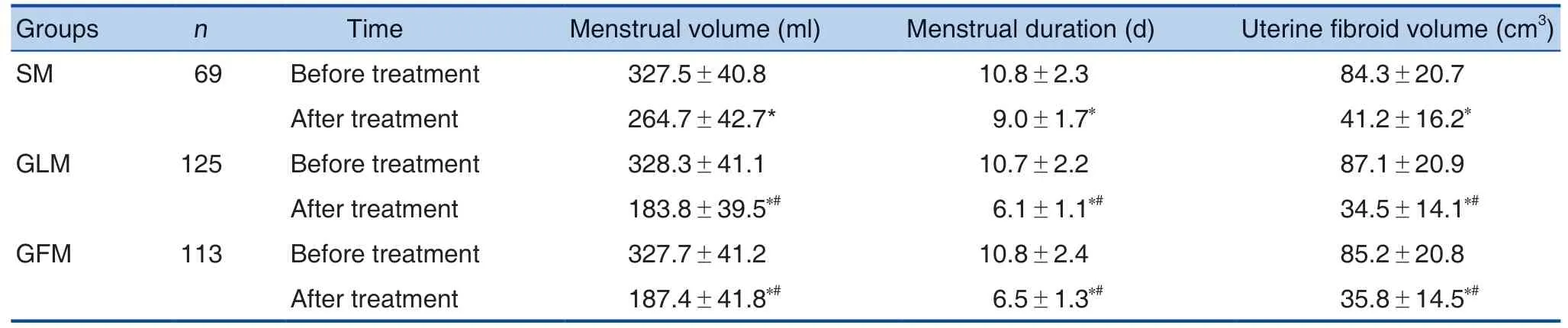
Table 2. Menstrual Volume, Menstrual Duration, and Uterine Fibroid Volume of 3 Groups of Patients (±s)
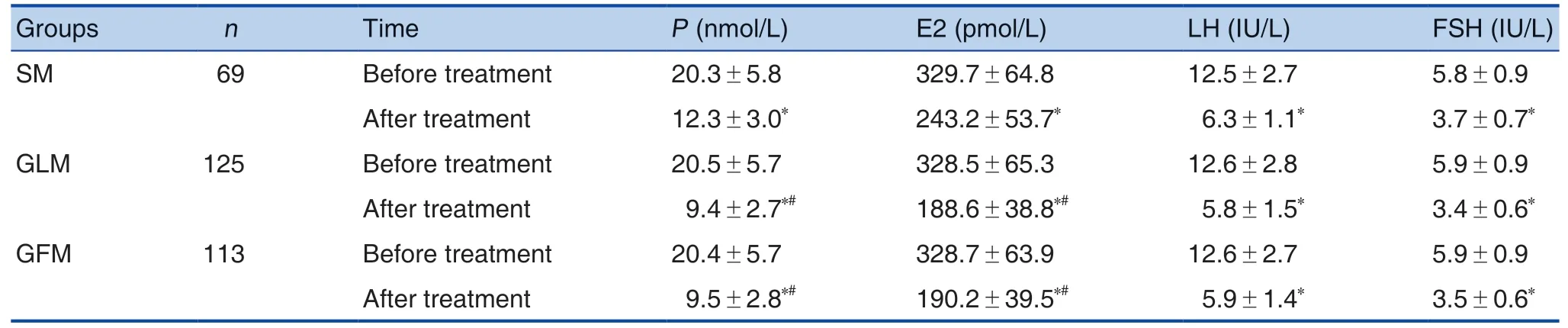
Table 3. P, E2, FSH, LH Levels of 3 Groups of Patients (±s)
Comparison of Menstrual Flow, Menstrual Duration, and Fibroid Volume Reduction
Before treatment, there were no significant differences in menstrual volume, Menstrual duration,and fibroid volume in each group (P>0.05). After treatment, the menstrual flow, Menstrual duration,and fibroid volume of the GLM and GFM groups were all smaller than those of the SM group (allP<0.05); there was no significant difference between the GLM and GFM groups (P> 0.05). See table 2.
Comparison of Changes in Estrogen Levels
There were no significant differences in related estrogen levels between the groups of patients before treatment (P>0.05). After treatment, the levels of P and E2 in the GLM and GFM groups were lower than those in the SM group (allP<0.05); there was no significant difference between GLM and GFM groups (P>0.05); there was no significant difference in FSH and LH levels in each group (P>0.05) . See table 3.
Comparison of Incidence of Adverse Reactions
A small number of patients experienced adverse reactions with mild symptoms, which resolved on their own after 1-2 days of discontinuation without affecting the actual treatment. There was no significant difference in the incidence of adverse reactions ineach group (allP>0.05). See table 4.

Table 4. Occurrence of Adverse Reactions of 3 Groups of Patients [n (%)]
DISCUSSION
The treatment goal of uterine fibroids is to reduce or eliminate fibroids in order to relieve or eliminate symptoms[6-7]. For older patients and patients who do not meet the indications for surgical exclusion, medications are usually used for treatment[8-9]. In addition, if the patient's uterine volume and fibroids are large, it will take a long time to operate, a large amount of bleeding during the operation, a high incidence of complications, and a slower postoperative recovery after operation.Usually, drugs are also used before surgery adjuvant treatment, alleviate the condition and reduce the difficulty of surgery[10-12].
The pathology of uterine fibroids is unclear in the field of western medicine, and it involves factors such as cell mutation in the myometrium and changes in estrogen levels[13]. It is now clear that the levels of E2 and P in its tissues are significantly higher than in other parts of the uterus.It is generally believed that E2 and P affect the related factors through their receptors and regulate the proliferation of uterine smooth muscle cells[14].Therefore, western medicine's drug treatment is to antagonize E2 or P to inhibit the growth of uterine fibroids and reduce or eliminate symptoms.Mifepristone is a strong anti-P drug, and its binding ability to PR is more than four times that of natural P in the body. It prevents competition of natural P and PR by competition, thereby blocking the proliferation of natural P on uterine fibroid cells. In addition,mifepristone can reduce the secretion of E2 and P,and also control the proliferation of uterine fibroid cells. But as mentioned before, the pathogenesis of uterine fibroids is related to a series of factors, not just P and PR. It has also been clinically found that PR levels in uterine fibroid tissue are low in some patients, and mifepristone is less effective in these patients. Related literature shows that[15-17], the total effective rate of SM in treating uterine fibroids is about 65% to 75%.
Uterine fibroids do not have a proprietary disease name in the field of traditional Chinese medicine, and should belong to the categories of Wei-Jia (癥瘕) and Shi-Jia (石瘕). The treatment is mainly based on promoting blood circulation and removing blood stasis and dissolving blood stasis[18-21].Gongliuqing Capsule (宮瘤清膠囊) contains ingredients such as Shudahuang (Cooked Rhubarb),Taoren (Semen Persicae), and Shuizhi (Hirudo).Guizhi Fuling Capsule (桂枝茯苓膠囊) contains the ingredients such as Guizhi (Ramulus Cinnamomi),Fuling (Poria), Mudanpi (Cortex Moutan Radicis),and has the effects of activating qi and activating blood, dredging collaterals and dispersing stagnation,absorbing clots and eliminating tumor. Clinically Gongliuqing Capsule (宮瘤清膠囊) and Guizhi Fuling Capsule (桂枝茯苓膠囊) have certain effects in treating uterine fibroids. Gongliuqing Capsule (宮瘤清膠囊) combined with mifepristone can achieve the effect of clearing blood stasis of meridians,and can also be used to eliminate blood of blood stasis[19-24]. And it can effectively promote the uterine contraction of patients, and has good anti-tumor, antiinflammatory, swelling, analgesic and hemostatic effects. Gongliuqing Capsule (宮瘤清膠囊) combined with mifepristone can reduce the volume of uterus and uterine fibroids, which will help later surgical treatment, reduce the degree of harm to the patient,and promote the early recovery of the patient[13,24-26].
In this study, integrative medicine therapy Gongliuqing Capsule combined with mifepristone,GuizhiFuling Capsule combined with mifepristone)were compared with SM in the treatment of uterine fibroids. The cure rate and total effective rate of the integrative medicine therapyhigher.And the cure rate of Gongliuqing Capsule (宮瘤清膠囊) combined with mifepristone was higher than the cure rate of Guizhi Fuling Capsule (桂枝茯苓膠囊) combined with Mifepristone, but there was no difference in total effective rate between the two regimens. In addition,indexes such as menstrual flow, menstrual duration,uterine fibroid volume, and changes in E2 and P levels were better than those of SM, while the levels of FSH and LH in the three groups of patients were not significant. There was no significant difference in the adverse reaction rate during the treatment.In summary, compared with SM, the integrative medicine therapy used in this study are safe and more effective methods for conservative treatment of uterine fibroids. And Gongliuqing Capsule combined with mifepristone has the highest cure rate.
 World Journal of Integrated Traditional and Western Medicine2021年1期
- World Journal of Integrated Traditional and Western Medicine的其它文章
- Review of the "International Alliance of Prevention and Treatment of Major Infectious Diseases with Traditional Medicine "Founding Conference
- World Integrated Medicine Master SHI Xuemin (石學敏)
- New Year's Message
- INSTRUCTION FOR AUTHORS
- Chinese Herbal Medicine Targets Mitochondrial Dysfunction in the Treatment of Psoriasis
- Potential Mechanism and Application of Strengthening the Spleen, Clearing Heat and Dampness in Treatment of Gastroesophageal Reflux Disease