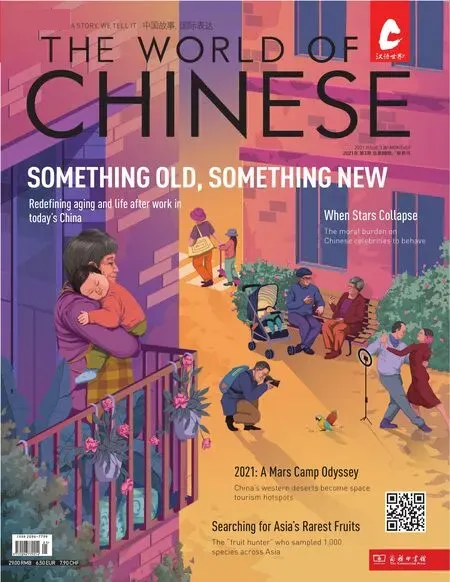
UNDER ONE ROOF
2021-06-18 07:03:56
漢語世界 2021年3期
As elders become their grandchildren’s primary caretakers, they face migrating to the city in their old age
At 3:20 p.m., Zhang Meihua can usually be found waiting at the school gate to pick up her 6-year-old granddaughter, clutching a basket full of fresh produce from the market.On the way home, she collects her other granddaughter, aged 3, from a relative’s house, then keeps an eye on both girls while cooking and doing housework until her husband, son, and daughter-in-law return home from work.
“Home” for Zhang these days is a 10-square-meter room in Beijing’s Haidian district crammed with two bunk beds, a small wooden table,and a gas stove.Until six years ago,though, Zhang and her husband lived in a spacious two-story farmhouse in Bozhou, Anhui province.After their first granddaughter was born, the couple moved to the capital to ease the burden of childrearing on their son and daughter-in-law.The family finances were tight, even with both parents working full-time, so Zhang’s husband, then in his late 50s, took up a job as a street cleaner to help out.
Traditional Chinese culture has long touted the concept of “four generations under one roof” as the ideal family structure, and 61-yearold Zhang claims migrating in their twilight years to be with their adult children is something “all” older people in her village do.“We don’t have jobs, just a few plots of farmland,so we might as well help our kids as much as we can,” she says.
According to the National Health and Family Planning Commission,about 18 million senior citizens over 60 years old, accounting for 7.2 percent of China’s total migrant population of 247 million as of 2016, have left their hometown for first-tier cities like Beijing for reasons such as job-seeking, retirement, and supporting their children.
The size of this elderly “floating”group climbed from over 5 million in 2000 to more than 13 million recorded in 2015, even as the total number of rural-to-urban migrants declined.A study from the Commission reveals that 43 percent of the elderly migrants—colloquially known as 老漂族 (lǎopiāozú, “elderly drifters”)—are moving to help raise their grandchildren in a way that eases the burden of their overworked children.
In a 2004 paper titled “Responsibility Ethics and Family Nursing of Urban Residents,” Yang Shanhua,a sociology professor at Peking University, noted that these trends are based on traditional Chinese beliefsthat parents have an obligation to help out their offspring financially,physically, and emotionally, even after they start their own families and careers.These ideas tend to be much more prominent in the countryside.“In my hometown, [it’s believed] an elderly person should take care of their grandkids.If not, others will call them heartless, and say they deserve it if their kids abandon them in their old age,” says Zhang.
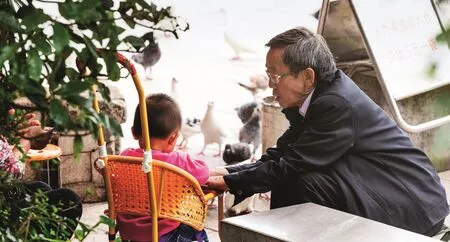
An elderly resident takes care of a child at a park in Qujing,Yunnan province
But behind this seemingly idyllic family support structure, elderly migrants face a variety of struggles.A report by the Chinese Academy of Social Sciences on “Beijing Social Governance and Development” in 2016 noted that elderly migrants can become “invisible” in their adopted homes because of differences in language and social habits, and lack a sense of belonging and trust.A 56-year-old retiree from Hebei province surnamed Liu, who was initially reluctant to talk to TWOC,confesses that she avoids talking to strangers because she fears being scammed or shamed.“Once, I tried to get a word in with a group of grandmas who were chatting while watching their grandkids,but everybody fell silent, and some laughed at my accent, and then they changed the subject,” recounts Liu.
In some cases, caregiving takes a physical toll.Wang Rui, a 67-year-old retired chairman of a labor union in a liquor factory, left Harbin for Beijing in 2014 to take care of her newborn grandson.Because Chinese citizens can only get reimbursed by state medical insurance if they are treated in the same locality as their household registration, Wang’s medical expenses are exponentially higher in the capital.“I have high blood pressure and other chronic diseases, and last year when I was in the hospital, my daughter had to pay all the expenses since my insurance isn’t available in Beijing,”clucks Wang, who also has to pay for medicine out-of-pocket.
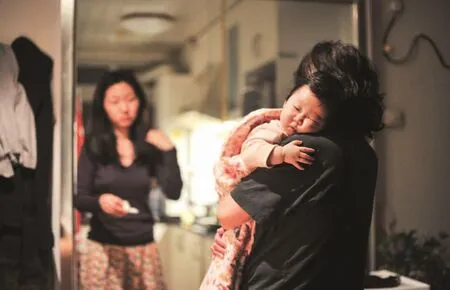
Grandmothers tend to play the primary caregiver role more than grandfathers

Elderly caregivers frequently babysit their grandchildren on the weekends as well
Living with their adult children also leads elders to lose their autonomy.Zhang complains that her son and daughter-in-law rarely talk with her in the evenings, preferring to watch short videos on their phones—unless it’s to squabble with her about dinner plans, money, or childrearing methods.Elderly grandparents and young parents, raised in different eras and often under vastly different economic circumstances, may have diverging ideas of how best to educate and communicate with children, or even how to dress and feed them.
Zhang says after every quarrel with her daughter-in-law, she resolves to quit being the family’s nanny and go home,only to relent when her granddaughter calls out for her.Amendments to China’s family planning policy in 2015,which allow urban couples to have a second child, also ended Zhang and her husband’s dream of escaping their adopted home.Before this, “I used to console myself that, after just a few years, once my granddaughter started kindergarten, I could go back home and never be a punching bag again,”she sighs.
Living in an unfamiliar city can be a lonely experience for seniors.“In our spare time, we just stay at home,watch TV or go to the market,”says Wang, who tells TWOC she misses being able to stroll out of her home, pay visits to neighbors in her hometown, and go on outings with her friends and relatives.
The mental toll of migration among the elderly is underreported.In an interview with local news in 2017, Quan Yanling, a psychologist at Shaoxing Central Hospital in
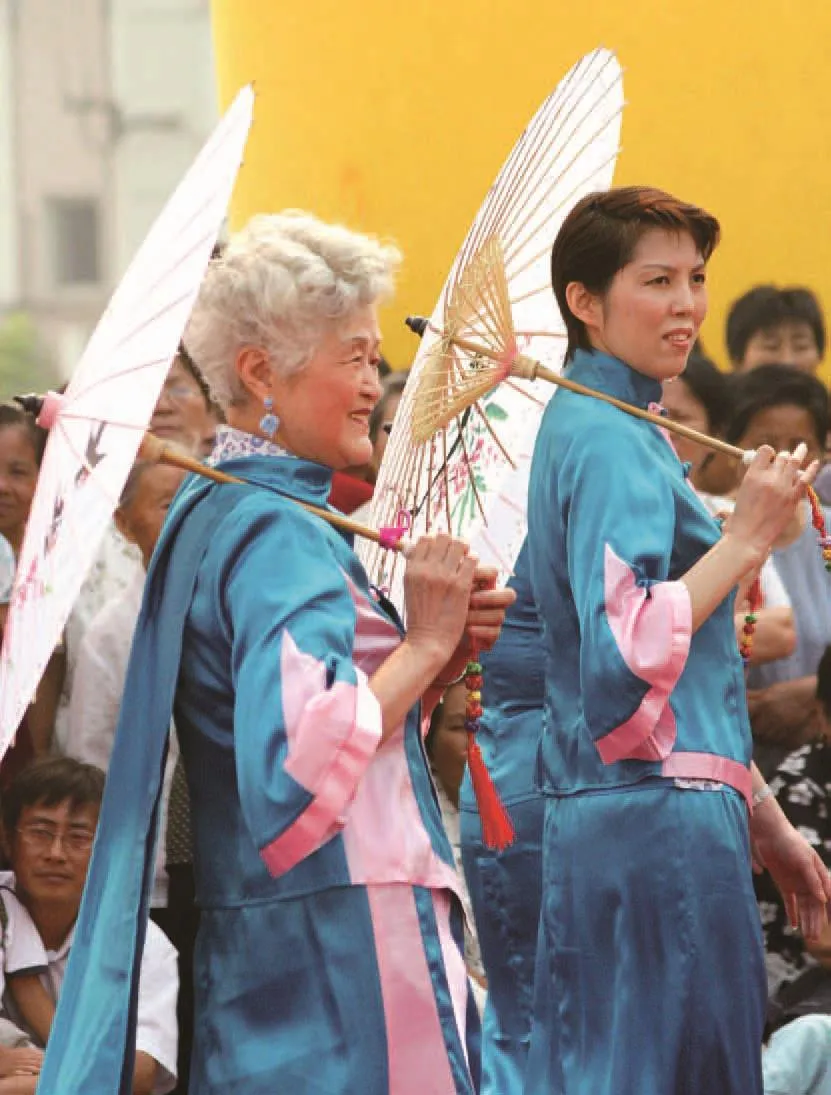
A fashion show for elders organized by a residential community in Nanjing
Zhejiang province, estimated that over 70 percent of elders treated for depression and anxiety in her department every day are primary caregivers of their grandchildren, and suffer from the stress of childcare,exhaustion, and inattention from their own children.
Grandparenting has also been linked to sleep problems.Elders like
Zhang often sleep in the same room Advertisements and “shopping
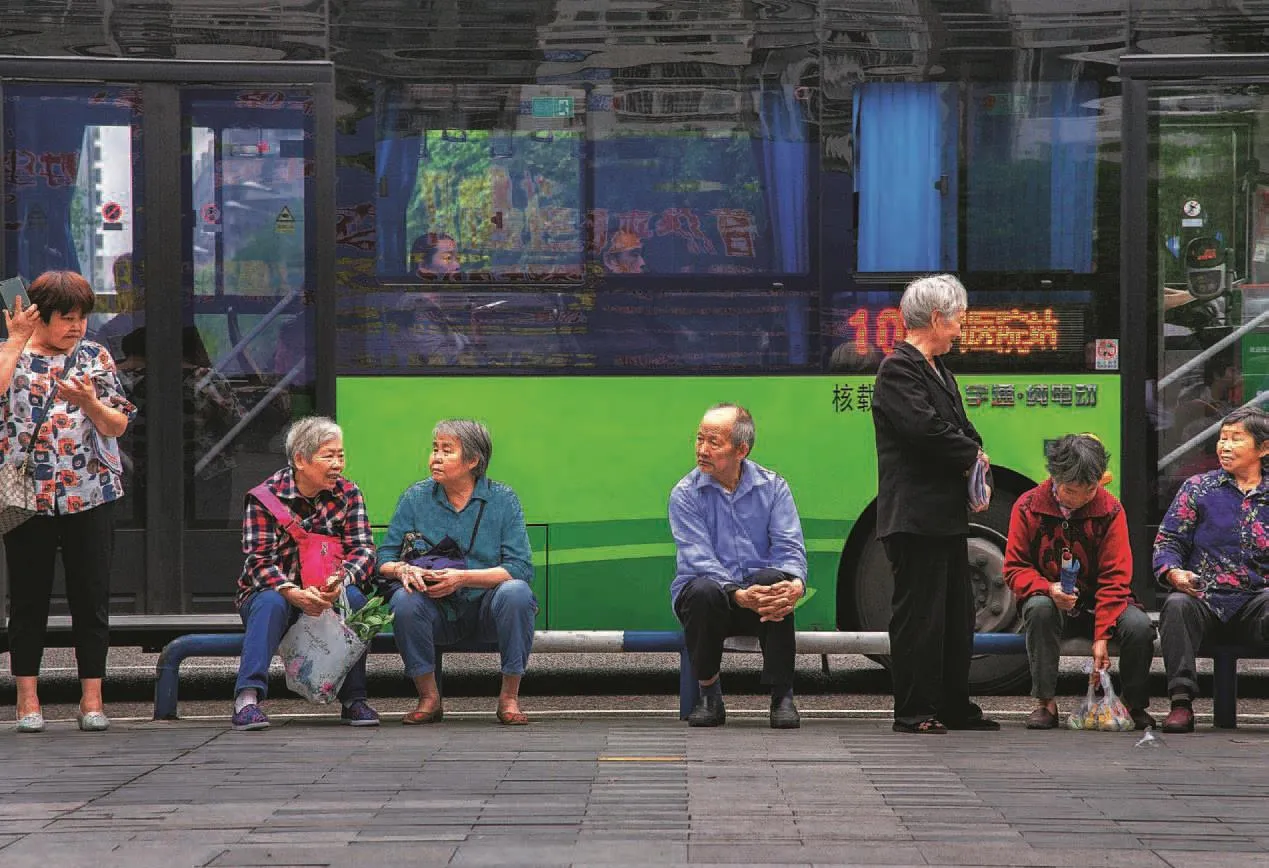
Living in a strange city, elderly migrants feel alone with few friends around
festivals”put pressure
on Chinese consumers to
spend as their grandchildren, take care of their needs during the night,and get up early in the morning to cook breakfast for the family.Zhang Changyong, director of the Hubei Sleep Research Society in Wuhan,found that around 30 percent of the 30 to 40 elders his department treats every day for insomnia were affected by caring for grandkids.
Migration can even lead to separation of elderly couples.After 38 years of marriage, Yang Yanping and Wang Gang from Lu’an,Anhui, now have to live apart in order to take care of the grandsons born to their two children, who live in different cities.“I’m worried about his high blood pressure,”the 59-year-old Yang says of her husband, “but how can we play favorites among our grandsons?”
Some cities have started initiatives to help migrant elders find a community in their adopted home.
“Lots of elderly migrants lead monotonous lives, doing the same kind of chores every day—grocery shopping, cooking, and taking care of kids,” stated a notice in a residential committee this April in Dongguan, Guangdong province.The committee started a choir,a smart phone study group, and monthly health care activities to add variety to seniors’ lives outside their family duties.
Wang says she finds happiness by being with her daughter and son-in-law, whom she missed while living in the northeast, and watching her grandchildren grow up.“Every time when I get ill, my children take me to the hospital without any delay.If I was back in my hometown, I might just put off going to the doctor,” she says.“During the pandemic, when I had difficulties getting a [mobile] health code [used for entering public venues], my daughter helped me learn to use a smart phone.”
Still, Wang has mixed feelings about whether to stay or go.“My daughter and son-in-law are very considerate, but in the end, this is not our home,” she says.“We miss home so much…But [our daughter]is our only child.If we don’t help her, who will? And, we love our grandson so much.We’re reluctant to leave him after all this time.”
Liu is still counting the days until she can go back to Hubei.“Here,I have to be careful with everyone and everything.One day, when they no longer need me, I will go back home,” she says as her grandson sits in the baby carriage, babbling.