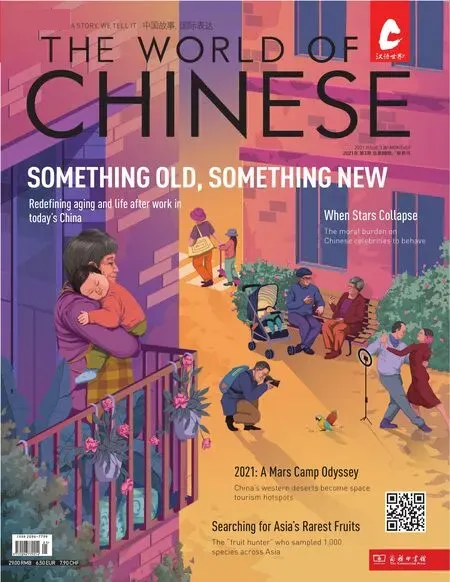
SEARCHING FOR ASIA’S RAREST FRUITS
2021-06-18 07:04:12BYWANGLIN王琳
漢語世界 2021年3期
BY WANG LIN (王琳)

Fruit hunter Yang Xiaoyang has sampled 1,000 weird and wonderful species in his journeys across China and Southeast Asia
“水果獵人”楊曉洋的奇珍異果搜尋之旅
While an average person may taste no more than 50 varieties of fruit in a lifetime, 33-year-old Yang Xiaoyang has sampled over 1,000 rare fruit species in just over a decade.
Since 2009, Yang has ventured to hundreds of rainforests in search of exotic fruits, ranging from the colorful finger lime that tastes like caviar, to the Javanese Keppel apple that leaves the eater’s body smelling of violets.“People call me a ‘fruit hunter,’ but I’m just having fun,” Yang tells TWOC over the phone from Guangzhou,Guangdong province.
Yang is not a scientist, but a selftaught plant “encyclopedia.” Over the past decade, he has seen over 30,000 plant species, one-tenth of the world’s total.He especially enjoys tasting new fruits and sharing his discoveries with over four million followers on Weibo,where he is a popular science blogger,and on Baidu’s Baijiahao platform,where he publishes videos of exotic fruit samplings that have attracted up to one million views.
Each video usually focuses on one exotic fruit.Yang tells his audience how to pick, store, and enjoy it, with a smattering of fun anecdotes from his fruit-hunting adventures thrown in.Each video rounds off with Yang cutting open and tasting the fruit.
Talking to TWOC, the fruit hunter’s passion shines through as he dives into tangents and trivia about his favorite fruits—like how the sweetest fruit in the world,Thaumatoccus danielli, is 3,000 times sweeter than sugar.“If you eat this jelly-like fruit and then drink water, even the water will taste like sugarcane juice,” says Yang.
Born in a village near Anyang,Henan province, Yang was a quiet child who spent hours observing plants.He was also curious to see the world outside.In 2008, Yang won a scholarship to study precision engineering at Singapore Polytechnic University.His family encouraged him,as they considered engineering a solid and respected profession.
While studying in this tropical paradise with over 20,000 plantspecies, Yang discovered nature’s greatest engineer—plants.“Humans cannot compete with their level of precision, design and fluid process,”he enthuses to TWOC.Yang would spend his spare time exploring botanical gardens or nature reserves,even joining an online group of avid plant lovers to boost his botanical knowledge.
His then-girlfriend teased that his real crush was plants.But actually Yang fell in love with fruits, calling them “the love language of plants.” “When I eat a fruit, I feel like [I’m] communicating with a plant,” Yang says.“No other language is sweeter than the fruit.”
In 2009, Yang started exploring rainforests, the planet’s oldest living ecosystem and home to over half of the world’s plant and animal species.Every expedition is a lucky draw.Sometimes, the rainforest would surprise him with a fruit more interesting than his original quarry.He would take photos of the fruit, and cut it open to examine the insides, try a fingernail-sized amount, and record the flavors and textures on the spot.

Clockwise from top left: Elaeocarpus sphaericus (yuanguo duying in Chinese);elephant apple (Dillenia indica) from the Philippines; Salak from Indonesia; Saurauia amoena; red durian (durian sukang)
After a tough day in the rainforest,says Yang, nothing beats the feeling of slurping on red-fleshed durian, or durian sukang in the breeze.Durian,the “king of fruits” in Southeast Asia,attracts both love and hate for its strong smell.As a durian lover, Yang has tasted more than 100 types of the pungent fruit, and says some of them taste like spices, coffee, and even chocolate.He once booked a flight to Malaysia immediately after hearing that a friend had found a rare durian there.He has also opened an online durian shop on Taobao.
In 2014, Yang’s passion landed him a job with the South China Botanical Garden under the Chinese Academy of Sciences in Guangzhou.Part of his work was coming up with Chinese names for Southeast Asian plants and fruits.“Once I named [a species] ‘bean paste fruit (豆沙果),’ because it tastes like our red bean paste dessert,” says Yang, who has given over 2,000 plants and numerous fruits catchy Chinese names based on their taste, appearance,or local name.
After his return to China, a friend gifted himThe Fruit Hunters, a book by Canadian writer Adam Gollner which documents the extraordinary universe of fruits and the smugglers, inventors,and explorers inspired by them.It was the first time he learned about “fruit hunters,” botanists who sailed around the world documenting new botanical finds before the 20th century (including Charles Darwin and Robert Fortune,the British “tea spy” who smuggled the seeds of thethea sinensisplant out of China in the 19th century).


But fruit hunting is not always a sweet job.In the mountainous rainforests of Southeast Asia, Yang has encountered pythons, crocodiles,clouded leopards, and even tigers.“Once on Sumatra island I was walking slowly to record everything.My guide got impatient and said he would wait in front.After two hours,I still couldn’t find him.Instead, I noticed huge paw prints in the mud,”Yang recalls.
When he dashed to the foothills, he saw his guide sipping coffee lazily.“Ja,that’s our Sumatran tiger.He won’t hurt you unless he is hungry,” the man said calmly.
Sometimes, though, sweet success comes at unexpected moments.One morning, he was searching for Malaysian jackfruits that grow on very tall trees, and saw some monkeys enjoying breakfast up among the branches.“A monkey looked at me and I looked at him.Then he threw a jackfruit at me.It was ripe and very sweet,” Yang laughs.“Perhaps he thinks I am a monkey too.”
Yang arranges his trips according to harvest seasons, generally from June to August and from December to February.Before 2015, Yang had spent more than 500,000 RMB(76,400 USD) out of his own pocket in his fruity quest.Now, he is signed with Baidu as a content creator, and focuses on fruit-hunting and blogging full-time.He has also published a book,A Fruit Hunter in Southeast Asiaand appeared in the documentaryThe Legend of Fruit.


Clockwise from top left: Tylophora arenicola in the rainforest; rafflesia, the biggest flower in the world; Couroupita guianensis; Titan arum (corpse flower); endangered lodoicea(sea coconut), which Yang has removed from his fruit-hunting list
Last October, Yang’s own documentary series,Fruit Hunter Yang Xiaoyang, was released on the Baidu and Haokan streaming apps, and garnered over 15 million views within the first month of release.The series takes viewers on a mouthwatering journey through the people and fruits of northern and southern China.In the southwestern province of Yunnan,Yang shares “rouge fruit (胭脂果)”with local children, teaching them how to paint with its magenta-like juices.In Jilin province in China’s northeast, Yang connects wild berries growing in the Changbai Mountains to the resilient character of Chinese Koreans living in the frigid area.In Guangdong, Yang shares the tasty local tip of dipping lychees in soy sauce, creating a sweet and sour flavor.

Yang is one of many young Chinese influencers finding success on social media by airing traditional skills or nature-themed lifestyles.Guangxi’s“village supermodel” Lu Xianren is also in this vein, along with traditional carpenter “Grandpa Amu,” and Li Ziqi, the Sichuanese vlogger whose bucolic videos of rural life enchant millions on Weibo and YouTube.
However, Yang says his biggest success was when an aunt in Henan,who always disparaged his passion as“just playing,” called to say she had found one of his videos on Baidu while searching for tips on choosing mangosteens, and had told all of her mahjong buddies.
For those who want to get started in fruit hunting themselves, Yang suggests creating a fruit calendar.“Every month, you can explore seasonal fruits in the markets [close to home] and become more aware of what’s available.That’s how you grow your fruit knowledge little by little.”Though most people simply take fruits for granted, there is still so much left unknown.“I am creating a foodie’s guide to fruits in China,” says Yang.