
Diyag People Know Where to Call Home
2021-06-20 01:09:21ByZHAOSHUBIN&WENKAI
CHINA TODAY 2021年5期
By ZHAO SHUBIN & WEN KAI
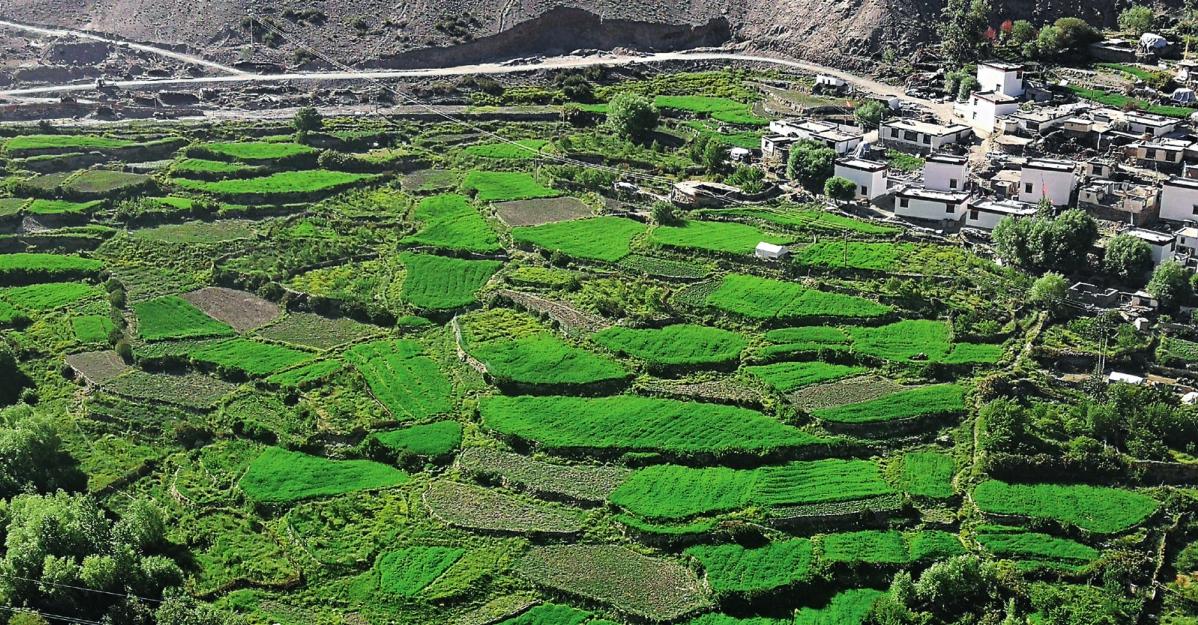
DIYAG Village of Ngari Prefecture is located in the westernmost part of Tibet Autonomous Region. The Xiangquan River has created a canyon and oasis here and then continued to flow into India through the Himalaya Mountains.
Hidden among rugged steep mountains, in the past, it was sealed off from the rest of the world by the heavy snow fall every year until spring came the following year. It seemed impossible to get out and travel beyond their local mountains to the closest Zanda County, which is about 200 kilometers away. Today though, asphalt roads have been paved to Diyag, connecting it with the outside world.
Ngodrup Palden, 78, once lived a poor life overseas when he was a child, but then returned to his homeland and become the first person to plant a white apricot tree in front of his ancestral home in Diyag. Yang Guifang, 62, came to and settled in Diyag from Jiangsu Province on the east coast of China some 25 years ago and has made Diyag his second home. Dekyi Chodron, a junior university student, left her home in the mountains and traveled across half of the country to study at Hainan University in the southern corner of China, and is now pursuing a happy life.
These three individuals representing different generations share a common affection for their home Diyag.
Returning to the Roots
“My life was particularly hard during the years when I lived and worked in Kashmir, India, and Nepal. I lived like a beggar!”Ngodrup Palden said. He was born in Sibgyi Village in the foothills of Lakema Mountain on the Sino-Indian border. Later he traveled abroad where he lived for six years from 1962 to1968. Recalling his experience of more than half a century ago, the old man still sighs with agony.
“My father was alive back then. He sent a message to me and said that my ancestors have lived here for generations and that I should return soon since life here was getting better,” he said. Now, Ngodrup and his son Gangzhu Dorje live comfortably in a new home equipped with modern commodities in a well-off village on the border. Outside the window, towering trees and snow-capped mountains can be seen not too far away. The old man looked at his son as he reflected over the past, involuntarily repeating the sentence his father had said to him 60 years ago,“Your family roots are here!”
Wearing a short-sleeved shirt, the 42-year-old Gangzhu Dorje leaned against the door and listened intently. The difficult past life of his father is so different from that of the modern generation. Since Chinas reform and opening-up, especially the 18th National Congress of the Communist Party of China in 2012, this border village in Tibet has continued to change with each passing day. Paved roads now reach their doorstep, border residents are receiving ever increasing government subsidies, and education and medical care is guaranteed. The hard time of his fathers vagrant life in the past is sharply contrasted by the present good days of living and working in peace and contentment. A sly smile came to Gangzhus face when he heard his fathers heartfelt statement that“his happiest time of life is today.”
Located on the slope outside the house, an orchard filled with lush white apricot and apple trees gleamed in the sun. White apricots are a local specialty. Gangzhu pointed to the oldest tree, and proudly said that it was his father who brought this fruit to Diyag.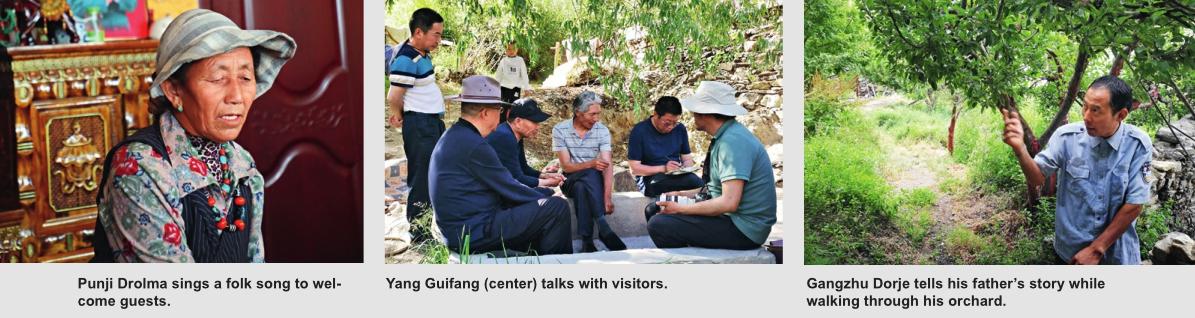
Diyag has a tradition of growing fruit trees. Back in 1985, Ngodrup Palden traded five kilograms of ghee (yak butter) and three goats for 200 white apricot saplings from an Indian merchant. He gave some of those saplings to neighbors, and planted others on a small piece of land in front of their ancestral home. Today, apples, apricots, and apricot wine support Diyags characteristic industries and serve as an important source of revenue to help border residents achieve prosperity.
Gangzhu removed some of the weeds from under the trees. Thanks to his arduous care, the apricot trees have continued to remain fruitful year after year. He looked at the Five-Starred Red Flag flying over the roof and said with emotions, “The country is in my heart! With the help of the Party, we can now enjoy a quality life that our grandfather and father could never have imagined. It is our duty to guard our hometown!”
From Alien Land to Hometown
Yang Guifangs hair is now gray and fluffy, and he speaks with an accent from his hometown of Xuzhou, Jiangsu Province. Yang and his wife, Tseji Drolma, were drying the freshly picked apricots with his grandson in their courtyard.
Yang was originally an accountant of a construction company in Xuzhou. In 1996, he came to Diyag for the first time with a construction team that repaired border defense facilities. The kind-hearted man always tried to help people who are in need. However, bad luck fell on this good heart. At the age of 19, he lost his love to leukemia. Devastated by her death, Yang made up his mind to stay single for the rest of his life. But his life took a different turn when he met Tseji Drolma while working in Diyag. Tsejis husband passed away some time earlier, leaving her with two children. The kind but heartbroken Yang could not help but feel pity for Tseji who also experienced emotional ups and downs. In the end, the two of them fell in love with each other.
In 1997, Yang and Tseji returned to Xuzhou to tie the knot. However, Tseji found it difficult to get used to life there. In the end, in order to provide a comfortable living environment for his wife and children, the considerate Yang bid farewell to his parents and relatives and moved with his wife and children back to Diyag. Yangs life changed remarkably from an accountant to a Tibetan farmer.
Yang and his family live on half a hectare of land and several heads of cattle and sheep. He learned how to live like the locals. They took their animals out to graze in the pastures and inspected the frontier either on foot or on horseback. He learned to use the Tibetan sickle, which sadly left a scar on his hand when he was learning to us it. He also helped locals repair roads and build bridges. Living as remotely as they did, he didnt receive the news of his dying parents in time to say goodbye to them. As such, he lit a butter lamp to mourn them thousands of miles away. “I cannot go back, because my home is here,” he said. From a shack to a stone building, a new house built with government subsidies, and then to the current well-furnished house, Yang moved four times during the 24 years he has lived in Diyag.
Yang has quite a close relationship with his grandson Palbar Chogyal and gave him a Mandarin name, Yang Changmin, hoping that the people living on the border of China would always be prosperous and happy.
From Mountains to the Coast
Dekyi Chodron, a Tibetan girl in her 20s from Diyag, now studies at Hainan University in south Chinas Hainan Province. The distance between her school and hometown is more than 5,000 kilometers.“The country is developing at leaps and bounds. We have grown up happily in the embrace of our motherland, and we feel a deep sense of pride as students coming from border region,” she said.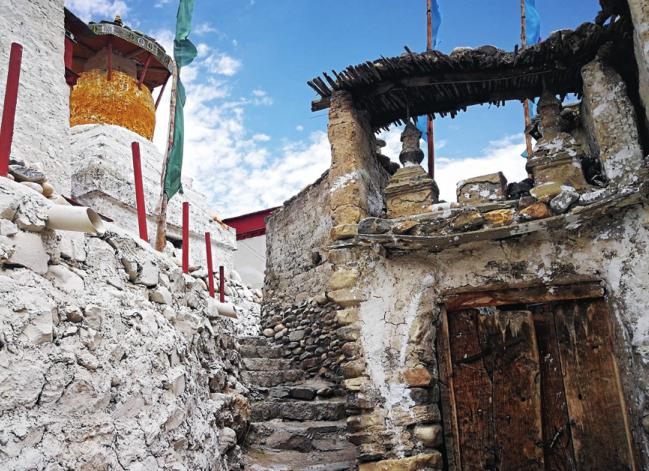
A visit to her home began with a light and slightly milky drink. The home-brewed apricot wine is typical of the hospitality of the Diyag people. When she asked her grandma Punji Drolma to sing a folk song to welcome guests, the cheerful and outgoing Dekyi continued to fill the cups with apricot wine to liven up the atmosphere. Knowing that only her grandma can sing particular songs heightened the expectation of Dekyi and the guests.
“The scenic valley is like a tent; Diyag is surrounded by clean mountains and crystal waters, and a story of three sisters from there is told...” The melodious folk song tells a legend: During the Gurga Kingdom period, three sisters in Sibgyi Village planned to hike to the Toling Monastery, but the two elder sisters were deterred by the high mountains, leaving the youngest sister to arrive at the final destination alone carrying apricot oil, a specialty of her hometown, on her back.
Different generations tell different stories, but they all share a common theme: happiness. The local peoples deep love for their hometown has grown stronger and more intense generation by generation.
- CHINA TODAY的其它文章
- Integration Key to Asia’s Sustained Economic Recovery
- Photography Exhibition on Xinjiang Opens in Beijing
- China to Cultivate National Industrial Parks Specializing in Processing Trade
- President Xi Jinping Attends Video Summit with French,German Leaders
- All Ethnic Groups as One Family
- Konghou:A Surviving and Evolving Musical Aristocrat