
Modern Revival of an Ancient Opera
2021-06-20 01:25:55ByTOBTSANGNYIMA
CHINA TODAY 2021年5期
By TOBTSANG NYIMA
WITH a history of at least 600 years, Ti- betan opera has been dubbed “the living fossil of traditional Tibetan culture.” Having been inscribed on both the national intangible cultural heritage list of China and UNESCOs intangible cultural heritage list, the ancient opera has gained many modern devotees.
Owing to local peoples passion for the opera and government support in its preservation, this ancient cultural treasure continues to shine in modern times.
Legendary Evolvement
Tibetan opera, called Aje Lhamo (fairy sisters) in Tibetan language, boasts a history of more than 600 years, about 400 years longer than another wellknown Chinese cultural treasure, the Peking opera.
In the 14th century, Drupthob Thangtong Gyalpo, a high-ranking monk and iron bridge builder, decided to build iron bridges across many key rivers in Tibet to improve local transportation.
He trekked all over Tibet to raise donations to fund the bridge projects. While on his travels he noticed that Tibetans all loved the local opera.
To collect more donations, he recruited seven beauties from Tibets Qonggyai County to perform at his fundraising events. The girls were all good at traditional Tibetan style singing and dancing.
Thanks to the contribution of the seven girls, donations were easily raised wherever they put on a performance, and all the donations were used for bridge building, metal smelting, and labor costs.
With the proliferation of iron bridge construc-tion, Thangtong Gyalpo and his performance troupe became famous, and officials across the region came to him for bridge orders. Tibetan opera is believed to have originated in this way, and thus Thangtong Gyalpo is considered the father of this art form.
Thangtong Gyalpo was a talented architect, metallurgist, and artist. During his reported 125-year life span, he constructed 58 iron-chain bridges in Tibet.
Today, to honor him, a salute to his statue precedes each Tibetan opera performance, which usually concludes with the presentation of the hada(a traditional white ceremonial scarf representing purity and honesty) by the performers to audience members.
During the reign of the fifth Dalai Lama in the 17th century, Tibetan opera was separated from religious rituals and became an independent dramatic form.
Generally, there are eight types of storylines about Tibetan opera practiced in different areas. They can be about Tibetan history, Buddhism, and ancient legends of heroes.
As an important Chinese cultural heritage, Tibetan opera is often performed at important national events, such as the Beijing Olympic Games in 2008 and the Shanghai World Expo in 2010.
A Unique Art Form
Traditionally, the Tibetan opera theater was an open circular space sheltered by a canopy, with the stage defined by a magical circle and central altar.
Apart from the major events mentioned above, Tibetan opera is traditionally performed on many local occasions, such as Tibetan New Year, the Shoton Festival, horse races, harvest celebrations, or religious rituals.
Today Tibetan opera does not necessarily require a fixed stage for performance. An open ground in the middle of a village, a clearing in a forest, inside a big tent or under a big canvas, can all be suitable to stage the art form. The opera also doesnt require stage settings or a curtain during the performance.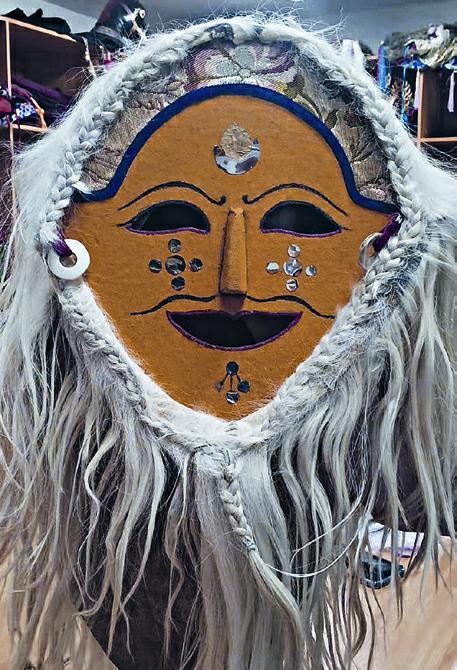
A distinctive feature of Tibetan opera lies in the fact that it is performed with masks from the beginning to the end. The duration of performances varies from less than two hours to as long as seven days. Tibetan opera can generally be divided into the old school and the new school. The four most popular blue-mask sects, namely the opera troupes of Jormolung, Jongba, Shangpa, and Jangar, belong to the new school. The old school mainly refers to the whitemask sects, plus those of the yellow mask.
Tibetan opera is usually composed of three main parts, the prelude, the main body, and the conclusion. First, a narrator makes an opening statement to indicate that the performance has begun; second, all performers work closely to perform a story with songs and dances; third, the narrator makes a closing speech.
Tibetan opera incorporates more than 20 different singing tunes, as each tune represents a different gender, age, emotion, plot, and character.
The various dancing gestures include climbing, sailing, flying, sailing in the sea, horse riding, fighting evil, and paying homage to the Buddha.
There are usually 16 actors in a traditional Tibetan opera, made up of seven hunters, seven fairies, and two kings. It is believed that the 16 different figures originated from Chogyal Norsang, one of the eight traditional Tibetan opera storylines.
Modern Development
Despite the availability of multiple entertainment options in modern times, rural people in Lhokha are still fond of the ancient opera.
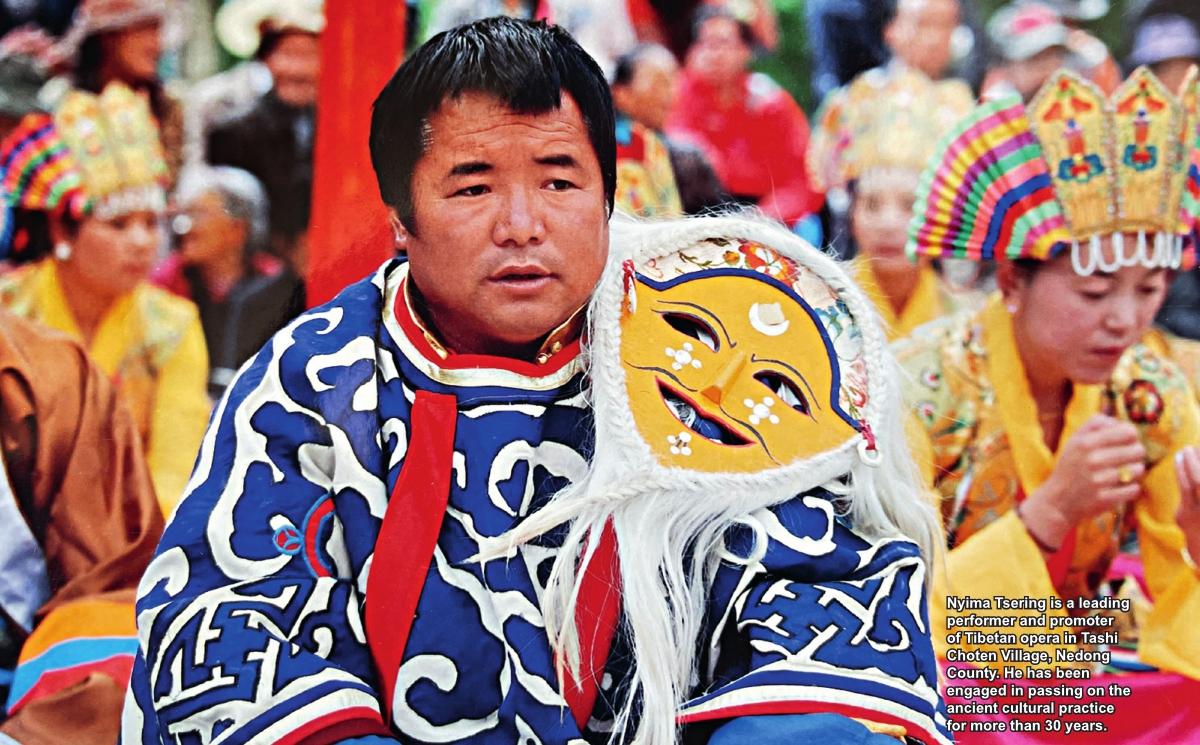
Tashi Choten Village in Nedong County of Lhokha City, Tibet Autonomous Region, is famous for its unique Tibetan opera, known as the Yarlung Tashi Sholpa, and the village is famed as the Opera Village. The Tashi Sholpa Tibetan opera is distinguished by actors wearing yellow masks.
Nyima Tsering is a leading performer and promoter of the opera form in Tashi Choten. He has been working hard to pass on the ancient cultural practice for more than 30 years.
The 49-year-old is the 11th generation of his family clan engaged in Tashi Sholpa Tibetan opera. Thanks to his efforts, he was accredited as a national-level inheritor of this intangible heritage in 2006.
“I have learned different singing tunes of different characters of the opera since I was a boy. I learned this from an old woman while we were herding together on the mountain,” said Tsering.
“At the age of 16, I was accepted by the opera troupe in our village, because I was very good at remembering all different types of opera scripts,” he said.
Instead of performing with 16 actors like other opera schools, the Tashi Sholpa opera requires 14 performers. Five perform in the prelude, and the other nine people join the rest of the play from the main section to the conclusion. Tsering directs the opera and performs the role of the king.
“The development and promotion of the opera, and the Tibet culture as a whole, is a great example of the benefits of the countrys reform and openingup policy, which was introduced in the late 1970s,”said Tsering.
According to him, there were only 16 opera actors in his village before 1968, and the opera troupe stopped performing for almost two decades afterward.
From 1987, a new opera troupe was set up to revive the art form, and it has continued to grow through the efforts of Tsering during the last few decades. Now the village has 30 professional opera actors, including 16 males and 14 females. Aged between 22 and 51, they are all farmers from the village.
Through most of the last three decades, his village opera troupe had been playing only the yellowmasked opera of Chogyal Norsang.
In 2017, the opera troupe adopted for the first time another Tibetan opera school, the blue-masked opera, and since have successfully played Drowa Sangmo, another one of the eight traditional Tibetan opera storylines.
In 2020, they added the blue-masked Tibetan traditional opera Pema Wopar to their repertoire. The two newly added storylines are played by 16 actors. An important change is that the length of each performance has been shortened as modern audiences have increasingly shorter attention spans.
As per tradition, the opera in Tserings village is performed during the New Year festival, harvest celebration rituals, various official events, and the annual Shoton Festival of Lhasa.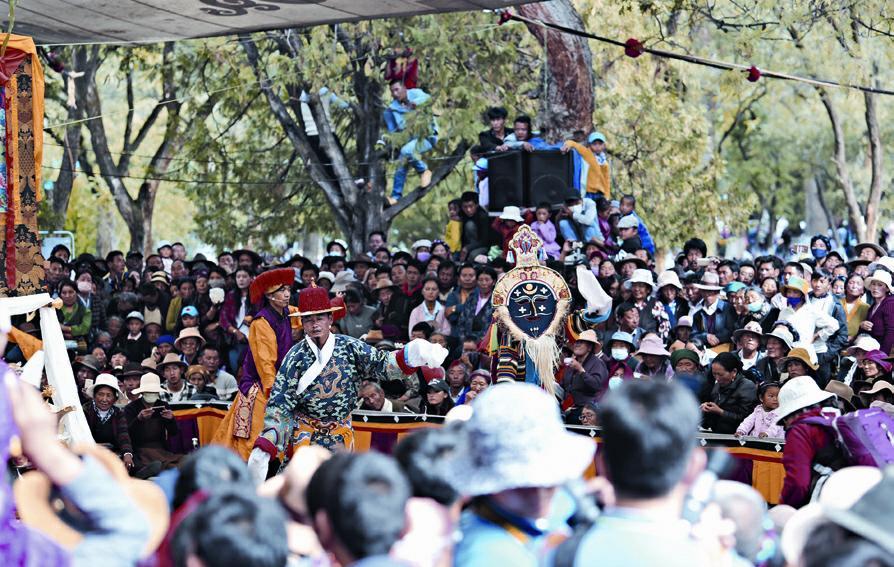
To assist with the continuation of opera preservation, the government began providing financial support, giving the troupe an annual subsidy of between RMB 40,000 and RMB 200,000, starting from 2011. According to Tsering, his county now has more than 150 opera actors in six opera troupes. Apart from his troupe, the other five all belong to the blue-mask school.
Another stimulus for the resurgence of the ancient opera in Tserings village is tourism. The village has set up a performance team for tourists.
“Our village has become a tourist attraction now. Tourists come to our village because they love watching opera and traditional Tibetan dances and songs,”he said.
Thanks to the tourism industry, now each of our opera actors receives a monthly salary for their involvement, said Tsering, adding that many villagers have begun to operate family inns to accommodate tourists.
Tsering plans to bring Tibetan opera to more villages in Tibet. He also hopes that more people, especially the youth, will grow to love this ancient art form. He has been invited to teach opera in his villages primary school.
“I hope Tibetan opera will be practiced in more villages of Tibet, and the ancient cultural practice will continue to be a shining star in the modern world of art performance,” he said.
- CHINA TODAY的其它文章
- Integration Key to Asia’s Sustained Economic Recovery
- Photography Exhibition on Xinjiang Opens in Beijing
- China to Cultivate National Industrial Parks Specializing in Processing Trade
- President Xi Jinping Attends Video Summit with French,German Leaders
- All Ethnic Groups as One Family
- Konghou:A Surviving and Evolving Musical Aristocrat