
Tibetan Monasteries and Thangka Art
2021-06-20 01:25:55ByAHREN
CHINA TODAY 2021年5期
By AH REN
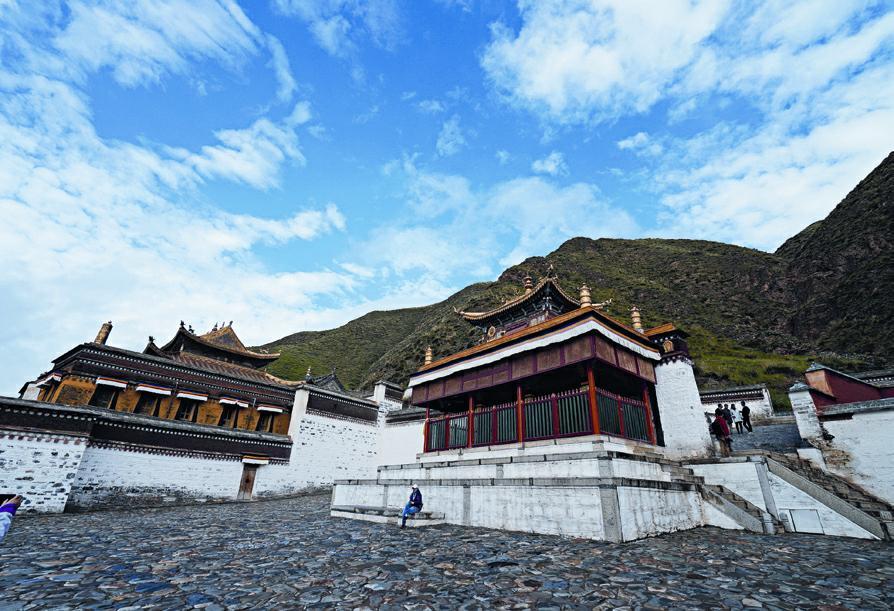
IN the western suburbs of Xiahe County, Gannan Tibetan Autonomous Prefecture, Gansu Province right at the foot of the Fengling Mountain lies the exquisite Labrang Monastery. A world renowned institution of higher learning for Tibetan Buddhism, it is one of six major monasteries of the Gelug School of Tibetan Buddhism.
In Qinghai Province, the waters of the Longwu River that flow through the provinces southern part renew and nourish a mystical region called “Rebkong” in Tibetan language. This artistically fertile land which is well known for thangka art is also the homeland of various beautiful ethnic cultures. The vibrant ambiance of Rebkong can be felt throughout the design and adornment of resplendent temples, study rooms containing multitudes of spiritual books, brightly lit thangka art studios, and abundant love by the local people for ethnic culture.
Labrang Monastery
The name “Labrang” means “mansion of the living Buddha master.” It was built in 1709, the 48th year of the reign of Emperor Kangxi during the Qing Dynasty(1644-1911). More than just a singular temple building, it is a sprawling complex of buildings matched only by the Potala Palace of Lhasa. All together the monastery contains over 90 buildings with nearly 10,000 rooms, including six colleges, 16 Buddha halls, 18 Nangchen (living quarters of the living Buddhas), living quarters for monks, platforms for teaching Buddhist sutra, a sutra printing house, pagodas, and over 24,000 Buddha statues. At the peak of its glory, over 4,000 monks resided here, and it was the political, religious, and cultural center of the region sharing borders with the neighboring provinces of Qinghai and Sichuan.
The longest corridor of prayer wheels in the world is located here, having over 2,000 prayer wheels that extend a distance of 3.5 kilometers around the entire monastery. To complete a whole round of spinning each prayer wheel takes at least one hour, making it a sight to behold. Prayer wheels here are different from those metal prayer wheels seen in other places, being that they are made of wood and painted in various bright colors. The weather-beaten prayer wheels match the sincere faces of the devoted believers that spin them, leaving a deep impression on the observer.
Labrang Monastery is also an institution of higher learning for Tibetan Buddhism in the northwestern region of China. It is composed of six colleges: Mejung Tosam Ling, Lower Tantric College, Upper Tantric College, Medical College, Kalachakra College, and Hevajra College. We visited three of these colleges. According to the Akar (an epithet for monks), our tour guide, anyone can apply to study at the monastery with no prerequisite classes required. As long as the family of the student applying to study there approves of their decision, the student is welcome. After 15 years of studying, students can graduate from the monastery after taking part in a final examination which consists of different kinds of debates over the interpretation of sutra.
Located in the center of the monastery is the Mejung Tosam Ling, the first and largest of the six colleges for the study of sutra and debate. Emperor Qianlong of the Qing Dynasty named it “Huijue Temple” and gave it a wooden plaque with those characters inscribed on it. The architectural style of this building is a fusion of ancient Chinese imperial architecture and traditional Tibetan architecture. Its roof is covered with various decorations such as refined golden steel tiles, copper goats, Dharma wheels, banners, and treasured vases. The main hall is 100 meters wide and 75 meters deep, supported by 117 pillars, and can accommodate 3,000 people at the same time. It has no windows, relying on hundreds of butter lamps for illumination. Each pillar is covered with an ornate column sleeve, and elaborately embroidered images of Buddha are hung between the pillars. Large frescos line both sides of the main hall, depicting Dharma protectors and 500 paintings of the Buddha. In the main sutra chanting hall are placed enshrined statues of Emperor Taizong (598-649) of the Tang Dynasty (618-907), Tibetan prince Songtsen Gampo (617-650), and the founder of the monastery the First Jamyang Zhepa. On the top of this hall is a showroom displaying various magnificent priceless cultural relics.
Shouxi Temple is the largest prayer hall at the Labrang, comprising of six stories and reaching 20 meters high. The top of the temple is designed with a palace square kiosk, has overhanging eaves at the four corners, and is decorated with various kinds of ornaments that include refined golden cylinders with lions, dragons, treasured vases, Dharma wheels, and so on. The golden Buddha statue inside the temple that stands 10 meters high was originally designed by a Nepali craftsman. Another treasure collected in the Shouxi Temple is Ganzhujing (Ganzhu Scriptures) written with unique golden and silver ink.
Within the depository, Buddhist sutra and texts are placed on a long rows of shelves which reach as high as the ceiling. Classic books are kept on the shelves wrapped in satin cloth, including the Tibetan Tripitaka which contains more than 200 volumes. This depository collects over 65,000 scrolls and 7,000 other engraved wood blocks. The vast diversity of Tibetan written materials here is one of the Labrangs major features, and it has had a significant impact on the Lama monasteries throughout China.
Stunning Views of the Donggei Cuona Lake
After a busy day of touring temples, we arrived at the county seat of Darlag, Golog Tibetan Autono- mous Prefecture, Qinghai Province in the evening. We were first greeted by the joyous melodies from the Zhumu Square where local residents often gather to enjoy evening activities including dancing. Another enjoyable activity is watching the sunset over the wetlands from the hill in the Gesar Linka Scenic Area behind the square. I drove the car along the small road up to the top of the hillside. But unfortunately the cloud was so thick that we were unable to experience the sunset. The net-like water distribution system here that is usually visible was almost obscured due to the recent rains that made the water overflow the divisions in the fields. Nevertheless, from the hill we enjoyed a panoramic view of the whole Darlag county town.
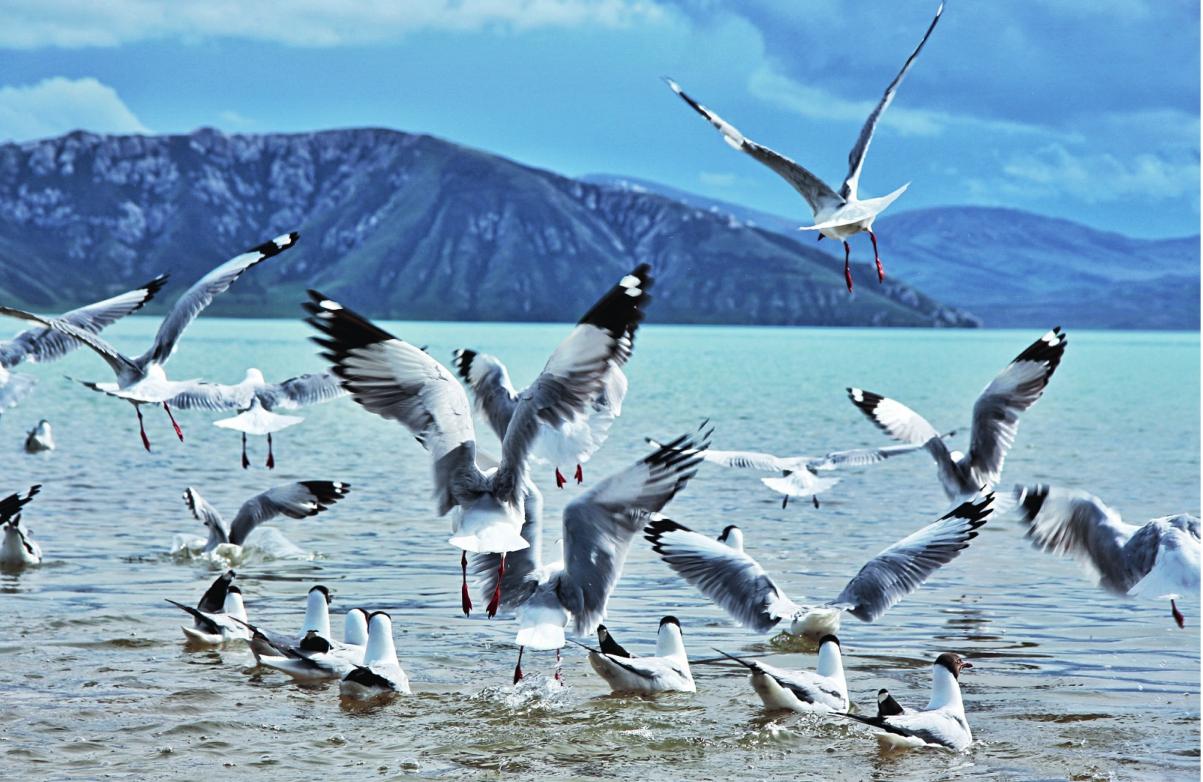
Donggei Cuona Lake is located in the Madoi County basin in northwest Golog at an elevation of 4,082 meters. It covers an area of 232.2 square kilome-ters with a maximum water depth of 48 meters. It is an inland saltwater lake that is similar to but not as big as Qinghai Lake. The surface of the lake seems to be always shimmering in the light. There are rolling mountains on one side of the lake and flat grassland on the other side. Looking down at the lake from a high vantage point is stunning. Though no doubt the black-headed gulls flying overhead would have the best views; after all, they are indigenous to the region and must have chosen to live near this lake for its beauty.
Sacred and Holy Rebkong Thangka Art
Moving on, we came across a Tibetan restaurant called Muthak Manor in an ordinary alley in Tongren County, Huangnan Tibetan Autonomous Prefecture of Qinghai. When we looked at the Longwu River from the restaurants observation deck, we could see that it has an inseparable relationship with the wellknown “Rebkong Art.” The little known Longwu River flowing through the remote mountain valleys of southern Qinghai refreshes and nourishes this magical land called Rebkong by the locals.
The Rebkong art that originated here is an important part of Chinese Tibetan Buddhist art and a genre that has an extensive range of influence. There is a large concentration of artists here who are engaged in creating folk Buddhist paintings and sculptures and have exquisite painting skills, which is rarely seen in other Tibetan areas. Because of its uniqueness, this area is known as the “hometown of Tibetan painters.” Thangka painting has become the main source of livelihood for local residents.
We walked along the Longwu River, reaching Wutunxia Temple. When this temple was first built, it belonged to a small temple of the Nyingma School of Tibetan Buddhism. Later, it was called “Magong Niangwa,” which means “ancient mother temple.”In the mid-17th century, a temple called Toumao Monastery was built and revered by the people in the upper and lower Wutunsi villages. The site of the temple was hit by a landslide, leading to the merge of Toumao and Magong Niangwa and the merged one was called Wutunxia Temple. The temples winding prayer wheel corridor and pagodas are all painted with exquisite patterns. The design features superb color coordination and is resplendently decorated.
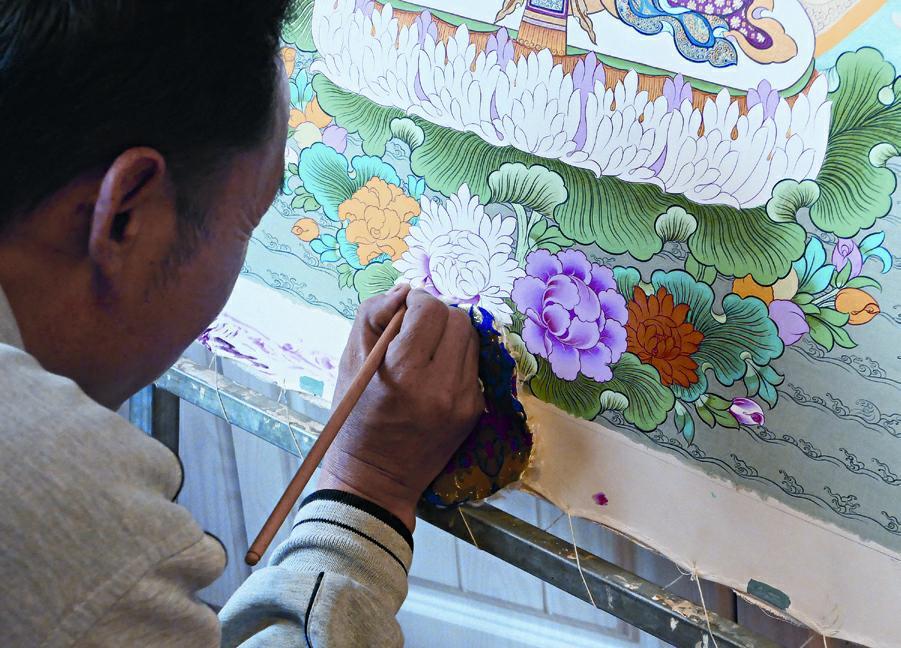
As we entered a nearby village, the front door of each dwelling were decked out in artwork. When we approached a Tibetan house, three painters were at work drawing thangkas that were vivid and exquisite. The host said that it takes two people painting for three months to complete a usual thangka — amazing pieces of artwork.
Making a traditional thangka painting requires adherence to strict requirements and complicated procedures. They must be carried out in strict accordance to the rituals written in the Buddhist scriptures and rules of the experienced masters, including a series of procedures ranging from pre-painting rituals, canvas making, drafting the composition, making the colors and dyes, contouring and drawing, inlaying gold and silver, mounting frames, to making seams. Painting a thangka may take anywhere from half a year to 10 years to complete.
Traditionally, the pigments used to make thangka art are all precious minerals such as gold, silver, pearls, agates, coral, turquoise, malachite, and cinnabar along with plants like saffron, rhubarb, and blue indigo, thus reflecting the sacredness of the art. As a result of using raw materials, it ensures that the colors of thangka paintings will remain bright and fresh even with the passing of hundreds of years.
The beauty that has been appreciated at Gannan, Golog and Huangnan is the kind that remains etched into the beholders memories forever.
- CHINA TODAY的其它文章
- Integration Key to Asia’s Sustained Economic Recovery
- Photography Exhibition on Xinjiang Opens in Beijing
- China to Cultivate National Industrial Parks Specializing in Processing Trade
- President Xi Jinping Attends Video Summit with French,German Leaders
- All Ethnic Groups as One Family
- Konghou:A Surviving and Evolving Musical Aristocrat